
To Word Routes: 4 Brilliant Destination Games for Kids
Carry the bus word into a wider collection. The $5 purchase gathers this ‘to’ sheet with nineteen supplied companions, arranged in source order inside one branding-free download.
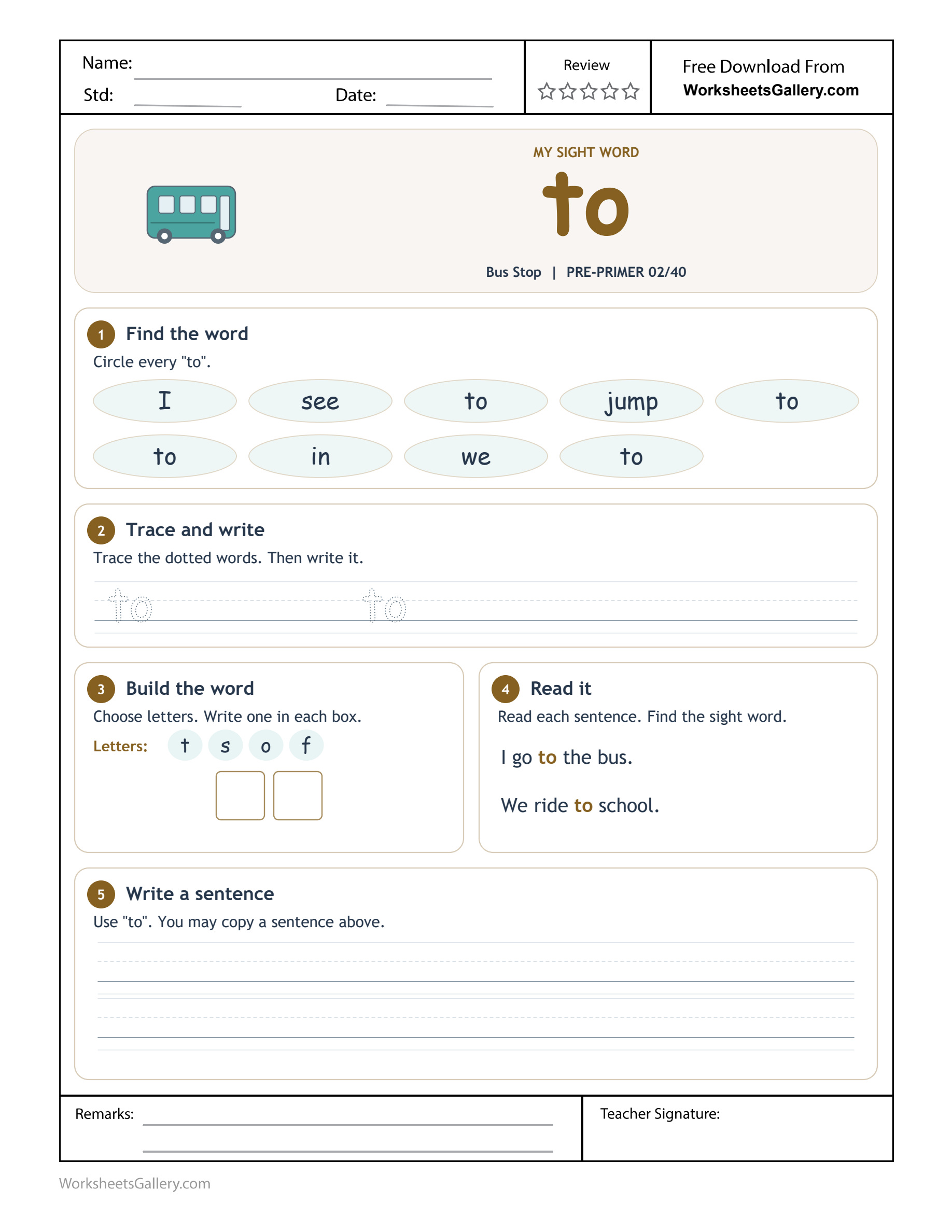
A destination gives a tiny word somewhere to lead. To Word Routes explores the two-letter spelling in the Bus Stop worksheet, where one sentence goes to a bus and another rides to school. Begin by saying a complete message with an adult, then locate the word that comes before the destination phrase. The sheet also offers a search, two dotted models, letter choices and sentence-writing space. Its bus picture makes the setting easy to discuss, while the letters provide the evidence for reading. A short route conversation can prepare the learner for a more careful look at print.
To Word Routes asks where a phrase is leading
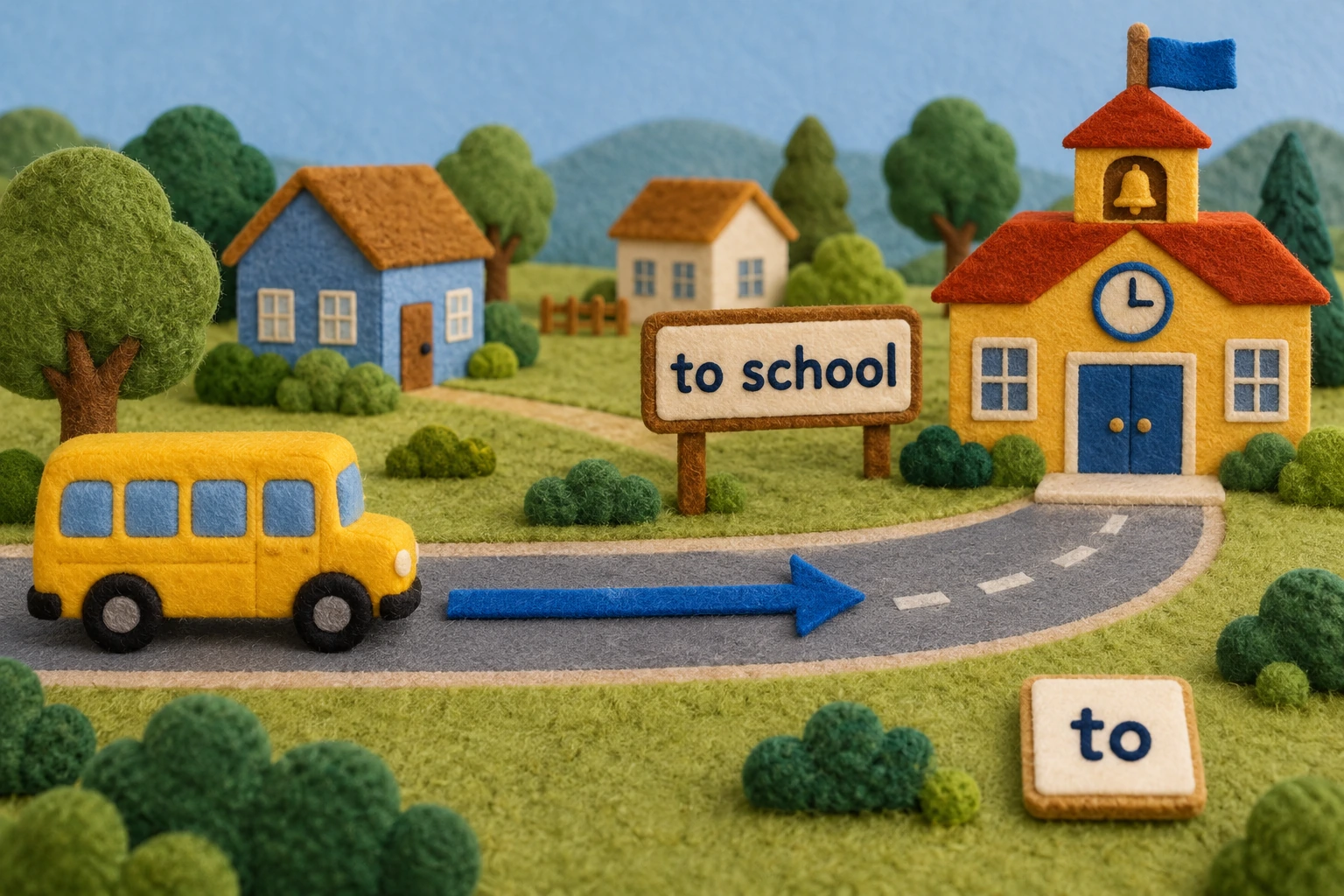
The felt town scene places a bus on a road toward a school. Its filled sign reads to school, with a separate to tile in front. The arrow illustrates a destination relationship; an adult can discuss that meaning before returning to the actual spelling on a card or worksheet.
To Word Routes uses the scene as a language invitation. A child who names the school has explained an object, but has not necessarily read to. Point to the letters, give an accurate pronunciation model and check whether the learner can follow the written target independently of the picture.
Vihaan plans a To Word Routes bus message
Vihaan tells his aunt that a pretend bus will carry a note to school. She writes his phrase on a scrap and reads it while he follows the print. They locate t followed by o, then compare that little word with the large model on the worksheet.
Their To Word Routes message changes when he says the passenger is first walking to the bus. His aunt places the two phrases beside one another and asks what stays the same. The destination changes, while the target keeps its spelling and its place before the new destination phrase.
To Word Routes can use a simple hand-drawn building or a familiar room instead of a detailed town. The important relationship is available in speech and print. Preparing elaborate props is unnecessary when one readable phrase already gives the word a purpose.
To Word Routes reads two different journeys on the source
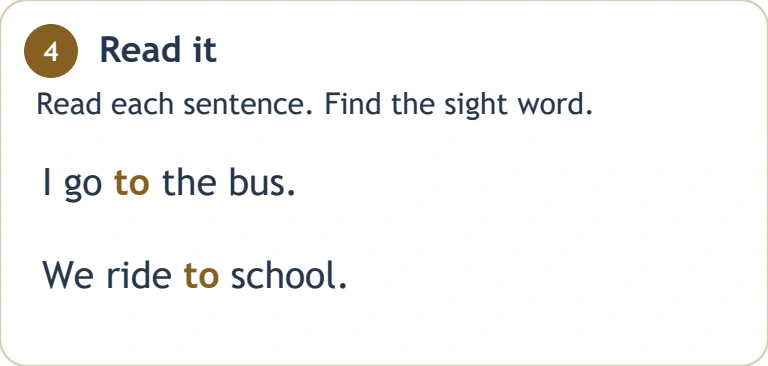
The printed lines are “I go to the bus.” and “We ride to school.” An adult may read unfamiliar words, leaving the learner to locate and read the introduced target. Ask where each message leads, rather than assuming that both sentences name the same destination.
To Word Routes can compare the two lines after a clear adult model. One contains the phrase the bus; the other names school without that article. Keep the conversation close to what is actually printed, helping the child notice a stable target within changing surrounding language.
Five To Word Routes opportunities inside a short practice visit
- Destination language: connect the small printed word with a phrase explaining where someone goes.
- Complete-word checking: inspect both t and o before selecting a search entry.
- Sound-spelling attention: hear the word clearly and receive direct support for its unfamiliar vowel spelling.
- Ordered construction: choose two needed letters from a bank containing distractors.
- Message making: dictate or copy a short sentence with a destination another person can understand.
To Word Routes offers thinking, writing movement and oral-language work without expecting identical independence in each. A learner may understand the journey while needing a pronunciation model. Another may read the target comfortably but need larger letters before writing it on narrow guides.
To Word Routes gives the vowel part an adult explanation
The written word has t then o. Its everyday pronunciation is not discovered by reciting those letter names or automatically giving o the sound used in every other familiar word. Model to in the sentence, then explain the spelling using the reading instruction the child already follows.
To Word Routes can keep that explanation brief. Ask the learner to look at the complete target, say it with support and locate it again. Do not require repeated guessing while withholding the model. A less predictable part can be taught explicitly alongside the portion the child recognises.
To Word Routes changes from a model to a selected match
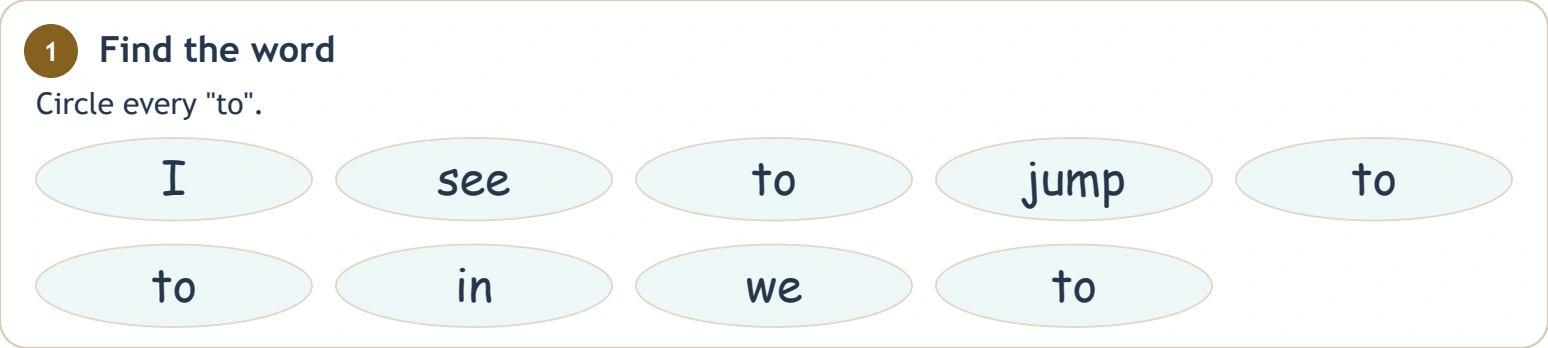
The search contains nine oval choices across two rows, with four to entries. I, see, jump, in and we provide the other choices. The target's position changes within the rows, so a child benefits from inspecting one complete entry before moving onward.
To Word Routes can use the large model as a reference during an early search. After the adult has taught the word, compare both written positions rather than relying on the length of the oval or the number of letters alone. Several distractors are also short words.
Four To Word Routes games for a little destination desk
Each extension uses separate paper and keeps one clear question in view. Pick an activity that follows the learner's current interest after introducing the target. A completed route message can be enough without adding another full worksheet to finish.
1. To Word Routes sends a destination strip
An adult writes a short phrase dictated by the child, such as to school or to the park. Read it together and ask the learner to find the introduced word. To Word Routes strips make the target useful in a message with a destination chosen by its maker.
The To Word Routes adult handles unfamiliar surrounding spelling and reads it accurately. The child can point, build or write the known target. This division of work allows meaningful composition without pretending that every word on the strip is already independently readable.
2. To Word Routes swaps the destination while keeping the target
Place a separate to card before two adult-supported destination phrases, changing one at a time. Say each complete phrase and discuss where it leads. To Word Routes swaps keep the spelling stable while showing how its surrounding words affect the message.
For To Word Routes, the learner returns to the actual t-o card after moving a prop. The object action explains the phrase's meaning. It does not establish that a bus or school picture can supply the identity of an unseen printed word.
3. To Word Routes opens a two-letter selection tray
Offer large t, s, o and f pieces to reflect the source bank. The child chooses the pieces needed for the target, places them in order and checks against a readable model. To Word Routes trays let spelling construction happen without the fine movement required by a pencil.
After a To Word Routes build, say the word and use it in a destination phrase. Letter order and meaning then remain connected. If the learner is unsure, provide the correct model and compare the result rather than requiring a timed independent reconstruction.
4. To Word Routes makes a listener's reply
The maker dictates a simple journey message for an adult to record. A willing listener reads or hears it, identifies the destination and asks a small question. To Word Routes replies give the message a reader without requiring a public performance or an actual trip.
Keep the To Word Routes note in a folder for a later supported reread. A changed destination can provide a fresh invitation another day. Returning to a meaningful message is different from memorising where the target happened to sit in the original search.
To Word Routes explores two dotted models at a comfortable scale

The writing panel presents two dotted to models on guides. Locate the first and last written letters before tracing. A learner can say the word once with the adult, then give attention to the movement needed to make the chosen letters readable.
To Word Routes handwriting can stop after a manageable attempt. If a small line becomes frustrating, copy the word larger on another sheet or build it with pieces. The adult can still observe word understanding without turning a difficult pencil movement into a reading failure.
To Word Routes turns the bank into an ordered spelling
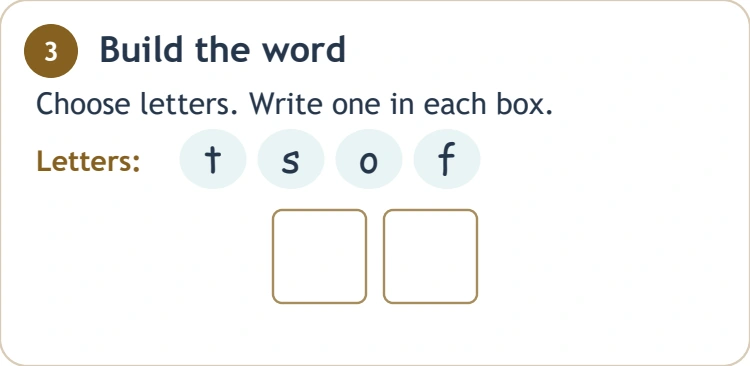
The source offers t, s, o and f above two boxes. Select t for the first position and o for the second, leaving s and f unused. The bank provides choices; it does not ask the learner to copy all four letters in their displayed order.
To Word Routes can use pointing before writing. Ask which letter belongs in each space and let the child indicate it. When the spelling is clear, the adult can support the separate physical task of fitting the letter into its box.
To Word Routes at home can begin with an oral journey
Choose a familiar destination and say a short phrase naturally. Place the worksheet alongside a larger to card, model the word and read one source sentence together. Invite the child to identify the target and explain where that sentence leads before selecting another panel.
During To Word Routes, one adult prompt at a time is enough. Help with other sentence words, page movement or a requested letter model. Quiet comparison time gives the learner a chance to inspect print without having to answer several rapid questions while writing.
End To Word Routes by describing a real decision: “You kept t first when we changed the destination.” The observation connects the stable spelling with the changed message. It does not make speed or a full page of handwriting the condition for a useful session.
A classroom To Word Routes destination board
A teacher introduces the target through the class reading sequence, then provides individual Bus Stop sheets and large phrase cards. Learners read or hear a source line, find the word and choose a simple destination for an adult-supported new message.
To Word Routes partners can locate the written target and listen to the destination explanation. The adult records whether a pronunciation model, spelling reminder or handwriting support was needed. This gives more useful information than comparing how many panels different children completed.
To Word Routes support begins by naming the actual difficulty
| What seems uncertain? | What to make clearer |
|---|---|
| The pronunciation. | Supply a clear spoken model. |
| The written order. | Compare t then o with a large card. |
| The sentence destination. | Read the whole phrase with adult help. |
Frequent To Word Routes missteps include giving o an unhelpful automatic sound, selecting every two-letter search entry or assuming a correctly circled word means the sentence was understood. Check pronunciation, spelling and meaning as related but separate observations. The child may need help in just one of them.
To Word Routes returns through a new message
This supported page can suit early readers in preschool readiness or kindergarten, commonly around four to six, when the task matches the sound-spelling work already taught. A younger learner may join through listening and pointing, with independent reading and writing introduced at a suitable pace.
To Word Routes practice can return through one destination swap, a letter tray or an earlier note. Pause when the learner becomes uncomfortable or hand movement grows tiring. A brief successful exchange can preserve interest without requiring a fresh whole sheet on every visit.
The final To Word Routes panel allows a sentence using the target and explicitly permits copying a supplied line. An adult can first rehearse the sentence orally. Choosing an idea, remembering its wording and forming letters need not become one unsupported demand.
Obtain To Word Routes for printing or a wider collection
Use the page's sample option for the retained original, or sign in with an active eligible plan for the separate clean To Word Routes membership PDF. Watermark text, website-name marks and domain promotion are removed from the clean document, and its page contains no embedded advertisements. Any advertising surrounding the online download is outside the PDF.
Inspect the US Letter print layout before making copies, keeping the search rows, spelling boxes and bottom writing guides visible. To Word Routes also belongs to the twenty-sheet $5 package shown in its native card. Buying that collection and accessing an individual membership attachment are different download choices.
Compare the shared-reference idea in the train word practice, another action context in the eat reading sheet or separate short-vowel instruction. Adults can consult UFLI's irregular-word teaching collection and Reading Rockets' phonics-and-word guidance when coordinating these visits with existing instruction.
Popular Worksheets
Printable resources families and teachers are downloading now.
 Free
 Free
 Free
 Free