
And Word Links: 6 Wonderful Pair-and-Read Games
Join fruit practice to another reading setting. The word ‘and’ shares the twenty-page clean collection with words about speakers, locations and actions. Choose the $5 package for the complete supplied group.
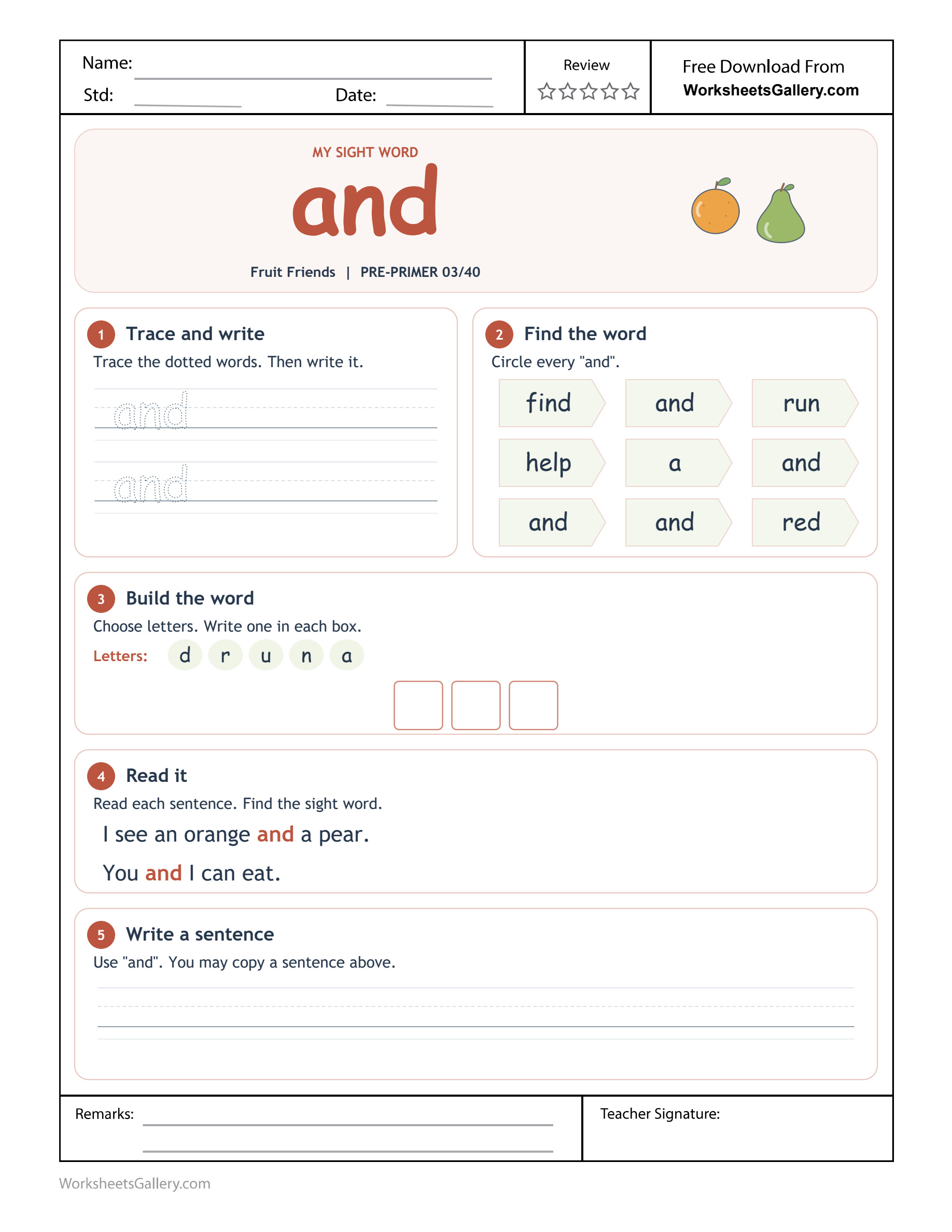
An orange rolls toward a pear, and suddenly there is something useful to say about both. And Word Links gives that tiny joining word a visible purpose on the Fruit Friends sheet. Children examine a-n-d, trace two models, inspect a nine-choice search and assemble the spelling before meeting it in sentences. The fruit illustration invites conversation; the written letters provide the evidence for reading. With an adult nearby, this can become a small lesson about connecting ideas, sharing a message and checking what print actually says, without expecting independent reading of every surrounding word.
And Word Links begins between two named things
Say orange, pause, then say pear. Now join the names with and. The extra word lets one message include both items. On the worksheet, a second sentence joins two people instead: “You and I can eat.” The relationship survives even though the things being joined have changed.
And Word Links therefore has a language purpose beyond finding matching shapes. Ask a child what belongs on either side of the joining word. An answer can be spoken, pointed to or dictated while the adult handles unfamiliar vocabulary. Naming two objects alone does not establish that the child has read the printed connector.
For And Word Links, look directly at a-n-d and connect the letters with their taught sounds. A learner familiar with these correspondences can blend them with guidance. Give an accurate model when necessary, rather than treating every frequent word as a mysterious shape that must be memorised whole.
Ria's picnic note gives And Word Links a reader
Ria wants her grandfather to bring two things to a pretend picnic. She chooses a cup and a napkin. He writes her request in large print, reads it back and invites her to find the word connecting those items. She checks the three letters against the source model.
Their And Word Links conversation changes when he accidentally names only the cup. Ria explains that the note asked for both. This is a useful correction about meaning, made within a friendly exchange. Nobody needs to invent a score or pretend that the note is a formal reading test.
Keep And Word Links tied to what the learner can currently manage. Ria may dictate most of the message, order the three target letters herself and listen while her grandfather reads the remaining print. These are different contributions to one shared piece of writing.
And Word Links makes six kinds of progress observable
- Connection: explain that the message includes both named things, rather than choosing only one.
- Sound work: blend the introduced correspondences in a-n-d when those sounds are already familiar.
- Visual checking: inspect the entire candidate word before deciding whether to circle it.
- Order: move selected bank letters into a sequence that differs from their printed arrangement.
- Hand control: follow dotted forms or write a short attempt without rushing small movements.
- Expression: dictate or reread a message that links people, objects or actions meaningfully.
In And Word Links, these observations need not develop together. A confident speaker may still need help forming d. Another child may copy the word accurately but omit it while reading a sentence. Describe the specific achievement and choose the next prompt from that evidence.
What And Word Links asks the reader to search for
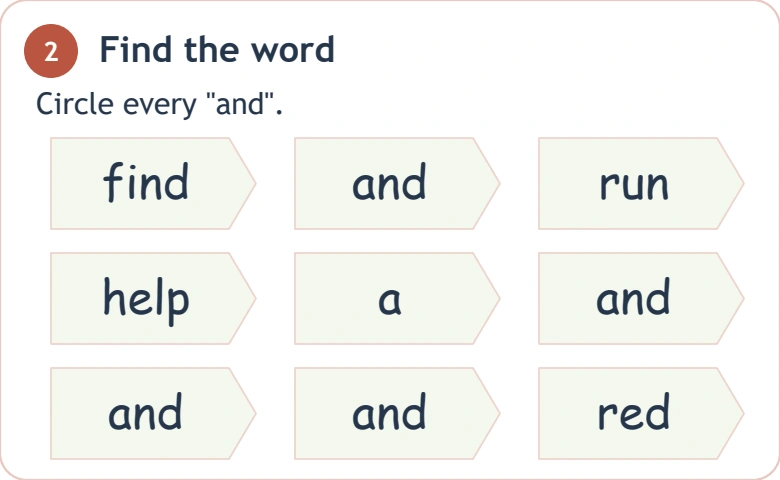
In And Word Links, the arrow-shaped search cells include nine entries, with four target matches. Other choices include find, run, help, a and red. Some candidates share letters with the target, so an adult should encourage a complete comparison rather than reward recognition of a single familiar character.
And Word Links makes find an interesting contrast because the endings resemble each other while the complete spellings differ. Point to the beginning as well as the ending, then read the introduced target. The adult can model the distractor if it is unfamiliar; the child does not need to decode every search entry independently.
During And Word Links, a circle means “I checked this whole choice.” A learner can first point while an adult records the response, especially when marking small cells adds an unnecessary motor challenge. Keep the comparison visible even when the method of answering changes.
Six And Word Links invitations beyond the printed panels
Choose one invitation that suits the available space and the child's energy. These are optional additions made beside the source sheet. They do not describe extra activities hidden inside the PDF or require completing six games in one lesson.
1. And Word Links sends a two-item picnic request
Set out three safe household objects and let the child choose two. Write the pair with the joining word between them, then read the note to another person. And Word Links gives the receiver a reason to bring both objects instead of responding to only the first noun.
After delivery, compare the written connector with the And Word Links model. Ask the maker whether the message obtained what was intended. An adult can supply the longer object names while the learner locates, builds or writes a-n-d at the appropriate level.
2. Two people enter an And Word Links portrait
Draw simple portraits of the learner and a willing adult on separate pieces. Place a large word card between them and make a spoken phrase naming both. And Word Links now joins people, reflecting the source's second sentence without copying its entire situation.
Move the And Word Links portraits farther apart and read the same card again. Its spelling has not changed with the distance. Keep attention on the letters rather than asking the child to infer the word solely because two faces are present.
3. And Word Links becomes a movement instruction
Offer an adult-written instruction such as “clap and wave.” Demonstrate the unfamiliar words, locate the connector and perform both actions comfortably. And Word Links can make the difference between carrying out one movement and following the complete spoken message quite noticeable.
The child may give a new And Word Links instruction by dictation. Read it back before acting, allowing a correction if the adult misunderstood. A seated gesture or an eye-pointing choice can replace movements that are uncomfortable or unsuitable for the learner.
4. An And Word Links spelling repair shop
Arrange a, d and n beside the correct model, intentionally leaving the final two pieces reversed. Explain that the pieces need checking, rather than presenting the arrangement as correct. And Word Links asks the learner to compare each position and repair the sequence with support.
Read the rebuilt And Word Links word together. If manipulating pieces is difficult, the child can direct the adult verbally or point to the next letter. Finishing one thoughtful repair offers more information than repeatedly shuffling pieces until an answer happens to emerge.
5. And Word Links records a sound pair
Make two gentle sounds, such as tapping a cup and rustling paper, then describe both in a dictated message. The adult writes the relevant words. And Word Links supplies a connector that can be located and read while the rest of the sentence receives adult support.
Repeat only the part of the exchange that interested the child. The purpose is an accurate connection between print and meaning, not an auditory memory challenge. Keep sounds comfortable and predictable, particularly for a learner who dislikes sudden noise.
6. And Word Links checks a deliberately incomplete order
An adult reads a two-item request but places just one requested object on the tray. Invite the child to explain what is missing. And Word Links gives a concrete reason to revisit the connector and confirm that both sides of the phrase have been included.
Make the adult's mistake playful and transparent. The learner is helping a partner understand a message, rather than being tricked. Close the exchange by reading the corrected request together and matching each named item with the actual tray contents.
And Word Links builds from choices, not bank position
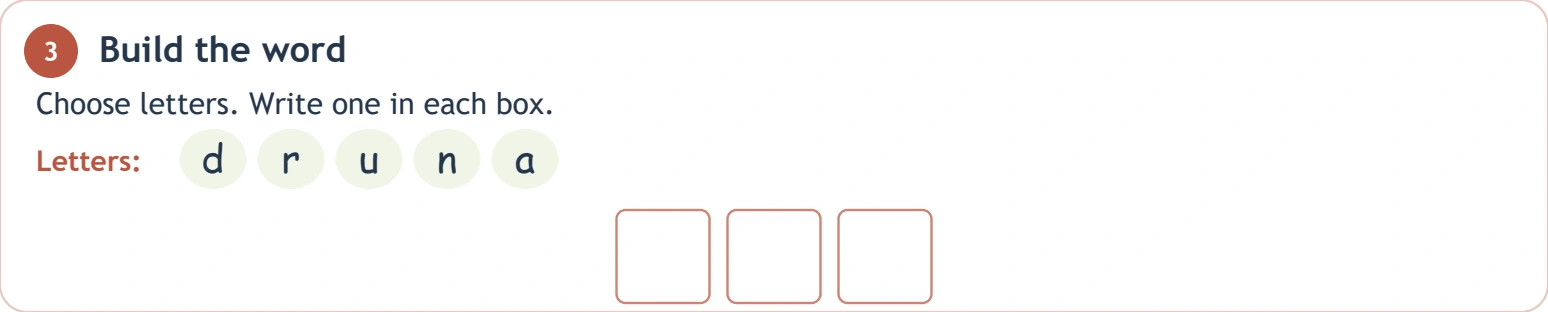
The And Word Links bank contains d, r, u, n and a. Three boxes wait below it. Select a, n and d, then put them into reading order; copying the first three bank entries would not form the target. Larger homemade pieces can make this selection easier to demonstrate before pencil work.
And Word Links also includes two dotted word examples and guided space for an independent attempt. The last task asks for a sentence using the word and explicitly permits copying one supplied above. Composition is an option, rather than a compulsory extra hurdle for an early writer.
A home sequence for And Word Links that follows the child
Start with one spoken pair and the large word model. Read the target, inspect its spelling and invite a supported build. Then choose either a search comparison or a short writing attempt. The printed numbering provides an available route, but the family can stop before the whole sheet is finished.
And Word Links works well when the adult distinguishes help with reading from help with the pencil. Offer a clear pronunciation model for an unfamiliar word. Adjust paper position or use larger letters for a movement difficulty. Neither adjustment requires abandoning the meaningful joining task.
Finish with an observation such as “You noticed that the note included the napkin too.” This gives the learner useful information about communication. A brief, willing return to the same note another day can be more productive than insisting on repeated full-page completion.
And Word Links in a classroom partner conference
A teacher pairs children with different responsibilities: one chooses two familiar classroom objects, while the other listens to an adult-supported written request. Swap the jobs after the message has been checked. Each child uses an individual sheet so search positions and writing attempts remain their own work.
During And Word Links, record the kind of assistance used. Did the learner need a sound model, a reminder to inspect d, or help moving a letter piece? Such notes explain an instructional next step more clearly than recording only whether all four circles were present.
Fruit art brings And Word Links back to its meaning
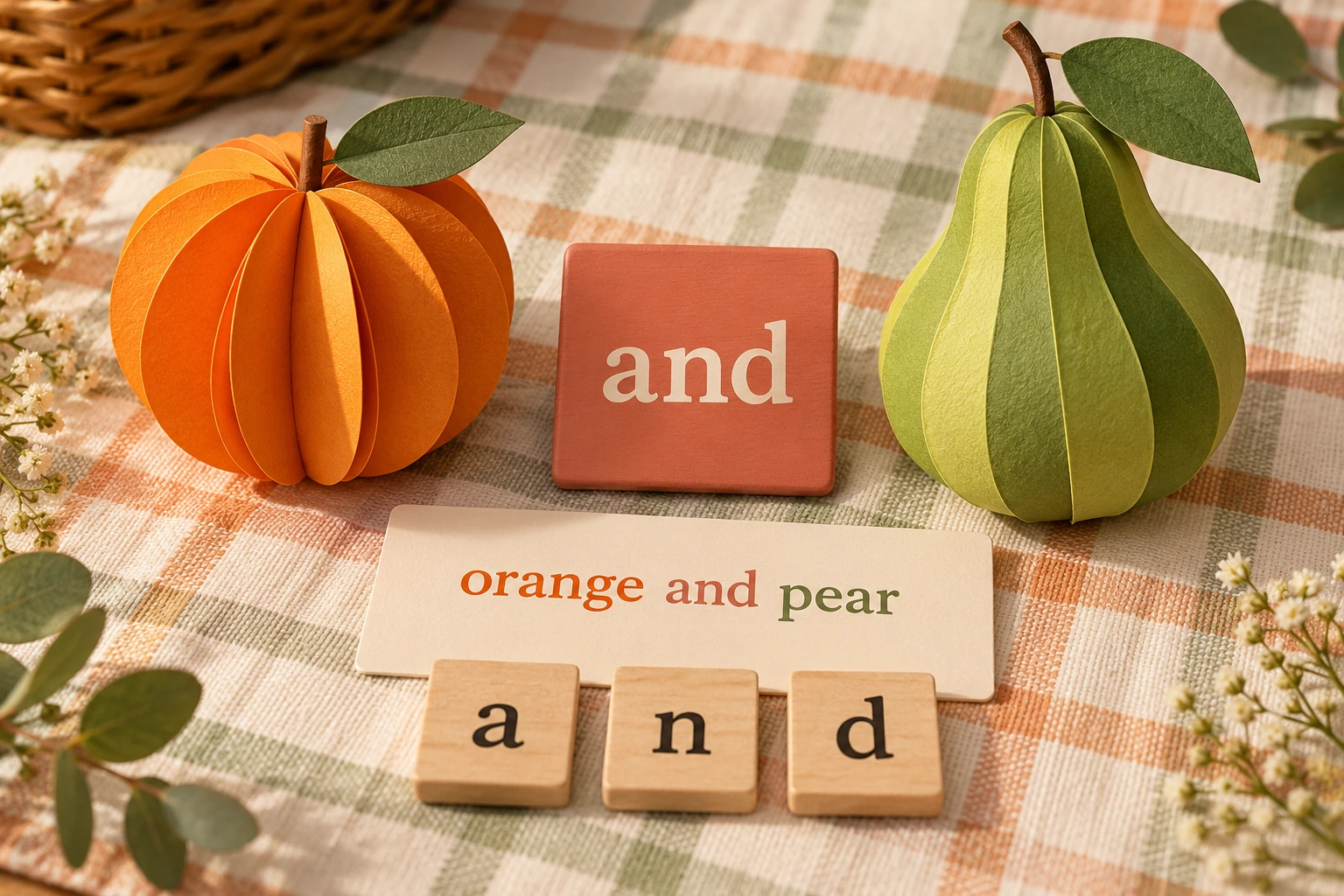
The companion illustration shows a paper orange, a pear, a filled phrase card and ordered letter pieces. It represents a separate teaching arrangement rather than a second worksheet. Use the visible pair to discuss what the connector contributes, then return to the actual spelling before calling a response reading.
For And Word Links, a picture can establish the topic while print identifies the word. Children can understand a picnic conversation long before they can independently read every noun. Keeping those achievements distinct allows the adult to celebrate understanding and still teach the needed spelling.
And Word Links support choices when an attempt stalls
| Observed difficulty | Next useful move |
|---|---|
| Only one item is requested. | Revisit both sides of the message. |
| The ending is checked alone. | Compare the complete spelling. |
| Bank order is copied. | Select letters before sequencing them. |
Avoid turning And Word Links into a rapid naming drill or using fruit pictures as the answer key. Supported preschool and kindergarten learners, commonly ages four to six, may need different levels of spoken-language, decoding and handwriting assistance. Age is a starting guide, not a promise of independent mastery.
Keep an And Word Links copy for a later conversation
Use the original download when a source sample suits your needs, or sign in with an eligible active membership for the separate clean individual PDF. Its printable page removes watermark material, website-name promotion and domain text. The downloaded clean file carries no embedded advertisements. Check the US Letter print preview and retain the full activity border within the printable area.
And Word Links also belongs to the twenty-sheet collection available for $5 through this page's related package card. That purchase supplies one combined clean PDF. The individual member option and the collection purchase are separate access routes; select the one that matches the file you intend to obtain.
A dictated food request can continue with the eat reading sheet. Contrast a connector with the destination work on the bus word page, or revisit taught vowel correspondences through the short-vowel activity. For adult planning, UFLI's instructional word activities and Reading Rockets' explanation of frequent-word instruction offer useful background alongside the child's current programme.
Popular Worksheets
Printable resources families and teachers are downloading now.
 Free
 Free
 Free
 Free