
A Word Discovery: 5 Brilliant One-Item Reading Games
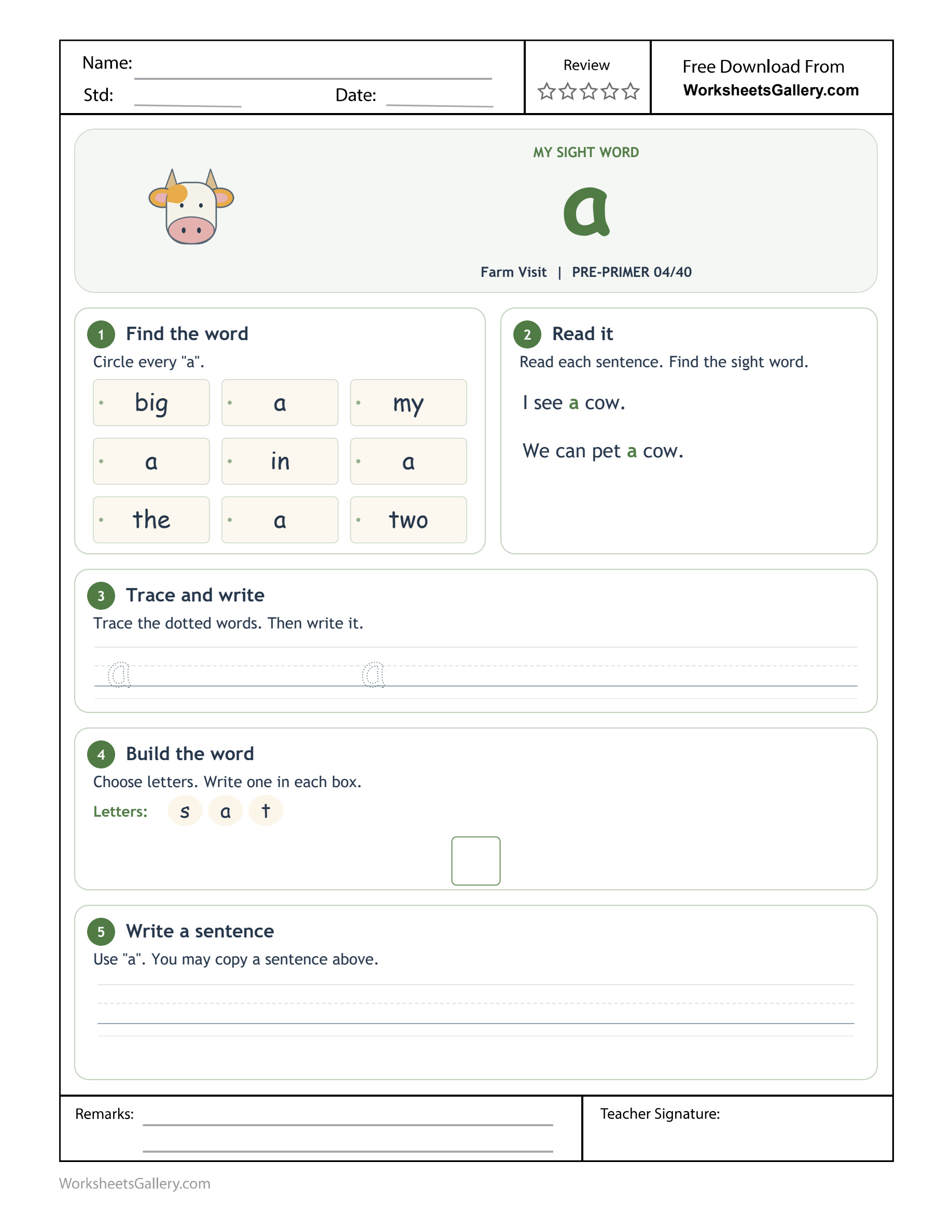
One small article sits within twenty word choices. The farm ‘a’ page is included in the combined premium PDF. Its $5 purchase brings all uploaded sheets numbered 01–20 into one clean file.
One small word can stand on its own even when it contains just one letter. A Word Discovery explores that idea through the Farm Visit page, where a cow gives the learner something concrete to discuss. The target appears as a complete word, in tracing models and within two short reading lines. A supportive adult can distinguish the article from the same letter tucked inside a longer spelling. That distinction matters more than filling the sheet quickly: the child is learning to notice where a word starts, where it ends and what it contributes to a message.
A Word Discovery gives a single letter a whole-word job
Begin A Word Discovery by pointing to a by itself, leaving its surrounding white space visible. Then show the word can in the source's second sentence. The middle letter looks familiar, but the complete printed word is different. The search asks for the standalone target, not every occurrence of that character anywhere on the page.
A Word Discovery keeps this boundary question concrete. An adult might frame the isolated word with two fingers, then move to a short phrase such as a cow. Help the learner follow the spaces between words without turning the task into a hunt for a shape inside larger spellings.
The pronunciation in A Word Discovery should fit ordinary speech. In a spoken phrase, the article is often unstressed; an adult can model that naturally. Naming the letter A is useful for discussing its written identity, but demanding the long letter-name sound in every sentence can make the language unnatural.
Arjun chooses a visitor for A Word Discovery
At home, Arjun places a toy cow beside his mother's notebook. She writes a cow beneath his dictated label and reads the phrase aloud. He points first to the animal, then to the separate small word before its name. She asks which printed word they are studying and helps him isolate it.
Their A Word Discovery visit continues when he adds a toy pig. His mother writes a pig on another line. The animal name changes, while the article stays the same. Arjun can discuss that difference orally even if the new noun needs a complete adult reading model.
A Word Discovery is not a requirement to classify articles formally. The home exchange establishes a usable phrase and a clear word boundary. The adult can leave grammar terminology for another stage while still responding precisely to what the learner sees and says.
Six A Word Discovery gains that a one-letter target can reveal
- Word boundaries: recognise that surrounding spaces let a single printed letter function as a complete word.
- Listening: hear an ordinary article within a spoken noun phrase rather than replacing natural speech with letter naming.
- Comparison: distinguish the isolated target from a familiar character embedded in can.
- Selection: choose a from the bank while leaving s and t unused.
- Movement: practise a small letter form with the amount of pencil support needed.
- Message making: introduce one named thing in a dictated label or supported sentence.
A Word Discovery combines language, attention and fine-motor work, but a child may find one part easier than another. Being able to point to the target does not automatically establish comfortable handwriting. Record the actual response rather than interpreting every unfinished box as a reading difficulty.
A Word Discovery shows the cow without giving away the spelling

The full source model presents a large a with the Farm Visit theme. Use the cow to establish the topic and invite a short conversation. Then point to the printed target, name its letter and read it in a phrase. The picture supplies a noun to talk about, not evidence for which search entry matches.
In A Word Discovery, a child can enjoy describing an animal while needing help with print. Make room for both responses. A factual observation about horns or a spotted coat can support vocabulary without being counted as independent word recognition.
A Word Discovery separates nine whole-word choices
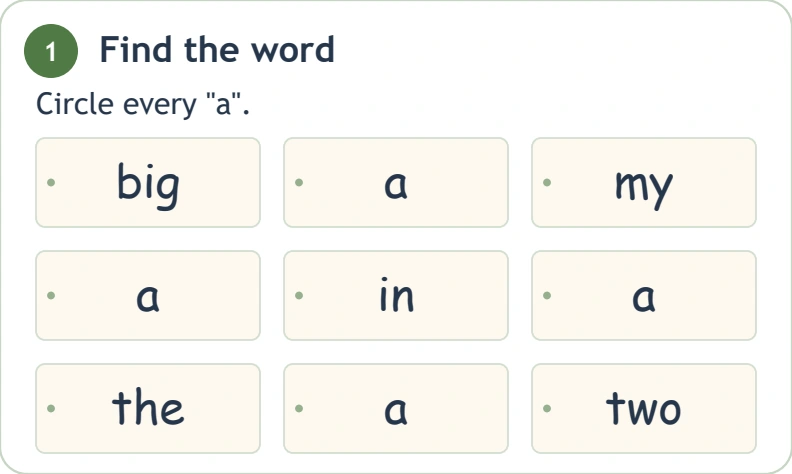
Four of the nine cells contain a. The remaining entries are big, my, in, the and two. Their arrangement gives the learner several opportunities to inspect a complete candidate. Keep the source model available, and ask the adult to review the four-match total privately after the child has made decisions.
A Word Discovery can be answered by pointing before circling. When a learner selects a longer word, compare the amount of print and its complete spelling with the isolated model. Explain the difference directly rather than offering a vague instruction to “look harder.”
Reading lines place A Word Discovery before a noun
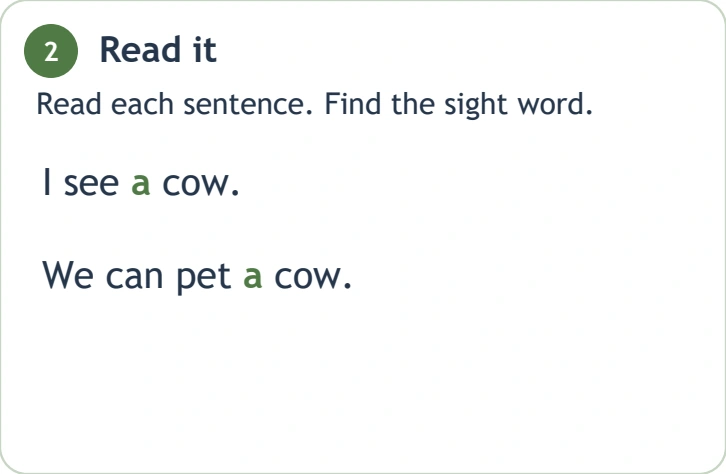
The first sentence says “I see a cow.” The second describes petting the same kind of animal. Read each line with support and locate the small article before cow. Discuss the message without assuming that every other word has already been taught.
A Word Discovery offers a useful opportunity to distinguish describing a worksheet scene from real animal handling. The sentence belongs to the printed activity; touching a live animal depends on an adult's directions and the actual situation. The reading task itself needs only the picture or a toy.
Five A Word Discovery games about naming one thing
These short additions use separate homemade materials. Select the invitation that fits the learner's interest, then return to the source for a brief spelling check. None requires a new purchase or a long preparation session.
1. A Word Discovery makes a tiny museum label
Choose one ordinary object, such as a cup, and let the adult write a cup on a large label. Read the phrase together and locate the separate article. A Word Discovery gives the child a meaningful reason to leave space between that word and the object's name.
Display the A Word Discovery label beside its object for a willing visitor. Let the learner explain what is being named, with adult help for the longer spelling. The visitor's role is to listen and read, rather than test the child by hiding the model.
2. Give A Word Discovery a word-boundary window
Cut a broad viewing window in a spare card and move it across an adult-written phrase. Show one complete word at a time without clipping individual letters. A Word Discovery lets the learner see that the single-letter article occupies its own place in the message.
Use the A Word Discovery window slowly and keep the complete phrase nearby. It is a way to direct attention, not a timed reveal game. If preparing a window is inconvenient, two adult fingers can mark the same boundaries on the paper.
3. A Word Discovery invites a changing animal label
Place a toy pig where the cow had been, then write a new matching noun phrase. Read both labels aloud and compare the first word. A Word Discovery keeps the article constant while the longer animal name changes, making a simple language relationship available for discussion.
An adult can model both A Word Discovery nouns and invite the child to point to the shared word. Avoid suggesting that looking at the toy is enough to read the whole label. Meaning and spelling each receive their own short check.
4. A Word Discovery sorts single words from letter sightings
On separate cards, write a alone and can as a complete word. Explain that today's target must be a whole word. A Word Discovery asks the learner to identify the standalone card and discuss why the longer spelling does not belong in the same answer group.
Keep the A Word Discovery comparison to two clear choices before adding another example. Use spoken explanations or pointing when the child is not ready to describe boundaries verbally. The adult should make the rule explicit rather than wait for repeated incorrect guesses.
5. A Word Discovery opens an object-description desk
The learner chooses an item and dictates one sentence introducing it. An adult writes the message and reads it back. A Word Discovery focuses the child's contribution on finding or writing the article, while the adult supplies any other words outside the learner's present instruction.
Ask whether the finished A Word Discovery message names what the child intended. Save one satisfying example to reread later. Repeating a personally meaningful sentence can provide a reason to revisit the target without requiring a fresh full sheet each time.
A Word Discovery makes tracing and selection manageable

Two dotted A Word Discovery models provide a starting point for guided movement. Demonstrate the form used on the actual sheet, keep the paper stable and allow one comfortable attempt. Do not add invented stroke arrows to the worksheet or claim that the source teaches a particular handwriting programme.
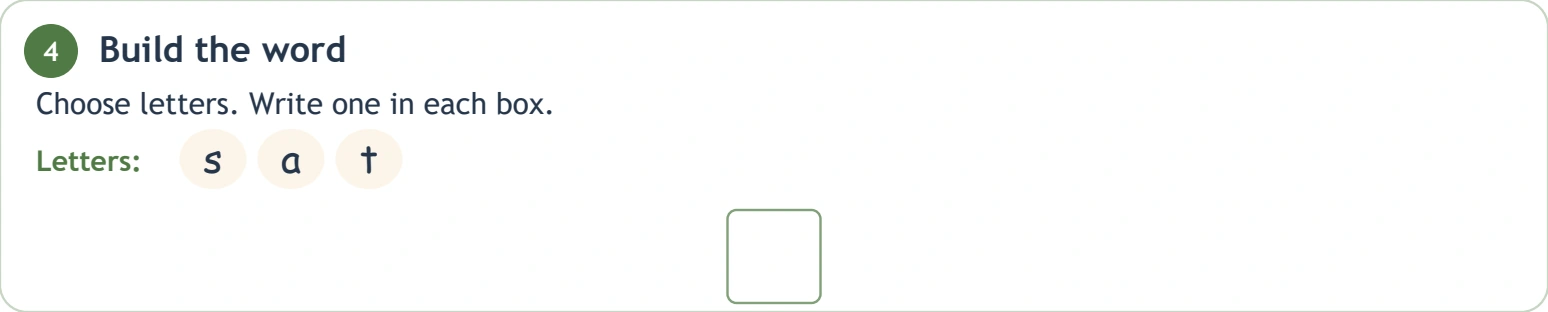
A Word Discovery then offers s, a and t above one writing box. The child selects the needed character instead of copying all three choices. If fine-motor control is the obstacle, use a larger homemade letter and return to the box only when the writing demand is suitable.
A Word Discovery moves between home and a teaching group
For a family session, begin with a named object, read its short label and compare the article with the source model. Choose one search decision or tracing attempt next. Stop while the learner can still describe a success, such as noticing a space or selecting the correct bank letter.
In a classroom, A Word Discovery can become a brief teacher conference. Each child hears one source sentence and locates the target on an individual sheet. The teacher records whether the learner used the word boundary, the model or a direct prompt, then plans the next supported comparison.
A partner may listen to a dictated noun phrase afterward, but one child's rapid response should not set the pace for everyone. A Word Discovery can involve pointing, oral rehearsal or writing according to the specific skill being practised that day.
A Word Discovery uses a filled farm scene for conversation
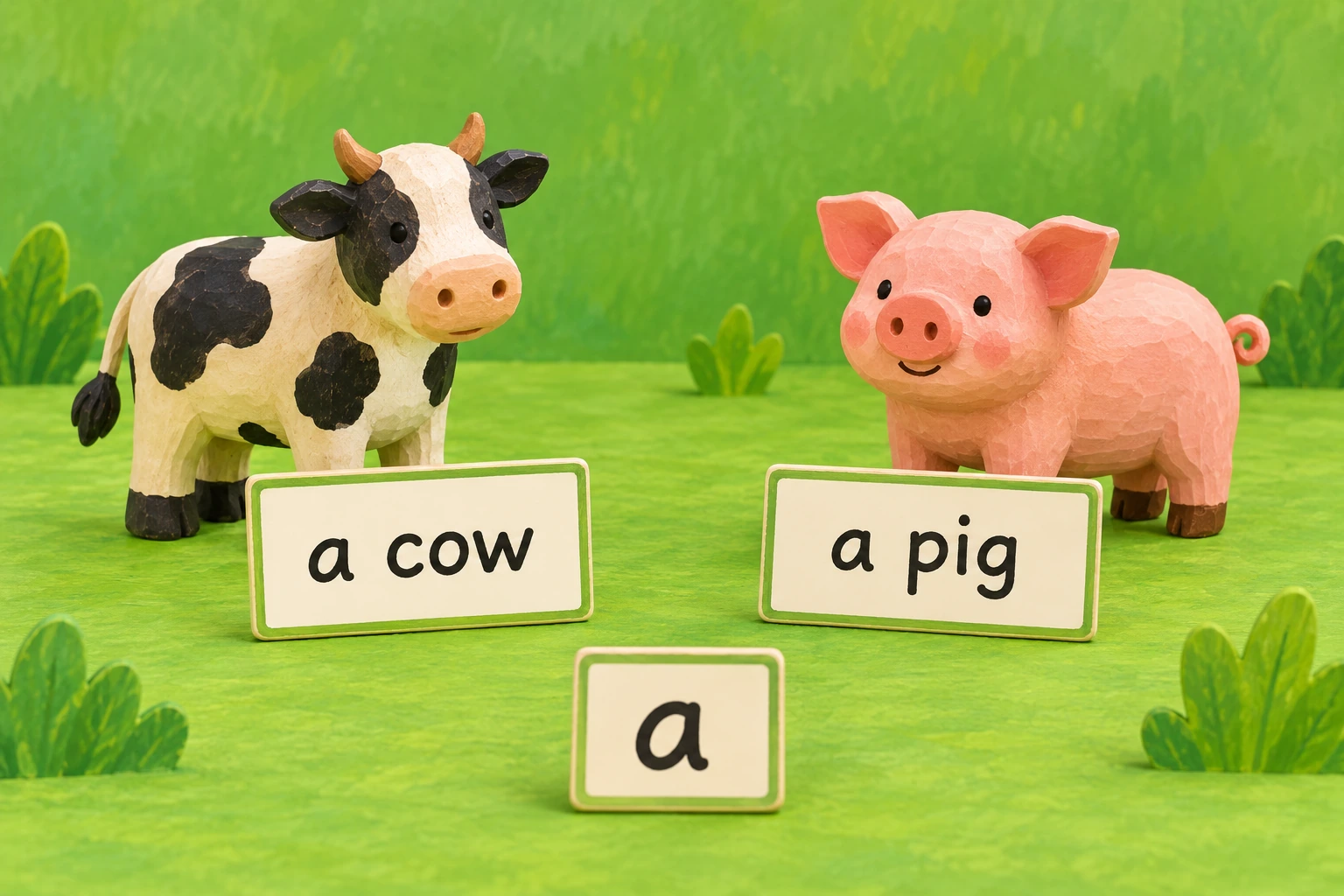
The supporting scene pairs a wooden cow and pig with readable labels. Its completed text belongs to an invented teaching display, while the PDF retains its unanswered exercise spaces. Compare the two noun phrases, discuss what changed and inspect the shared small word.
A Word Discovery may feel inviting because the learner can choose which animal to name. Offer that choice without letting the illustration replace reading. Knowing which animal is pictured and recognising the written article are two observations an adult can notice separately.
A Word Discovery adjusts the prompt instead of increasing pressure
| If you notice | Try this response |
|---|---|
| The letter inside can is chosen. | Frame the entire printed word. |
| Speech sounds overemphasised. | Read the phrase naturally. |
| A small tracing form feels difficult. | Offer a larger movement model. |
A Word Discovery commonly suits supported learners around four to six, depending on their reading and pencil experience. Avoid equating age with independent sentence reading. Invite a short return through the saved label, praise a precise observation and put the page aside if sustained effort starts to feel uncomfortable.
Print A Word Discovery or choose the complete word collection
The download options distinguish the retained source sample from a clean individual member edition. An eligible active membership unlocks the latter through the site's normal protected delivery. The clean PDF has no worksheet watermark, website name or promotional domain, and its pages contain no advertisements. Print the US Letter page after checking margins and the complete border in your printer preview.
A Word Discovery is included in the separate $5 twenty-page package linked on this page. Purchasing that collection provides the merged clean file; downloading this individual member attachment follows its own membership route. The final source task permits copying a supplied sentence, so a printed copy remains useful before independent composition is ready.
Continue a discussion of named things with the leg word activity, compare a joining word on the fruit connector page, or select a different sound lesson from the vowel practice sheet. Adult reading support can draw on Reading Rockets' word-teaching discussion and UFLI's resources for high-frequency words, using instruction that matches the child's taught correspondences.
Popular Worksheets
Printable resources families and teachers are downloading now.
 Free
 Free
 Free
 Free