
See Word Evidence: 5 Powerful Turtle-Reading Activities
A turtle observation can introduce the next reading choice. ‘see’ also appears in the twenty-page premium collection. Purchase the $5 combined file to keep all supplied targets together as clean printable worksheets.
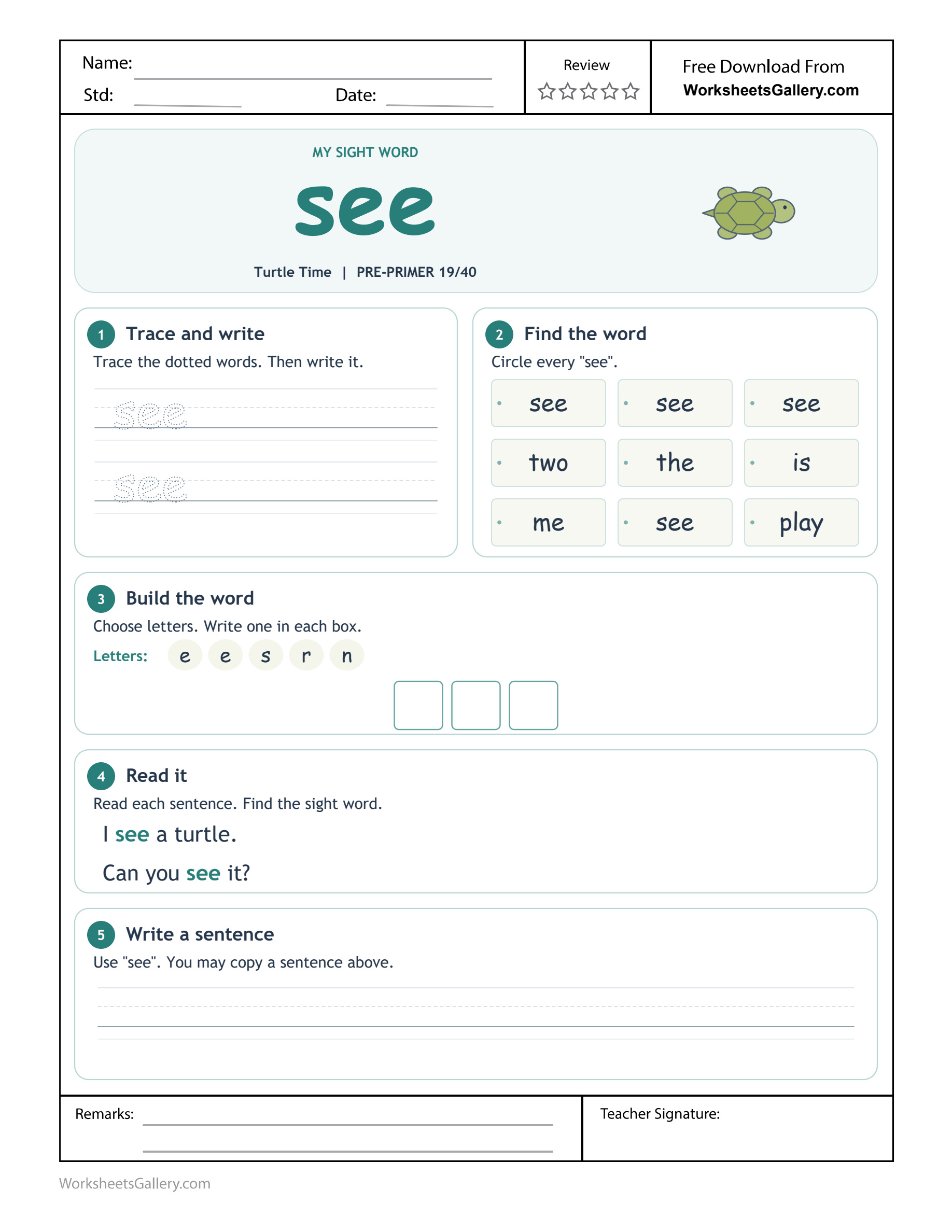
A statement about a turtle can become a question for someone else without losing its key word. See Word Evidence explores that change on the Turtle Time worksheet, bringing s-e-e into a meaningful exchange. The learner also traces two models, inspects a search, selects letters and attempts sentence writing. An adult can explain the double-e spelling while providing unfamiliar surrounding words. The turtle picture starts a conversation about seeing, but identifying the printed target still depends on its actual letters. A short supported message gives this small word something useful to do beyond a circle.
See Word Evidence reads three letters through two useful sound parts
The target has an initial s followed by ee. The two e letters work together as a long-e vowel spelling. An adult can connect those parts with the learner's current instruction, model the whole word and avoid asking for a separate spoken vowel sound from each e.
See Word Evidence distinguishes a three-letter count from a sound-spelling explanation. The source's three writing boxes record individual characters. A broad ee piece can be useful in a reading demonstration while two separate e pieces show how the same spelling fits the letter boxes.
For See Word Evidence, a clear model is available whenever the vowel spelling is unfamiliar. Knowing the letter name e does not automatically establish how the pair works in this word. Teach that connection directly before expecting an independent reading choice.
Pari's turtle message gives See Word Evidence a home setting
Pari chooses a turtle drawing to show her grandmother. She dictates a short observation, and her grandmother records it in large print. They listen to a supported reread, identify the target and compare its beginning and double-e ending with the source model.
Their See Word Evidence exchange continues when the grandmother turns the observation into a question for a willing listener. Pari indicates who is being addressed and locates the same target again. The adult supplies every unfamiliar surrounding spelling so the print responsibility stays manageable.
See Word Evidence can use a clear picture already available at home. No real turtle, magnifier or special observation trip is required. The conversation has a purpose through a chosen message, and the adult can adapt how the child participates without changing the written target.
See Word Evidence compares a statement with a question

“I see a turtle.” gives the first speaker's observation. “Can you see it?” addresses a listener. Read both source lines with appropriate help and identify the target in each. Explain that it refers to the turtle within this shared context.
See Word Evidence allows the learner to discuss who speaks and who listens without formal grammar labels. The meaning of the whole exchange can be established orally. Then inspect s-e-e so an accurate conversational answer is not mistaken for independent recognition of the printed word.
In See Word Evidence, the picture supports what the messages concern. It does not tell the learner which search entry reads see. Keep returning to the actual spelling when the question is about reading, while acknowledging useful observations about the turtle separately.
Six See Word Evidence benefits have inspectable signs
- Vowel-spelling attention: notice ee as a two-letter spelling for one long-vowel sound.
- Written order: place s before both e letters in the complete target.
- Sentence purpose: distinguish an observation statement from a question to a listener.
- Search reasoning: inspect complete written evidence instead of deciding from theme or apparent length.
- Motor planning: choose a suitable pencil attempt or guide another person's placement of larger letters.
- Expression: dictate a meaningful observation and clarify what the message concerns.
See Word Evidence brings cognitive checking, hand control and spoken language together without assuming equal independence. A learner may explain the turtle reference while needing the vowel model repeated. Notice which help was useful and choose a specific next prompt from that evidence.
See Word Evidence needs both bank copies of e
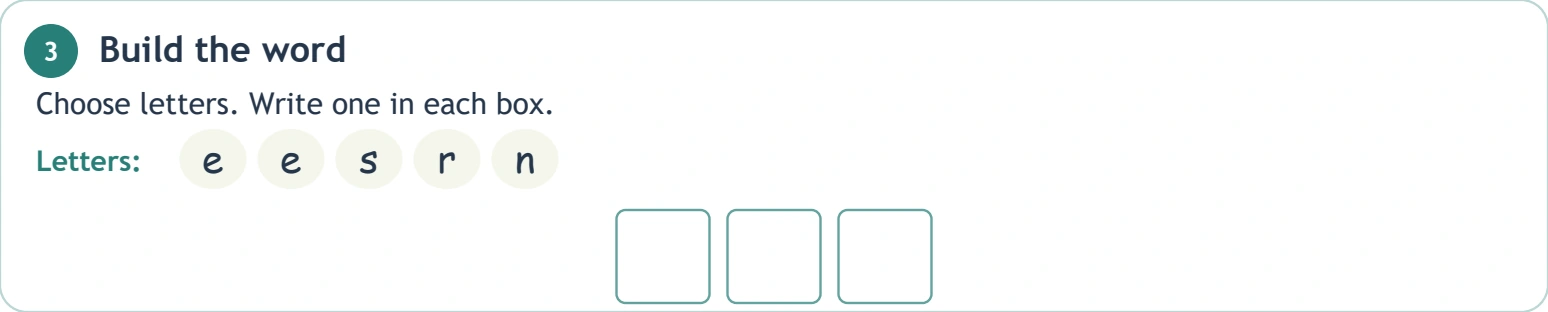
The bank lists e, e, s, r and n. Select s and both e choices, arranging them s-e-e across the three boxes. R and n remain unused. Choosing only one of each letter type would leave this spelling incomplete.
See Word Evidence can make selection visible before writing begins. Gather the needed pieces, compare them with the model and then order them. Read the finished build with support so the spelling task remains connected with the spoken target and its use in a message.
Five See Word Evidence invitations give a listener something to understand
Choose one optional exchange using a separate completed card or simple drawing. The adult models the target and supplies unfamiliar text. These invitations extend the conversation around the source without promising extra worksheets inside the individual PDF.
1. See Word Evidence prepares an observation card
The learner selects an ordinary picture and dictates a short statement about it. An adult writes the line and helps read it. See Word Evidence gives the target a real communication role before the child checks the complete s-e-e spelling.
For See Word Evidence, the chosen observation need not be elaborate. One clear item and one supported message are enough. Ask whether the adult's written version matches what the child intended, allowing a correction through pointing or speech.
2. See Word Evidence changes a statement into a question
Read a completed observation statement, then offer an adult-written question for a willing listener about the same item. Locate the target in both. See Word Evidence shows that a stable spelling can serve messages with different conversational purposes.
The See Word Evidence adult supplies any changed surrounding words. The learner can identify the listener and inspect the target without independently rewriting the sentence. Keep the comparison about meaning and print rather than testing punctuation terminology.
3. See Word Evidence repairs a missing vowel letter
Prepare s-e with the complete s-e-e reference beside it. Tell the child that one written character has been left out and invite a supported repair. See Word Evidence makes the omission visible while the adult keeps the long-e pronunciation clear.
During See Word Evidence, adding a letter does not require adding another separately pronounced vowel sound. State that distinction when needed. A single accurately explained repair can be a useful stopping point without repeated reshuffling of the pieces.
4. See Word Evidence clarifies an unclear it
Place two pictures beside a supported question using it, then explain that the intended object needs naming. Invite the learner to identify the referent. See Word Evidence gives the complete message a reason to be clarified before inspecting the target again.
For See Word Evidence, the adult should resolve ambiguity openly instead of expecting a hidden answer. The child's explanation can be a point. Return to s-e-e afterward so understanding the object reference and recognising the printed word remain separate observations.
5. See Word Evidence saves a familiar message for a reread
Keep one dictated observation with its picture and return to the target on another willing visit. See Word Evidence can provide regular practice through a familiar communication rather than demand a newly completed source sheet each time.
Ask the See Word Evidence learner whether the saved message still fits its picture. One supported vowel-pair check or reread can be the complete return. Add a new question only when that makes the exchange more interesting for the child.
See Word Evidence reviews nine search entries deliberately
The source includes four see matches. Two, the, is, me and play are the other printed choices. Compare the whole target against each candidate, including both e letters. Keep the four-match total as an adult review aid rather than announce the answer locations beforehand.
See Word Evidence can begin with pointing before circles are drawn. If me is chosen because of its ending, inspect the different beginning and read the introduced target again. A specific comparison offers more information than a demand to look harder or answer faster.
See Word Evidence gives pencil work a manageable role
Two dotted word examples and writing guides provide the source's tracing opportunity. Read first, demonstrate the actual printed forms and invite a comfortable attempt. If the source lines make movement awkward, use another sheet to show the same word at a broader size.
See Word Evidence ends with sentence writing that allows a copy from above. Talk through the intended meaning and let an adult record it first when needed. The learner can contribute the target while the adult handles unfamiliar spellings, rather than face independent composition as an all-or-nothing requirement.
See Word Evidence can fit a short classroom conference
A teacher models ee and reads the source exchange with the group. Individual learners then locate the target, choose bank letters or attempt guided writing on their own sheets. The teacher records whether the response needed a pronunciation model, a sequence reminder or a physical adjustment.
See Word Evidence can give a willing partner the separate job of listening to an adult-supported question. Keep the child's target-word decision distinct from the partner's answer. A quiet pointed response may show understanding even when extended speaking is not comfortable.
See Word Evidence uses its labelled turtle display as a conversation aid
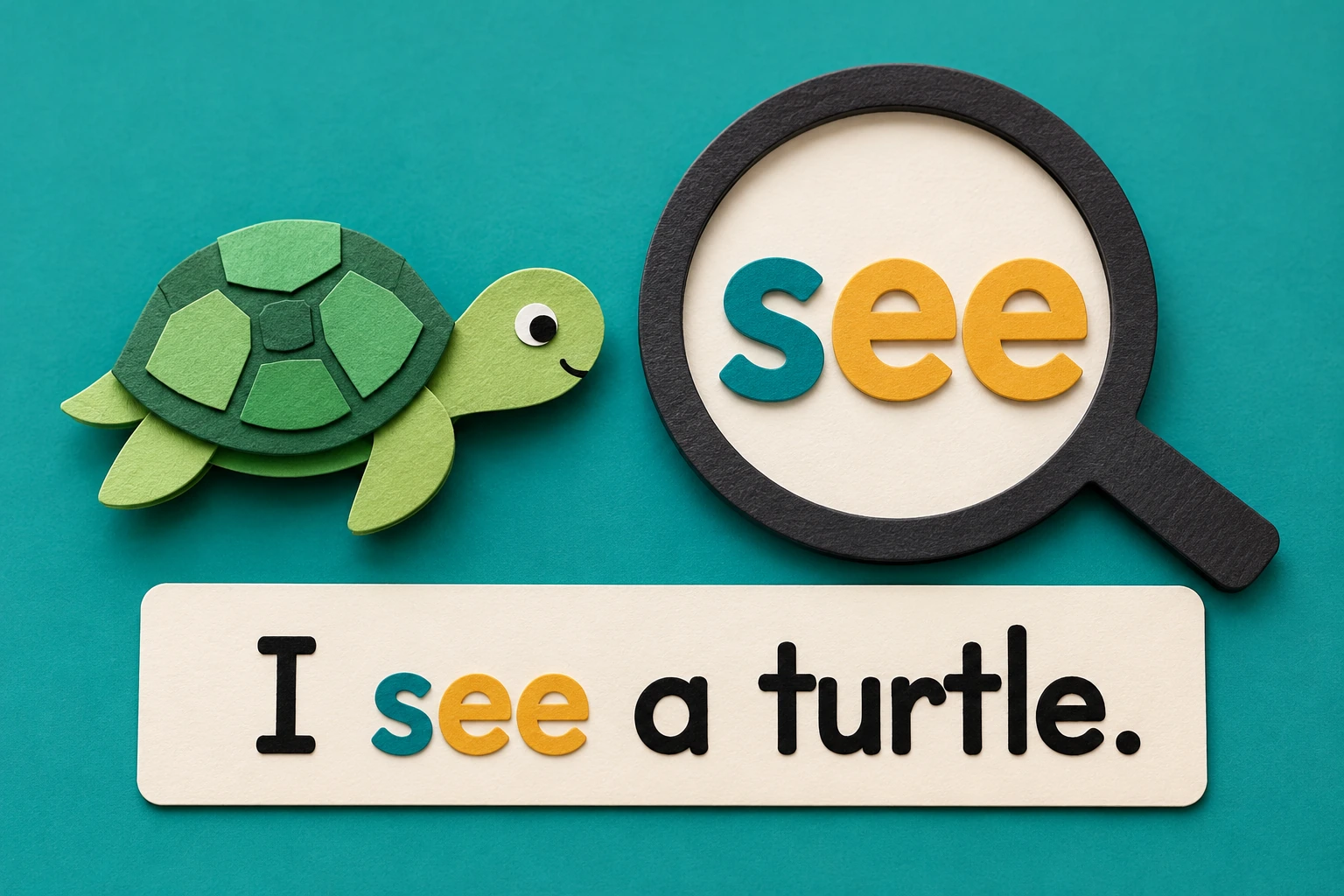
The supporting still life shows a paper turtle, magnifier, completed word card and finished observation strip. It is a separate imagined teaching arrangement. The readable text provides an explicit example while the source PDF retains its intentional writing spaces for the learner.
See Word Evidence does not require the child to reproduce that display. A shared topic can explain the message, while the actual letter sequence establishes the reading response. Let an ordinary chosen picture supply interest and keep the adult's print model accurate.
See Word Evidence changes support when a misconception appears
| What needs clarifying? | The next useful prompt |
|---|---|
| One e is omitted. | Compare all three written positions. |
| Each e gets its own vowel sound. | Model the ee spelling as a pair. |
| The picture supplies every answer. | Inspect the actual target letters. |
See Word Evidence often suits early readers of roughly four to six with adult help based on their current instruction and comfort. A precise observation such as “You remembered that both e letters belong after s” names an achievement. Pause when sustained effort becomes uncomfortable and invite a short return when interest reappears.
Obtain See Word Evidence in the file edition you want
The source-download option retains the original sheet. For the clean individual edition, sign in with a qualifying active membership and choose the protected member PDF. That file has been cleared of worksheet watermark material and promotional website/domain markings, with no advertisements inside the downloaded page. Before printing, check that the complete US Letter work area fits your printer margins.
See Word Evidence also belongs to the collection reached from the package card. The price is $5 for a merged clean PDF containing the twenty supplied sheets. This page's clean single-sheet attachment uses membership access. Related print comparisons appear on the butterfly vowel-pair page, listener meaning on the fish conversation sheet, and referent work on the ball reading activity.
For adult planning, use Reading Rockets' explanation of spelling-aware frequent-word instruction and UFLI's word activities for explicit reading support alongside the learner's established programme. Choose one clear feature for a brief revisit rather than increase every session's demands.
Popular Worksheets
Printable resources families and teachers are downloading now.
 Free
 Free
 Free
 Free