
Not Word Meaning: 4 Brilliant Woodland-Contrast Games
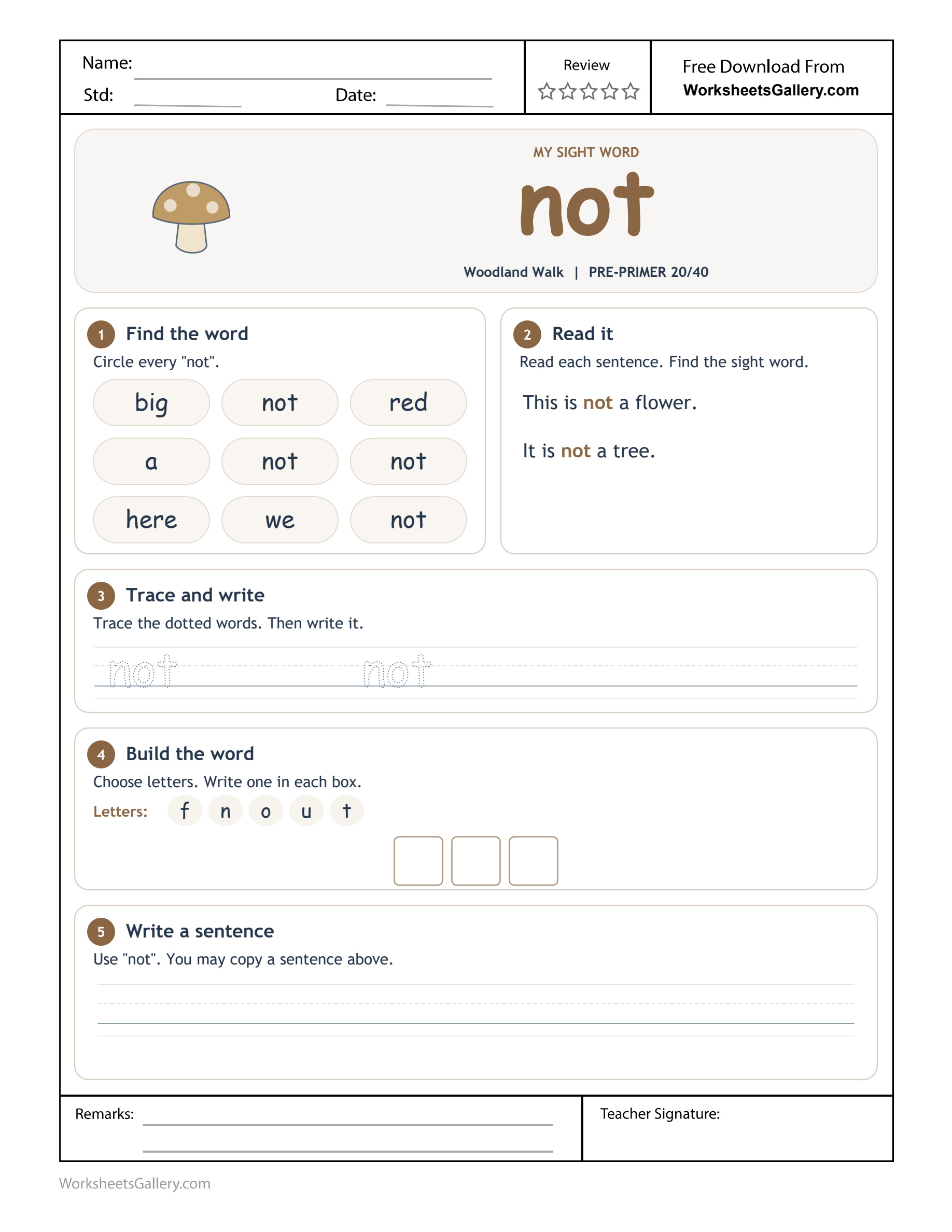
The woodland contrast completes this supplied twenty-word group. ‘not’ joins sheets 01–19 in the clean collection PDF. The full twenty-page download is a separate $5 purchase, with original learning content preserved throughout.
Leave out one small word and a woodland message can say something quite different. Not Word Meaning explores that change through the Woodland Walk worksheet, where a mushroom provides the shared topic for two short statements. The learner studies n-o-t, compares search choices, traces, selects letters and attempts sentence writing with adult support. A clear explanation connects the printed target with its effect on meaning. The picture makes the conversation understandable, while the actual letters remain the evidence for reading. One thoughtful contrast can be more valuable than quickly filling every available space.
Not Word Meaning changes what a statement claims
Compare an adult-written sentence identifying a drawing as a tree with a second sentence saying it is not a tree. Read both clearly and discuss whether each fits the intended picture. The small word changes the claim rather than simply making the sentence longer.
Not Word Meaning can establish that relationship through ordinary talk before a print decision is requested. Name the shared object, model the complete messages and clarify what each says. The child can point to the relevant picture or explain the difference in their own words.
In Not Word Meaning, this is a language comparison rather than an instruction to disagree with someone. Keep examples concrete and cooperative. The learner is examining how a written message works, with an adult supplying unfamiliar words and a clear target model.
Not Word Meaning starts from its full three-letter model
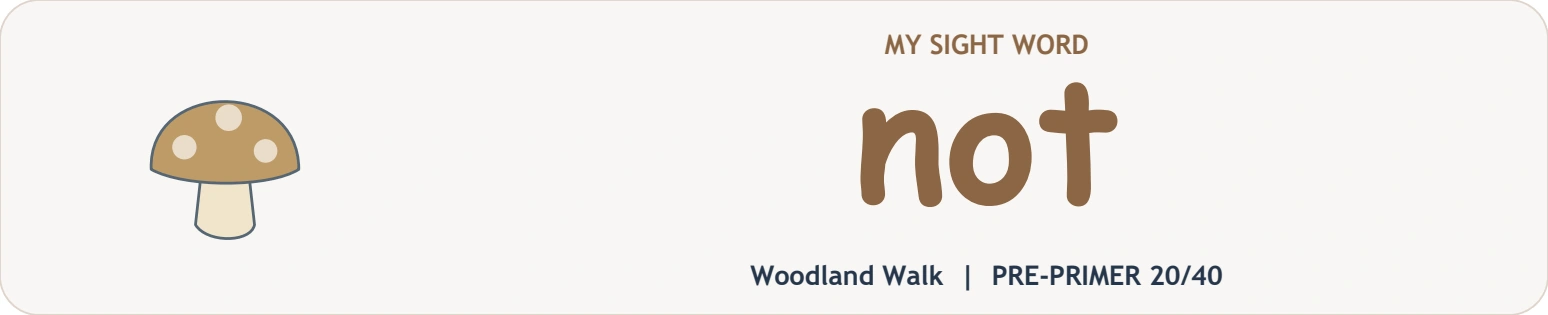
The source prints not beside the Woodland Walk illustration. Follow n, o and t in order, connecting them with taught correspondences and a natural adult pronunciation. Model an unfamiliar part directly rather than expect the child to infer the word from the mushroom theme.
Not Word Meaning can use a supported blend with the short vowel appropriate to the learner's speech and instruction. Letter names help discuss written order, while sounds help explain reading. Invite the complete word after arranging its characters so the activity reaches beyond naming letters.
A small Not Word Meaning table keeps the comparison clear
| The adult's example | What to notice |
|---|---|
| A clear tree identification. | The message names the object positively. |
| A statement containing not. | The claimed identity is denied. |
| A picture that could be unclear. | Ask its maker what was intended. |
Not Word Meaning should avoid ambiguous drawings used as hidden answer keys. Establish what an image represents before asking whether a sentence fits. A child can reason accurately about the message while still needing an explicit reading model for its target.
Yuvan's woodland captions give Not Word Meaning a home purpose
Yuvan draws a mushroom and a tree for his sister to inspect. An adult writes two clear messages after asking what each drawing represents. The adult reads them aloud, and Yuvan helps decide which statement fits which intended object before locating the small target.
Their Not Word Meaning exchange makes a mismatch worth clarifying. If his sister places the wrong caption beside the mushroom, Yuvan points to the intended picture and explains the difference. The adult then returns to n-o-t so the correction leads back to actual print.
Not Word Meaning can remain a short drawing conversation. No woodland trip or live object is required. A saved caption can provide another willing reread later, while the adult observes language understanding and spelling attention as related but distinct skills.
Not Word Meaning reads the source's two negative statements
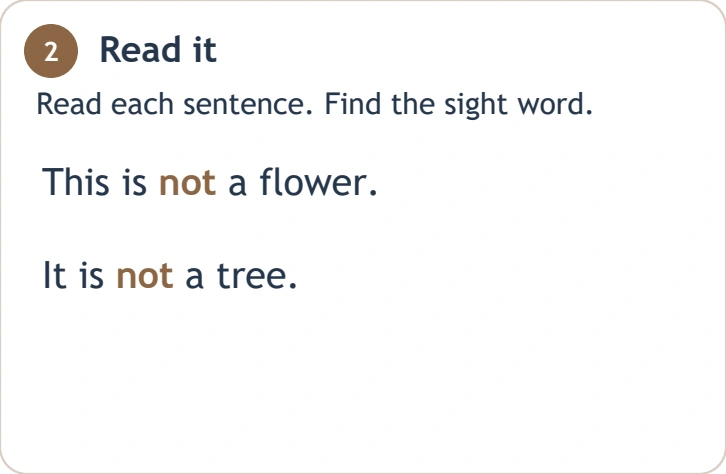
“This is not a flower.” supplies the first message. “It is not a tree.” supplies the second. Read both with assistance and establish the mushroom referent in the shared source setting. Ask what each line rules out, accepting speech or pointing.
Not Word Meaning gives the child a reason to notice the target instead of skipping a short word during a supported reread. The rest of the line may look familiar, but leaving out not changes the claim. Model that difference explicitly rather than wait for the learner to guess why a sentence no longer fits.
For Not Word Meaning, supply unfamiliar surrounding spellings directly. The child does not need independent mastery of flower, tree or This to participate in the target-word comparison. Keep the amount of new reading work specific and manageable.
Seven Not Word Meaning gains can show in different ways
- Sentence reasoning: explain how a small added word changes the claim.
- Sound connection: blend the introduced n-o-t correspondences with suitable adult help.
- Word attention: notice a short target that could otherwise be skipped in a sentence.
- Sequence: select the three needed characters from a larger bank.
- Comparison: inspect the complete spelling rather than choose through the woodland picture.
- Motor participation: use tracing, writing or larger pieces at a comfortable level.
- Expression: dictate a clear contrast that a listener can understand.
Not Word Meaning combines cognitive checking, fine-motor work and language without expecting equal independence across them. A child may explain the contrast while needing the vowel modelled, or read the target while preferring dictation. Record the actual support used instead of drawing conclusions from page completion alone.
Not Word Meaning inspects every search candidate
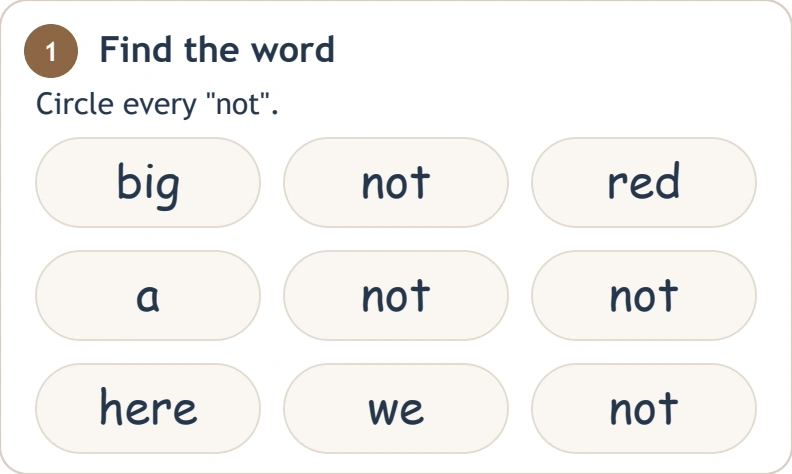
The nine-cell source search includes four not matches. Big, red, a, here and we are the other printed entries. Compare each whole choice with the large model, checking beginning, middle and ending before a circle is added.
Not Word Meaning can begin with pointing when small circles are physically awkward. Keep the expected total as private review information until the child has inspected the candidates. A correct picture description is useful conversation, but it does not establish which written entry matches.
Four Not Word Meaning activities make a contrast useful
Choose one separate drawing or completed card arrangement. The adult models the target and reads every unfamiliar surrounding word. These optional invitations support the source lesson without claiming that additional exercises or answer-key pages are included in its PDF.
1. Not Word Meaning opens a woodland-caption desk
Use two clearly identified drawings and dictate a statement that rules out one identity. An adult records and reads the message. Not Word Meaning gives the learner a reason to inspect n-o-t before a willing listener chooses the intended picture.
For Not Word Meaning, clarify the drawing names first. The child can point, speak or direct the adult's placement of a caption. The goal is an understood contrast with an accurate printed target, rather than a test of artistic detail.
2. Not Word Meaning compares a paired message
Prepare two complete adult-written sentences that differ by the presence of not. Read each and discuss its claim about a shared picture. Not Word Meaning makes the effect of the short word visible while the rest of the wording remains supported.
During Not Word Meaning, point to the actual target after discussing the difference. Recognising which claim fits the picture and reading n-o-t are separate responses. Offer enough help for each instead of assuming that solving the meaning question proves both.
3. Not Word Meaning repairs an adult's skipped word
An adult reads a clearly printed negative statement but deliberately omits its short target, then explains that the message was changed. Invite a supported reread. Not Word Meaning makes careful attention useful because one omission alters what the sentence says.
The Not Word Meaning adult should show the missing printed word openly and model it accurately. This is a cooperative repair, not a concealed trick. The learner can point to the target before hearing the complete line read correctly.
4. Not Word Meaning saves a clear contrast note
The child dictates one suitable statement about an invented picture, with adult help to include the target. Write and read the note for a willing listener. Not Word Meaning connects spelling care with a message the maker actually wants understood.
Keep the Not Word Meaning note for another short visit if the learner chooses. A supported blend or a three-letter comparison may be the entire return. Add another contrast only when it keeps the conversation interesting rather than making practice longer by default.
Not Word Meaning traces after the word has been introduced

Two dotted models preserve the complete sequence on writing guides. Demonstrate the actual source forms and invite one comfortable attempt after reading. A larger separate example can reduce a narrow-line movement challenge without changing the spelling being studied.
Not Word Meaning can continue through spoken explanation or letter selection when the pencil rests. Avoid correcting every mark during a sentence discussion. Choose which skill is being observed and keep the support focused on that particular step.
Not Word Meaning chooses three letters rather than copying five
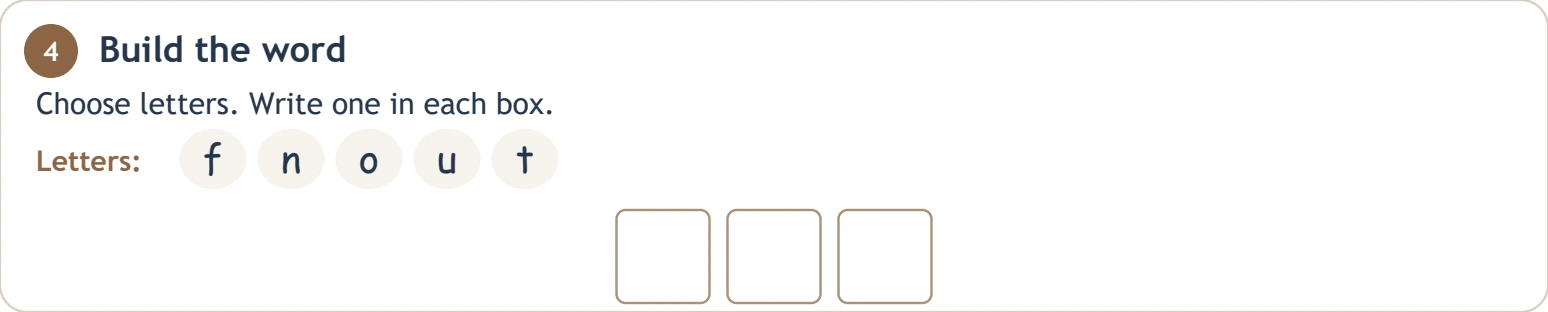
The bank offers f, n, o, u and t. Select n, o and t and arrange the written target across three boxes, leaving f and u unused. Choosing the needed characters and ordering them are separate decisions that an adult can demonstrate with larger pieces.
Not Word Meaning ends with a sentence task allowing a copy from above. Talk through the message first, then choose dictation, supported copying or another composition according to readiness. Independent sentence spelling is one possible response, rather than a requirement for using the sheet meaningfully.
Not Word Meaning in class can be a brief meaning-and-print conference
A teacher identifies a clear picture, models the target and reads a source line. Each child then locates n-o-t on an individual sheet, checks one candidate or chooses letters. The teacher records whether meaning, pronunciation, sequence or physical writing needed the most assistance.
Not Word Meaning can assign a willing classmate a listening role during a supported contrast. Keep the target-word decision with the learner rather than allow a confident reader to supply every answer. A quiet gesture can show understanding without requiring a public spoken explanation.
A filled Not Word Meaning scene makes its claims explicit
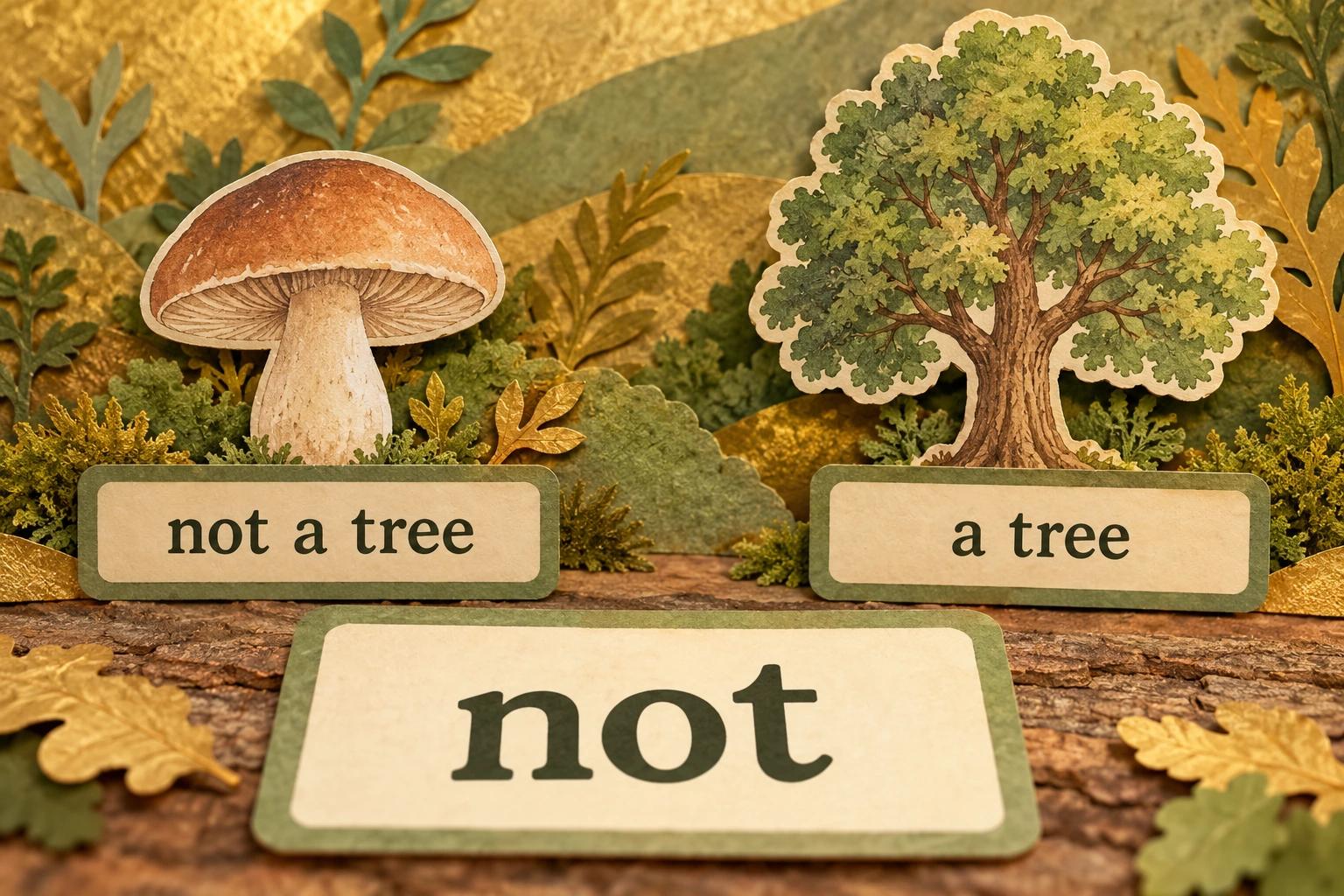
The companion image places a paper mushroom and tree beside a not tile and completed comparison messages. Its readable labels make the intended claims available for discussion. This is separate supporting art, while the source PDF keeps its deliberate answer spaces unchanged.
Not Word Meaning often suits supported learners near four to six, with help matched to their current reading programme and hand comfort. Clarify the intended object and teach the spelling before asking for an independent contrast. A comment such as “You noticed that leaving out not changed the message” identifies a concrete achievement.
Keep Not Word Meaning practice brief and purposeful
Return to a saved contrast when the child is willing rather than require a full page every day. Read one target, check one letter sequence or clarify one message. Pause when sustained attention, talking or writing becomes uncomfortable, leaving a useful point to revisit later.
Not Word Meaning should not turn into repeated demands to disagree or a rapid correct-or-incorrect quiz. Use a cooperative adult model, a clear referent and a specific print question. Those choices make the task understandable while leaving room for thoughtful responses.
Select the Not Word Meaning edition before downloading
The original-source download preserves the supplied sheet. For the protected clean individual PDF, sign in and use the member attachment with a currently eligible plan. This Not Word Meaning edition removes worksheet watermark material, website promotion and domain text; its downloaded page carries no ads. Check your printer preview for the complete Letter-size border before producing a copy.
Not Word Meaning also appears within the twenty-sheet $5 collection linked through the package card. Its purchase obtains all twenty clean sheets in one file; this single-sheet attachment remains a member option. A positive identification context appears on the pig statement sheet, a referent comparison on the ball word page, and a supported ability statement on the duck reading activity.
Adults can plan the word-level support with UFLI's frequent-word resources for explicit teaching and Reading Rockets' account of phonics-connected word instruction. Use that background alongside the learner's established lessons when selecting one manageable feature for the next visit.
Popular Worksheets
Printable resources families and teachers are downloading now.
 Free
 Free
 Free
 Free