
I Word Voice: 4 Powerful First-Person Reading Games
A speaker can choose another word next. Keep this ‘I’ activity with the remaining nineteen targets through the $5 collection purchase, which delivers twenty clean pages in a single PDF.
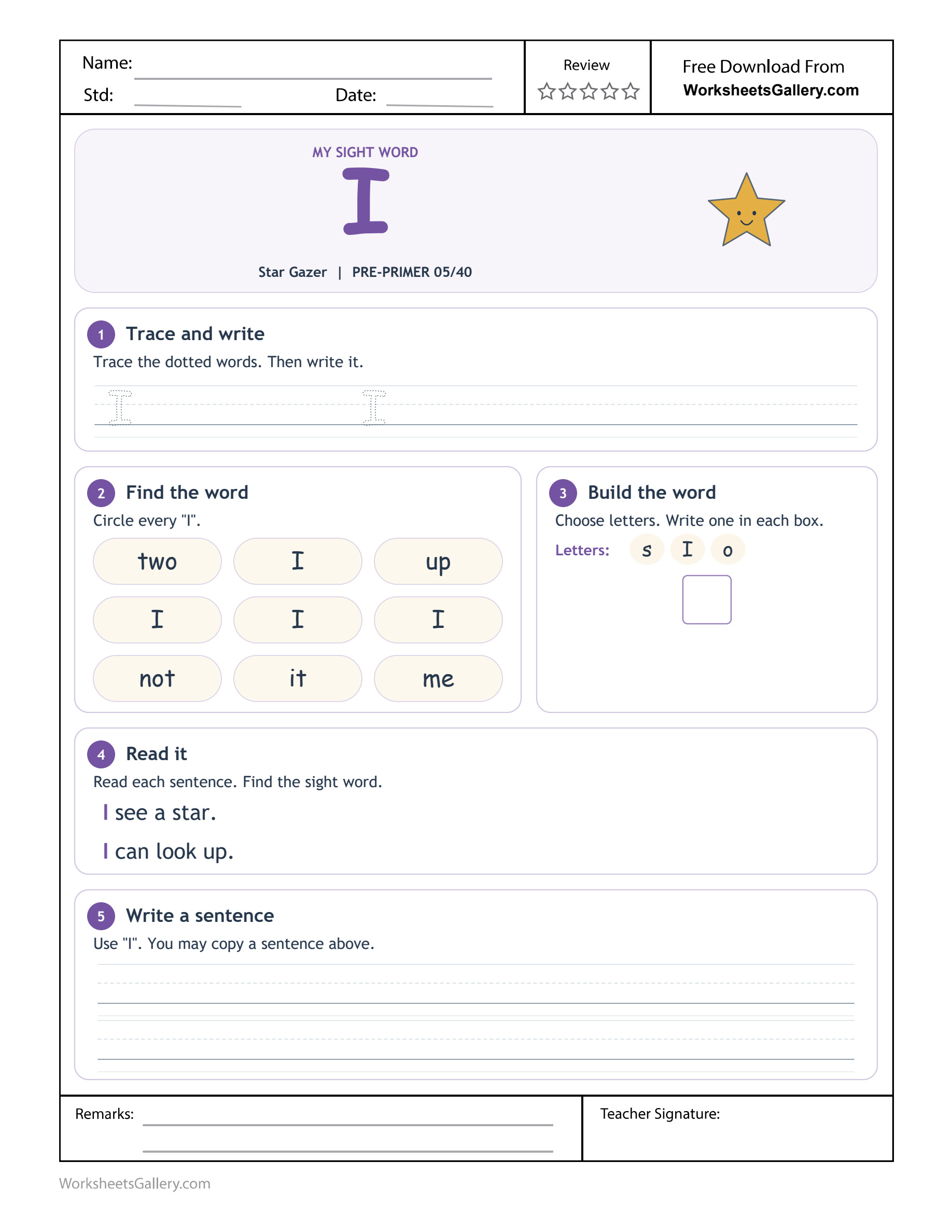
Who is speaking when a sentence begins with I? I Word Voice turns that question into a gentle reading conversation around the Star Gazer worksheet. A child can say a message about a star, hear an adult say it too and notice how the speaker changes while the printed word remains the same. The sheet offers tracing, searching, letter selection, sentence reading and a final writing space. Its target is the standalone capital pronoun. Adult modelling keeps attention on that written form while allowing the learner to contribute a real observation in their own voice.
I Word Voice belongs to the person speaking
When Sara says “I see a star,” I refers to Sara. When her uncle says the same sentence, it refers to him. The word does not permanently name the girl in the picture or the person holding the pencil. Its reference follows the speaker in each actual message.
I Word Voice can establish that relationship without a grammar lecture. Ask a willing child to point toward themselves while making a simple statement. Then the adult models another statement about their own view. Keep both turns clear, and avoid speaking as the child without explaining the change.
In I Word Voice, meaning supports a reason to read, while the capital printed character identifies the target. A learner can understand whose turn it is and still need help recognising the word. Offer the written model explicitly rather than relying on gestures to supply an answer.
Why I Word Voice keeps its capital letter
The English standalone pronoun I is capitalised, including when it appears within a sentence. This is a particular writing convention, not a suggestion to capitalise every short word. On the source page, the search and bank use the same uppercase target that appears in the large model.
I Word Voice therefore concerns a word, rather than a general alphabet-identification lesson. An adult can name the letter and model the spoken pronoun clearly. If the child writes a lowercase form, explain the convention and provide an accessible example without turning the whole page into a correction exercise.
For I Word Voice, compare the complete entry with it only after the target is established. A familiar-looking first character inside another spelling does not make the longer word equivalent. Space, case and the amount of print all provide information worth noticing slowly.
A star-window exchange starts I Word Voice at home
Sara places a paper star on the window and tells her uncle what she sees. He writes her sentence on a separate strip, reads it back and asks her to locate the word she used for herself. She points to the capital I while he helps with the remaining spellings.
Their I Word Voice exchange continues when he describes something else in the room. Sara identifies him as the new speaker. Neither needs to wait until evening or observe a real sky: the paper prop supplies a conversation topic, and the written message supplies the reading evidence.
Keep I Word Voice voluntary when a child prefers listening. An adult can model two clear speaker turns first, then invite pointing or a short dictated response. A learner's willingness to address an audience is different from their knowledge of the target word.
Six I Word Voice observations worth recording
- Speaker awareness: explain or indicate whose message is being heard at a particular moment.
- Print recognition: locate the complete uppercase pronoun rather than a similar-looking part of another entry.
- Writing convention: preserve capital I when using the word in a sentence.
- Choice making: select one needed character from a bank containing distractors.
- Pencil control: attempt the printed form at a comfortable size with appropriate guidance.
- Personal language: dictate a genuine observation and listen to its written version read back.
I Word Voice brings cognitive attention, movement and expressive language into one activity, but each deserves its own observation. A child can dictate a strong sentence while finding a small guide line difficult. Another may trace comfortably while needing an explicit explanation of who I refers to.
The I Word Voice search asks for a complete pronoun
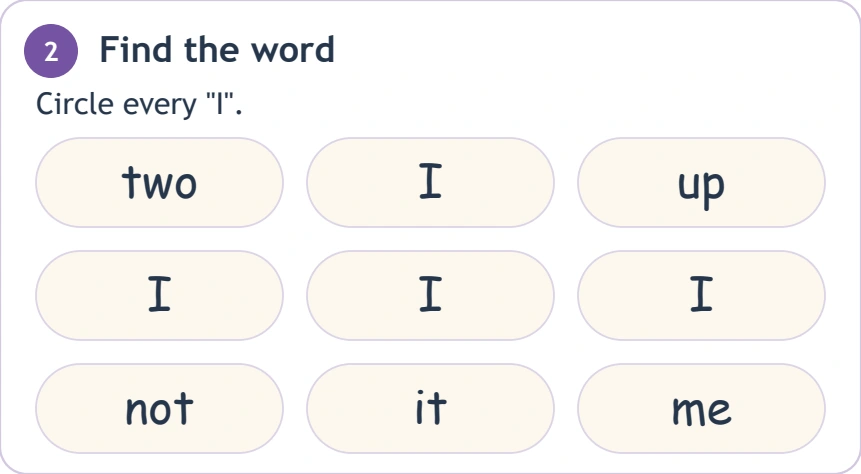
Nine source cells contain four instances of I. The other entries are two, up, not, it and me. The adult can retain the target count for later checking. Let the learner examine the words instead of announcing that a particular row contains several answers.
I Word Voice becomes more useful when a child explains a choice through visible print. Ask what makes the selected entry match the model, with pointing accepted as an explanation. If the child chooses it, compare the additional character and read the target clearly before trying another cell.
An I Word Voice search can begin with two covered-off choices on a separate copy made by the adult, while the original worksheet stays intact. Gradually widening the view reduces the number of comparisons without changing the word being taught or demanding faster answers.
I Word Voice gives one box one precise purpose
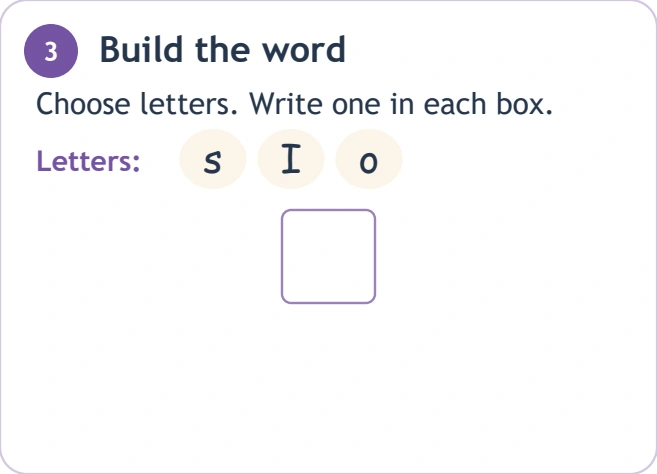
The I Word Voice bank offers s, I and o. Only capital I belongs in the single answer box. The task asks for a deliberate selection, even though the written answer is short. A learner should not be asked to copy all three bank characters merely because they are printed beside one another.
I Word Voice also includes two dotted models. Demonstrate a comfortable movement using the actual form shown. The page does not specify a specialist handwriting method, so an adult can follow the learner's current instruction rather than add conflicting stroke rules or invented arrows.
Four I Word Voice activities that make a speaker visible
Pick one activity after the target has been introduced. Each uses completed adult-written cards or a simple prop beside the PDF. The activities invite meaningful turns without requiring performance, recordings or a large group.
1. I Word Voice passes a speaking star
Place a large paper star beside the current speaker. That person gives a short statement about something they see, while the adult writes and reads it back. I Word Voice lets the child connect the capital word with whoever is taking that particular turn.
Pass the prop to a willing partner and make a different statement. During I Word Voice, the star indicates the speaking turn; it does not become a substitute for reading the card. Return attention to the printed I before discussing how the rest of the message changed.
2. I Word Voice makes a two-speaker caption pair
Draw two simple portraits and write a dictated first-person caption for each. Read one caption while pointing to its speaker, then switch. I Word Voice can show that the same pronoun belongs in both captions even though the people and their observations differ.
Let the learner choose which caption the adult reads next. I Word Voice keeps that choice small and clear, with unfamiliar words supplied by the adult. Compare the identical capital target after each turn rather than asking for independent reading of both complete messages.
3. I Word Voice collects an ordinary personal fact
Invite one comfortable statement such as “I have a cup.” Write it with suitable support and reread it together. I Word Voice does not require a surprising story: an everyday true message gives the pronoun a personal reference that the child can understand.
Keep the chosen fact private if the learner prefers. I Word Voice can remain a conversation with one trusted adult rather than a classroom presentation. The point is to connect speaker and spelling, not to make self-disclosure a condition of successful reading practice.
4. I Word Voice repairs a changed speaker label
An adult intentionally points to their own portrait while reading the child's caption as if the child were still speaking. Explain the mismatch and invite a correction. I Word Voice gives the learner a reason to clarify whose turn the written message represents.
After the repair, read with the correct speaker identified. I Word Voice should leave the child confident that adults can make and fix understandable mistakes. Avoid disguising the activity as a trick question or withholding the pronunciation of an unfamiliar word.
I Word Voice reads two messages before writing another

The I Word Voice source begins with a statement about seeing a star. Its other line says “I can look up.” Read both with the required adult assistance and locate the target at each beginning. Ask who could be speaking rather than assuming that the illustration has a permanent ownership of I.
The final I Word Voice panel asks for a sentence using the target and allows copying a sentence above. Oral rehearsal, dictation or supported copying can bridge the gap between having a message and managing all its spelling. Independent composition is not the only acceptable route through this task.
I Word Voice at a classroom listening station
A teacher models a first-person statement, then offers individual sheets for a brief print check. Each learner locates the capital pronoun, chooses its bank form or attempts one guided model. The teacher notes the support used rather than interpreting matching completion times as matching understanding.
I Word Voice can continue with a partner who listens to an adult-supported caption. One child speaks while the other identifies the speaker through a gesture. Swap only when both are willing. Children who communicate differently can use a chosen picture or an adult-read dictated message for their turn.
I Word Voice uses a labelled scene without replacing the source

The companion picture shows a girl pointing toward a paper star beside an I card and a finished sentence strip. It is an invented demonstration setting, not an additional task printed in the PDF. Its filled labels support a conversation about the speaker and the visible target.
For I Word Voice, let the scene start the conversation, then let the letters settle the reading choice. Change the imagined speaker and discuss what happens to the reference. The capital spelling stays available for inspection even when a different person says the message.
I Word Voice support when language and writing need different help
| What happens? | A suitable adjustment |
|---|---|
| The picture is treated as I's fixed name. | Model a second speaker's turn. |
| A lowercase pronoun is written. | Show the English capital convention. |
| The response is hard to say aloud. | Accept pointing or supported dictation. |
I Word Voice is appropriate for many supported preschool and kindergarten learners around ages four to six, with readiness judged individually. Revisit one saved caption when the child is interested, and acknowledge a concrete success: “You showed that this message was yours.” Stop before speaking or pencil work becomes an unwelcome demand.
Choose an I Word Voice download and a useful next reading step
This page offers the retained original and a separate clean member attachment. Sign in under an eligible active plan to obtain the protected individual PDF. Its worksheet watermark, domain promotion and site-name branding have been removed, and no ads are embedded in the downloaded file. Review the US Letter print layout so the complete activity area fits your printer.
I Word Voice is also included in the $5 collection shown by the related package card. That purchase provides all twenty supplied sheets as one clean PDF, while this page's member download supplies the individual sheet. Choose according to the file and access route you want.
For a message about two people, explore the joining-word fruit activity. A named object can lead into the farm article page, while the leg reading printable offers another concrete word context. Adult planning resources include UFLI's high-frequency spelling guidance and the Reading Rockets model for teaching frequent words; align examples with the learner's existing reading instruction.
Popular Worksheets
Printable resources families and teachers are downloading now.
 Free
 Free
 Free
 Free