
Go Word Journeys: 4 Brilliant Car-and-Reader Games
A paper-road journey can continue with another word. ‘go’ appears in the twenty-sheet collection available as one $5 purchase. Download the combined clean PDF when the whole supplied set suits your reading plan.
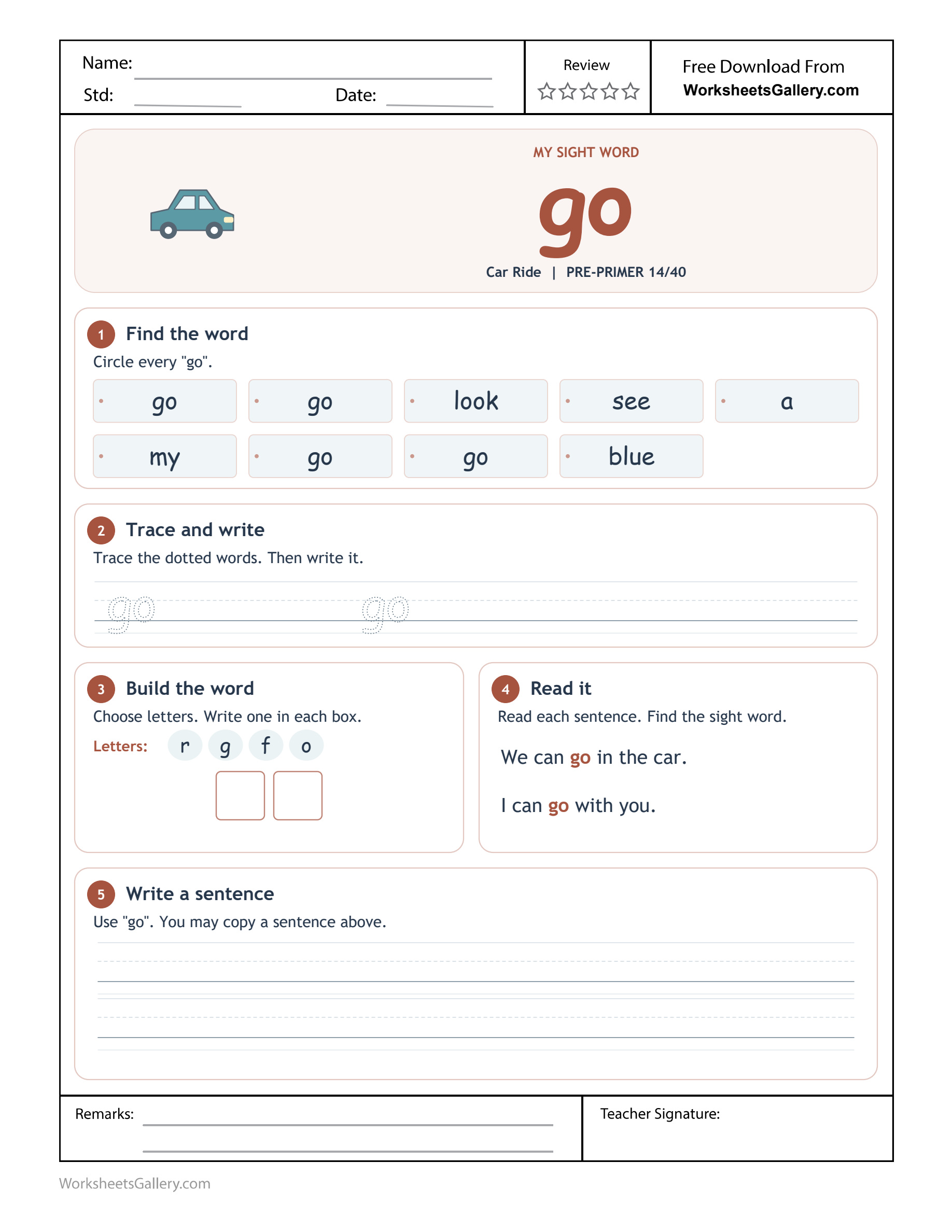
A toy car waits on a paper road, and a small written message can start its pretend journey. Go Word Journeys connects that action with g-o on the Car Ride worksheet. The learner studies a large model, compares search choices, traces, selects letters and reads two short lines with support. One message mentions travelling in a car; another mentions going with someone. An adult can help with the surrounding spellings while the child inspects this particular target. The conversation needs only a drawing or tabletop prop, leaving room for a comfortable, purposeful reading attempt.
Go Word Journeys gives a paper trip a readable beginning
Reyansh draws a short route between a pretend house and a park. His grandfather writes a simple journey message beside it and reads the whole line. Reyansh locates the target by comparing it with the source model before moving a paper car along the drawing.
Their Go Word Journeys exchange keeps the adult responsible for unfamiliar destination names and sentence words. Reyansh can choose the route, dictate a message and inspect g-o without independently spelling every part. The prop gives the communication a purpose rather than supplying a reading answer.
Go Word Journeys can stop after the first supported message. Save the route if the learner wants to use it again. A second visit can begin by rereading the same target instead of introducing more roads, longer instructions or a requirement to finish the full worksheet.
Go Word Journeys models the long vowel explicitly
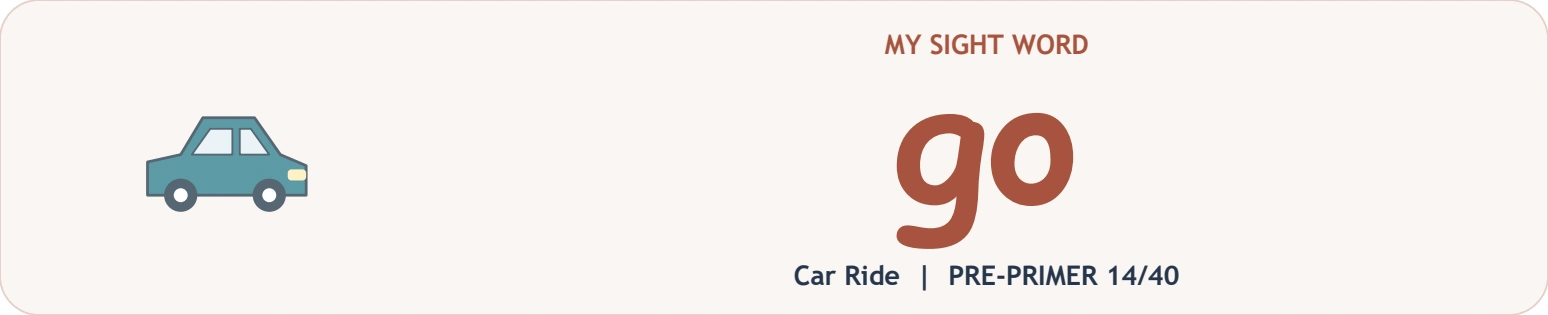
The target places g before o. In this word, the final vowel has the long-o pronunciation; the syllable ends with that vowel spelling. An adult can explain the open-syllable example at the learner's current level, rather than applying a short-vowel reading merely because the word is short.
Go Word Journeys connects the spelling with a clear spoken model. Name the written letters when discussing their order, then read the complete word naturally. If long-o is unfamiliar, teach it directly before expecting the child to identify the target independently.
In Go Word Journeys, the car illustration establishes the theme. Reading go still requires attention to both printed characters. A learner may identify a car immediately but need help with g or its following vowel, and those responses should be observed separately.
Go Word Journeys compares two different journey messages
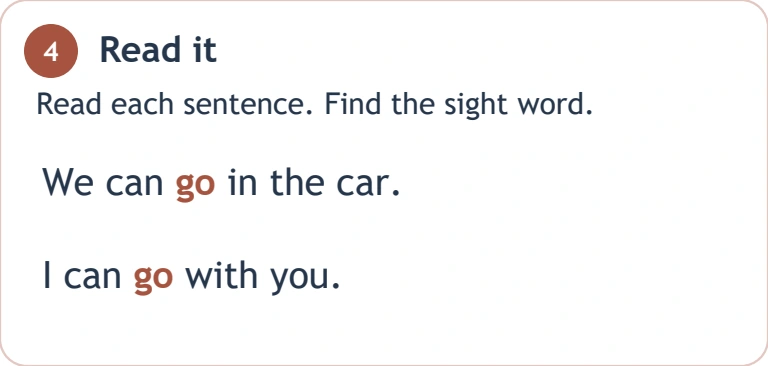
The source says “We can go in the car.” The other sentence says “I can go with you.” Read each with adult assistance and locate the target. Discuss the difference between naming a travel setting and mentioning a companion, without requiring formal grammar labels.
Go Word Journeys keeps that discussion grounded in the actual lines. The second sentence does not specify a vehicle, and the child need not invent one to make sense of it. An adult can help the learner notice what is stated and what belongs only to their pretend extension.
For Go Word Journeys, a complete message can be understood orally before every spelling is familiar. Supply unknown words rather than encourage guesses from the car. Then ask the learner to inspect the introduced g-o within the sentence.
Four Go Word Journeys invitations make a trip worth describing
Use one separate note or paper route for the invitation that appeals today. Adult modelling should make the target available before a reading decision is requested. These are optional activities around the source, rather than additional tasks claimed to be printed in the PDF.
1. Go Word Journeys opens a paper-route message desk
The child chooses a destination on a simple drawing and dictates a short journey message. A trusted adult writes it clearly and reads it back. Go Word Journeys gives the learner a reason to find the target before a willing partner moves a paper marker.
In Go Word Journeys, the partner can ask where the trip is intended to finish. Clarify that through a name or gesture and then check g-o again. The location conversation supports meaning while the spelling comparison supplies evidence about reading.
2. Go Word Journeys invites a travelling companion
Place two paper people beside a pretend route and dictate a message about going together. Read the adult-written line with support. Go Word Journeys lets the learner connect the target with companionship rather than assume it always means using the pictured car.
The Go Word Journeys learner can select a pretend companion or use invented characters. No personal invitation needs to be delivered. Keep the reading contribution manageable by supplying unfamiliar names and asking only for a supported check of the introduced target.
3. Go Word Journeys builds a departure label
Arrange g and o beside the source model and read the completed word. Place the label at the beginning of a paper route and discuss its purpose. Go Word Journeys makes a two-letter build useful without treating a road symbol as a replacement for written evidence.
For Go Word Journeys, briefly compare the label away from the route. The same spelling still reads the target. If the child produces a short-o reading, model the correct vowel explicitly rather than ask for repeated guesses until the answer changes.
4. Go Word Journeys checks a narrator's mismatch
An adult reads a supported journey note but moves a paper marker toward a different clearly named destination. Explain the mismatch and invite a correction. Go Word Journeys gives the learner a reason to check a whole message before rereading the target together.
During Go Word Journeys, the child may point instead of moving the marker. The adult can handle any physical action or unfamiliar print. A successfully clarified trip is a useful finish; the game does not need a timer, penalty or repeated deliberate mistakes.
Go Word Journeys checks nine whole entries
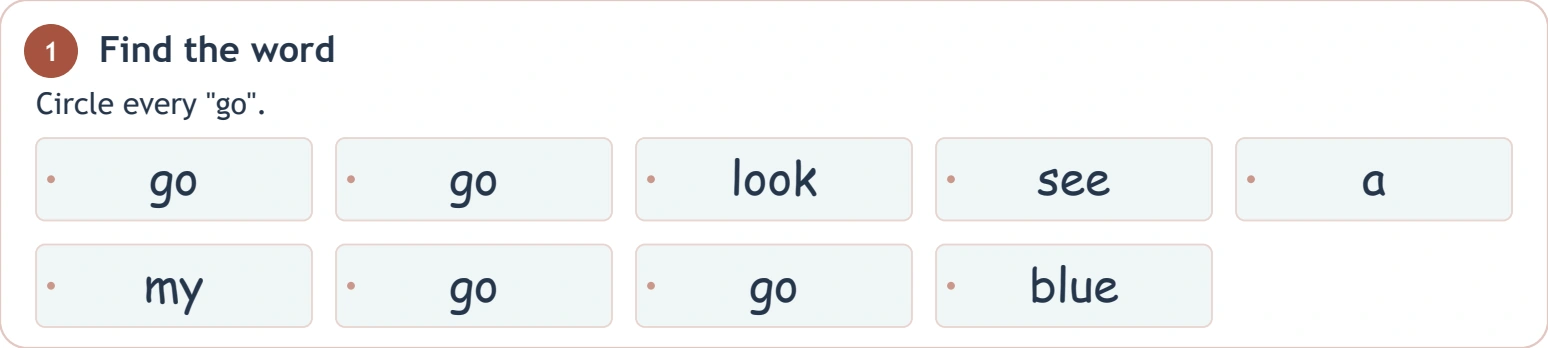
The search contains four go matches, with look, see, a, my and blue as the other choices. Compare each entry with the model and read the target with suitable help. The adult may retain the answer total privately while the learner makes actual print decisions.
Go Word Journeys can begin with pointing before circling. If a response is uncertain, inspect g and o directly and compare the complete candidate. Choosing by word length or by the car theme bypasses the information that the reading task is intended to use.
Go Word Journeys selects its own two-letter order
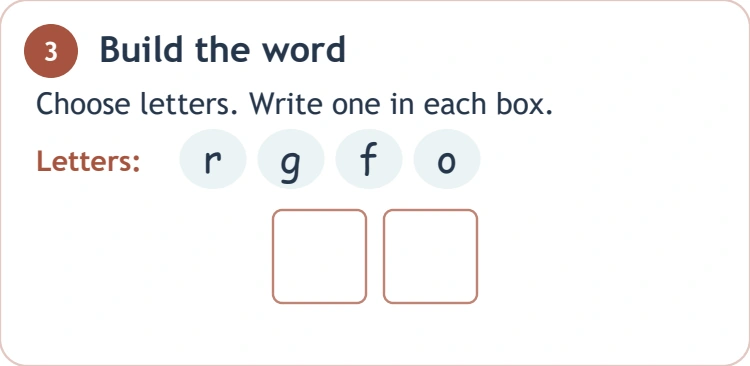
The bank provides r, g, f and o above two boxes. Choose g and o, then place them in the target's sequence. The other characters remain unused. A larger separate arrangement can show the selection before a child attempts the narrow writing space.
Go Word Journeys also includes two dotted examples and guides for writing. Demonstrate the source's forms, keep the paper stable and offer a comfortable tool. A shorter attempt is appropriate when fine-motor effort starts to interfere with the conversation about the word.
Six Go Word Journeys benefits give adults useful observations
- Vowel knowledge: connect the final o with the long-vowel reading in this example.
- Sequence: select and arrange g-o from a mixed set of letters.
- Meaning: explain a journey or shared movement in a supported message.
- Attention: inspect complete candidates instead of relying on topic or length.
- Motor participation: trace or write at a suitable size with practical support.
- Language: dictate a message another person can understand and follow.
Go Word Journeys combines reasoning, hand control and communication without demanding the same independence in every part. A strong route explanation may come before a secure long-o reading. Record which prompt helped and choose the next step from that evidence.
Go Word Journeys can begin at home with one complete message
Start with the child's chosen paper destination. Introduce g-o clearly before offering an adult-supported reading of the relevant source message. Follow with either a bank-letter selection or a search comparison. Tracing and sentence writing can wait for another willing visit rather than become compulsory additions.
Go Word Journeys can return through the saved route rather than a full-page quota. A precise comment such as “You remembered the long-o reading on this label” makes the achievement clear. Allow thinking time and pause if sustained writing or conversation becomes uncomfortable.
Go Word Journeys in class keeps partner jobs distinct
A teacher models the target and reads the actual source sentences. Each learner uses an individual sheet to identify the word, select letters or make a supported writing attempt. The teacher records the kind of assistance used instead of treating matching completion times as matching understanding.
Go Word Journeys can then give a partner the job of listening to a dictated journey note. The adult supplies unfamiliar print, while the learner checks the target. Clarify these roles so a confident reader does not make every choice on someone else's behalf.
A completed Go Word Journeys display keeps its text visible
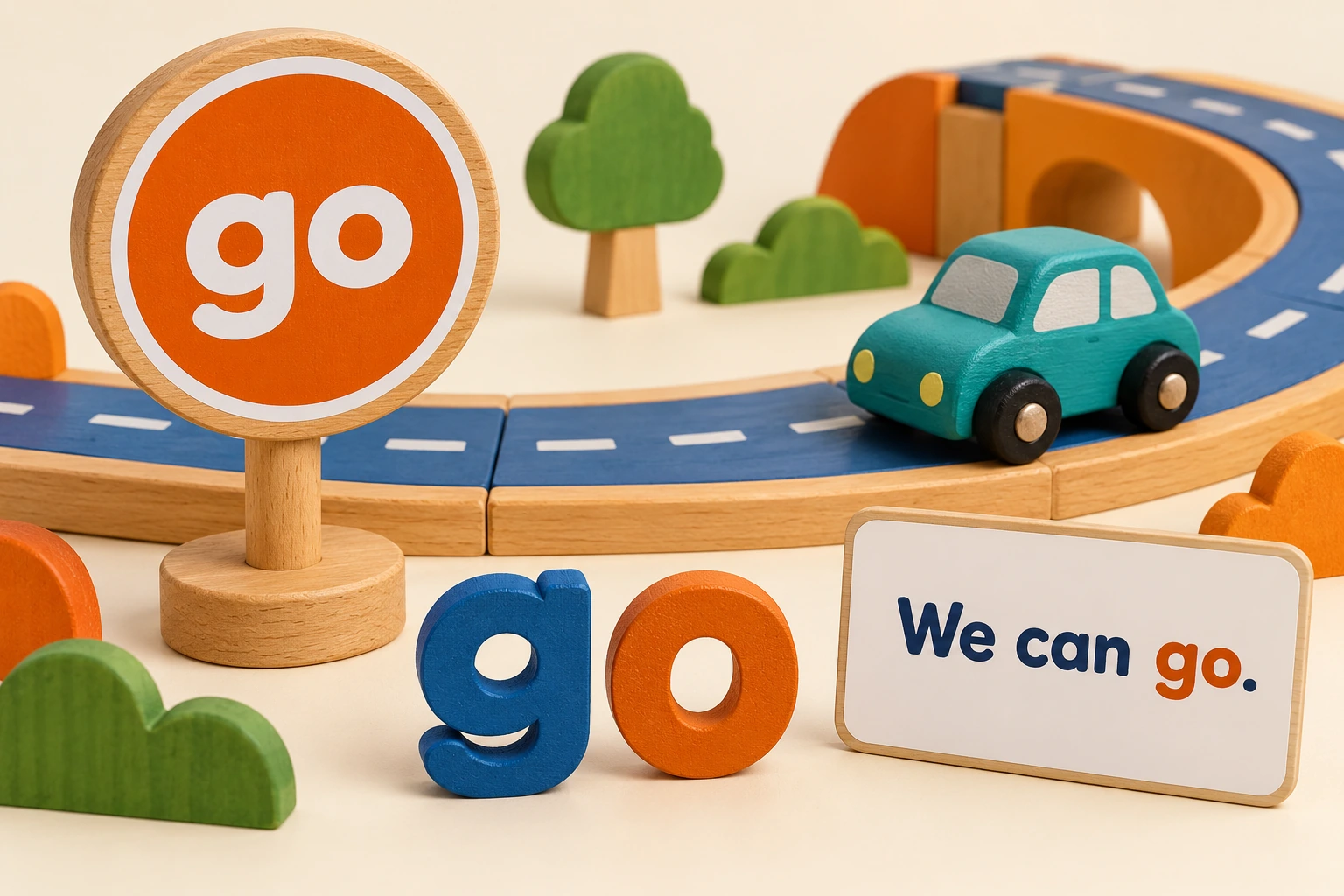
The supporting image shows a toy car, paper road, filled go sign, ordered letters and a completed sentence strip. Those separate props illustrate an adult-led conversation beside the PDF. The real worksheet retains its original tasks and its intentional writing spaces for the child's responses.
Go Word Journeys may appeal to learners who enjoy choosing where a pretend trip leads. Let that choice give the message a purpose, then inspect the spelling before calling a response reading. Understanding the scene and recognising the target can develop with different amounts of support.
Go Word Journeys changes a prompt when a misconception appears
| The observed issue | A useful clarification |
|---|---|
| The vowel is read as short o. | Model long-o in this open syllable. |
| The car picture supplies the answer. | Compare g and o in the print. |
| Every bank letter is copied. | Select only the two needed choices. |
Go Word Journeys can suit children near four to six with adult help informed by their current reading and pencil experience. Age alone does not establish independent sentence reading. The final task allows copying a supplied line, so oral rehearsal, dictation or a supported copy can precede new composition.
Obtain Go Word Journeys as a single sheet or within the collection
The original-source option provides the retained supplied sheet. An eligible active member can sign in and use the protected clean individual download. That PDF removes worksheet watermark material, domain promotion and website-name branding, and there are no advertisements inside the downloaded activity. Check the full US Letter border against your printer's margins before printing.
Go Word Journeys appears within the twenty-sheet collection offered for $5 on the related package card. A collection purchase supplies the combined clean PDF; this individual attachment remains a membership download. Another destination relationship appears on the bus phrase page, a location relation on the school-bag activity, and listener reference on the fish exchange sheet.
Adults can consult UFLI's teaching resources for frequent-word spellings and Reading Rockets' phonics-based account of word instruction. Use that background with the learner's established programme when deciding which target feature needs a clear model next.
Popular Worksheets
Printable resources families and teachers are downloading now.
 Free
 Free
 Free
 Free