
Primer Word Postcards: 26 Brilliant Early Reading Lessons
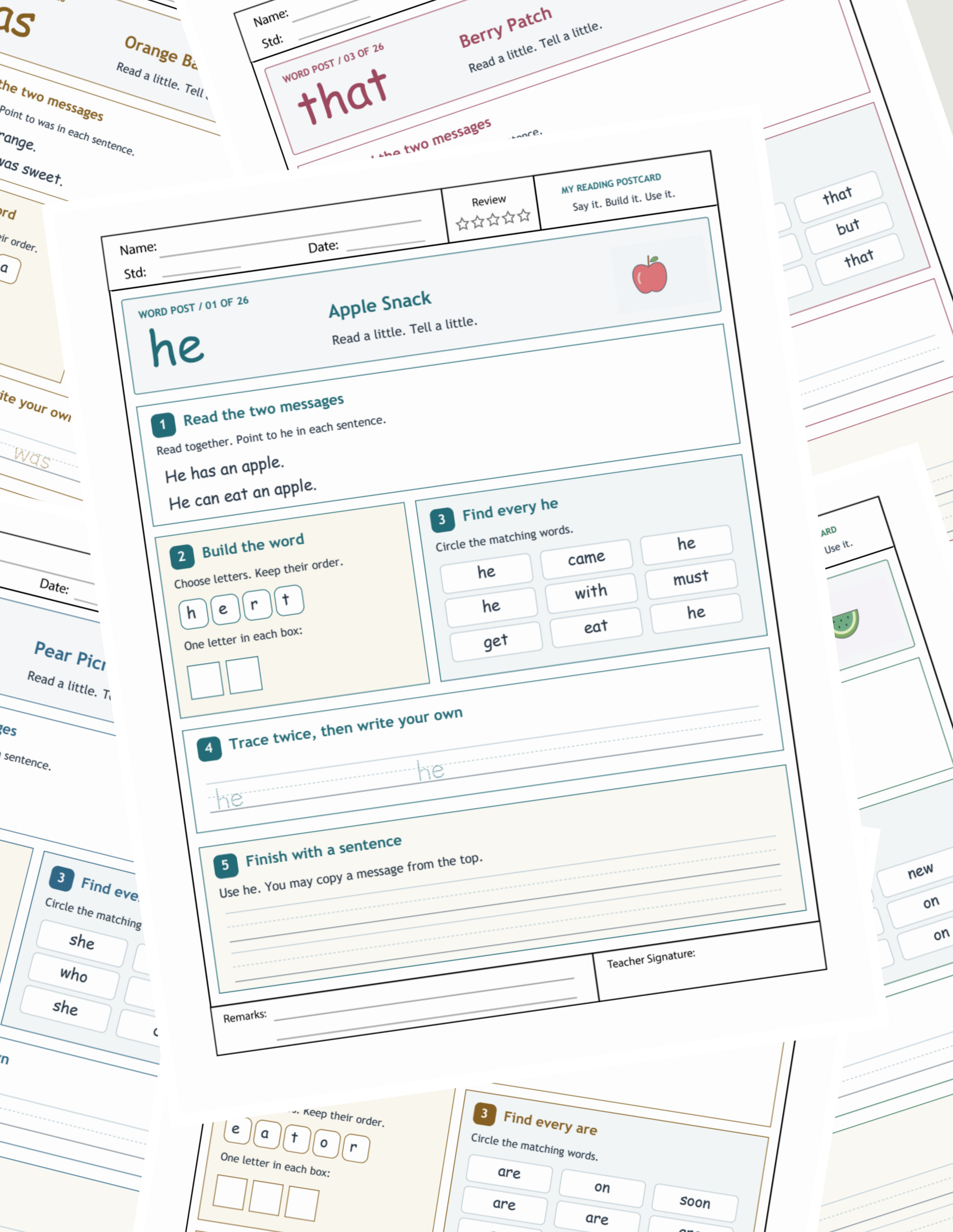
An actual-page collage introduces the clean reading-postcard collection.
The foremost sheet preserves every he activity; angled sheets behind show other supplied primer lessons.
A tiny word can change who a sentence describes, when something happened, or where a reader should look. Primer Word Postcards gathers twenty-six of those useful words into a clean printable collection for early readers. Children meet complete messages before moving into spelling, matching and handwriting. Each sheet offers one manageable word rather than an entire list to memorise at once. The $5 collection contains the supplied lessons from he through are, arranged in their original sequence, with a newly organised reading-first interior and the familiar outer frame retained.
A collection organised around meaning
The word he can refer back to a person. Was places a description in the past. On names a relationship between objects, while but connects ideas that pull in different directions. Treating these words as twenty-six unrelated shapes misses much of their usefulness. Here, short sentences give each spelling a job. Adults can explain that job in conversation, demonstrate it with a familiar object, and then return to the print.
There are twenty-six single-page lessons in one PDF, not the complete fifty-two-word primer list. The included words are he, was, that, she, on, they, but, at, with, all, there, out, be, have, am, do, did, what, so, get, like, this, will, yes, went and are. Other primer words may appear as choices in a search, but they do not receive separate lessons in this collection. That distinction makes planning straightforward: select a particular lesson by its word and page position.
Children often need help reading the surrounding vocabulary. A child can recognise a target word without independently decoding every other word in its sentence. Offer the unfamiliar vocabulary aloud and keep attention on the message. Do not describe this collection as a reading-level assessment or use completion speed to compare children.
Open the Primer Word Postcards at the sentence banner
The clean edition starts with two source sentences. An adult reads one naturally, the child points to its target word, and both reread the message together. Beginning with meaning gives the isolated tasks a reason: the letters they build belong to a word they have just used.
Two examples show the range. “The orange was sweet.” invites a conversation about something remembered. “We will share it.” describes an intended action. They are not interchangeable time words. A quick gesture towards a remembered snack or a future pretend snack can make that difference understandable without introducing formal grammar terminology.
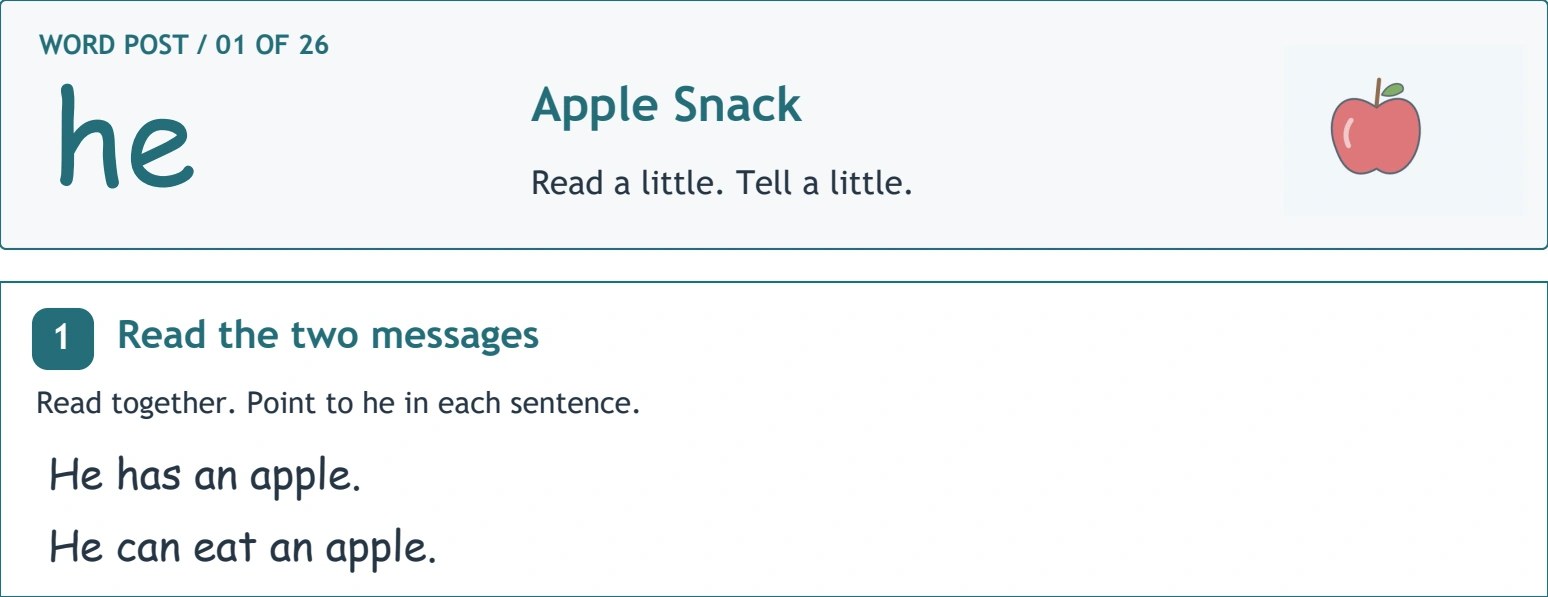
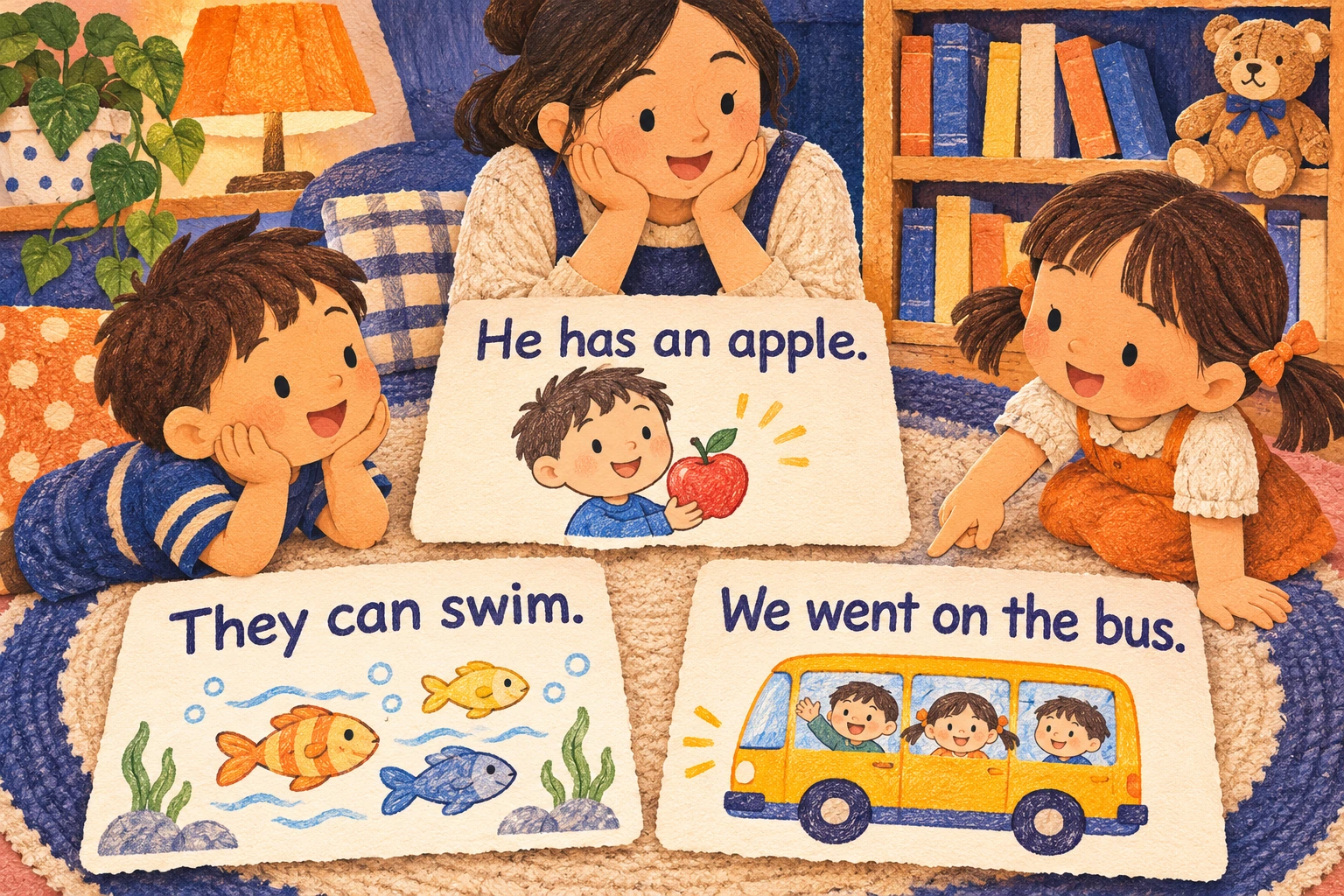
The illustrations provide a context, not a reliable substitute for reading. A picture of an apple does not tell a child whether the printed pronoun is he or she. Introduce the character clearly, read the sentence, and point to the actual letters. When a child guesses from the picture alone, cover the illustration briefly and revisit the word within the sentence.
Two workstations meet in the middle
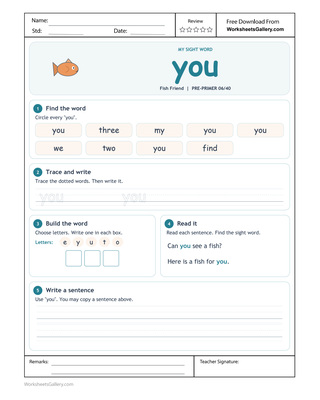
The left station is a letter workshop. Each bank contains the letters needed for its target plus two distractors. Duplicates matter: that requires two t letters, there needs two e letters, and all finishes with two l letters. Saying the spelling while moving counters towards the response boxes can prepare a hesitant writer before pencil work begins.
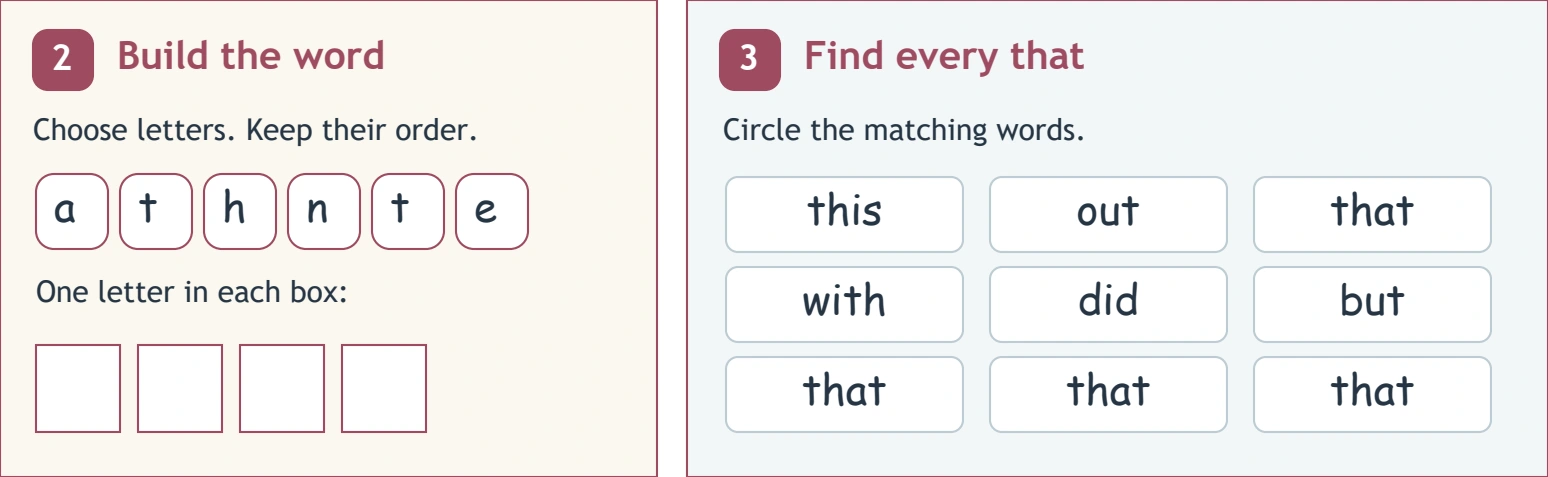
The neighbouring station contains nine printed choices, with four exact target matches on every sheet. A child checks a whole spelling before circling. Some distractors share an initial letter, and a longer word can contain a familiar-looking beginning. Encourage an orderly route through the rows rather than announcing where the four answers sit.
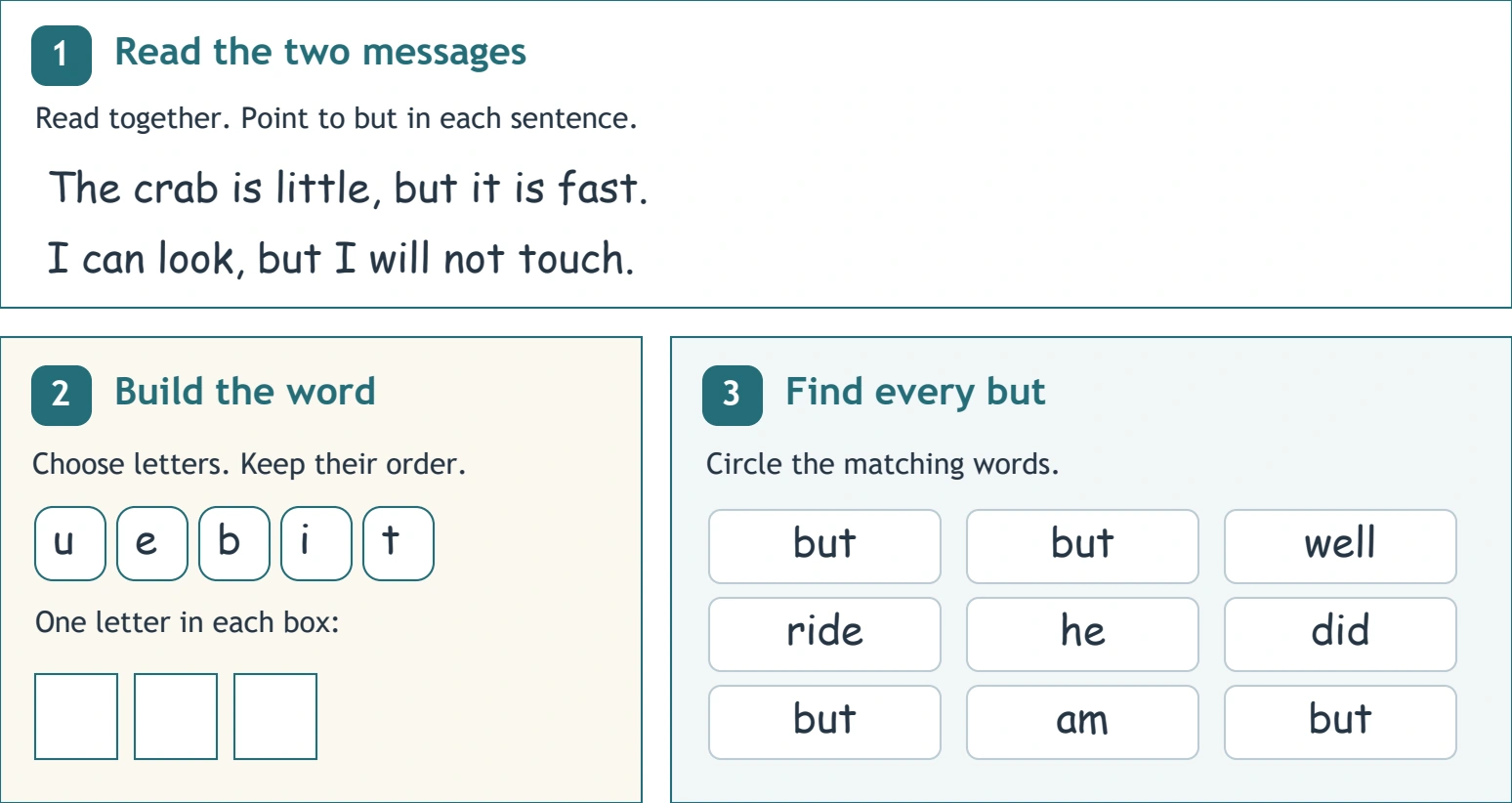
Adults may count the final circles to check the task, but a correct count alone is insufficient. Four circles around the wrong words still need attention. Ask the child to read each circled choice and compare it against the large model. This turns correction into a small investigation instead of a race for a score.
Handwriting follows a spoken message
After reading, building and finding, children trace two dotted word models and try a copy on the remaining guide. The final station provides more room for a complete sentence. Copying either printed example is an allowed response; composing a new one is an optional next step.
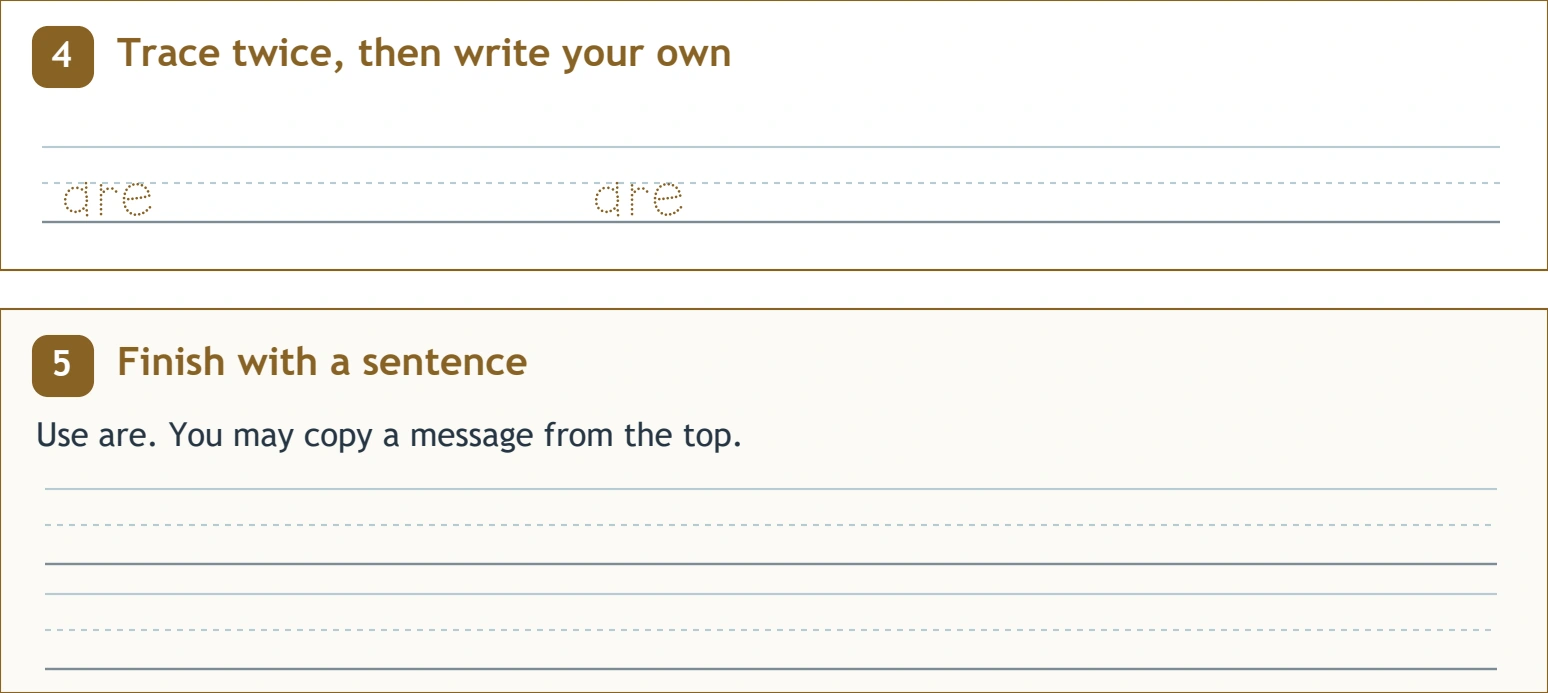
Keep handwriting and comprehension separate in your observations. Someone may explain the sentence accurately yet tire while forming letters. Another child may produce careful copies without understanding the target. The page can support both needs, but those are different teaching decisions. Let a tired writer dictate the ending while an adult records the words beside the work, or finish the remaining pencil activity another day.
Six learning opportunities to watch for
- Reference: pronoun lessons ask readers to connect a small printed word with the person or group already being discussed.
- Time: was, did and went encourage talk about completed events, while will introduces an intended future action.
- Relationships: on, at and with become useful when a child can explain the position, place or companion in the message.
- Letter order: building requires a deliberate sequence rather than collecting the right letters in any arrangement.
- Visual attention: checking nine choices practises inspecting complete spellings and leaving distractors uncircled.
- Written expression: the final ruled area connects a spoken idea with a readable sentence, with copying available as support.
These are practice opportunities, not promised outcomes. Notice the help required and the child's explanation alongside the marks on the page. A short oral response may reveal more about understanding than an entire perfectly traced line.
Choose a route that fits the reader
Most adult-supported preschool and kindergarten readers around ages four to six can explore selected activities, depending on their language, letter knowledge and pencil experience. The suggested age range is a planning guide. It does not mean every four-year-old should complete a whole worksheet independently.
| Starting point | A useful choice | What to listen for |
|---|---|---|
| Beginning to connect spoken words with print | Share one sentence and locate its target together. | A meaningful explanation or gesture. |
| Recognises several letters | Build a two- or three-letter target with movable letters. | The same letter order as the printed model. |
| Comfortable with short copies | Trace, write and copy a complete source sentence. | Word spaces and a message that can be reread. |
| Ready to transfer learning | Invent a different sentence using the day's word. | A new example that preserves the word's meaning. |
Do not assign all twenty-six sheets in one sitting. One useful conversation and part of one sheet can be a sensible visit. Return to a previously practised word after a gap and see whether it remains available without a prompt.
At home: a snack becomes a reading visit
Imagine Anya preparing a pretend snack with a family member. The adult selects like because Anya has been explaining food preferences. They read the cupcake sentences together, then Anya describes a different favourite without being required to enjoy the pictured food. A preference is allowed to differ from the printed character's choice.
Next, the adult sets out the letter bank and asks which letters belong in like. Anya checks the ending, circles the four matching search choices, and dictates a new sentence about a pear. The writing may wait until after the conversation. This possible session uses the worksheet to hold an idea still while the child explores it; it is not a report of a guaranteed result.
For a later visit, choose have and talk about an object Anya actually has. Compare the two messages orally. That transition adds a second sentence purpose without making snack preparation into a long test.
In a group: the teacher listens before collecting
A small classroom station can use different sheets for different needs. Two children might investigate they with toy fish, while another revisits do through a ball question. Each reader first shares the sentence with an adult or a familiar partner. Loose letters, a pencil and a small counter are sufficient materials.
The teacher watches one choice rather than correcting every mark immediately. Did a child choose the first matching letter and stop? Did another explain what there points towards? Record that specific observation. A page with several unfinished boxes can still provide valuable information when its reader has made a clear new connection.
Before children move away, invite a quiet reread. Partners can point while the reader speaks, then swap roles. Keep the exchange collaborative. A confident reader should not complete another child's search or announce every spelling before that child has examined it.
Five ways to carry a word beyond the paper
1. Make a character substitution game. Name a familiar toy character, establish the character's pronoun, and replace the repeated name in a short sentence. Check that everyone knows the referent.
2. Create a tiny time line with “before” and “later” cards. Retell a completed bus trip with went, then plan a different trip with will. The activity is oral; the worksheet remains a place to confirm the spelling.
3. Stage a position photograph with safe household objects. Put a pretend melon on a plate, describe it, and then change its position. Ask whether the same sentence still fits.
4. Build a word with one hidden letter. Show the complete model first, remove a single movable letter, and let the learner restore its proper position. Use both copies of repeated letters when the target requires them.
5. Fold a message card for someone else. The child dictates or writes a fresh sentence containing the practised word, then reads the message to its recipient. Give the word an audience rather than adding another timed repetition.
Corrections that protect the child's idea
Avoid teaching a word only through its colour, its illustration or its position in a row. Those details can change in another book. Return to the letters and sentence meaning when a child relies on a visual shortcut. For a capitalised sentence opening, show the lowercase model beside it and explain that it is the same word starting a message.
Another common difficulty is asking for original sentence writing before the child can explain a sentence orally. Let the reader say the idea, rehearse it, and choose whether to copy or compose. Correct the particular spelling being practised without turning every unfamiliar word into another task.
Celebrate a specific decision: “You noticed the second l,” or “You explained who they means.” Such comments identify something the learner can do again. Keep review visits brief and predictable, and leave room for the child to request a familiar sheet. Familiarity can support participation without requiring a reward for every completed box.
Continue with a different kind of practice
For an earlier set of short-word activities, explore the sight-word starter collection. Readers who need more pencil preparation can choose the prewriting discovery activities before attempting a whole sentence. An eat reading worksheet offers another familiar snack-related word to discuss. Broader early-literacy play also belongs alongside printed practice: NAEYC's family play resources offer starting points for shared play, while PBS Parents' learning activities provide ideas for conversations away from the page.
Buy, print and keep the clean collection
The premium collection costs $5 USD and supplies one ordered, twenty-six-page PDF. Use the purchase control on this page, complete the website's checkout and open the authorised download from your account. Membership access to an individual worksheet is separate from this purchase-only collection. The download itself contains no website watermark, domain name or advertising panels.
Print on US Letter paper, 8.5 by 11 inches, and inspect one sample before producing a class set. Keep the full frame visible in the printer preview. The new interior places reading first; the original free samples on individual pages retain their supplied activity order. Store the file where an adult can find the desired lesson, and select only the pages needed for the next reading visit.
Popular Worksheets
Printable resources families and teachers are downloading now.
 Free
 Free
 Free
 Free