
Went Sight Word: 2 Amazing Bus-Journey Reading Messages
Continue beyond went with twenty-six clean reading-first practice sheets in one $5 printable collection.
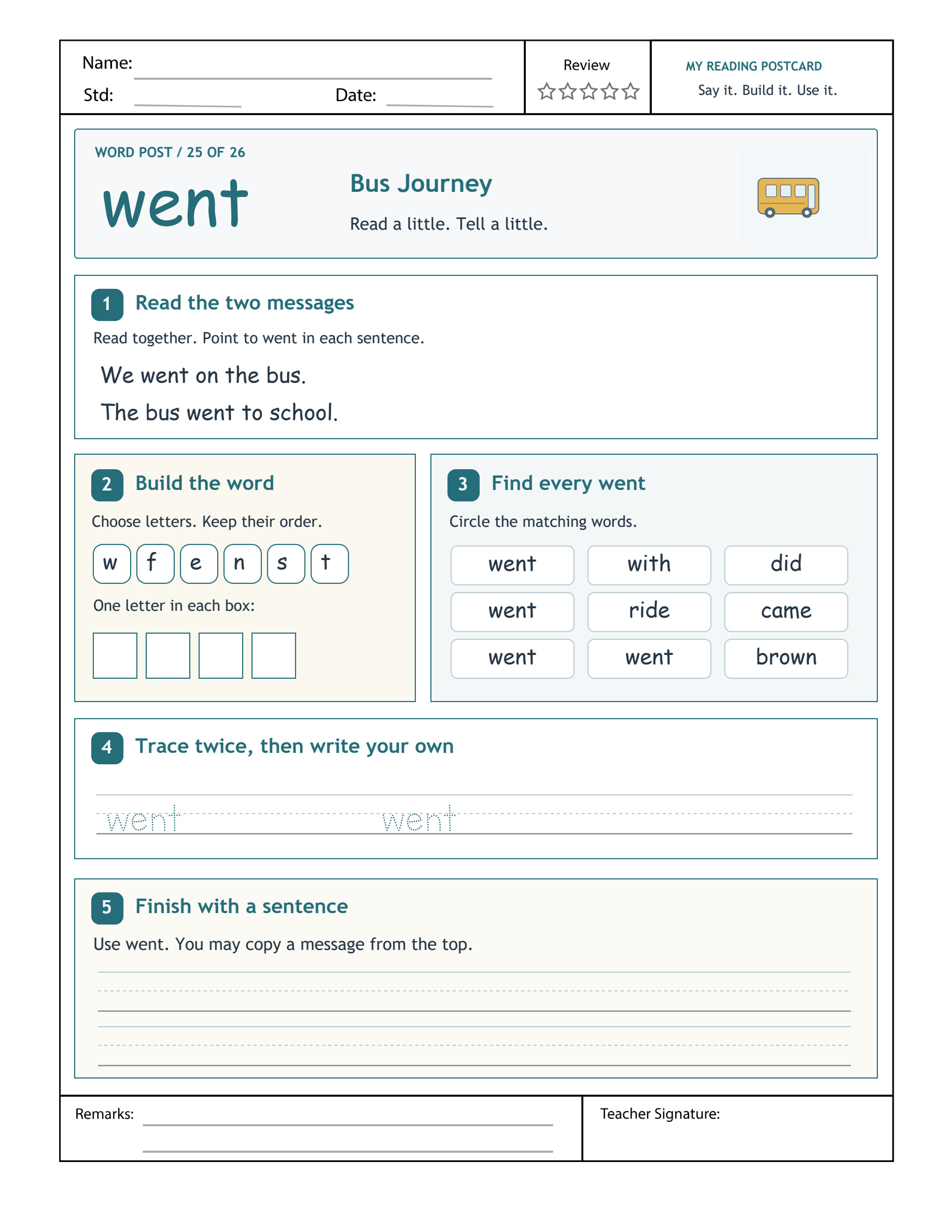
The full went sheet retains its US Letter frame.
Describe a bus journey as an event that already happened. The complete redesigned page appears without cropping.
Jaya has arrived in a pretend school story and can now tell someone about the bus journey. Went Sight Word practice connects that earlier travel with two short messages, a four-letter spelling, exact matching and handwriting. A simple before-and-now scene gives the word a clear time reference without requiring an actual trip. The clean worksheet opens with reading, while the original sample keeps the supplied task order. An adult can establish the earlier trip and travellers while leaving w-e-n-t available as a spelling model for the child's report.
Tell about the journey after establishing it
Show a toy bus travelling to a pretend school, then announce that the story's journey has happened. Read “We went on the bus” from the point of view of the introduced travellers. The listener should know who we includes and what event is being recalled.
The second source message is “The bus went to school.” It names the vehicle and its destination. Read it while the earlier journey remains visible in a picture or toy setup. The target helps tell about that travel rather than naming the bus itself.
Went is a past form of go. A spoken contrast such as go now and went earlier can be helpful after the source messages are understood. Do not invent a go-ed form or suggest that every past-time word is made by the same spelling change.
Went Sight Word reading has a shared event
Read both complete messages and ask what journey they concern. One names the travellers through we; the other names the bus. An adult can supply the surrounding vocabulary while a learner tracks went and explains the earlier event.
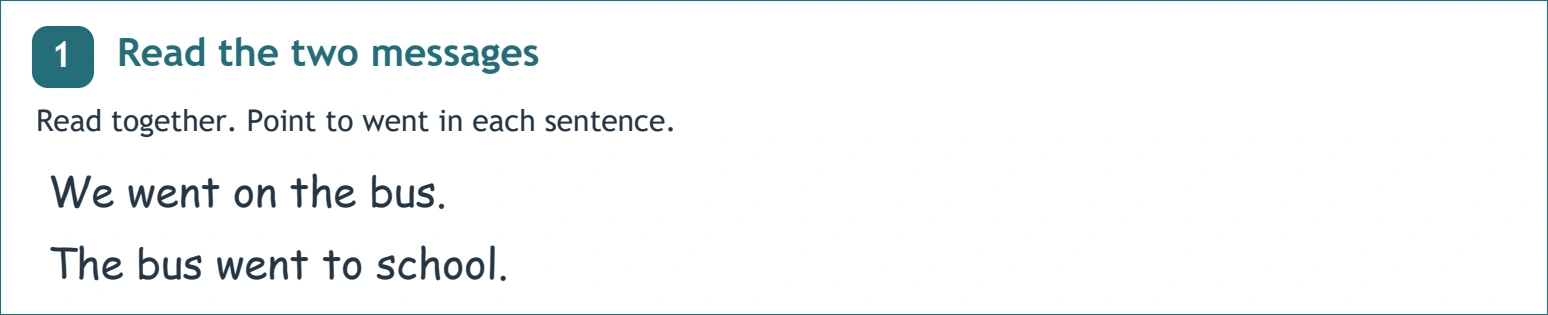
The target appears inside both sentences, so the child needs to follow the line rather than assume the practised word comes first. Pointing under each spoken word can support that tracking. Return to the whole message after locating w-e-n-t.
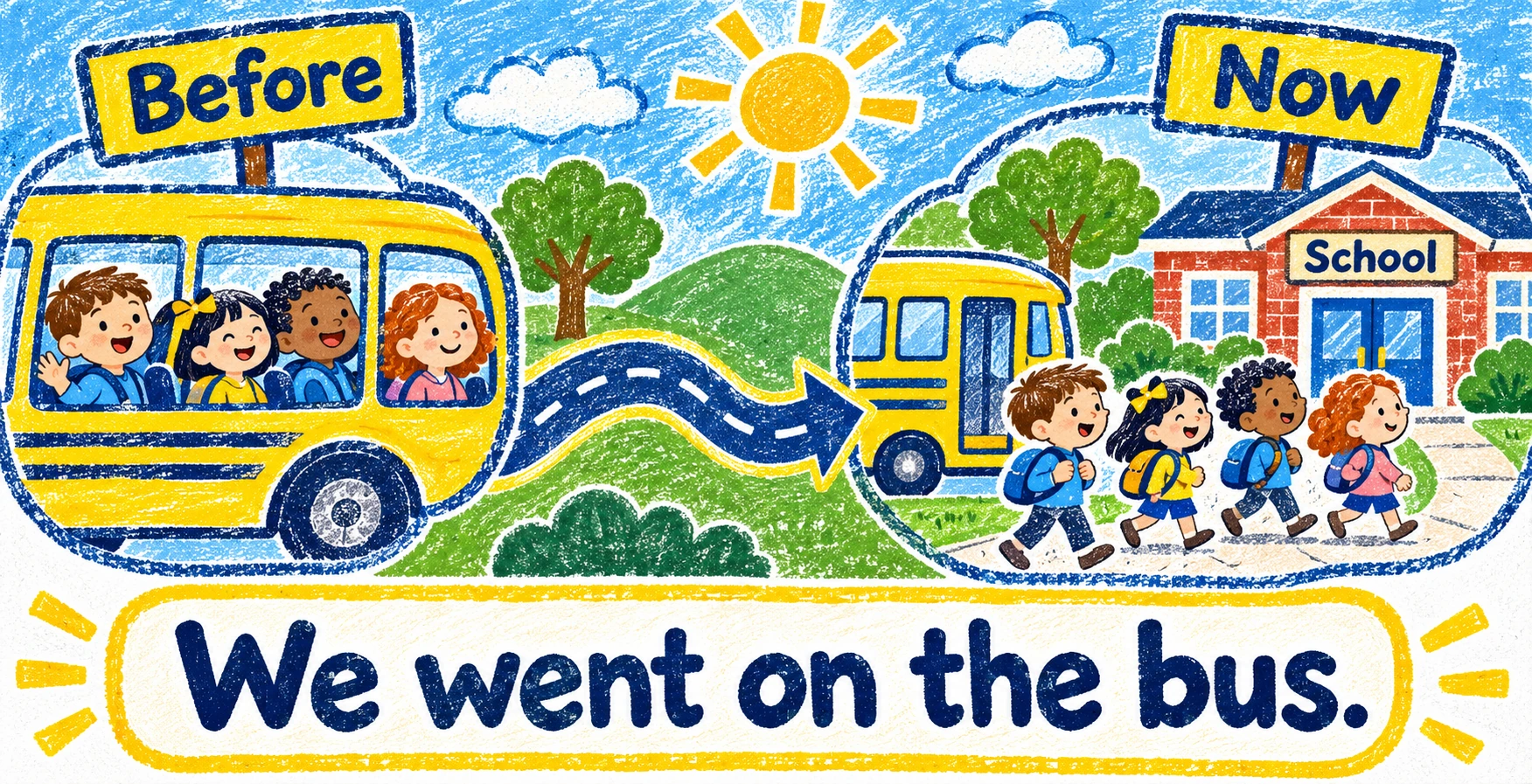
The supporting artwork shows an earlier ride and a later arrival. It supplies a story context rather than evidence of a real class trip. A child without personal bus experience can still participate through the pretend sequence or a familiar alternative journey discussed orally.
Select four bank letters in reading order
The bank presents w, f, e, n, s and t. Choose w-e-n-t for the four response boxes, leaving f and s unused. The required pieces are separated by distractors, so compare each selected position with the model before writing.
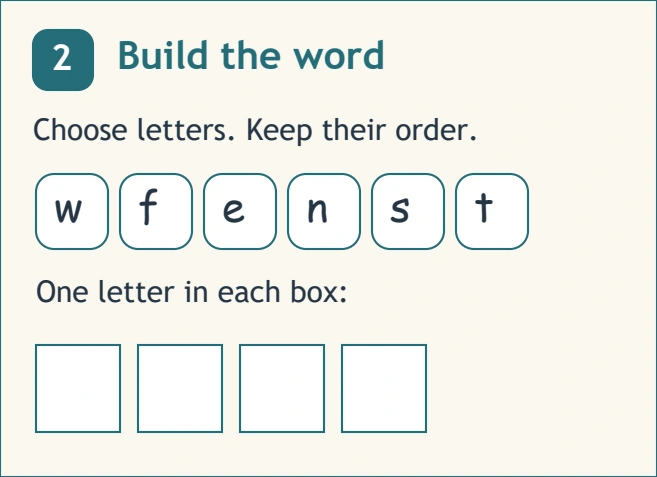
Say went naturally and connect the complete spoken form with its written sequence. A learner with suitable sound knowledge can inspect its component sounds through adult modelling. Keep the travel message available so the isolated letters do not become a task with no sentence purpose.
If the child selects all four required pieces in another order, ask where w starts the model and which letter follows. A positional comparison is more useful than announcing that the whole attempt is wrong. Loose copies can support the repair before a new pencil demand is added.
Related past words are still different search choices
The nine entries read went, with, did; went, ride, came; went, went, brown. Adult went key: 1, 4, 7, 8.
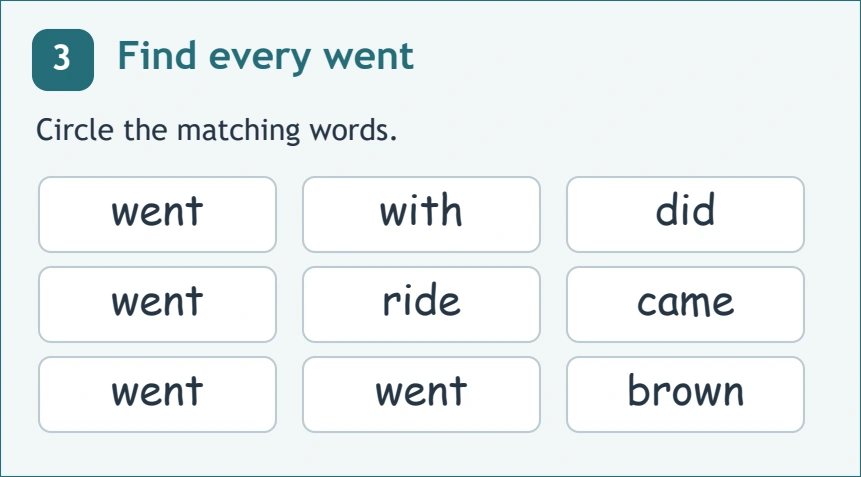
Did and came can also concern earlier events, but the grid asks for a specific spelling. Separate related meaning from exact written form. A child should compare w-e-n-t rather than circle every word that might belong in a past-time story.
With shares an initial w but differs in its remaining letters. Inspect the middle and ending as well as the beginning. The bottom row contains two adjacent targets, so finding one should not cause the next to be skipped. A place-keeping counter can support a steady row scan.
Write after a journey has been retold
The went guides retain w-e-n-t in order, ready for the learner's own four-letter version. Demonstrate the joining turns in w or the single arch of n when either makes Jaya hesitate. Leave w-e-n-t nearby while she decides whether another copy would help.
The final ruled activity permits a sentence using went, including a copied source message. For an original report, establish an earlier journey and rehearse the idea aloud. An adult can write the destination name after the child identifies the earlier journey and contributes went. The reader should have enough context to know what travel is being described.
The clean bus page establishes its earlier-journey messages before w-e-n-t selection. The grid shares the centre, while tracing prepares the expanded sentence finish. The retained sample gives dotted work the first position. This bus edition retains every activity within the same 612-by-792-point outer frame.
Six observations in an earlier-journey lesson
- An event is located in time: the learner understands that the story is recalling established travel.
- Travellers are identified: we is connected with the introduced group in the first message.
- A destination is heard: school is understood as the place named by the second statement.
- A spelling is ordered: w-e-n-t is assembled despite distractors between its bank choices.
- Meaning and form are separated: did or came is not accepted merely because it can describe an earlier event.
- A written report communicates: the final sentence gives another reader an understandable journey idea.
Identify the journey the learner recalls, then note whether went was distinguished from came or did in print. Related past meaning is not the search's matching criterion.
Jaya's possible home toy-bus retelling
A family member might move a toy bus to a drawn school, introducing its travellers along the way. After the movement ends, Jaya helps retell the journey using the first source line. The adult reads the vehicle-and-destination statement and asks what information it adds.
Jaya locates went in the travel messages and builds its four-letter sequence before checking a grid row. A shorter visit can end there. Her longer journey report can wait until she has the energy to compose and write it.
For a closing turn, recall a different announced pretend journey and prepare a suitable went statement. The listener should know who travelled and where the story concerns.
Classroom possibility: a journey timeline desk
The teacher sets up two completed scene cards: an earlier toy-bus ride and a later arrival. Introduce the travellers and destination, then invite a learner to report the earlier event. A partner points to the scene that supplies the report's context.
Return to the worksheet and compare its two subjects, we and the bus. Read the bus story's harder words aloud while the learner finds went and identifies the destination. Learners can participate through speaking, pointing, letter selection or writing rather than all producing identical independent copies.
During search work, listen to the choice around came or did. A child who selects those words has noticed a real meaning connection but needs the exact-form task clarified. That differs from reversing bank positions or not knowing which journey is being recalled. Respond to the observed cause.
A guide to the next helpful adjustment
| Observed response | A bus-story adjustment | Recheck |
|---|---|---|
| Cannot identify the recalled trip | Show the earlier movement and announce its place in the story. | A clear event reference. |
| Cannot explain we | Name the established travellers before rereading. | The group in the first message. |
| Circles came or did | Separate past-time meaning from the w-e-n-t spelling. | The exact target form. |
| Writes the bank's display order | Compare each box with the model sequence. | A deliberate four-letter arrangement. |
Five extensions for a reportable journey
1. Move a toy between two familiar pretend places, announce that the travel happened and dictate a went report about it.
2. Create a completed earlier-and-now picture pair. The child identifies which scene supplies the event being recalled in a short written message.
3. Compare went with another past-event word on completed cards. Discuss the meaning connection while keeping an exact spelling decision separate.
4. Build w-e-n-t with movable pieces, let a puppet follow the bank's display order instead and invite a model-based repair.
5. Dictate a journey caption for an introduced group of story characters. An adult supplies unfamiliar destination vocabulary while the learner contributes went.
Readiness and a calm return to the bus story
For bus-story readers near 4–6, an understandable earlier journey is the starting point, while w-e-n-t formation can remain supported and brief. A child can retell an event before independently reading every word in its printed report. Jaya's reader can keep w-e-n-t visible and write a short report rather than repeatedly copying the complete journey text.
Avoid requiring personal bus experience, leaving we unexplained or treating every past-time word as a matching spelling. Use a clear pretend event and return to its actual w-e-n-t form. A clear destination reference or a deliberate rejection of with is worth identifying in the learner's own work.
For more early-word visits, explore the starter collection for short-word readers. The discovery practice for pencil control can support motor needs before longer copies. Another familiar action appears in the eat lesson for beginning readers for a separate focus.
Adults may adapt everyday conversation prompts from PBS Parents' learning resources or play settings from NAEYC's family play materials. Choose a small event the child can understand and talk about afterwards.
Download the bus-journey worksheet
The free bus file retains the provided sequence. A current eligible membership opens a separate clean PDF through the premium control. Its reading messages lead, and the remaining tasks stay intact. The clean bus file omits its domain and promotional watermarking, contains no advertising, and gives the introduced trip a printable reading-first companion.
Make one US Letter bus test and examine its entire frame and four-letter dotted route. A pencil is sufficient; a toy timeline is an optional addition. The $5 collection linked on this page supplies twenty-six clean primer sheets together in order. Another word can be chosen for a later story while went continues to report an event the listener has been shown.
Popular Worksheets
Printable resources families and teachers are downloading now.
 Free
 Free
 Free
 Free