
Will Sight Word: 2 Powerful Doughnut-Planning Messages
Continue beyond will with twenty-six clean reading-first practice sheets in one $5 printable collection.
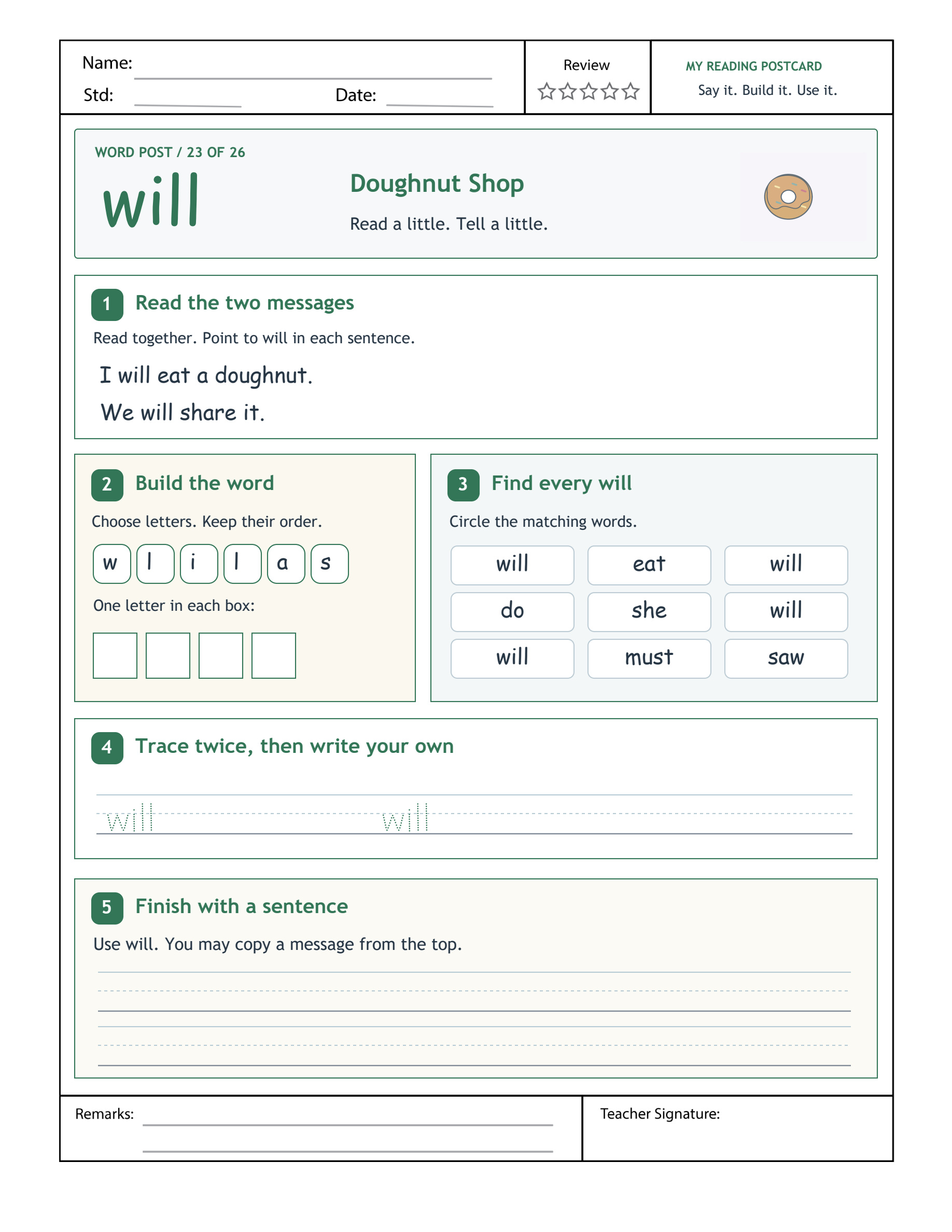
The full will sheet retains its US Letter frame.
Describe an intended future action and shared doughnut plan. The complete redesigned page appears without cropping.
Iris and a friend are planning to share a pretend doughnut. The sharing has not happened yet, which gives will a clear place in their conversation. Will Sight Word practice pairs two intended-action messages with letter building, exact matching and supported writing. Children can say what a character plans before inspecting the four-letter spelling in print. The two doughnut intentions introduce the clean page, before either l receives its writing practice. Adults can establish who is speaking, share unfamiliar vocabulary and choose a pencil finish that suits the learner's current confidence.
Put the plan before the action
Set a pretend doughnut on a plate and introduce the speaker of “I will eat a doughnut.” The character is stating an intended future action. Leave the prop untouched while the plan is discussed, so the language refers to something still ahead in the pretend scene.
The second source message is “We will share it.” Establish who belongs to we and what it refers to. The two companions can plan to share the introduced doughnut. A listener needs that context rather than guessing which people or object the speaker has in mind.
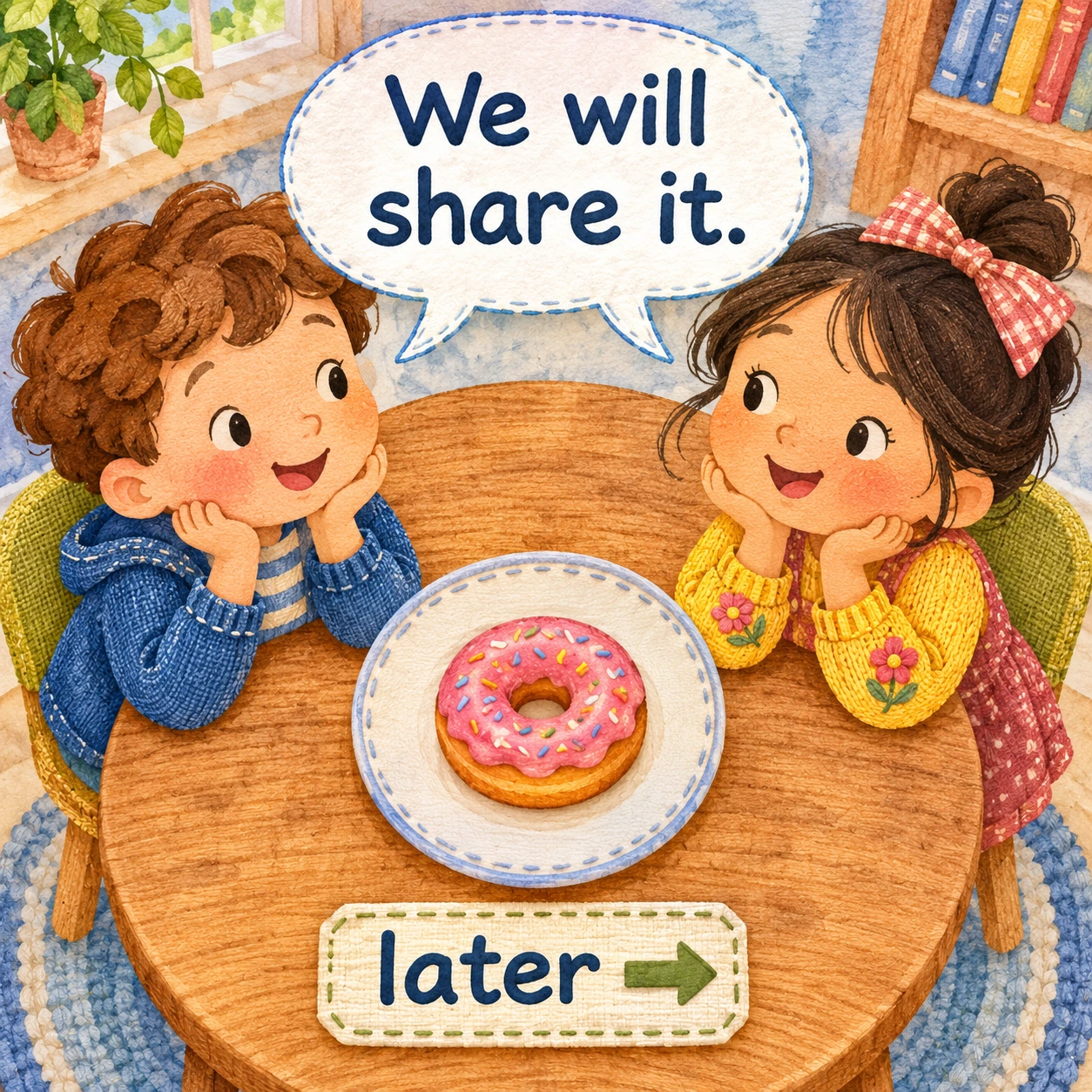
This lesson focuses on will in the two printed plans. It does not need a claim that every use of will in English has exactly the same purpose. The concrete before-action setup gives a beginning reader enough meaning to investigate the supplied messages.
Will Sight Word reading keeps the speakers clear
Read each complete line and ask who is making the plan. One message concerns I; the other includes a shared we. Point to will only after those roles are established, then reread the full statement with the learner contributing the target.
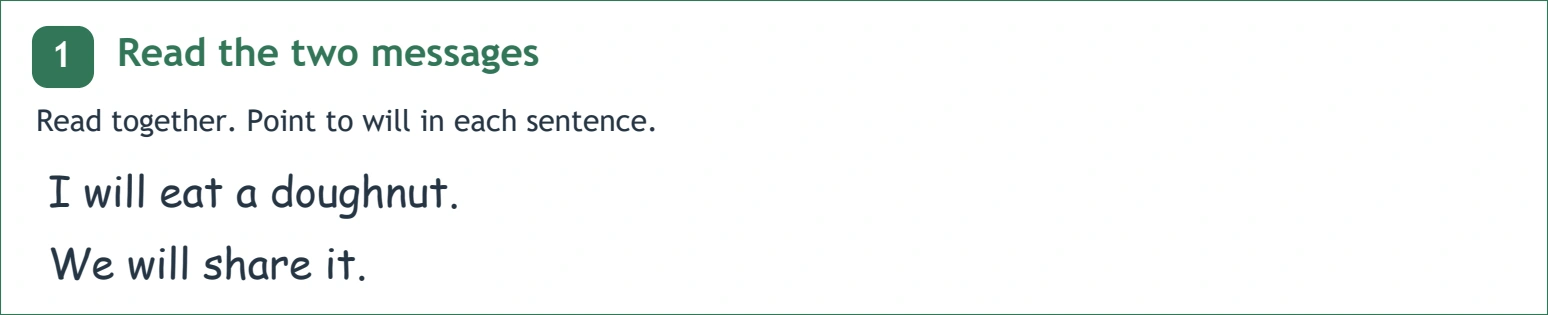
The word appears inside both source lines, so the child needs to track rather than assume it comes first. An adult can supply doughnut, eat or share while the learner locates will and explains what is intended. Supported participation is appropriate for an early reader.
After the pretend action takes place, distinguish a new report about what happened from the earlier plan. You need not add a written tense exercise; a short oral comparison is enough. Keep the source will messages attached to their before-action moment instead of reading them as if they describe a completed event.
Four boxes include two l positions
The bank presents w, l, i, l, a and s. Select w-i-l-l for the four response boxes, leaving a and s unused. Both l copies are required at the end. Collecting one of each different letter name would leave the spelling incomplete.
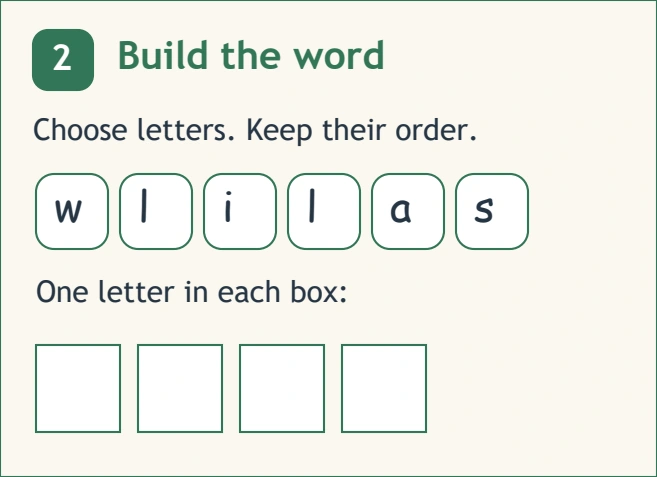
Point through the model's positions and name the sequence before writing. A learner may find w, i and l and stop; ask how many written places remain to be filled. Move the second l into its own final position so the repeated-letter requirement becomes visible.
Read will naturally in the complete plan after building it. A child with suitable sound knowledge can connect the spoken word with its spelling through adult modelling. The two l letters are two written positions, not an instruction to add an extra spoken syllable.
Find every complete w-i-l-l match
The nine choices read will, eat, will; do, she, will; will, must, saw. Adult will key: 1, 3, 6, 7.
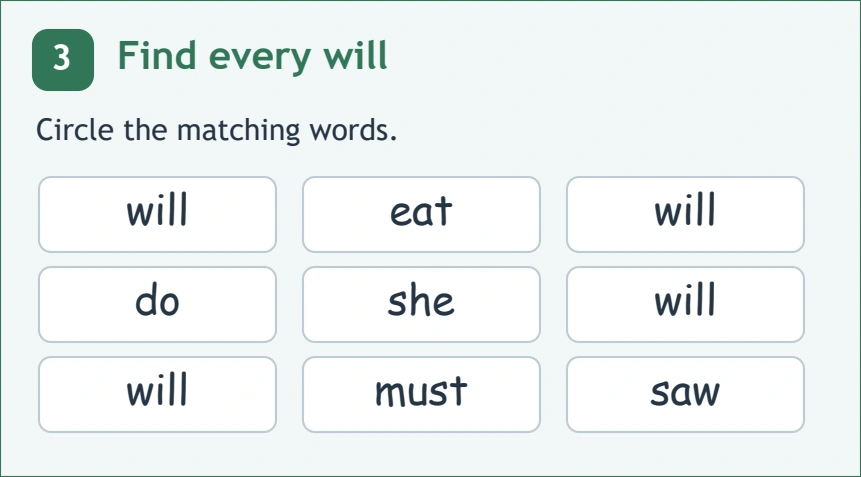
Must can also appear in statements about actions, but related sentence use does not make it a spelling match. This task asks for w-i-l-l exactly. Compare the beginning, middle and repeated ending against the model rather than choosing a word because its meaning feels connected.
A place-keeping counter can help a child inspect one cell at a time. Invite the reader to show why a will entry qualifies and a different action word does not. The final number of circles is useful checking information, but four circles around incorrect entries would still need a different response.
Trace a complete ending, then write a plan
Trace will with both ending l marks visible, then check the independent copy for the second l. Preserve both l forms as distinct letters. If the ending merges into one mark, return to the model's separate positions before asking for another full word.

The final task permits a sentence with will, including a copied source message. For a new idea, rehearse a plan aloud and establish the speaker. Supply unfamiliar action words for the writer after the speaker's future plan is clear, with will as the child's contribution. The intended action should still be ahead in the described scene.
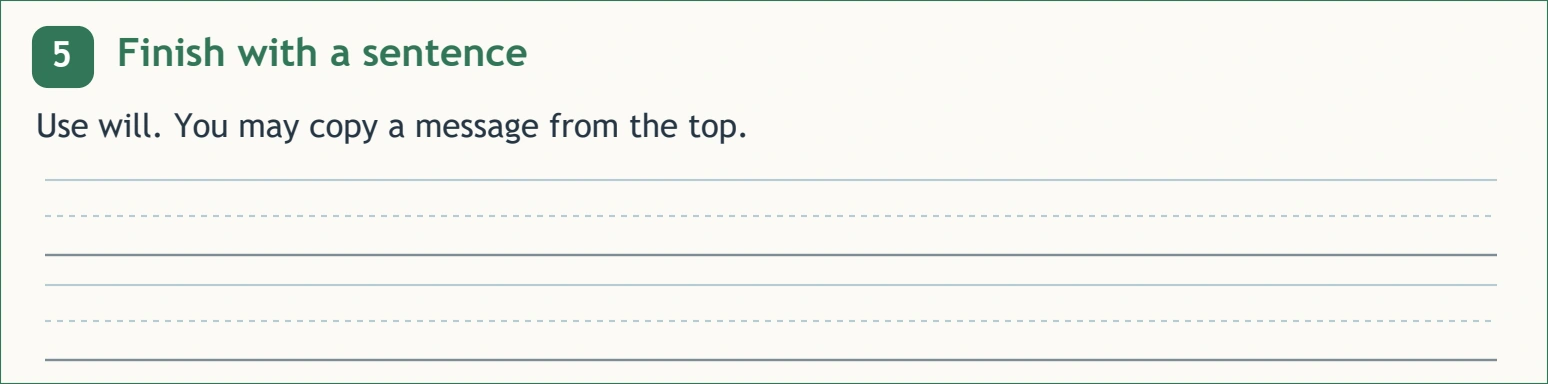
The amount copied should reflect pencil stamina rather than the length of the printed examples. A child can explain a shared plan accurately while needing help with w. A neat sequence of letters may still require a separate conversation about who we includes.
What changes in the clean edition
The clean doughnut route begins with the individual and shared plans. Its bank and search sit together, then the dotted w-i-l-l models lead into the roomier writing finish. The original sample starts with tracing. Five source activities and the established framed US Letter format are preserved.
The download is one printable worksheet. The doughnut scene on this webpage and any toy-sharing game are supporting contexts, not additional PDF pages or a required food activity. Paper props work well when an adult wants to make the plan visible.
Choose a manageable route through the page. One shared reading and a carefully checked ending can be enough for a short visit, leaving other tasks available after a gap. The purpose is an understandable plan connected with print, not filling every line before play continues.
Six observations in a planning conversation
- A future action is established: the learner understands that the stated plan comes before the pretend eating or sharing.
- An individual plan: the first speaker's I identifies who intends to eat the doughnut.
- A group reference is clear: we includes the introduced companions in the second message.
- An object reference continues: it points back to the doughnut already discussed.
- A repeated ending is retained: both l positions appear in the completed w-i-l-l spelling.
- A written intention has context: the final line tells a reader what someone plans to do.
Note whose plan is being described and whether both l letters are present. A clear future intention does not automatically produce a complete four-position copy.
Iris's possible home pretend-sharing scene
A family member might introduce two toy companions and a paper doughnut. One character announces the first source plan, then the pair makes the shared plan. Iris identifies the speakers and the object before either pretend action occurs.
They read the worksheet messages and find will inside each line. Iris selects w, i and both l pieces, then inspects a search row. Pause before further will writing if Iris needs a break. The adult can save the sentence finish for another visit.
For a closing turn, Iris makes a different announced plan for a toy. A listener should know who will act and what action is intended.
Classroom possibility: a plan board for toy characters
At a small-group station, the teacher introduces a toy character and a familiar intended action. A learner dictates a will statement before the action is performed. A completed plan card records the idea, with the adult supplying unfamiliar vocabulary.
Return to the doughnut messages and compare the individual I plan with the shared we plan. Children can participate through pointing, speaking, tracking the target or selecting letters. Independent reading of every surrounding word is not required for a meaningful role.
During individual work, inspect the repeated l ending. A missing letter calls for a positional comparison, while an unclear we calls for better shared context. Partners can listen and refer to the model without completing another child's boxes or circles.
A guide to a particular mismatch
| Observed response | A planning-lesson adjustment | Recheck |
|---|---|---|
| Describes only an action already finished | Introduce a new pretend action still to come. | The before-action plan. |
| Cannot identify we | Name the companions included in the shared statement. | A clear group reference. |
| Builds w-i-l | Count the model's four written positions. | The second final l. |
| Chooses must as a search match | Separate related meaning from exact spelling. | The complete w-i-l-l form. |
Five extensions for a plan worth recording
1. Dictate a will message for a toy before a familiar pretend action. Perform the action afterwards and discuss the earlier plan orally.
2. Make an individual plan and a shared plan with introduced characters. Explain who I and we refer to before recording either statement.
3. Build w-i-l-l with movable pieces, let a puppet remove one l and invite a repair using the visible model.
4. Prepare a completed plan card for a drawing activity. The child contributes will while an adult supplies the remaining vocabulary.
5. Match a spoken will statement with an acted scene that is still being planned. Keep the intended action clear enough for a listener to explain.
Readiness, common mistakes and a short return
Doughnut-plan talk is aimed at supported readers around 4–6, including children who can explain a future intention but need help retaining both written l letters. Familiarity with speaking about later actions may precede independent spelling. A writer who understands the future plan may still need help with both l positions, so limit copying to an achievable part.
Avoid dropping the second l, leaving we unexplained or making pretend eating a requirement for participation. Keep the language goal clear and accept a small written contribution when appropriate. Appreciate an observed decision such as retaining both ending letters or identifying the shared speakers.
For another early-word sequence, see the short-word reading starter pack. The discovery pack of pencil activities can support motor needs. A separate familiar action may be explored on the eat practice resource page when the learner is ready for another focus.
Adults can adapt shared activity prompts from NAEYC's family play resources or PBS Parents' learning collection. Select a small plan that a child can explain before carrying it out in pretend play.
Download the doughnut-plan worksheet
Use the free doughnut sample for the supplied order. A currently eligible member can choose its clean premium counterpart through the membership control. The two plans open that PDF, while all other source practice remains. No website domain, watermark or advertising is included inside the clean worksheet, so the print can accompany a plan made before the pretend action.
Test one doughnut page at US Letter size, checking the entire border and both final l positions in the dotted models. A pencil is enough; paper props are optional. The companion $5 collection combines twenty-six clean primer sheets in a single ordered file, ready for the next sentence purpose after the individual and shared will plans have been explored.
Popular Worksheets
Printable resources families and teachers are downloading now.
 Free
 Free
 Free
 Free