
Are Sight Word: 6 Clever Sheep-Group Reading Discoveries
Continue beyond are with twenty-six clean reading-first practice sheets in one $5 printable collection.
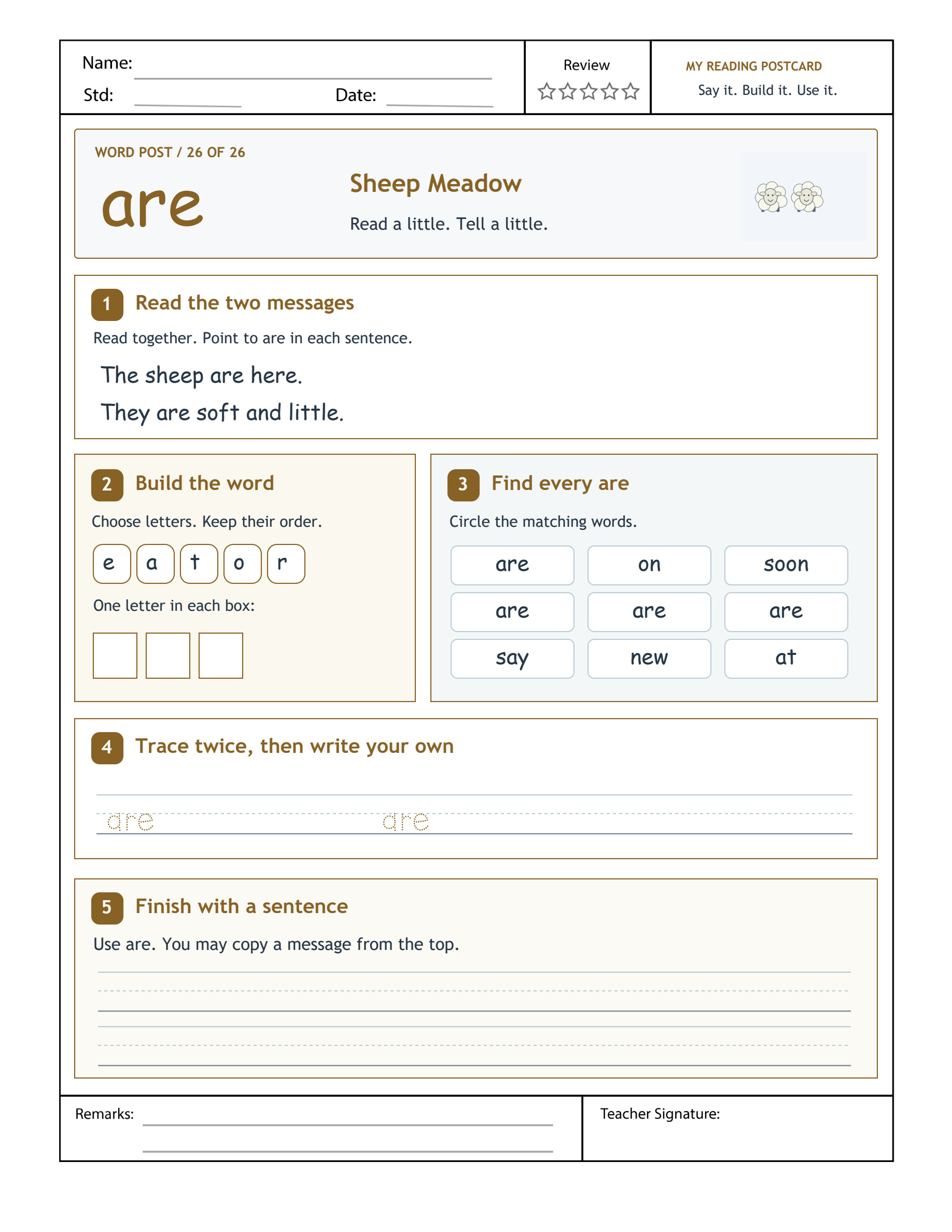
The full are sheet retains its US Letter frame.
Connect plural sheep with a present-tense description. The complete redesigned page appears without cropping.
Eli sees two sheep together in a meadow picture and describes the group with are. The small word connects those sheep with information about where they are and what they are like. Are Sight Word practice pairs two complete messages with a-r-e selection, whole-word comparison and a manageable written contribution. A clearly established group gives the target a purpose before isolated print work begins. The clean edition opens with reading and preserves the provided activities inside the familiar frame. Adults can share unfamiliar vocabulary and select a pencil contribution that suits the learner's current experience.
Establish the sheep group first
Show two toy or paper sheep and make clear that both are being discussed. Read “The sheep are here” while indicating the group. Here needs a shared place reference, such as the pretend meadow on the table, so the listener knows where the speaker means.
The second source statement is “They are soft and little.” Explain that They continues to refer to the same sheep. The line gives descriptive information about the story group rather than introducing new animals. A learner can point back to both sheep while the adult rereads it.
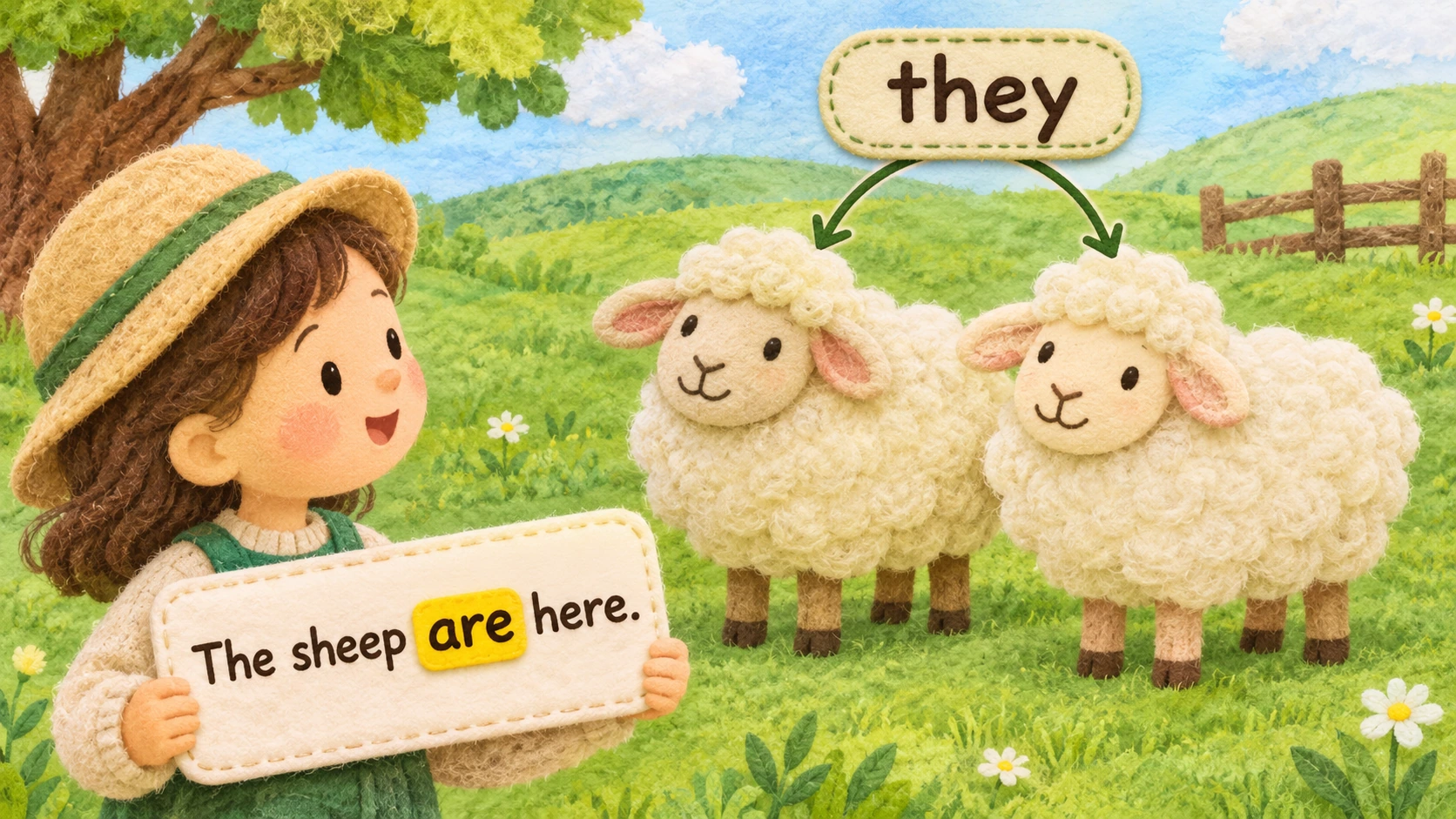
These examples use are with a plural group. Keep the explanation tied to them rather than claiming that are can only appear with several people or objects in every English sentence. The concrete group reference supplies enough meaning for this early lesson without a complete verb chart.
Are Sight Word reading connects two descriptions
Share the first message as a location statement and the second as a description. Ask which animals each concerns and what information changes. Adults can supply sheep, soft or little while the learner tracks are and explains the group reference.

The written noun sheep does not gain a final s in this plural example. The two visible animals, are and the following They message make the group context clear. Do not demand an invented sheeps form merely to demonstrate that more than one animal is involved.
The target appears inside both lines. A child needs to follow the sentence to locate it rather than assuming it is the opening word. After finding a-r-e, return to the full message so the spelling stays connected with the location or description being communicated.
Three bank positions selected from five options
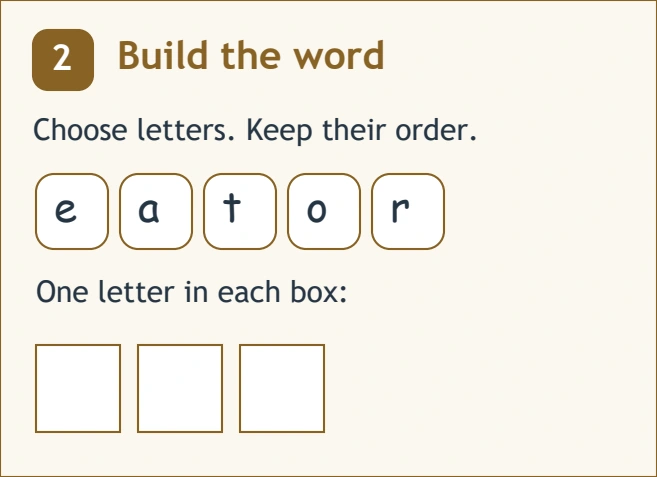
The bank presents e, a, t, o and r. Choose a-r-e for the three response boxes, leaving t and o unused. The first displayed letter belongs at the end of the target, so copying the bank order does not answer the task.
Say are naturally in your own speech and connect that spoken form with a-r-e. Pronunciation varies across accents, especially around r. Naming letters for the spelling should not force an invented three-sound pronunciation into the completed sentence.
If all three required pieces are present but arranged differently, compare each position with the large model. A learner can repair the order with movable copies before another pencil attempt. Keeping the reference visible allows attention to stay on sequence rather than adding an unnecessary memory test.
Four complete matches in a nine-cell search
The grid rows read are, on, soon; are, are, are; say, new, at. Adult are key: 1, 4, 5, 6.
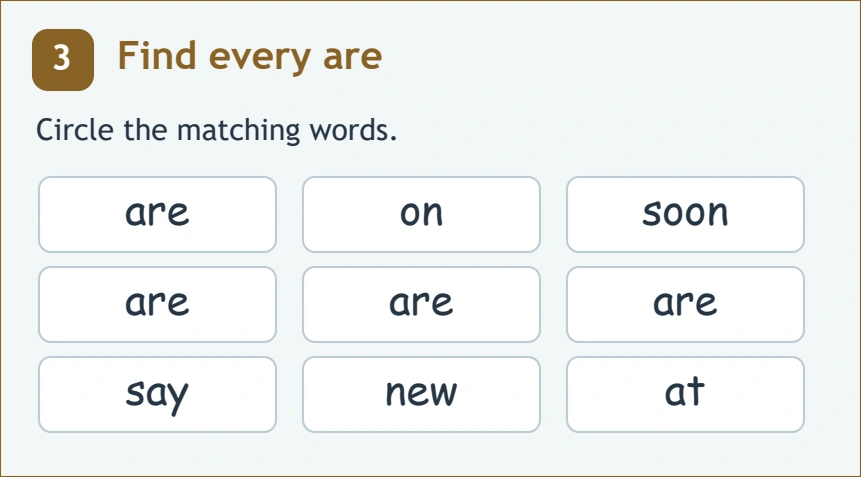
At has only two positions and lacks the r-e ending of are. New contains e in another position without spelling are. Ask for the whole a-r-e comparison instead of accepting a familiar letter as enough evidence to circle a cell.
The middle row contains three adjacent matches. Inspect every cell even after one target has been identified nearby. A place-keeping counter can help maintain the route. Listen to the reader compare an are cell with at so the spelling decision becomes visible.
Trace a complete spelling before a group message
Trace are from a through r to e, then compare a freehand copy with the complete model. A particular a or r formation may need a short demonstration. Keep the model available and choose a quantity that reflects pencil stamina rather than requiring repeated full-line corrections.

A source are statement may be copied into the sentence finish. For an original idea, establish a group and rehearse the statement aloud. Help record unfamiliar qualities only after the learner has identified the sheep group and supplied are. The reader should have enough context to identify what is being described.
The clean meadow lesson lets the sheep messages establish a group before a-r-e selection. Its workshop neighbours the grid, and dotted copies lead into the larger sentence area. The source sample begins with tracing. Every supplied task stays within the established frame on the same US Letter page size.
Six observations for a sheep-group conversation
- A group is identified: the learner knows that both introduced sheep belong to the current discussion.
- A reference continues: They in the second sentence points back to the same animals.
- Information changes: location and descriptive qualities are heard as different additions about that group.
- A noun form is respected: the plural context is understood without inventing a sheeps spelling.
- A sequence is deliberate: the bank pieces become a-r-e rather than their display order.
- A written group idea communicates: the final message gives another reader a clear subject and description.
Record which sheep the child includes in They and how a-r-e was ordered. A clear continuing subject can be understood before all three handwritten forms are comfortable.
Eli's possible home meadow scene
A family member might place two paper sheep in a drawn meadow and introduce them as the story group. The adult reads the location message, then the descriptive statement. Eli identifies both sheep and explains what the second line tells the listener about them.
Eli points under are, builds a-r-e, then explains why a selected grid cell matches or differs. A small written copy can follow while the learner remains comfortable.
To close, Eli introduces a different familiar toy group and dictates an understandable are statement. Show Eli's new toy group to the listener before the are statement is spoken.
Classroom possibility: a group-description display
The teacher establishes a small collection of toy animals and models a location statement. A learner supplies another suitable description, while a partner identifies the group being discussed. Keep the subject stable before switching to a different collection.
Return to the sheep messages and compare The sheep with They. An adult voices the sheep description while the child locates are or identifies the animals still meant by They. A spoken group explanation, an a-r-e arrangement or a dictated meadow caption can each give a learner an appropriate role.
During bank work, notice whether the final e is deliberately placed rather than copied first. During the grid task, listen for complete comparisons instead of one-letter guesses. A partner can point to the model without filling another child's boxes or circling every answer for them.
Match support to the observed need
| Observed response | A meadow-lesson adjustment | Recheck |
|---|---|---|
| Points to only one animal after the group statement | Reintroduce both sheep as the current subject. | The intended plural reference. |
| Cannot explain They | Point back to the same established sheep collection. | A continuing subject across the lines. |
| Copies e first from the bank | Compare the first model position with a. | The ordered a-r-e spelling. |
| Circles at after noticing a | Inspect the remaining letters and length. | A complete target match. |
Five extensions for a clear group statement
1. Introduce a pair of familiar toys and dictate a completed are message about their location. Let the listener identify the group before rereading the target.
2. Prepare two short captions about the same animal collection, one naming the animals and another using They. Discuss the continuing reference across both lines.
3. Have a puppet place e first in are, then ask the learner to restore a-r-e beside the printed model. Repair the sequence using the printed model.
4. Compare are and at on completed word cards. Inspect the shared beginning and the different ending rather than relying on colour or card placement.
5. Create a class drawing of an introduced toy group. An adult records unfamiliar descriptive vocabulary while the learner contributes are to its caption.
Readiness, common mistakes and a short revisit
Sheep-group language around ages 4–6 can be explored through pointing and talk, with a-r-e writing added according to the child's actual pencil experience. A child may describe a group accurately before independently reading every word in the source sentences.
Avoid changing the animal subject without explanation, inventing a plural s for sheep or treating a shared initial a as a complete spelling match. Keep the group and model visible. If handwriting becomes tiring, accept a dictated description and a short target contribution rather than repeated long copies.
For regular review, introduce another clear group and show a completed are statement. Appreciate an observed contribution such as identifying the continuing They reference or placing e last. A brief meaningful revisit can be enough without reassigning every task.
The starter collection of early-word routes offers other reading visits. The discovery activities for beginning pencil work can support motor demands. Another familiar action appears on the eat practice page for early readers for a separate focus.
Adults can explore more shared-play settings through NAEYC's family play resources or everyday learning ideas from PBS Parents' learning hub. Select a group the child can identify and describe for a listener.
Download the sheep-group practice
The sheep sample preserves the original route as the free download. The premium control provides a clean sheep PDF when the member's plan is currently eligible, with group reading ahead of the other four stations. That worksheet removes the website domain, watermark and advertising. Choose it when the two introduced sheep need a clean printed page for their location and description conversation.
Try one US Letter meadow copy and inspect the full frame plus the a-r-e dotted models. A pencil is enough, with paper animals optional. The linked $5 purchase combines the twenty-six clean primer lessons into one ordered file, offering another word for a future conversation while this page keeps are connected with a clearly identified group.
Popular Worksheets
Printable resources families and teachers are downloading now.
 Free
 Free
 Free
 Free