
They Sight Word: 6 Joyful Fish-Group Reading Discoveries
Continue beyond they with twenty-six clean reading-first practice sheets in one $5 printable collection.
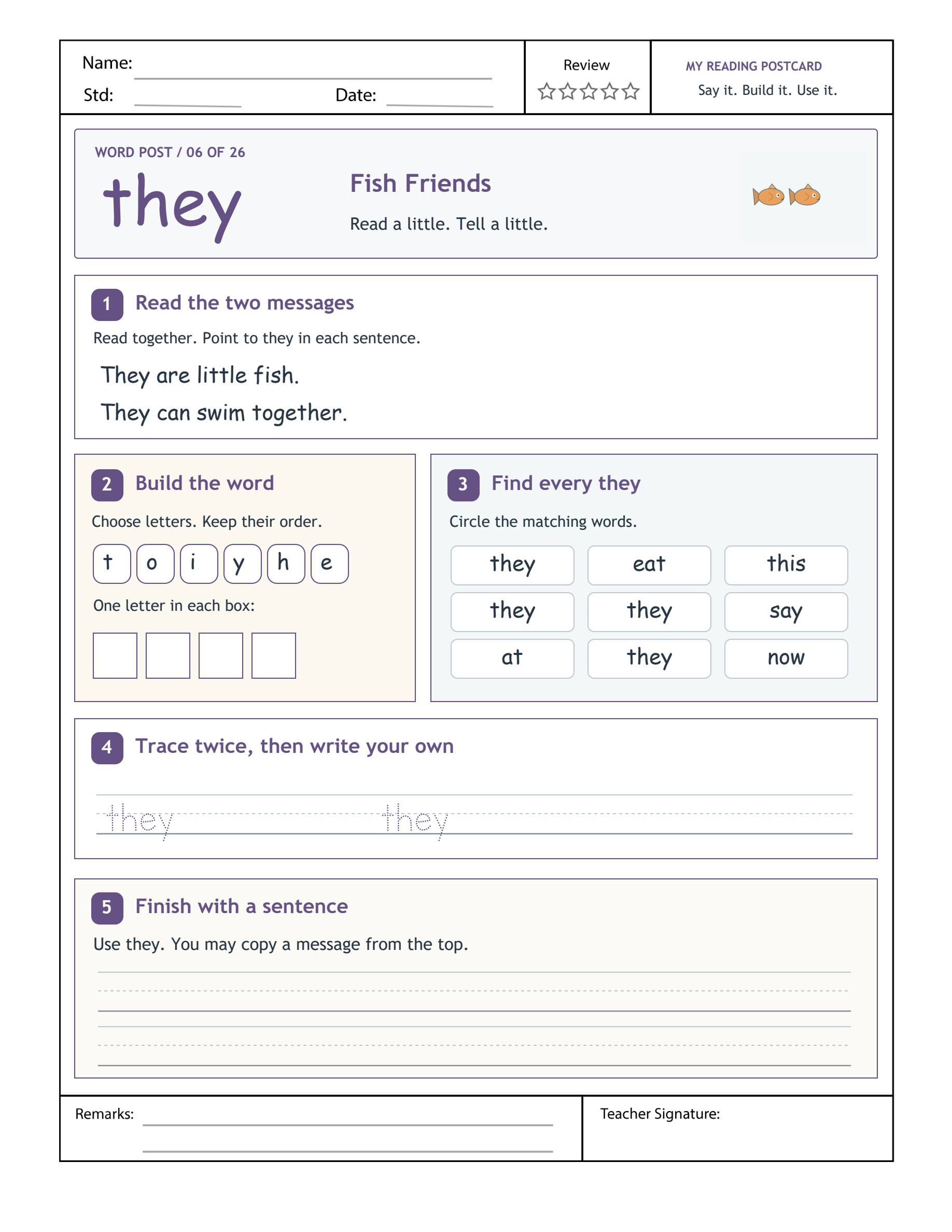
The full they sheet retains its US Letter frame.
Refer to a whole group of fish using a plural subject. The complete redesigned page appears without cropping.
Imani watches several little fish turn through the water together. Talking about each fish separately is possible, but they lets a speaker keep the whole group in view. They Sight Word practice uses that shared reference as the starting point for reading, spelling and handwriting. The two fish messages are followed by opportunities to build the word, inspect exact matches and record a sentence. Adults can begin with toy fish or the supplied illustration, then choose how much pencil work suits the reader. The clean worksheet puts the complete messages at the beginning.
Keep the fish together in the conversation
Set out two or three paper fish and establish that you are discussing the group. Say “The fish can swim,” followed by “They can swim.” Move a hand towards the whole collection as you speak. The gesture helps a listener connect the pronoun with its intended reference in this example.
The page concentrates on they for a group of fish. It does not need a rule claiming that every use of they must concern several animals; English also uses the pronoun in other contexts. Keep the explanation tied to these messages: here, the speaker means the fish together.
If one fish is separated from the others, ask which fish the current statement concerns. The question is about reference, not a test of whether children can count perfectly. Put the group back together before returning to the worksheet. A stable subject makes it easier to judge whether the written word has been understood.
They Sight Word in two complete fish messages
The source sentences read “They are little fish.” and “They can swim together.” The first identifies and describes the group. The second reports an ability shared by that group. Read both aloud with an unhurried voice and trace the printed words with a finger if that supports the child.
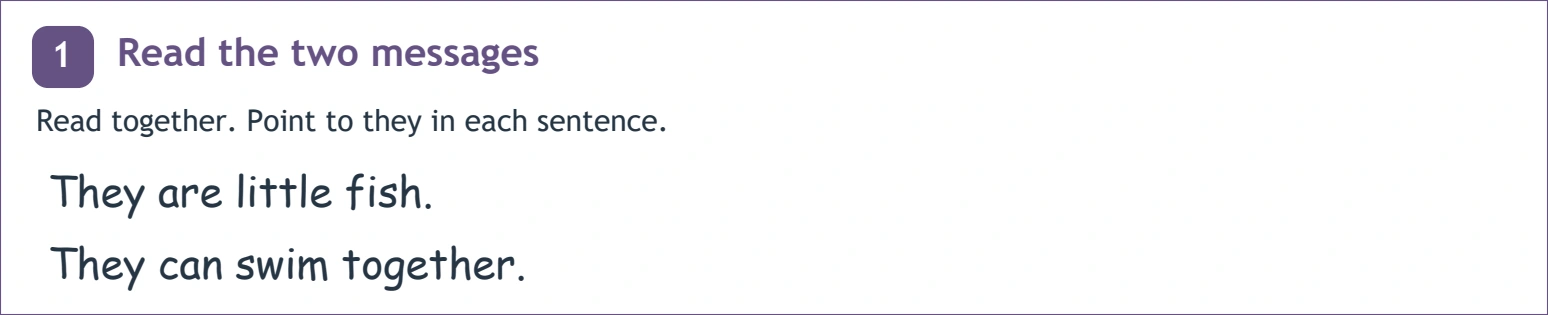
Each example starts with capital They, while the large isolated model shows lowercase they. Connect T and t explicitly and check that the reader still recognises h-e-y afterwards. Case changes can be unfamiliar even when a child knows the spoken word well.
Ask whom They refers to in the first sentence and what the second sentence adds. A child can point towards all the fish, name the group or offer a brief spoken answer. Supply are or together when those surrounding words are unfamiliar. The target lesson does not require independent reading of every word on the page.
Count written positions, then select the bank letters
The word has four letter positions: t, h, e and y. Its bank presents t, o, i, y, h and e in a shuffled arrangement. Choose the four required pieces and leave o and i unused. Children can first arrange movable copies beside the response boxes, then transfer the same sequence to writing.
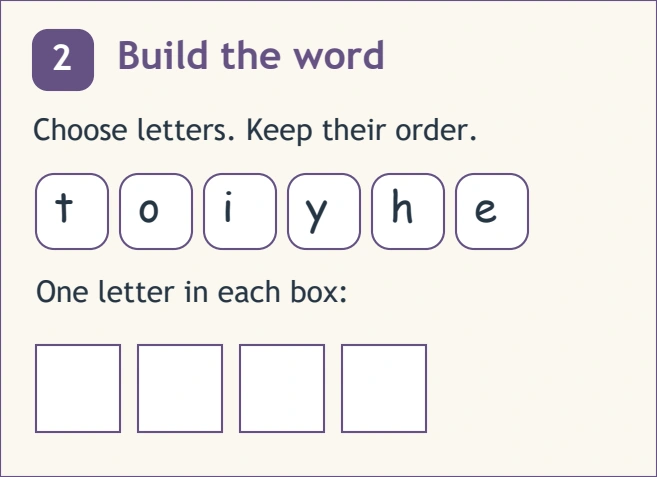
Do not copy t-o-i-y merely because those four choices lead the fish bank. Compare each selected letter with its position in the large model. If a learner starts with the y because it is easy to notice, ask where that letter belongs in the finished spelling. A correct collection still needs a correct arrangement.
Say they naturally in a sentence. Its th opening works together in speech, and the written ey ending represents the vowel sound in this particular word. Name the letters for spelling while preserving a normal spoken model for reading. Avoid asking the child to pronounce four isolated letter sounds as though that automatically produces the whole word.
A search with four fish-group matches
The nine printed choices are they, eat, this; they, they, say; at, they, now. Adult they key: 1, 4, 5, 8. These positions are useful to an adult checking a completed attempt. They should not replace the child's comparison of each spelling.
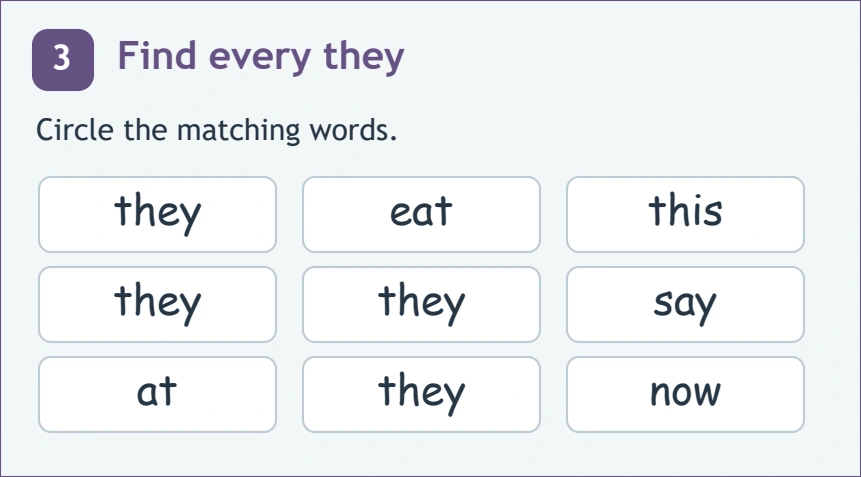
This shares th but changes the ending. Say contains a y without spelling they. Invite the child to look beyond the first familiar feature. One productive check is to point along t-h-e-y in the model and then along the candidate cell. The two complete sequences either agree or they do not.
A child may overlook the middle-row pair because a single match has already been found nearby. Check the fish grid for all four they entries, treating adjacent cells as separate decisions. There is no hidden rule requiring one answer in each row, and there is no reward for leaving the page quickly.
Tracing is a bridge, not the whole reading lesson
Trace they with the y descending as shown, then compare a freehand version with the model. Follow the sequence from t towards y, then attempt a copy in the available space. The descending portion of y may require a demonstration; show the movement without covering the model the child still needs.

Tracing can support controlled pencil movement, but it cannot establish understanding of the fish-group reference by itself. Return to an oral sentence after the pencil band. If the learner can tell who they means yet needs help with the y, record those as separate observations rather than treating the entire lesson as one ability.
The sentence finish allows a copied source message or an adult-supported original idea. Rehearse the statement before writing. A child might describe toy fish swimming slowly, for example, with an adult supplying unfamiliar spellings. Keep the reference understandable to a listener who knows which group is being discussed.
What remains in the supplied and clean versions
The clean fish edition gives the group messages the first station. Letter assembly and the search share the middle, while the dotted they band leads into sentence writing. The source sample starts with tracing. This new route keeps every supplied activity, with the same US Letter page and established outer frame.
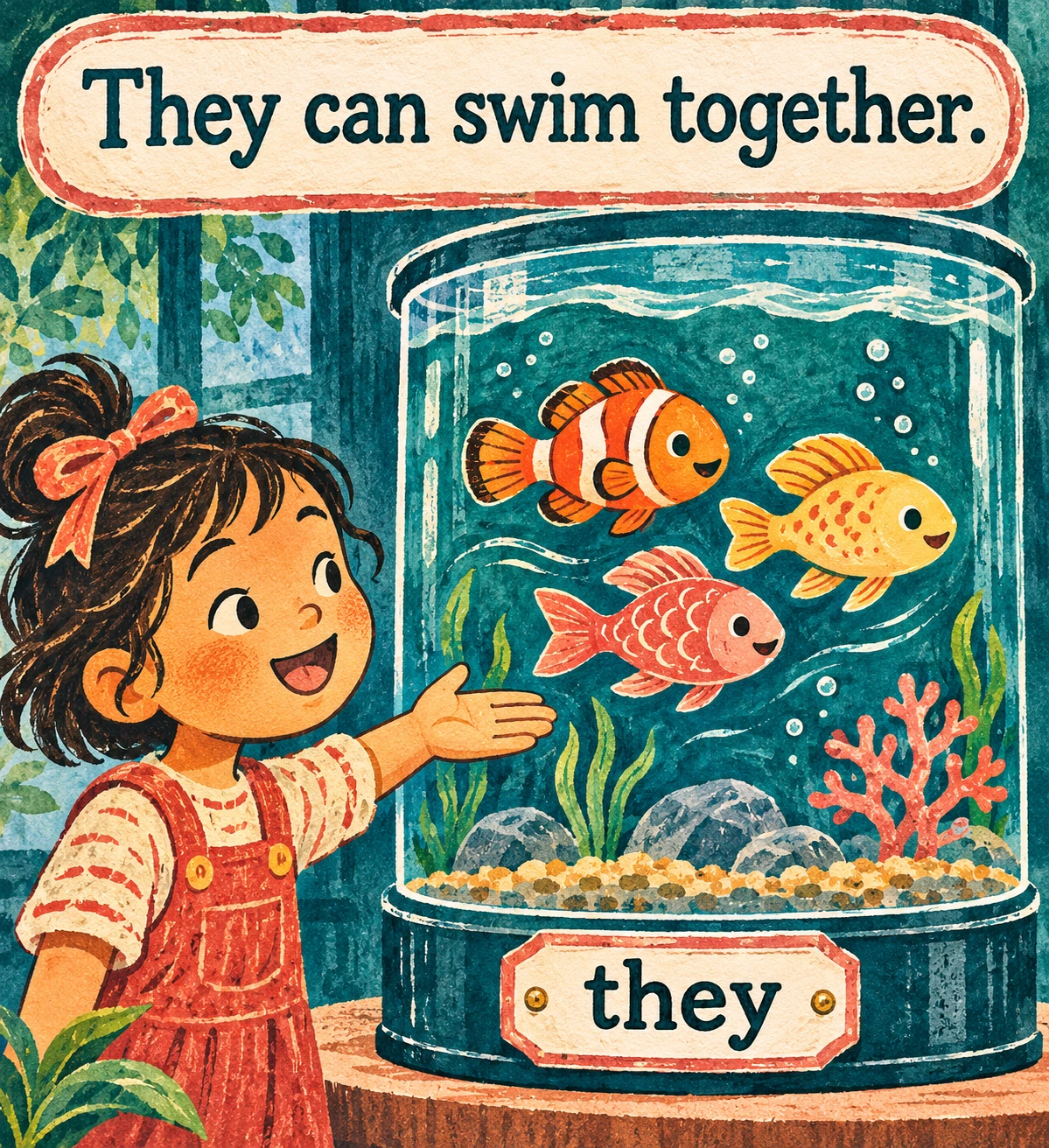
The download is one printable page. The aquarium scene on this webpage is extra supporting art rather than a second worksheet, and movable fish are an optional adult addition. You do not need a real aquarium or live animals to teach the reference. Paper shapes or familiar toys are enough to establish a group.
Decide which edition to use before starting the session so the learner sees one clear route. You can explain that the clean page starts with the story messages, while the sample begins with the dotted words. Neither route changes t-h-e-y, the four matches or the content of the two supplied sentences.
Six things a reading partner can notice
- Group reference: the child connects they with all the fish currently under discussion.
- Added information: identifying little fish and describing swimming are heard as two related messages.
- Case connection: They at the sentence opening is recognised alongside the lowercase standalone form.
- Ordered selection: the bank's t, h, e and y are arranged rather than copied in display order.
- Ending inspection: this is rejected after the reader notices its different final letters.
- A readable report: a spoken group idea becomes a dictated, copied or newly attempted sentence.
Notice whether the learner indicates the fish group and whether the e-y ending is retained. A clear spoken group reference can coexist with uncertain spelling.
Imani's possible home scene: a paper aquarium
A family might make a paper aquarium with three fish drawings. The adult names the fish collection and says that they can swim in the pretend story. Imani moves the fish together and repeats or changes the message. If the child speaks about just one fish, the adult clarifies the current group reference without dismissing that observation.
They turn to the reading banner and locate They in each statement. Imani then selects the letters from the bank or checks a single search row. The adult chooses a manageable stopping point, leaving the remaining tasks available for a later visit. A short successful exchange is preferable to a tired sequence of guesses.
At the finish, Imani tells another family member something about the fish. The listener first sees which group is meant, then hears the they sentence. This suggested scenario creates a real reason for reference and listening; it is not a report of a tested outcome.
A classroom group that listens for the subject
Give a small group a set of toy fish and a separate set of toy birds. Announce which collection is being discussed before using they. One learner states something about that group, and a partner points towards the intended collection. The teacher changes the topic explicitly before the other animals become the subject.
This avoids a confusing game in which the teacher silently changes the answer. The point is to share information, not to catch children guessing. Once the reference is clear, return to the fish worksheet and compare the spelling in its two messages with the model.
Different readers can make different written contributions. One learner fills t-h-e-y with support, another explains why this is a distractor and a comfortable writer prepares a new group sentence. Record a particular language or spelling decision. Do not equate the neatest page with the clearest comprehension.
Choose support from the observed difficulty
| During fish practice | Try this response | What the follow-up checks |
|---|---|---|
| Points to one fish after a group statement | Re-establish the collection with an inclusive hand gesture. | A shared group referent. |
| Copies letters in bank order | Match each position against the t-h-e-y model. | A deliberate spelling sequence. |
| Circles this after seeing th | Compare e-y with i-s at the ending. | Attention beyond the opening pair. |
| Can explain but struggles with y | Demonstrate its descent and accept less copying. | One achievable pencil movement. |
Five further invitations for they
1. Make a group caption for a drawing of several familiar animals. Establish which animals are meant before the child dictates a they statement.
2. Sort toy collections by a visible action in a pretend story. Speak about one announced group at a time and let a listener identify the intended set.
3. Build the spelling with large alphabet pieces, then ask a puppet to move y into the wrong place. Invite a repair using the printed model.
4. Prepare completed they and this cards. Compare their shared th opening and distinct endings, keeping the decision about spelling separate from picture guessing.
5. Record an oral fish message for a family audience. Listen back, check that the group reference is understandable, and point towards they in the worksheet afterwards.
Readiness and a calm return
For fish-group work around ages 4–6, let the child's reference to the collection guide the language challenge and use pencil experience to set the copy length. Some children can join the group conversation before they can write all four letters. Others benefit from another oral example even when tracing is comfortable.
Avoid treating they as a label for the fish picture alone. Change the group in a later conversation, introduce it clearly and see whether the pronoun transfers. Keep the print visible when needed and appreciate a specific observation, such as checking the y or explaining which animals are meant. Brief revisits can remain enjoyable when they end with an understandable message.
The earlier sight-word pack offers another collection for readers building familiarity with short words. For a separate everyday verb, explore the eat practice page. The prewriting challenge collection is available when controlled pencil movement needs more attention.
Adults may adapt shared-play prompts from NAEYC's play guidance for families or choose an everyday conversation from PBS Parents' learning resources. Keep the selected activity small enough for the child's own contribution to be heard.
Download the fish lesson and print one test
The fish sample remains free in its original layout. A member whose current plan is eligible may choose the premium control for the clean PDF. Reading opens that version, and the complete set of five practice tasks remains. Domain text, website watermarks and worksheet advertising are removed from the clean file rather than hidden behind a removable cover.
Try one full-size US Letter fish page, checking the border and the descending y in its dotted models. A pencil and a few optional paper fish are enough for a visit. The linked $5 file gathers all twenty-six clean primer lessons, so an adult can select another sentence purpose after the they group has been discussed without managing separate purchases.
Popular Worksheets
Printable resources families and teachers are downloading now.
 Free
 Free
 Free
 Free