
But Sight Word: 5 Powerful Crab Contrast Adventures
Continue beyond but with twenty-six clean reading-first practice sheets in one $5 printable collection.
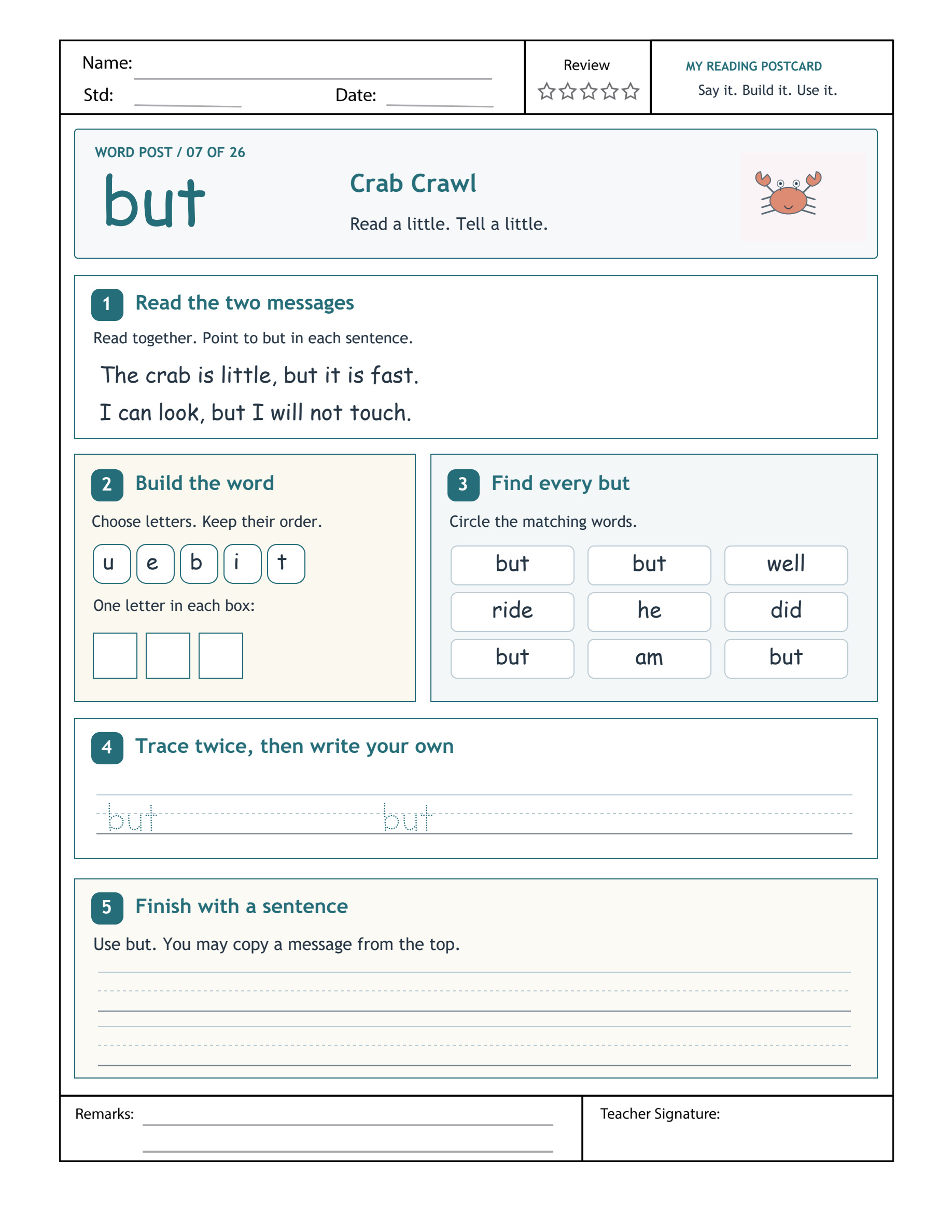
The full but sheet retains its US Letter frame.
Join contrasting ideas about a little fast crab. The complete redesigned page appears without cropping.
Little does not always mean slow. A quick crab gives Ravi a reason to notice the small connecting word but, which brings an unexpected second idea into a sentence. But Sight Word practice combines that contrast with letter building, exact-word searching and supported writing. Children hear two complete messages before examining the three-letter spelling in the clean edition. The original sample retains its supplied order. Use the sheet as a shared language activity for an early reader, with a pencil finish that can be shortened or extended to suit the learner.
Hear the turn in the crab sentence
Read the source statement: “The crab is little, but it is fast.” The first part describes size. The second adds speed, which may surprise someone expecting a little animal to move slowly. But signals the contrast between those ideas. Both parts can be true at the same time.
You do not need to invent a universal rule that little creatures are slow. Instead, explain that the sentence sets up a contrast the speaker wants the listener to notice. Ask what changes after but. A child can answer “fast,” demonstrate quick movement with a toy or explain the surprise in their own words.
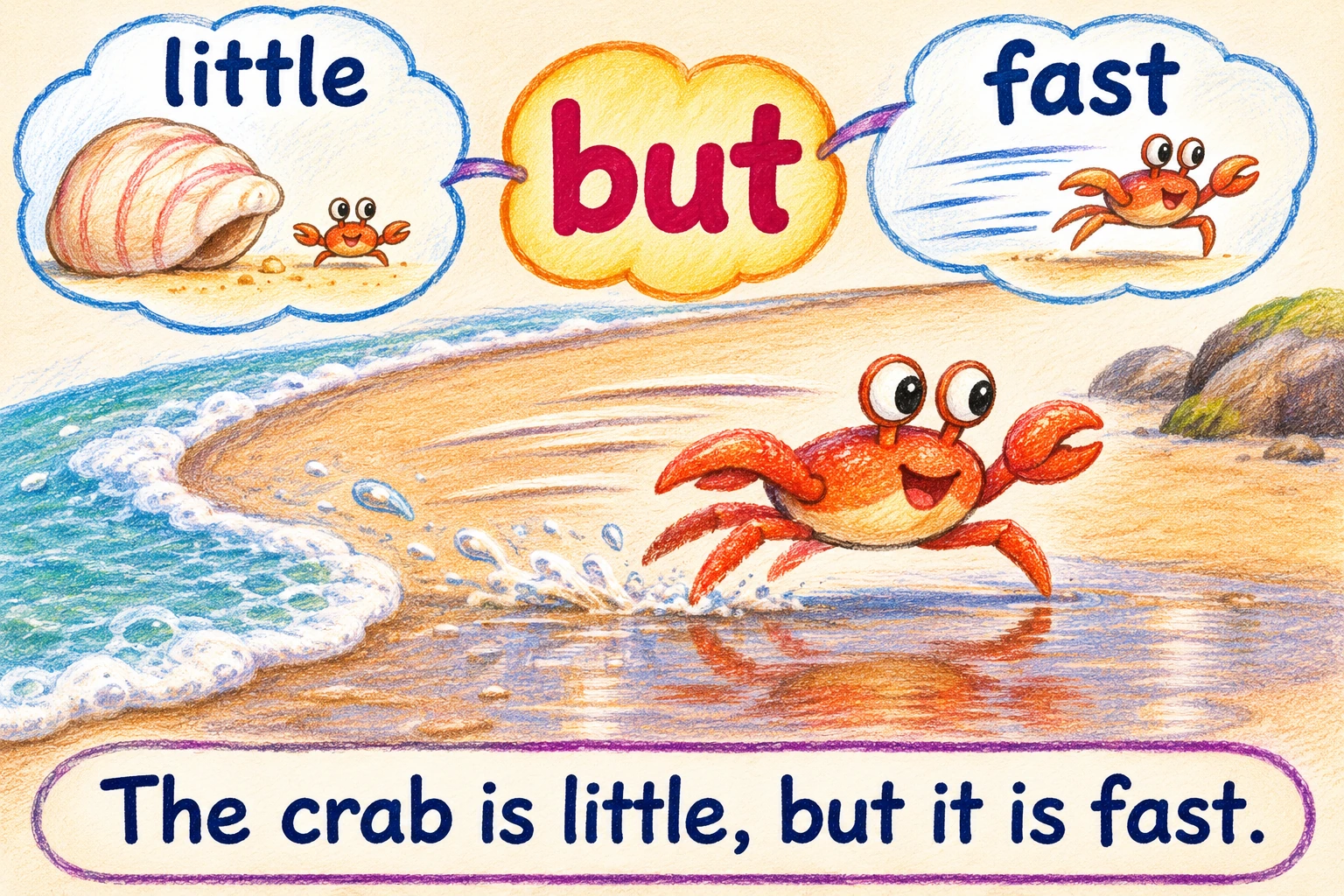
The other source message is “I can look, but I will not touch.” It contrasts permission or ability to observe with a decision about touching. Use a picture crab or a toy for discussion. The worksheet does not require approaching or handling a live animal.
Read two messages with a useful pause
Share each sentence smoothly, allowing a small natural pause at the comma. Then point to but and reread the words on either side. An adult may read the unfamiliar surrounding vocabulary while the child locates the target. That supported role still gives the learner a real part in the message.
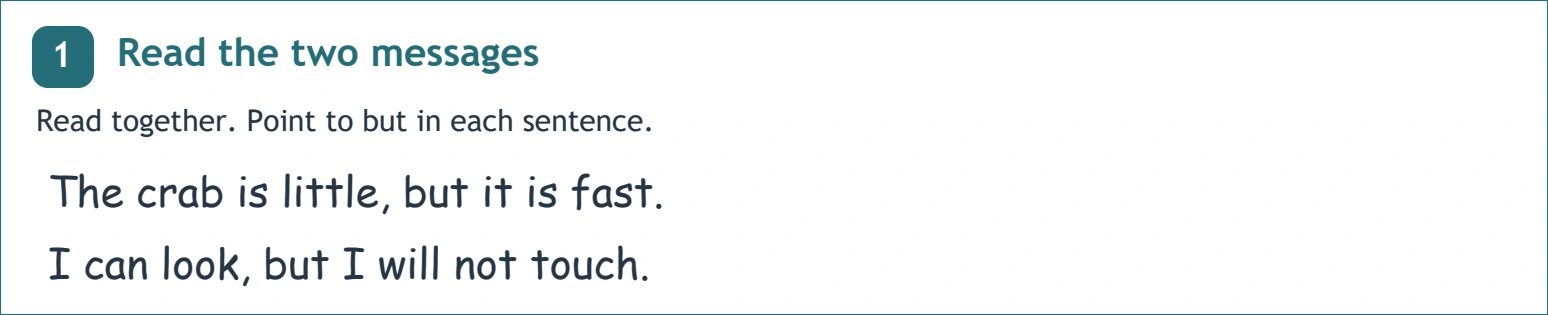
Avoid teaching but as if it means fast or no. Those words occur in these particular examples, while the connector's job concerns the relationship between the ideas. Try a spoken extension such as a large toy that is light to lift. Discuss the two descriptions before adding a new written task.
Longer sentences can be demanding for a beginning reader. You may speak the first part, let the child say but, then finish together. Return to the complete statement afterwards so that the sentence does not remain a set of fragments without a connected meaning.
But Sight Word building: b, u, then t
The five-choice bank contains u, e, b, i and t. Select b-u-t for the three response boxes, leaving e and i unused. Compare each position with the large word model. A child who selects the right three pieces but arranges them differently needs help with order rather than more distractor choices.
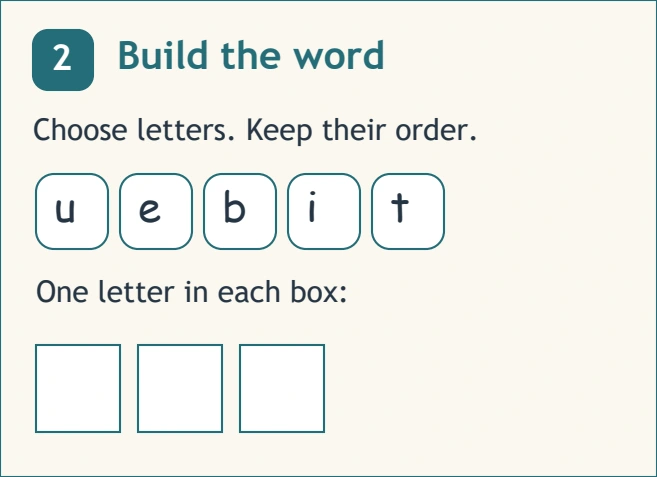
Say but naturally and connect its sounds with the written sequence when the learner is ready. The b begins the spelling; its direction may need a separate pencil demonstration. Keep that movement lesson brief so that a difficult letter shape does not obscure the sentence's contrast.
Loose letters allow the spelling to be checked before writing. Ask the learner to read the completed arrangement and point under the model. The bank is shuffled deliberately; copying u-e-b simply follows its display order and does not answer the task.
Inspect every choice, including the adjacent matches
The search rows read but, but, well; ride, he, did; but, am, but. Four exact matches occur at positions one, two, seven and nine. Both adjacent but entries at the top deserve inspection; one successful circle does not complete that row.
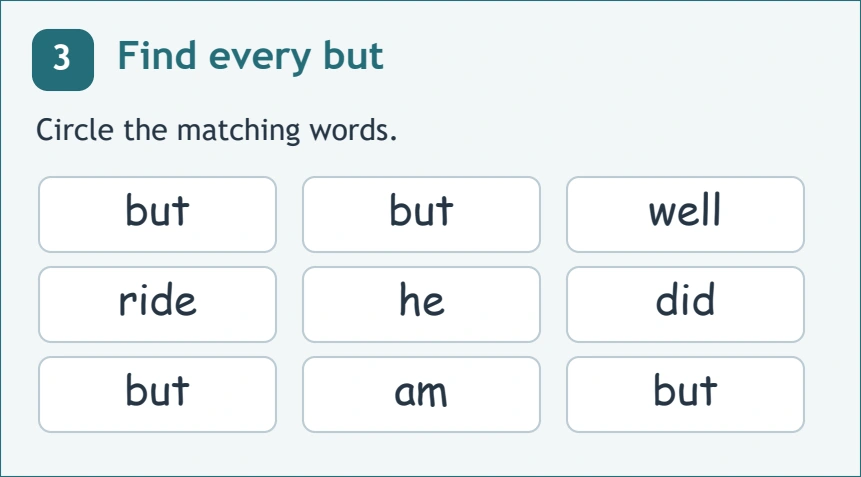
Each candidate needs a complete b-u-t comparison. The other choices are actual different words, not damaged targets to repair. A child can leave well or did uncircled after checking it and have made a correct decision.
If search attention wanders, place a counter on the current cell and move it along the row. Ask what letter comes first and whether the ending agrees with the model. Do not announce four locations in advance or use a timer. The useful evidence is the spelling comparison the learner can explain.
Pencil work after the meaning is established
Follow the dotted but forms and inspect the b direction before trying b-u-t without dots. Trace from the beginning, then make a separate attempt on the remaining guide. If the b is reversed, demonstrate that specific formation beside the model and invite a manageable retry.

The sentence finish accepts but in a complete connected message. Copying either supplied message is allowed. For a new sentence, rehearse both ideas aloud and check that the connector makes sense between them. Write the longer contrasting ideas for the child if necessary, then invite but between the two parts already rehearsed aloud.
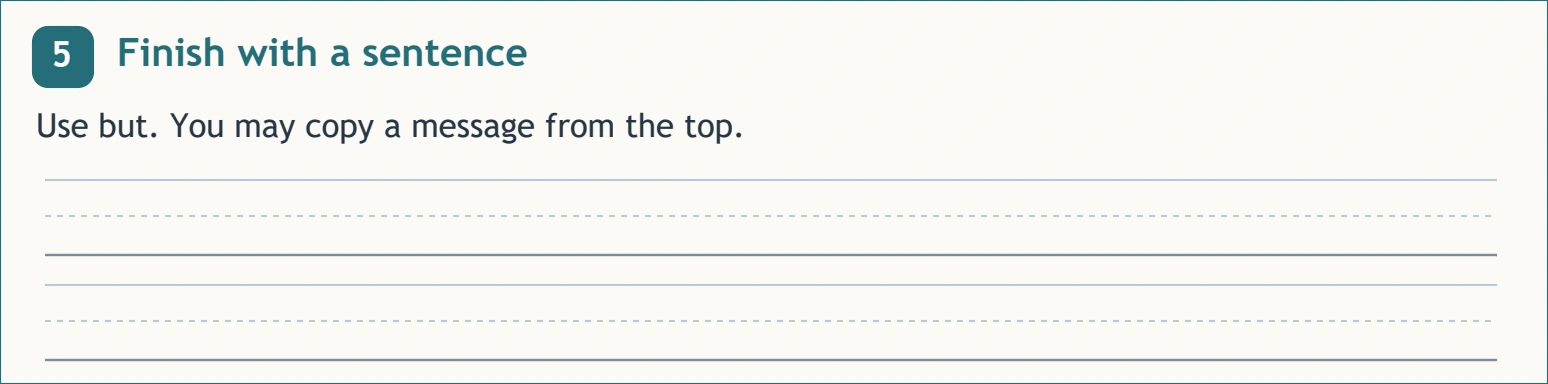
Do not require an independent eleven-word copy simply because the longer crab sentence is printed. One careful target copy plus an oral explanation may be the appropriate amount for a tired hand. Meaning, recognition and handwriting should each be observed on their own evidence.
Six observations worth recording
- Contrasting ideas: the child can explain the crab's size and speed without treating either description as false.
- A spoken connection: but is heard as the turn between two parts of a message.
- A behavioural distinction: looking and choosing not to touch remain separate ideas in the second example.
- Letter sequence: the selected bank pieces become b-u-t rather than their scattered display order.
- Adjacent inspection: both first-row matches are considered individually.
- Sentence composition: an oral contrast is prepared before the writer attempts a new message.
For the crab visit, record what contrast the child explains and how b-u-t was checked. A plausible spoken contrast is different evidence from a lucky circle.
A possible home game with a surprisingly light box
Ravi's family might place a large empty box on a mat. The adult describes it as big, then lets Ravi notice that it is light. They say a complete but sentence about those two features. The box gives the connector a new context while keeping the contrast easy to discuss.
Next they share the crab messages and locate but. Ravi chooses b, u and t from the bank, then checks a few search cells. The adult accepts a short pencil attempt rather than insisting on the whole sheet before the game resumes.
For a closing message, Ravi describes a toy with two contrasting features. The adult listens for a genuine relationship between the ideas and helps supply vocabulary. This imagined sequence is an example of possible use, not a claim about measured progress from the worksheet.
A classroom contrast circle
Bring two or three familiar objects with clearly discussable properties: a large light box, a small loud toy or a worn but useful pencil. Select one object and model a sentence joining its contrasting descriptions. Invite children to supply either part before attempting a complete spoken message.
Return to the printed crab statement and ask what but connects there. The teacher may read most of the line while a learner tracks the target. This keeps participation available to children whose oral language is stronger than independent reading.
At the writing station, some children copy a supplied example and others dictate a new contrast. A partner can listen for the two ideas without supplying every answer. Record one specific observation per learner rather than ranking the number of completed marks.
Choose the correction that matches the problem
| Observed response | A useful crab-lesson move | Recheck |
|---|---|---|
| Says but means fast | Compare the looking-and-touching message. | The connection between ideas. |
| Writes bank letters in display order | Match b-u-t to the model position by position. | The finished sequence. |
| Skips the second cell after one match | Inspect the adjacent entry separately. | Both first-row targets. |
| Can explain but cannot write the long sentence | Accept oral composition and one target copy. | A manageable written contribution. |
Five contrast activities beyond the page
1. Make a puppet describe a large empty box. Invite a second observation and join the two ideas with but after discussing why the pairing is interesting.
2. Dictate a picture caption with a contrast, such as a small object doing something surprisingly noticeable. The adult records longer words and the child contributes the connector.
3. Place b, u and t in a scrambled line. Ask the learner to restore the spelling while keeping the completed word card visible for reference.
4. Read two short oral descriptions and decide whether but creates a sensible relationship. Accept more than one reasonable explanation when the child's ideas are coherent.
5. Act out looking at a toy without touching it. Say the complete source message and identify the target in print after the movement has finished.
Appropriate challenge and another visit
The crab contrast is suitable for supported readers near 4–6, including children who can explain the surprise orally before copying its longer message. A child may understand a spoken contrast before being ready to read its entire printed sentence. Pencil experience should guide the amount copied, while language experience guides the examples you discuss.
Common difficulties include supplying unrelated sentence halves, teaching the connector as a synonym for one nearby word and insisting on long copies too early. Use a concrete example, ask what the second idea adds and keep the target model available. On a later visit, bring a different contrast so the learner has a reason to use but again.
For more short-word practice, consider the starter pack of reading routes. The prewriting discovery lessons can provide a shorter motor task before sentence copying. A familiar everyday action can become another focus through the eat worksheet page on a separate day.
Adults can explore NAEYC's ideas about family play or the activities at PBS Parents' learn-and-grow pages for additional contexts in which children can explain a surprising observation.
Access the printable crab lesson
Use the free crab file for the supplied activity sequence. The premium membership option delivers its clean counterpart when the account is currently eligible. That PDF presents reading first, retains all five tasks and removes website branding, domain lettering and watermark overlays. Advertising is not part of the clean worksheet, leaving the printed contrast messages and practice areas available for use.
Print a single crab test on US Letter paper before making a group set. Inspect the entire frame and the longer contrast sentence for readable size. Optional loose b-u-t pieces can accompany the pencil. The collection link gives a $5 purchase option for twenty-six clean primer sheets in one ordered file, including this contrast lesson and its companion words.
Popular Worksheets
Printable resources families and teachers are downloading now.
 Free
 Free
 Free
 Free