
At Sight Word: 2 Brilliant Turtle-Pond Conversations
Continue beyond at with twenty-six clean reading-first practice sheets in one $5 printable collection.
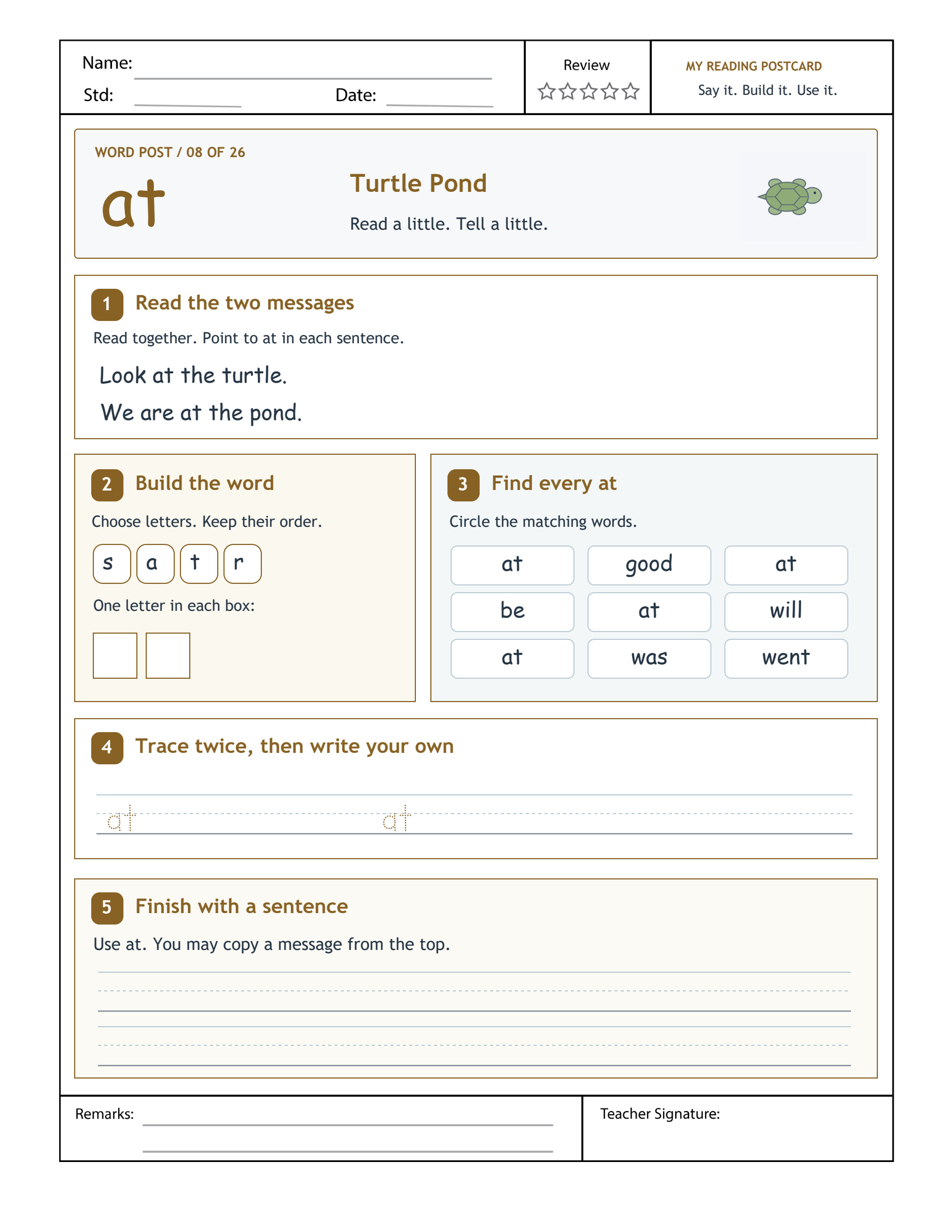
The full at sheet retains its US Letter frame.
Locate a turtle or a shared meeting place. The complete redesigned page appears without cropping.
Pond talk can tell us where we are and where to direct our attention. The little word at appears in both kinds of message on this turtle worksheet. At Sight Word practice brings those uses into shared reading, then adds two-letter building, matching and handwriting. Cora can look towards a turtle, describe a pretend pond visit and examine the same spelling in each sentence. The clean edition opens with reading while preserving the source tasks and page frame. Begin with conversation, choose a comfortable pencil goal and leave time to hear the child's explanation.
Two uses of at on one turtle page
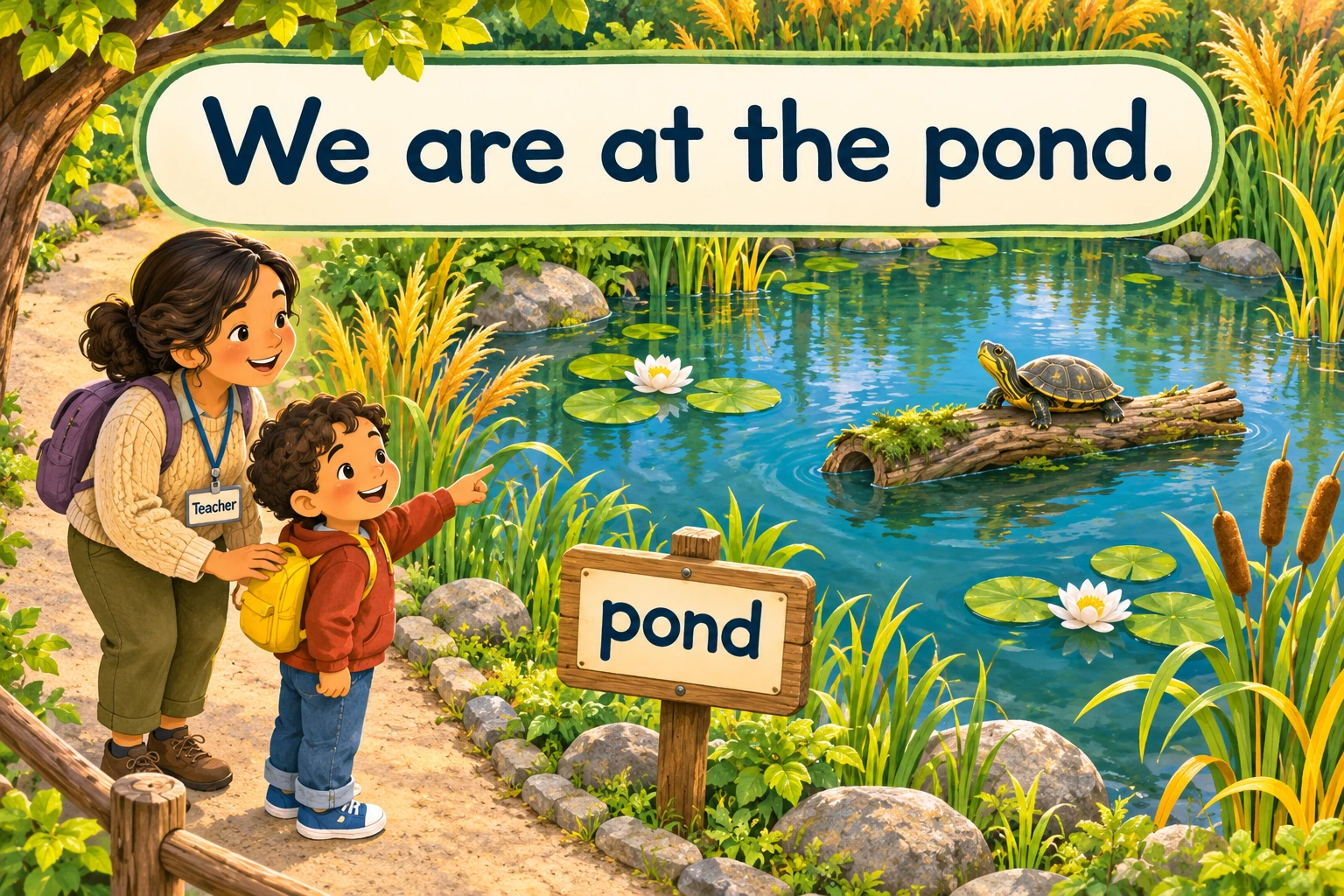
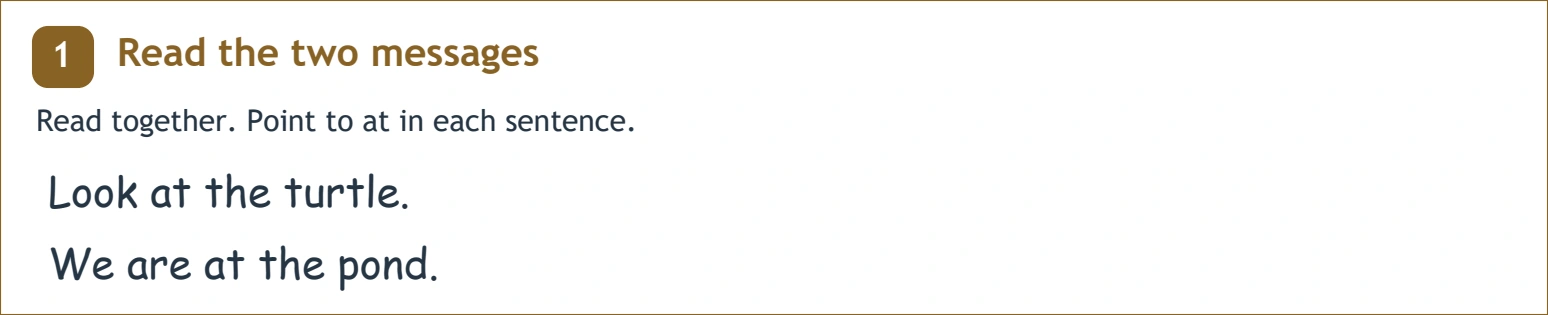
The supplied sentences are “Look at the turtle.” and “We are at the pond.” In the first, at belongs to a direction to look towards something. In the second, it helps name the place where the speakers are. Both messages use the same two-letter spelling, but the surrounding words give each a different purpose.
Demonstrate the attention message by looking towards a turtle picture. For the location statement, place two toy visitors beside a pretend pond and describe where they are. Do not put the visitors on the turtle or suggest that at requires sitting on an object. The examples need clear contexts of their own.
A child does not need to name the grammatical function. Ask what the listener should do after the first message and what place the second tells us about. Acting, pointing and ordinary conversation can demonstrate understanding before an independent reading attempt is appropriate.
Read with a reason to respond
Share the attention sentence, then allow the learner to look towards the turtle illustration. Read the location statement and identify the pond setting. Point under at in each line after the whole message has been heard. Revisit the sentences together instead of leaving the target as an isolated label.
Turtle and pond may be familiar spoken vocabulary but unfamiliar printed words. An adult can supply them while the child participates in locating at. This division of reading is useful support. It does not require pretending that a learner has independently decoded every surrounding word.
Once the examples are understood, change the spoken object or place: look at a book, or describe being at school. Introduce each situation clearly. The word's usefulness should extend beyond one pond picture, while the worksheet continues to provide a stable spelling model.
At Sight Word: match the need to the task
| A starting need | Use this turtle-page activity | A useful response |
|---|---|---|
| Needs a clear spoken context | Act on Look at the turtle. | Directs attention towards the named picture. |
| Needs help identifying the spelling | Compare the large a-t model with one sentence. | Points to the same printed word. |
| Knows the letters but reverses them | Arrange a and t before filling the boxes. | Keeps a first and t last. |
| Recognises at comfortably | Prepare another complete place statement. | Uses the word in an understandable new message. |
The table is a planning aid rather than a level chart. A learner may need different kinds of help within the same visit. Keep the printed model available and choose a challenge that preserves the purpose of the sentence.
A compact spelling bank with two spare choices
The bank contains s, a, t and r. The answer needs a followed by t, one letter in each of the two boxes. Children can select loose copies first or point directly to the printed choices. The unused s and r remain outside the spelling.
Name a-t in order, then say at naturally. A reader with suitable letter-sound knowledge can blend the short word with adult support. Do not require an unfamiliar phonics explanation before the learner has heard the completed sentence and knows what it is communicating.
If t-a appears, compare its first position with the model rather than accepting the correct letters in any arrangement. A small start marker beside the left box can help. Remove unnecessary movement demands when the goal is to understand order: pointing at two letters may be more manageable than repeatedly rewriting them.
Four exact targets among nine pond choices
The grid presents at, good, at; be, at, will; at, was, went. Read across one row at a time. Adult at key: 1, 3, 5, 7.
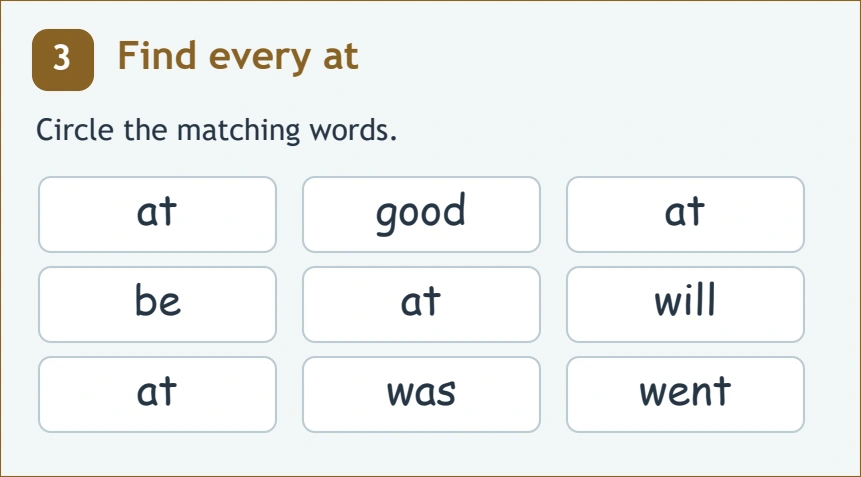
Was includes a but is a different three-letter spelling. Went contains t without becoming at. Encourage a complete comparison with a-t before a circle is made. Recognising a familiar letter is a useful starting observation, but the task asks for the whole word.
Avoid telling a child that each row must contain one answer. The top row has two. A place-keeping counter can help the reader inspect every choice instead of searching for a pattern in where answers ought to appear. Let the child explain one match and one rejected distractor to show how the decision was made.
What changes in the reading-first clean edition
The turtle's clean route establishes its attention cue and pond statement before isolated practice. The bank and grid occupy neighbouring stations, followed by tracing and the sentence finish. The supplied sample opens with dotted at work. All five activities and the original framed US Letter format remain.
The two at models demonstrate a-t in order; leave the standalone attempt visibly separate. The final ruled area permits a sentence with at, including a copied source example. A child may first dictate an original statement, then contribute only the target in writing while an adult supplies unfamiliar words.
This is a one-page PDF rather than a pond field-trip guide or an interactive application. The webpage's scene illustrates a conversation. Paper turtles, a toy pond and movable letters are optional teaching additions, not extra materials hidden inside the download.
Six ways to notice participation
- Attention follows language: the learner responds to the look-at message by locating the intended picture.
- A place is communicated: the pond statement is connected with the visitors' setting.
- A spelling remains stable: a-t is recognised in both sentence contexts.
- A selection becomes ordered: the bank pieces fill the response boxes in reading direction.
- A distractor is examined: an a inside was is distinguished from the complete target.
- An idea is recorded: an understood spoken message becomes a copy, dictation or independent attempt.
Record the look-at response and pond-place explanation separately. The learner may understand one context sooner than the other while a-t copying remains another task.
Home example: Cora's pretend pond visit
One possible family activity begins with a blue cloth for water and a paper turtle on a log shape. The adult reads “Look at the turtle,” and Cora directs attention towards it. Two toy visitors stand nearby while the adult introduces the location sentence. Cora can explain where the pretend visitors are.
They move to the page, identify at in the messages and build a-t using the small bank. The adult may select a single search row and one written copy as the day's pencil work. The rest remains available for another brief visit.
To conclude, Cora dictates a statement about being at a familiar place. The adult supplies enough context for a listener to understand which place is meant. This imagined session shows a route from play into print without claiming a measured result or requiring an actual pond excursion.
Classroom example: a listening station with a map
A teacher can place a simple classroom map beside a toy visitor. Establish one location, such as the reading corner, and describe the visitor as being at that place. Then ask a partner to look at the named corner on the map. The same small word appears in two understandable instructions or statements.
Return to the turtle page and compare its examples. The teacher reads the longer vocabulary while learners find a-t. A child who cannot yet copy a sentence can still respond through a gesture or oral place description. More experienced writers can compose a new location statement after rehearsing it.
Partners should listen before helping. One child can track the printed sentence while another speaks, then swap roles. Do not let a confident reader fill the bank or circle every match for someone else. Each learner needs a visible opportunity to inspect and decide.
Five extensions without another worksheet stack
1. Make a paper visitor stop at a drawn library, park or home. Announce each place before asking the child to describe where the visitor is.
2. Play a gentle look-at game with familiar room objects. Keep each direction clear and give the learner time to orient towards the intended item.
3. Put a and t on large completed letter cards. Let a puppet display t-a and ask the reader to restore a-t by comparison with the model.
4. Dictate a picture caption about a pretend trip. For an at message, keep the pond or attention reference visible while an adult helps record any unfamiliar surrounding vocabulary.
5. Prepare a pair of scene pictures and a completed pond sentence. Ask which scene fits and listen to the child's explanation of the place reference.
Common mistakes that are easy to adjust
Do not explain at only as a location word and then ignore the look-at use printed on the same sheet. Demonstrate both source contexts. Equally, avoid claiming that it always means on; the visitors can be at the pond while standing beside its water.
Another difficulty is adding too many directions before the child responds. One attention cue and one place statement provide enough material to start. When copying becomes tiring, separate the target word from the longer sentence and accept a short written contribution with oral meaning intact.
Turtle-page visits near ages 4–6 can begin with acting or pointing; independent writing is an additional demand rather than the entry requirement. A child who understands both messages may still need help forming a. A careful writer may need another spoken demonstration of the two contexts. Neither observation calls for a race through the whole page.
Keep review connected with a place or a listener
On a later day, mention at during an ordinary conversation about school, home or a pretend park. Show a short completed statement and invite the reader to locate the target. Appreciate the particular connection made: a correct place, a deliberate letter order or a careful comparison in the search.
For additional short-word work, browse the pre-primer word starter resource. The discovery pack for beginning pencil control can support a learner before longer copies. Another everyday action is available through the eat reading activity page for a separate language visit.
Family play prompts at NAEYC and everyday learning activities from PBS Parents' learn-and-grow collection can provide further contexts. Choose an idea the child can discuss, rather than adding activities just to fill time.
Download, open and try a single print
The free turtle sample keeps its supplied order. Eligible membership opens the clean premium PDF, where the two source messages introduce the lesson. The remaining activities are preserved inside the frame. The website domain and watermark have been removed from this clean edition, and no advertising panel interrupts the printable practice areas.
Inspect one US Letter turtle print for its full border and legible a-t guides. A pencil and an optional place counter can be enough; the pretend pond is an adult-added prop. The associated $5 collection holds twenty-six clean primer lessons in sequence, providing a single file to use when another attention or place conversation is ready for print.
Popular Worksheets
Printable resources families and teachers are downloading now.
 Free
 Free
 Free
 Free