
With Sight Word: 5 Delightful Ocean Companion Activities
Continue beyond with with twenty-six clean reading-first practice sheets in one $5 printable collection.
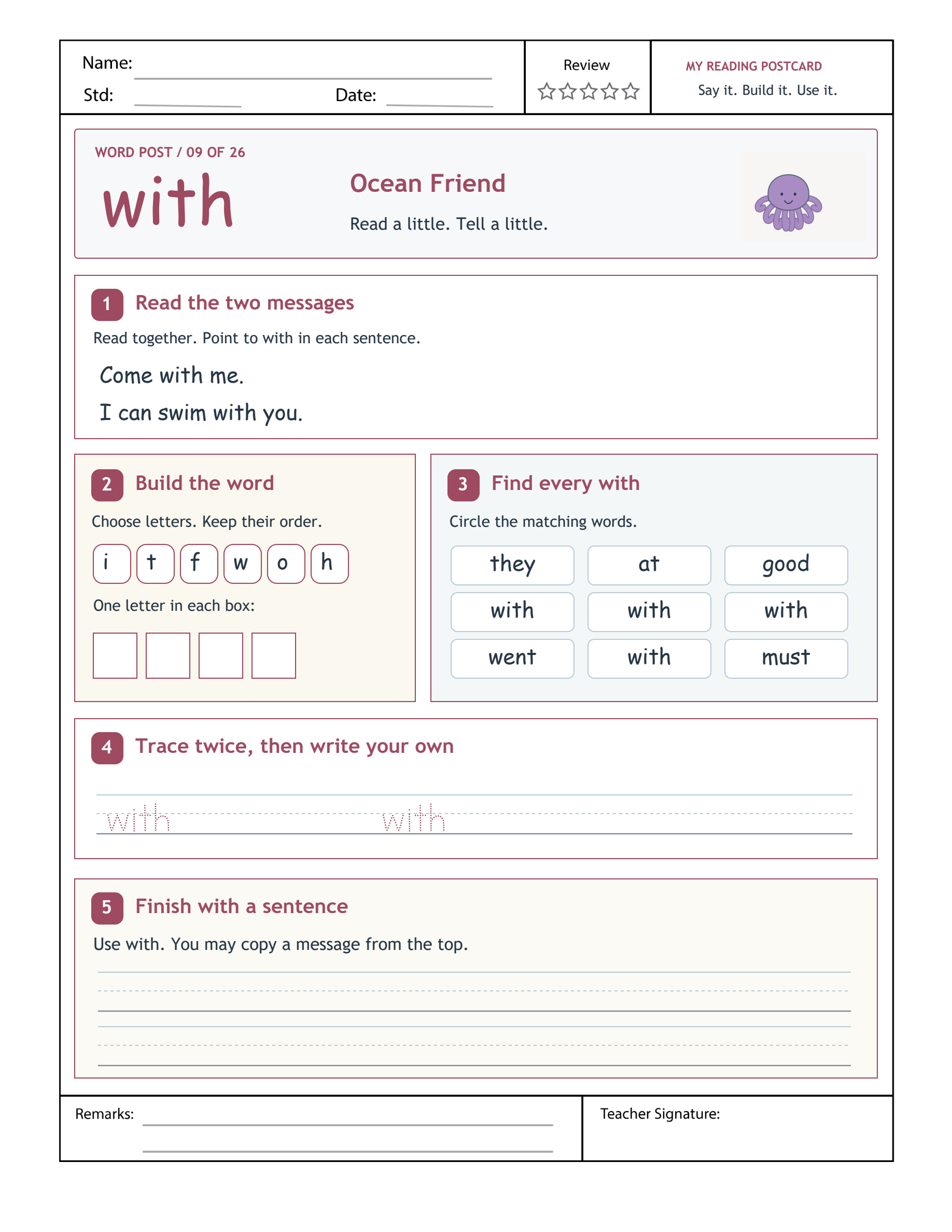
The full with sheet retains its US Letter frame.
Express companionship with an ocean swimming partner. The complete redesigned page appears without cropping.
An ocean invitation needs more than a direction to move. “Come with me” tells a companion that the journey is shared. With Sight Word practice explores that connection through two friendly messages, a four-letter spelling bank, matching choices and supported handwriting. Sami can move two toy sea creatures together, explain who accompanies whom and then find the same word in print. The clean lesson starts with reading and ends with sentence writing. Its original sample remains available in the supplied arrangement, giving adults a choice of routes through the same five source tasks.
A companion belongs in the message
Place two paper sea creatures side by side and establish which one is speaking. Move them together while saying, “Come with me.” Then change the speaker and repeat the invitation. Me refers to the current speaker; with connects the companion to that speaker's proposed action.
The second source sentence is “I can swim with you.” It describes an ability involving a partner. Introduce who I and you refer to before the learner acts it out. If those references change silently, a child may become confused for reasons unrelated to recognising with.
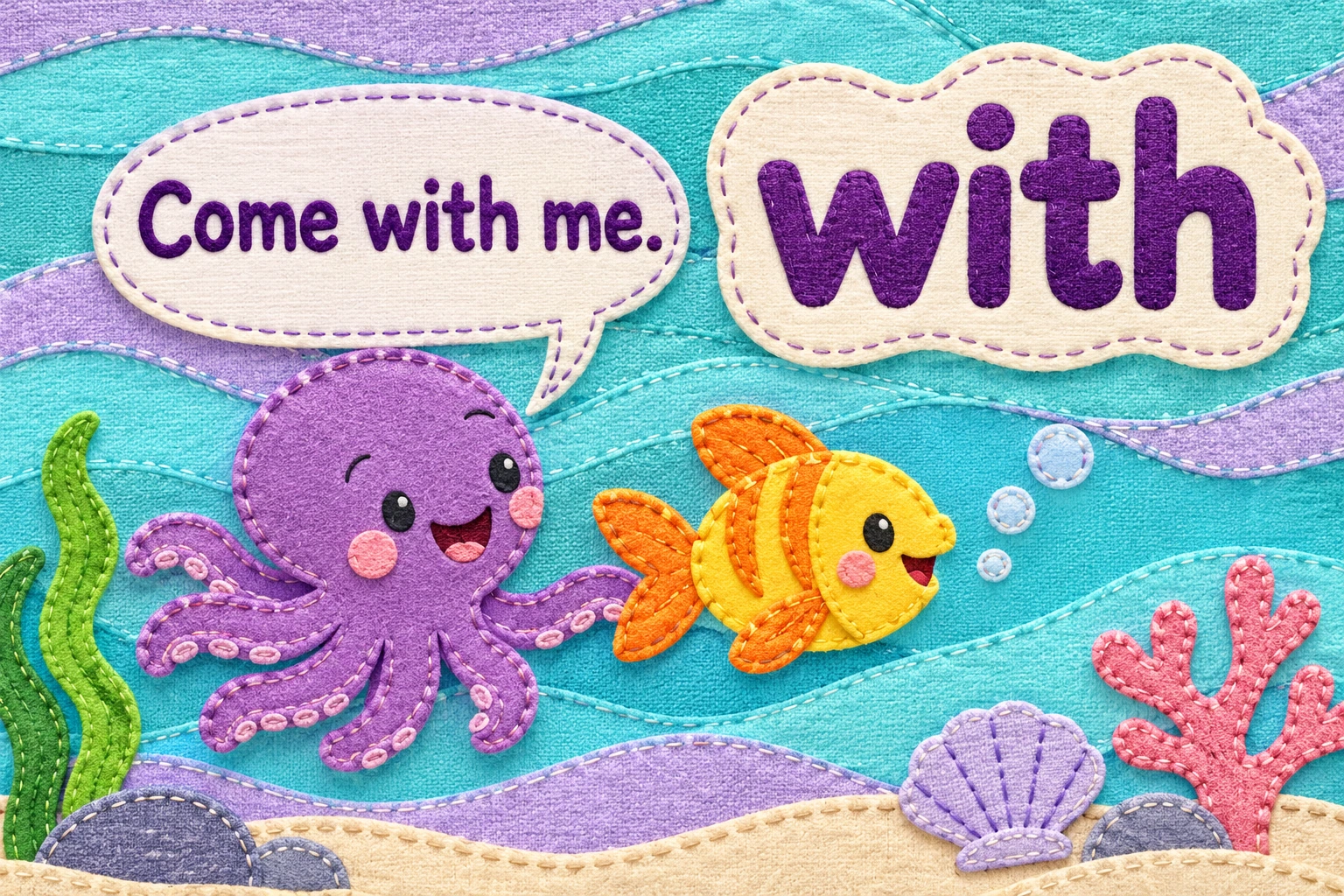
The octopus illustration supplies a playful ocean setting. It is not the meaning of the target. With also works when children build with a friend or a character walks with a companion. Begin with the companionship examples printed here, then extend the conversation when the reader understands the shared action.
Read the invitation and the ability statement
An adult can voice the invitation while a learner moves the listening toy alongside the speaker. For the swimming sentence, establish the two companions first and read the message as a complete thought. Point to with after the action and say the word again inside the sentence.

These messages contain other pronouns and an unfamiliar action spelling. Supply those words as needed. A child can participate meaningfully by locating with, identifying the companions or explaining the shared movement, even when the adult reads most of the line.
Ask what would be missing if only one creature moved away by itself. The conversation can reveal whether the learner understands companionship rather than merely naming the ocean picture. Keep the comparison playful and accept a clear gesture as part of the explanation.
With Sight Word spelling keeps four positions
The six bank letters are i, t, f, w, o and h. Choose w-i-t-h for the four response boxes and leave f and o unused. The letter order differs from the display order, so the large model is important. Point along its positions before the child selects or writes.
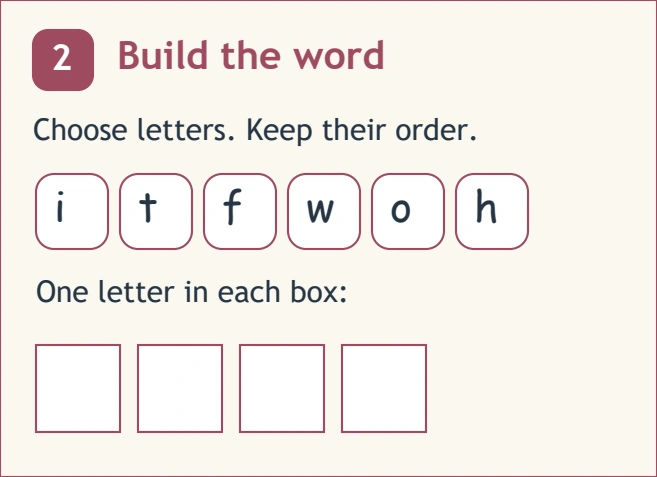
Some learners notice h early because it is easy to identify. Ask where it belongs in the finished word rather than accepting it in the first box. A correct set of pieces does not yet establish a correct sequence. Moving loose copies can make this distinction easier to see.
Pronounce with naturally in your own speech. The final th is a joined spelling, and its pronunciation can vary across accents and contexts. Do not require four isolated letter pronunciations as the definition of reading the word. Letter names support spelling; a natural complete example supports spoken recognition.
Search choices reward attention beyond a familiar ending
The grid reads they, at, good; with, with, with; went, with, must. Adult with key: 4, 5, 6, 8. The entire middle row qualifies, so a child should inspect all three cells even after finding one.
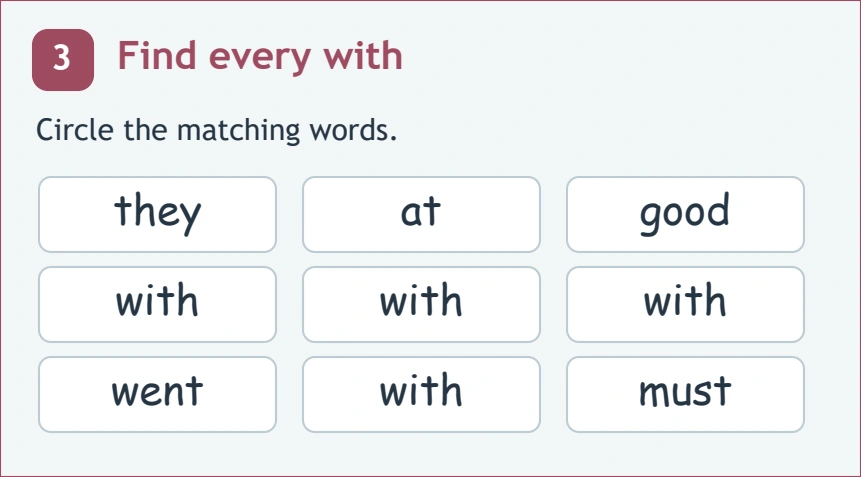
They begins with th, whereas with ends with that letter pair. Went shares an initial w but has a different middle and ending. Use these contrasts to prompt a whole-word comparison. The target stays visible while the reader decides whether a cell matches.
After an attempt, ask the child to explain one circled word and one uncircled word. This can reveal the decision process more clearly than counting circles alone. Four circles around unrelated choices would need a different response from three well-checked matches with one overlooked cell.
A short pencil route after shared movement
The tracing band provides two dotted with models and space for a separate copy. The t and h at the end can be checked against the large spelling before the writer starts. Demonstrate an individual letter if necessary, then let the child try the word without requiring uniform adult handwriting.
For the sentence finish, the source permits copying either printed message. An original idea can also be dictated first. A child might describe playing with a friend, with an adult supplying unfamiliar spellings. The important check is whether the companion relationship remains understandable in the completed message.
The clean ocean page lets the invitation establish companionship before its w-i-t-h investigation. Spelling selection neighbours the grid; the dotted band and final message follow. Tracing starts the retained sample. Each version contains the five provided tasks within the established US Letter frame.
Six contributions a learner can make
- A shared action: two introduced creatures move together in response to an invitation.
- A clear speaker: me, I and you are connected with the established roles in each message.
- A transferable relationship: with remains meaningful when the companions or activity change.
- A four-letter sequence: w-i-t-h is selected deliberately from six shuffled options.
- An exact search decision: a familiar w in went or th in they does not establish a match.
- A message for another reader: a copied or original sentence explains companionship through writing.
Note who the child identifies as the invitation's speaker and companion. Track the final t-h spelling separately so reference and letter order stay distinguishable.
Possible home use: an ocean crossing for two toys
Sami and a family member might place two paper sea creatures on a blue cloth. The adult voices “Come with me” from one creature and lets Sami decide how the companion responds in the pretend story. After a shared movement, they read the printed invitation and locate with.
They choose the four bank letters and inspect part of the grid. The adult can pause the pencil task before fatigue turns a useful visit into guessing. Sami may dictate a new sentence about travelling with a toy friend, with the established characters still visible.
On another day, the same relationship can appear in a different setting, such as two toys walking together. A listener should know the companions before hearing the message.
Possible classroom use: a partner invitation station
The teacher gives pairs two clearly identified toy characters and establishes whose turn it is to speak. One character issues the printed invitation; the partner moves the other character alongside it. Roles then change explicitly so that me has a clear new reference.
Return to the worksheet after the action. One learner tracks with in the sentence while another explains the shared movement. Different readers may contribute through pointing, speaking, selecting letters or writing. A partner may record the invitation's harder words once the learner has explained who travels with whom and contributed with.
For a group finish, a child dictates a new companion message and the teacher records it. Read the caption back and ask who is involved. Keep the exchange collaborative: partners listen and check rather than filling every box or circling another child's answers.
Choose one helpful adjustment
| Observed difficulty | Try in the companion game | Check afterwards |
|---|---|---|
| Moves only the speaking creature away | Revisit the invitation with both roles introduced. | The intended shared action. |
| Confuses who me refers to | Announce the speaker before each turn. | A stable reference within the message. |
| Builds the bank's first four letters | Match each selected piece to w-i-t-h. | The sequence rather than the collection. |
| Stops after one middle-row match | Inspect the next cell on its own spelling. | Every qualifying choice considered. |
Five ways to continue the companionship idea
1. Create a completed caption for two toy friends on a pretend journey. The child dictates who travels with whom and then locates with in the finished writing.
2. Swap speaking roles in an invitation game. Establish the new speaker clearly before the learner responds to me or you.
3. Prepare a w-i-t-h model and four movable letters. A puppet rearranges one position, and the learner repairs the word by comparison.
4. Compare a picture of one character alone with a picture of companions together. Discuss which scene fits a specific completed with sentence.
5. Invite the child to plan a shared building or drawing activity. Record a short message about working with a named partner, then read it to that partner.
Age, confidence and a useful practice rhythm
Companion talk can make sense to a supported reader around 4–6 before w-i-t-h is easy to write, so leave both the roles and word model visible. Language experience, familiarity with letters and pencil stamina should guide the amount attempted. An oral invitation can be a suitable first contribution before independent sentence copying is realistic.
Avoid making the character roles ambiguous, teaching the target as a synonym for an ocean animal or demanding every search choice be read without support. Keep the lesson's purpose visible. If letter formation becomes tiring, accept a spoken companion statement and save the remaining guide for later.
Review can begin during a familiar shared activity: name a partner, say what you are doing together and show a completed with message. Appreciate a precise contribution such as identifying the companion or keeping h in its final position. Short, understandable uses provide a reason to return without requiring a longer drill each day.
The short-word starter collection offers earlier reading activities. For a different familiar action, see the eat word practice resource. The pencil discovery workshop can provide a gentler motor task before a full sentence copy.
For more shared activity ideas, adults can explore PBS Parents' learning suggestions and NAEYC's family play resources. Select one context where a companion relationship can be discussed naturally.
Open the printable ocean lesson
Choose the ocean sample for the original worksheet layout. The premium control supplies an eligible current member with a clean PDF whose reading station comes first. All source activities remain, but the website name, domain text and watermark are removed. The clean worksheet also excludes advertising, so its printed invitation can accompany the two introduced toy companions.
Make a trial ocean page on US Letter paper and check both the complete frame and the four-letter dotted word. A pencil is sufficient, with toy partners optional. For continued reading visits, the $5 collection brings the twenty-six clean primer sheets into one ordered PDF. Select another word when it gives the companions a new message purpose rather than adding more repetition to this one.
Popular Worksheets
Printable resources families and teachers are downloading now.
 Free
 Free
 Free
 Free