
What Sight Word: 2 Brilliant Car-Corner Reading Questions
Continue beyond what with twenty-six clean reading-first practice sheets in one $5 printable collection.
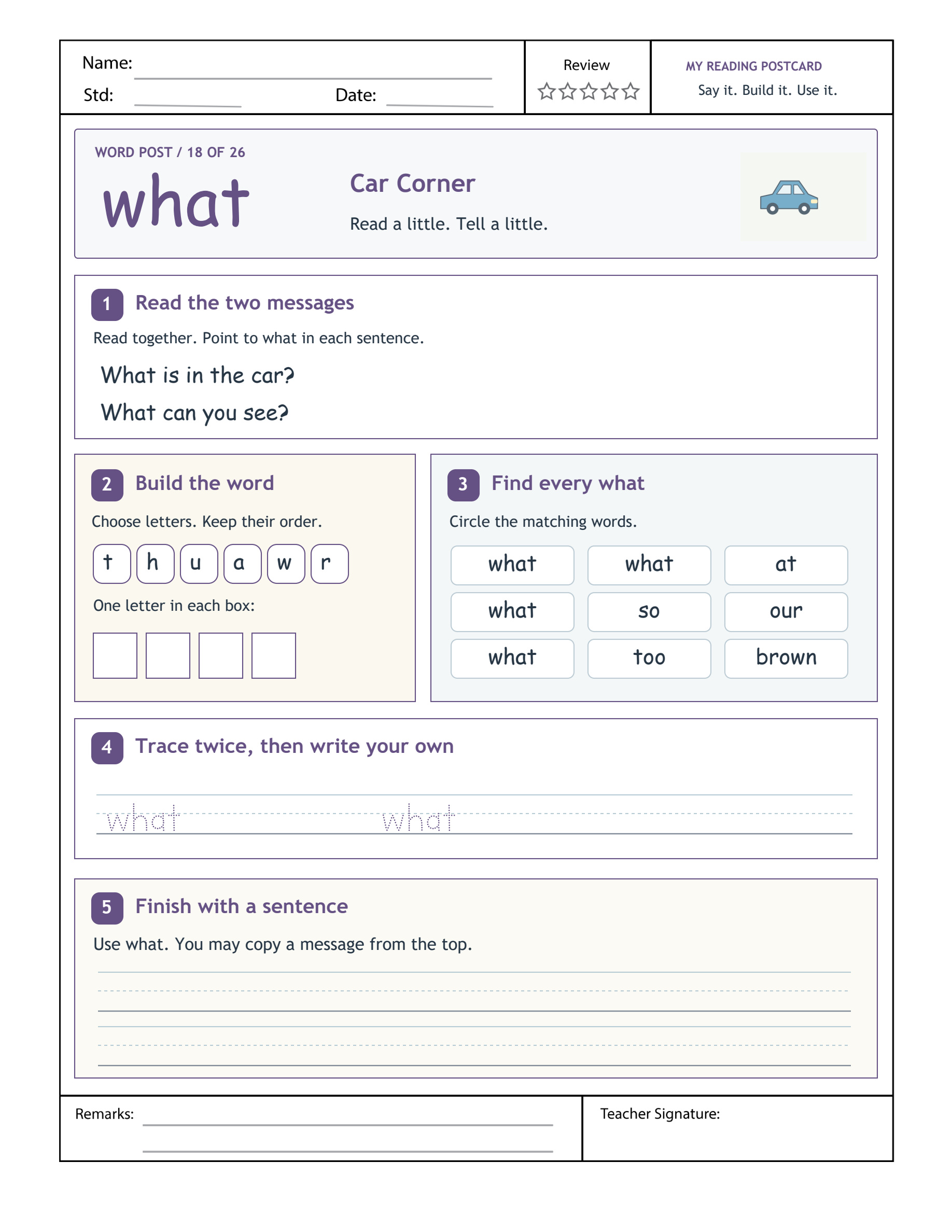
The full what sheet retains its US Letter frame.
Ask for information about an unseen car item. The complete redesigned page appears without cropping.
Ada can see a toy car, but a question invites closer attention to what is inside it. What Sight Word practice begins with that information gap: the speaker wants a listener to identify something rather than simply agree. Two short car-corner questions lead into spelling, matching and handwriting. The clean page puts those complete messages first, giving the four-letter target a purpose before isolated practice. Let the adult supply the car vocabulary while the reader explains the question's information need. A toy, picture or pretend car scene is enough to start the conversation.
Ask for information the listener can supply
Read “What is in the car?” with a familiar object visible inside a toy or drawn car. The answer might name a block, a toy passenger or another established item. The question asks for information about the contents rather than a yes-or-no response.
The second source question, “What can you see?” is broader. Establish the scene being discussed, then allow the learner to identify something actually visible. More than one answer can be reasonable when the picture contains several objects. Explain the chosen context instead of requiring a private adult answer.
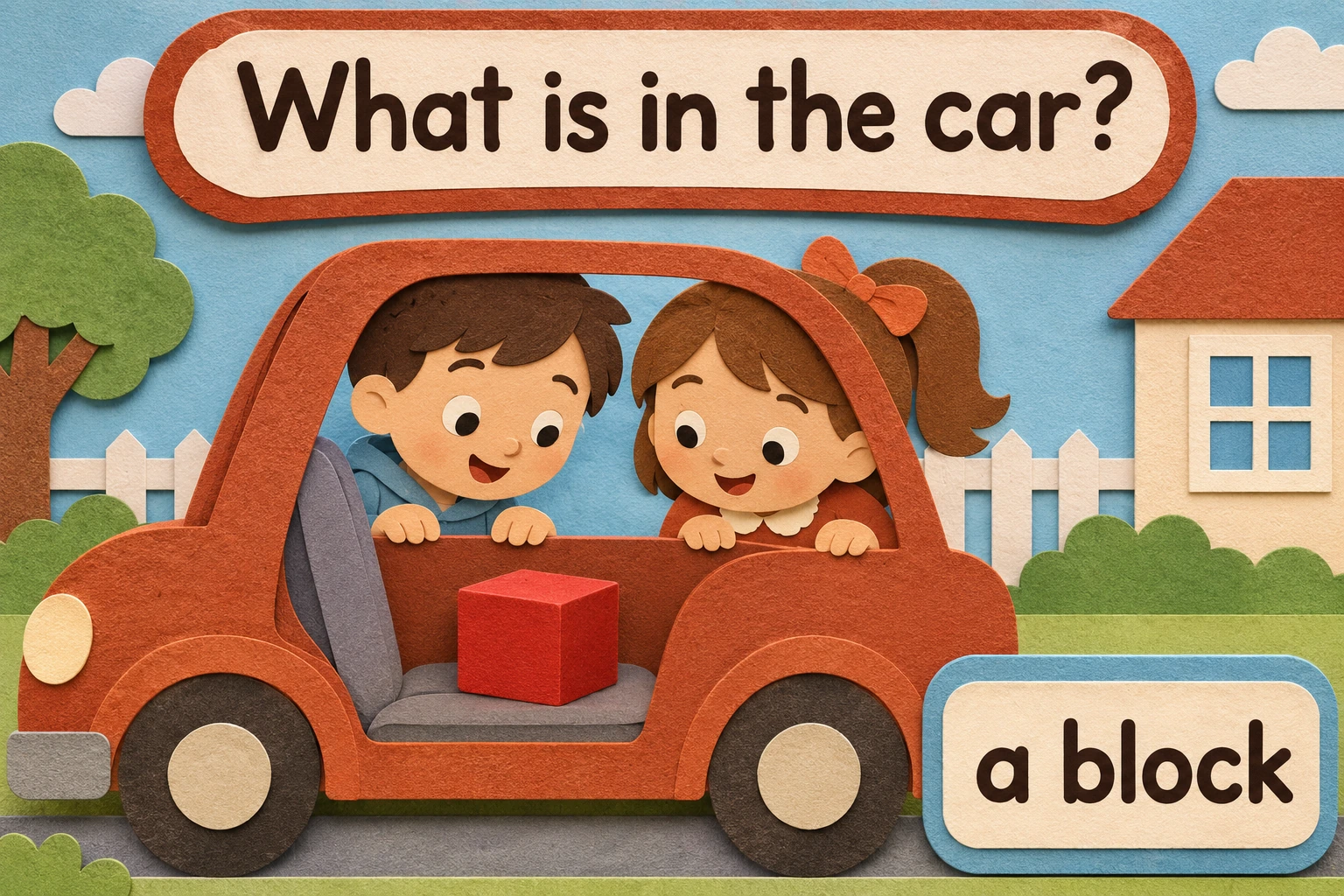
The supporting artwork shows a red block and a completed answer card. That is one example, not a new required answer built into the PDF. A different familiar object can give the same question a fresh, understandable use.
What Sight Word reading begins with a complete question
Share each printed line naturally and point out its question mark. Ask what information the speaker wants, then give the listener time to respond. After the meaning has been explored, locate What at the beginning of both lines and compare it with the lowercase model.
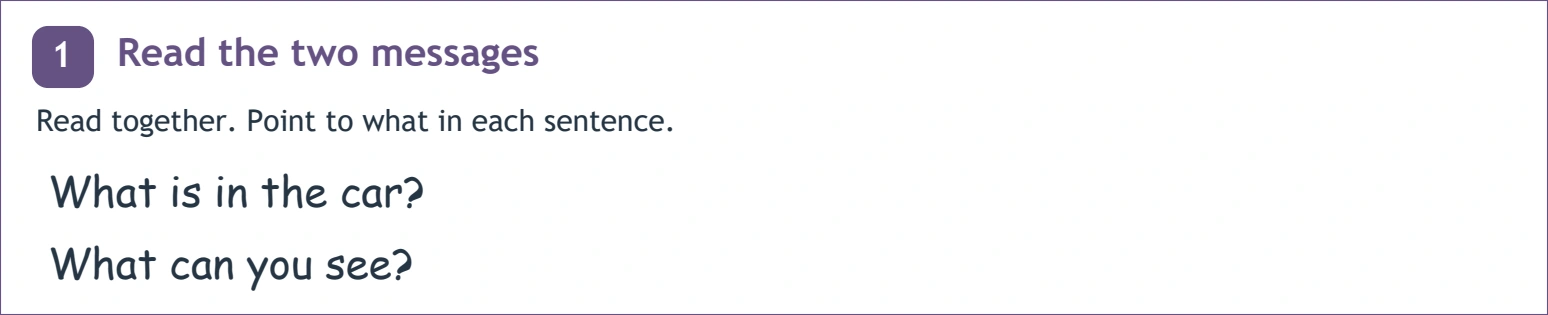
Capital W starts the questions, while lowercase w begins what on its own. Connect the two forms without treating the case change as a new word. Adults can supply car or see while a learner contributes the target and an answer grounded in the scene.
Do not treat any spoken response as proof that the print has been read accurately. A child may answer sensibly from the picture but still need help identifying w-h-a-t. Return to the actual letters after the conversation so meaning and written recognition both receive attention.
Build four positions from a shuffled bank
The bank contains t, h, u, a, w and r. Select w-h-a-t for the four response boxes, leaving u and r unused. Compare the order with the large model before writing. The bank begins with t, but that does not make t the target's first letter.
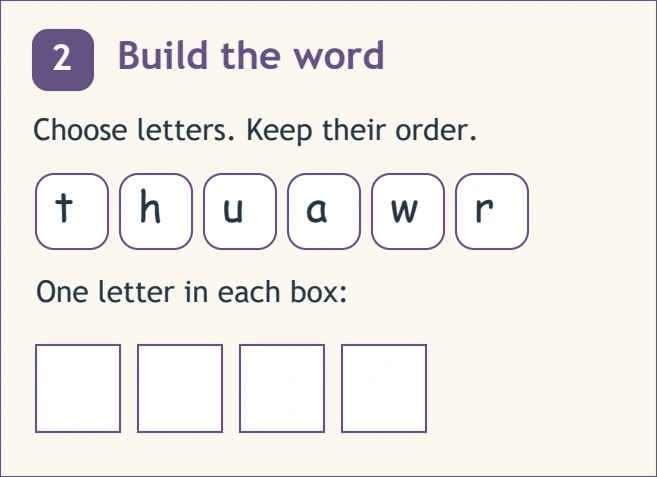
Say what naturally in the source questions. The wh opening is pronounced differently across accents, so use your familiar spoken form while keeping the written sequence stable. The learner does not need an exaggerated letter-by-letter pronunciation that makes the complete question sound unfamiliar.
If all four needed pieces are present in another order, invite a positional comparison. Which letter begins the model? What comes next? Loose copies can support this check before the child manages the additional movement demands of handwriting.
Nine search choices include a shorter ending match
The grid reads what, what, at; what, so, our; what, too, brown. Adult what key: 1, 2, 4, 7.
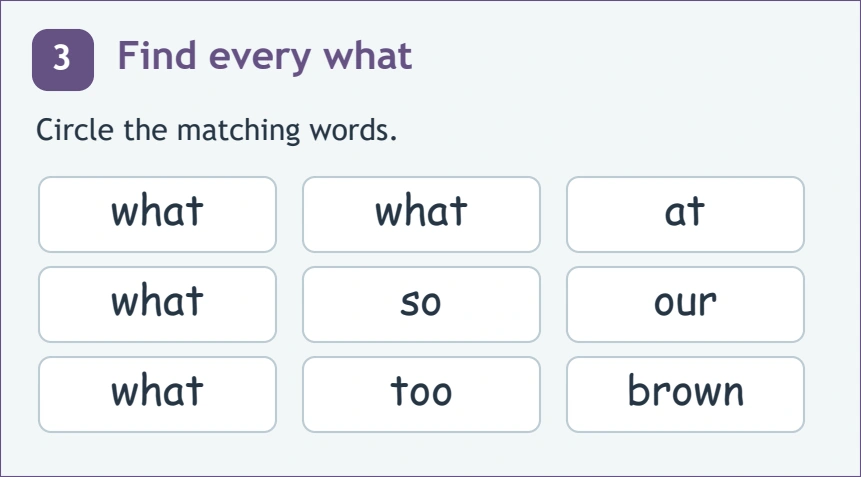
At matches the final two letters of what but omits the w-h beginning. It is a useful opportunity to distinguish a word part from a complete target. Ask the child to compare all four positions instead of accepting a familiar ending alone.
The first row starts with two adjacent matches. Inspect the second cell independently after finding the first. A place-keeping counter can help the learner maintain a row route without turning answer locations into a guessing pattern. One clearly explained rejection can be as informative as a correct circle.
Pencil work follows a question worth asking
The what guides preserve w-h before a-t; the untraced version should keep that full beginning. Keep w-h together at the beginning when making the independent what attempt. If a particular w or h formation is difficult, demonstrate that movement without requiring an entire sentence to be rewritten.

A supplied what question may be copied into the final writing area. For a new question, first decide what information is needed and who can answer. Let the reader decide what information is needed before helping with the spellings around what in the new car question. A message should remain understandable rather than becoming a random collection of practised words.
The clean car-corner page reads its information questions before the four-letter investigation. Bank and grid stations sit side by side, then tracing and a larger sentence space finish the visit. The source sample begins with dotted words. Five activities and the framed US Letter format are retained.
Six contributions adults can observe
- An information request: the learner understands that what asks for something to be identified or explained.
- A context-based answer: the response comes from the established car scene rather than a memorised yes.
- A flexible question: the same opening word remains useful when the visible object changes.
- A case connection: capital What is paired with lowercase what in the model.
- A complete spelling: w-h-a-t is distinguished from the shorter at ending.
- A purposeful written line: a copied or original question has a listener and a clear information need.
Record what information the child supplies and whether w-h is retained before a-t. A reasonable car-picture answer alone does not establish recognition of the whole spelling.
Ada's possible home car-corner exchange
A family member places a familiar toy item in a pretend car and asks the first printed question. Ada identifies the visible contents. The adult then asks the broader question and listens to any reasonable observation from the established scene, rather than insisting on only one object name.
They open the worksheet and find What in the two lines. Ada chooses the four bank letters and inspects a few search cells, including at. Pause before further what writing if Ada needs a break. The adult may save the final sentence area for another day.
To conclude, Ada places a new object in the scene and asks a partner a question. The listener supplies information the speaker requested.
Classroom possibility: a questioner's picture desk
A teacher sets out a small car scene with clearly visible contents. One learner asks a what question, and a partner identifies an object. On a later turn, change the contents explicitly so the same question has a new answer. Keep the information available rather than making the activity an impossible hidden-object guess.
Return to the printed lines and ask what each requests. The teacher may voice the car question's harder words while the learner locates what. A learner may participate by pointing, giving an oral answer, selecting letters or preparing a new written question.
At the individual station, listen for complete comparisons. A child who circles at needs help with the missing beginning, while one who always answers yes needs a clearer information-question demonstration. Respond to the particular evidence instead of assigning extra copying as a universal correction.
Choose an adjustment that addresses the cause
| Observed response | A car-scene adjustment | Recheck |
|---|---|---|
| Answers only yes | Model naming the visible car contents. | The requested information. |
| Guesses an object not in the scene | Establish the shared view before asking. | A response grounded in context. |
| Circles at as the target | Inspect the missing w-h beginning. | All four spelling positions. |
| Builds t first from the bank | Compare its position with the large model. | The w-h-a-t sequence. |
Five extensions for asking useful questions
1. Change one visible item in a toy car and ask a completed what question. Let a listener identify the new contents before showing the target in print.
2. Dictate a question about a familiar picture with several reasonable answers. Accept observations supported by the image and discuss the speaker's information need.
3. Compare at and what on completed cards. Point to the shared ending and the additional w-h beginning before choosing an exact match.
4. Build w-h-a-t with large alphabet pieces. Have the puppet start with t, then invite the child to restore w-h-a-t beside its model.
5. Prepare a question for a story character about something visible in a shared illustration. An adult records longer vocabulary while the child contributes what.
Readiness and a thoughtful return
A curious reader around 4–6 may ask a useful what question well before writing it independently; preserve that oral contribution while supporting the letters. Oral curiosity can be present before the child writes a complete question. Select pencil quantity according to actual letter formation and stamina, keeping the large word model available.
Avoid requiring a single secret answer when the question is broad, treating picture-based guessing as complete reading evidence or accepting a partial spelling as the whole target. Keep both the message and the letters explicit. Appreciate a specific contribution such as asking for information clearly or noticing the missing beginning of at.
For additional early words, browse the starter reading-route pack. The pencil-control discovery collection can support handwriting demands. Another familiar action may be explored through the eat lesson page on a later visit.
Adults can find further conversation ideas in PBS Parents' learn-and-grow resources and shared-play contexts from NAEYC's family play collection. Choose a situation where the child's question can receive an understandable answer.
Download and print the car-question sheet
The car-question sample delivers the original arrangement free. A currently eligible member can choose the clean premium PDF instead, beginning with the two messages and preserving the other four tasks. Domain lettering, website watermarks and advertising panels are removed from the clean worksheet. Select it before the questioner and listener begin their picture exchange.
Preview the car page on US Letter paper and check a single trial for the full frame and four-letter guides. A pencil can be the only equipment, with a toy scene optional. For $5, the companion PDF keeps what alongside 25 other clean primer lessons, ready for a later question or statement visit.
Popular Worksheets
Printable resources families and teachers are downloading now.
 Free
 Free
 Free
 Free