
So Sight Word: 6 Joyful Rocket-Description Discoveries
Continue beyond so with twenty-six clean reading-first practice sheets in one $5 printable collection.
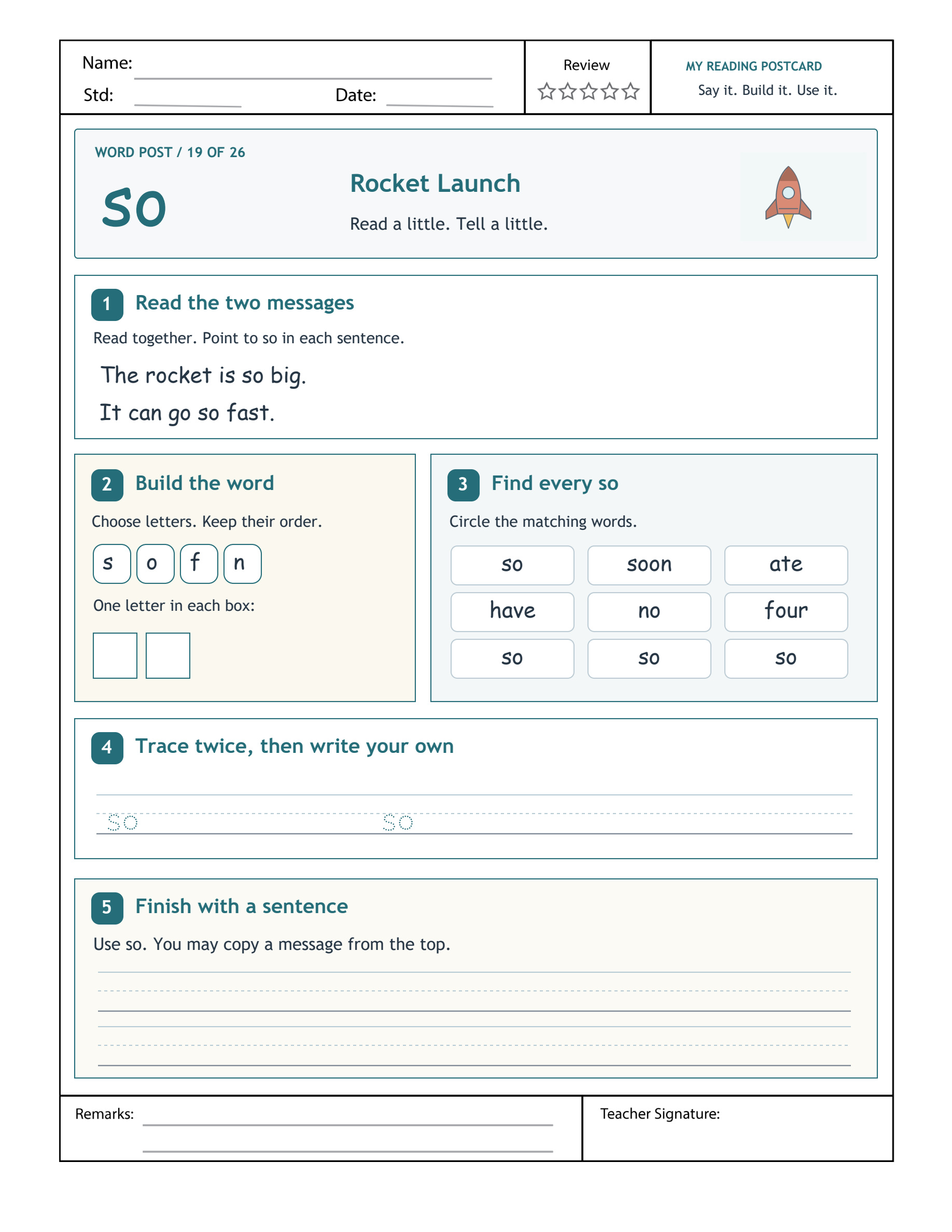
The full so sheet retains its US Letter frame.
Add emphasis to a rocket description without changing the object. The complete redesigned page appears without cropping.
Niko looks up at a storybook rocket and calls it so big. The tiny word adds force to the description without naming another object. So Sight Word practice explores that emphasis through two rocket messages, then connects it with a two-letter spelling, exact matching and handwriting. Children can hear the difference in a spoken description before inspecting the target in print. In the clean rocket lesson, the size and speed messages introduce the s-o investigation. Adults can share unfamiliar vocabulary and choose a small pencil goal that leaves room for the child's own explanation.
Hear what so adds to the description
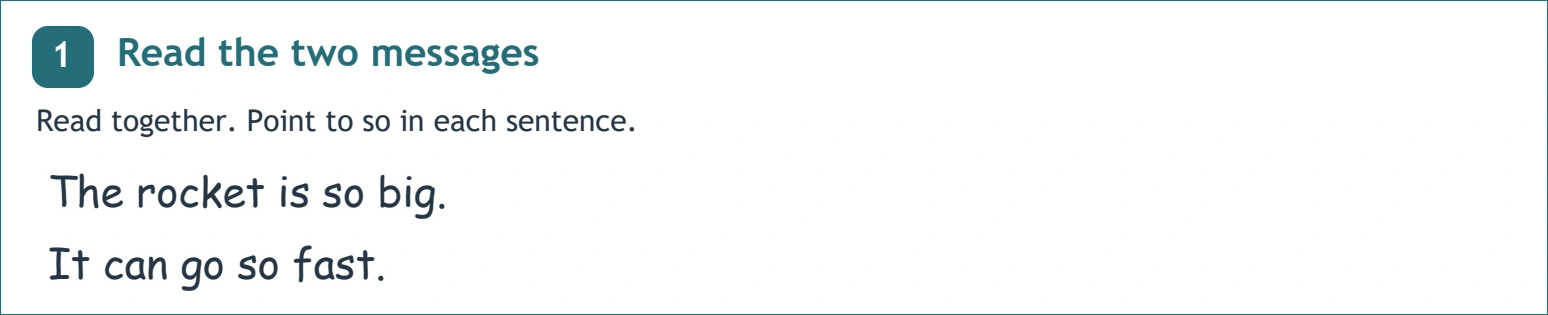
Read “The rocket is big,” then the source version, “The rocket is so big.” Discuss what the speaker wants the listener to notice in the second statement. So adds emphasis to big. It does not create a new rocket or supply a numerical size.
The other source message is “It can go so fast.” Here, so strengthens the description fast. The target's role is similar across the two examples even though one concerns size and the other speed. Use a normal expressive voice rather than requiring the learner to shout the word.

So has other uses in English, including connecting a result with an earlier idea. This worksheet concentrates on emphasis in the two printed descriptions. Keep the first explanation local rather than telling a beginning reader that the word always has one function everywhere.
So Sight Word reading with an established rocket
Introduce the illustrated rocket before reading the second sentence so that it has a clear reference. Then share both messages and invite the learner to locate so. Adult support with rocket, big or fast is appropriate during this guided reading.
The supporting scene uses a large storybook rocket and a small observer to make the size description understandable. It is an illustration of language, not a measurement diagram. Ask what feature the speaker emphasises, rather than expecting the picture to prove a specific scientific fact about rockets.
After locating the target, try another spoken example with a familiar prop, such as a toy that seems so small. The new description can show that so is not a rocket label. Return to the actual s-o spelling once the learner has heard its contribution to the message.
Two letters selected from four options
The bank contains s, o, f and n. Select s-o for the two response boxes, leaving f and n unused. The learner can point to the required letters, arrange loose copies or make a written attempt with the large model still available.
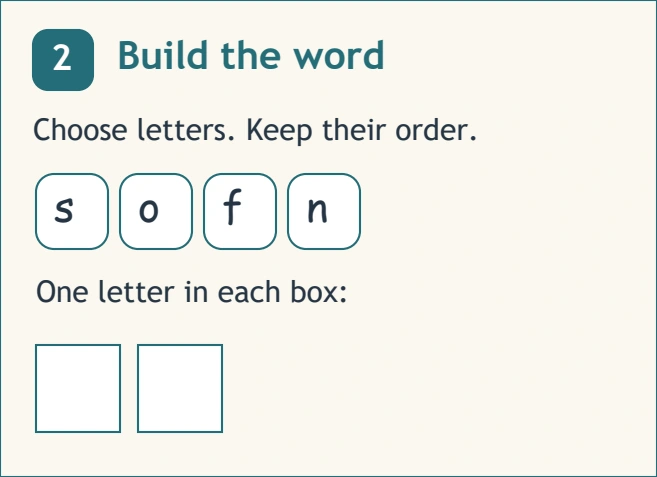
Say so naturally and connect its long vowel sound with the written o in this word. Do not turn one example into a rule claiming that o always sounds the same. Naming s and o supports the spelling, while a complete descriptive sentence keeps the spoken form meaningful.
If o-s is built, compare the first position with the model. Both pieces are present but the sequence differs. A short positional check can resolve the issue before another pencil attempt; extra distractors are not needed merely to make a simple task harder.
Soon starts similarly but is not the target
The search rows read so, soon, ate; have, no, four; so, so, so. Adult so key: 1, 7, 8, 9.
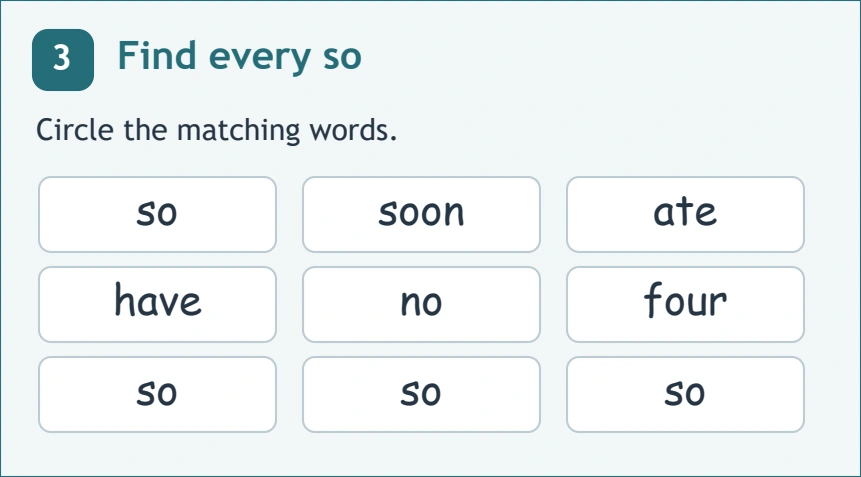
Soon begins with s-o but continues with o-n. The activity asks for the complete standalone so spelling, not any longer word containing its beginning. Point to the extra letters and compare both written forms. This is a useful way to distinguish a whole word from a familiar part.
No shares the o ending but starts with another consonant. Inspect both positions before circling. The bottom row contains three adjacent targets, so every cell still deserves a separate decision after one match has been found.
Trace the word, then prepare an expressive message
Use the dotted so pair to shape s and close o, then try the untraced space. A curved s or a closed o may need an individual demonstration. Keep the correction focused on that movement rather than requiring repeated copies of an entire sentence.

The final writing task allows a sentence with so, including a copied source message. An original description can be rehearsed aloud first. Decide what feature is being emphasised and supply enough surrounding words for the reader to understand the idea.
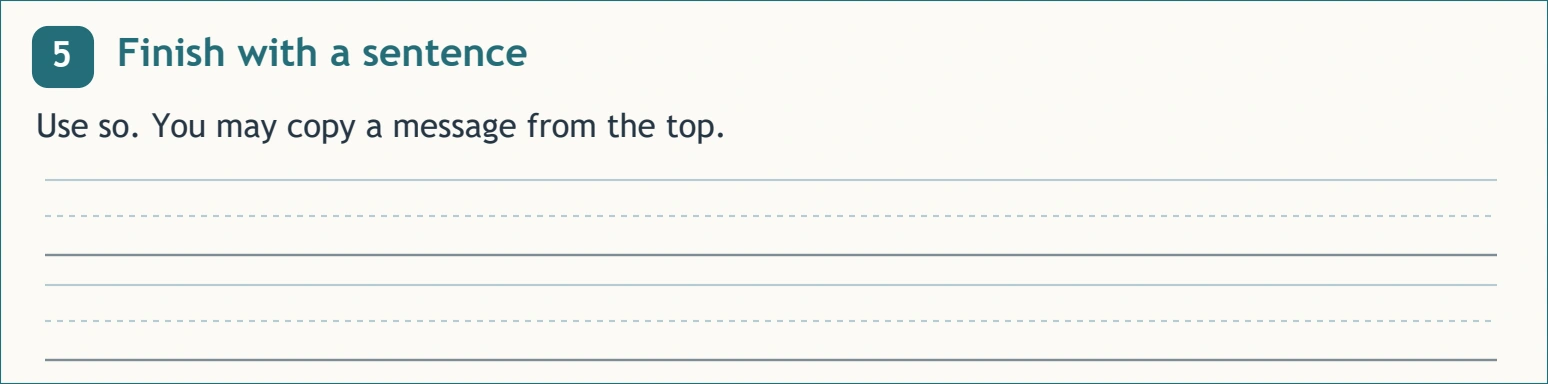
Preserve the child's chosen descriptive feature while an adult supplies harder vocabulary around so. The pencil quantity should remain comfortable. A learner may explain emphasis accurately while still needing support to form s, and a neat copy may need a separate conversation about what the speaker means.
What is retained in the clean reading-first sheet
The rocket's clean layout introduces emphatic descriptions before its s-o tasks. The letter bank neighbours the exact-match grid, followed by dotted models and the sentence finish. Dotted s-o practice comes first on the supplied rocket sample. Every source activity remains inside the established border on the unchanged US Letter page.
The download is a single printable lesson. The webpage's rocket illustration and any spoken comparison game are supporting ideas, not extra worksheet pages or an interactive launch simulation. A familiar toy or picture can supply enough context for the language activity.
A rocket visit can stop after one carefully considered s-o decision. A shared reading, one careful search decision and a short copy can be a sensible amount. Return to another part after a gap and listen for the word's meaning alongside its spelling.
Six observations for an emphasis lesson
- A descriptive feature is noticed: the learner identifies big or fast as the quality receiving emphasis.
- A reference remains clear: it in the second message is connected with the introduced rocket.
- A spoken contrast is heard: the child compares a plain description with its so version.
- A spelling is ordered: s precedes o in the selected bank pieces.
- A whole word is checked: soon is rejected after its additional letters are inspected.
- A message is planned: the final written contribution uses emphasis for an understandable descriptive purpose.
Keep the highlighted feature, such as big or fast, in your observation notes. Track the rejection of soon separately from the child's spoken use of emphasis.
Niko's possible home comparison game
A family member might show a large toy rocket in a pretend story and read the first source sentence. Niko says what feature stands out. The adult compares big with so big, then offers another familiar prop for a fresh spoken description.
They find so in the printed messages and select s and o from the bank. Niko examines the first search row, including soon, and explains whether the whole spelling matches. One guided copy can follow before the adult chooses a comfortable stopping point.
For a final turn, Niko dictates a descriptive sentence about another toy. The adult helps record unfamiliar vocabulary while preserving the child's chosen feature.
Classroom possibility: an observation display
The teacher presents a familiar object or picture with an obvious feature and models a plain description followed by an emphatic so version. Children explain which quality the speaker highlights. Different reasonable observations can be accepted when they fit the object and message.
Return to the rocket examples and ask what so strengthens in each. An adult may read longer words while learners track the target. Some children can contribute through oral explanation, others through bank selection or a written description.
At the individual station, inspect the decision around soon. A child who circles it has noticed a real shared beginning but needs the whole-word boundary clarified. That is a different need from reversing s and o or being uncertain about the descriptive feature. Respond to the specific evidence.
A short response guide
| What happens | A rocket-lesson adjustment | Recheck |
|---|---|---|
| Calls so the rocket's name | Use a different object in a spoken so description. | The word's emphasis role. |
| Circles soon | Inspect the extra o-n after the shared beginning. | The complete standalone target. |
| Builds o-s | Compare the starting position with the large model. | The ordered s-o sequence. |
| Copies accurately without explaining | Compare the plain and emphatic statements orally. | The feature being highlighted. |
Five extensions for descriptive emphasis
1. Compare a plain spoken description with its so version using a familiar toy. Ask which feature the speaker wants a listener to notice.
2. Dictate a caption for a drawing with an obvious quality. The adult supplies longer spellings while the learner contributes so to the completed message.
3. Place so and soon on completed word cards. Compare the two-letter target with the longer beginning match before selecting an exact spelling.
4. Build s-o with large alphabet pieces and let a puppet reverse the positions. Repair the word using the visible model rather than a colour cue.
5. Read a familiar story illustration together and prepare an understandable emphatic description. Keep the child's observation grounded in the shared picture.
Readiness, common mistakes and a calm revisit
Rocket descriptions near ages 4–6 can begin with a spoken observation, leaving s-o copying as a small additional task matched to pencil confidence. A learner may use emphasis naturally in speech before recognising its printed word. Pencil stamina and letter formation should guide how much copying is attempted.
Avoid treating every word starting with so as an exact match, making exaggerated volume the definition of emphasis or claiming the illustration supplies a measurement. Check how the complete s-o spelling contributes to the rocket description. A useful explanation might identify soon's extra ending or name the feature that fast describes.
For more early words, consider the starter word-reading collection. The discovery activities for pencil control can support motor demands before sentence copying. A familiar action may be explored separately through the eat printable activity.
Adults can adapt conversation ideas from PBS Parents' learning resources or shared-play prompts at NAEYC's family pages about play. Choose a small observation the learner has a reason to describe.
Download the rocket-description lesson
The free rocket sample preserves the supplied sequence. A membership plan with the required eligibility provides a clean rocket PDF, opening with the two descriptions. The other four tasks remain, but domain text, website watermarking and advertising are absent from the printable edition. Use that file when the emphatic rocket description needs a clean page for shared practice.
Make a US Letter rocket trial and inspect the complete border and dotted s-o models. A pencil is enough; any comparison toy or alphabet pieces are optional. The $5 collection linked here brings all twenty-six clean primer lessons together. It offers another sentence purpose for a later visit while keeping today's so lesson focused on the feature the speaker emphasises.
Popular Worksheets
Printable resources families and teachers are downloading now.
 Free
 Free
 Free
 Free