
Get Sight Word: 5 Clever Building-Block Reading Activities
Continue beyond get with twenty-six clean reading-first practice sheets in one $5 printable collection.
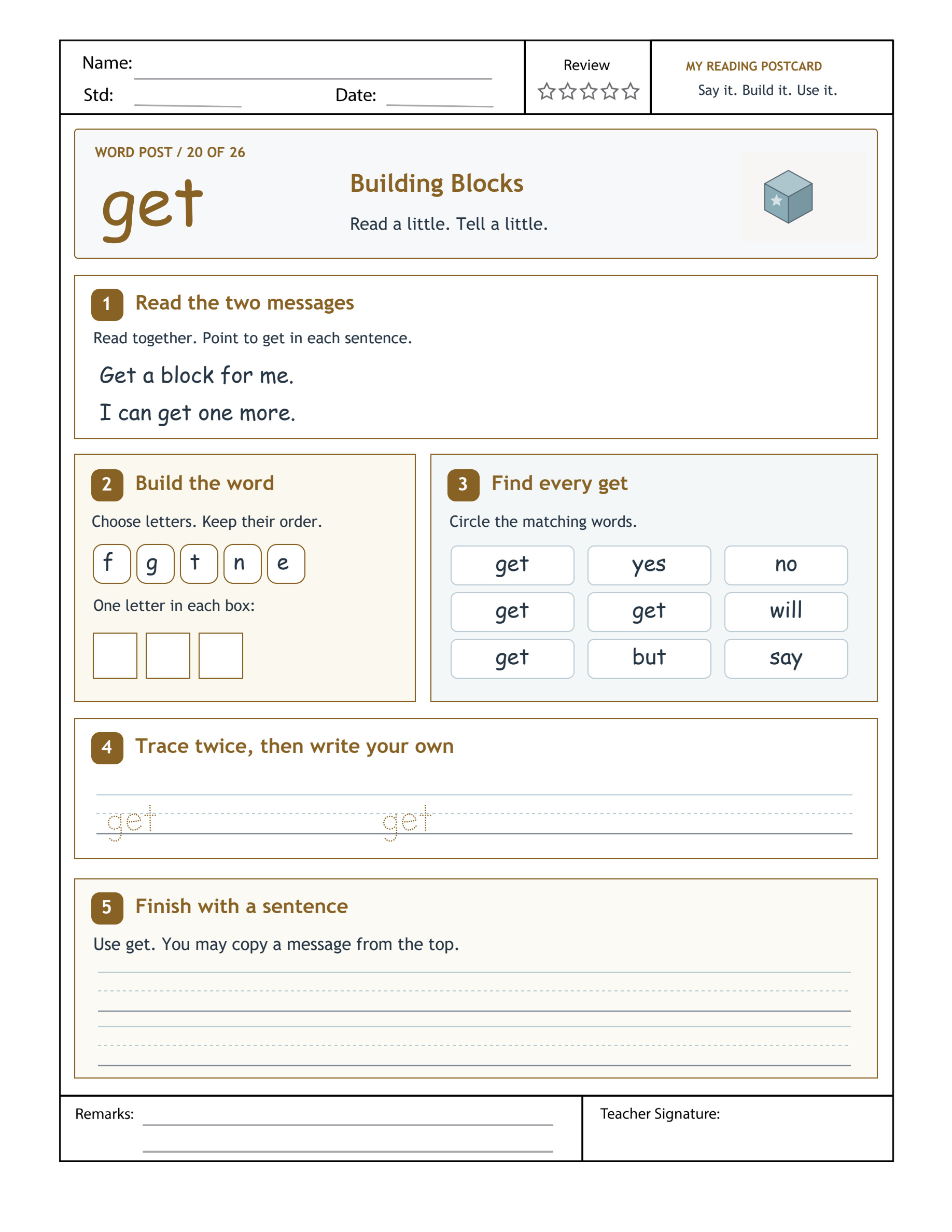
The full get sheet retains its US Letter frame.
Request a block and describe obtaining one more. The complete redesigned page appears without cropping.
Pia needs a block for a pretend building project, so the little word get has something useful to ask a partner to do. Get Sight Word practice connects obtaining an object with two short messages, a three-letter spelling and careful matching. Children can make a request, hear a statement about getting another block and inspect the same target in print. The clean block page presents the request before g-e-t selection, giving the letters a practical job. A few toy blocks, a listening partner and a manageable pencil task can give the page a clear purpose.
A request should lead to an understandable action
Read “Get a block for me” as the voice of a clearly introduced toy builder. Establish which person is asking, who is listening and what object is needed. A partner can obtain a block and bring it to the speaker, making the request's meaning visible.
The second source statement is “I can get one more.” Explain that one refers to another block in this setting. The speaker is describing an ability to obtain an additional item. It is not a separate request for a particular total unless the surrounding activity establishes one.
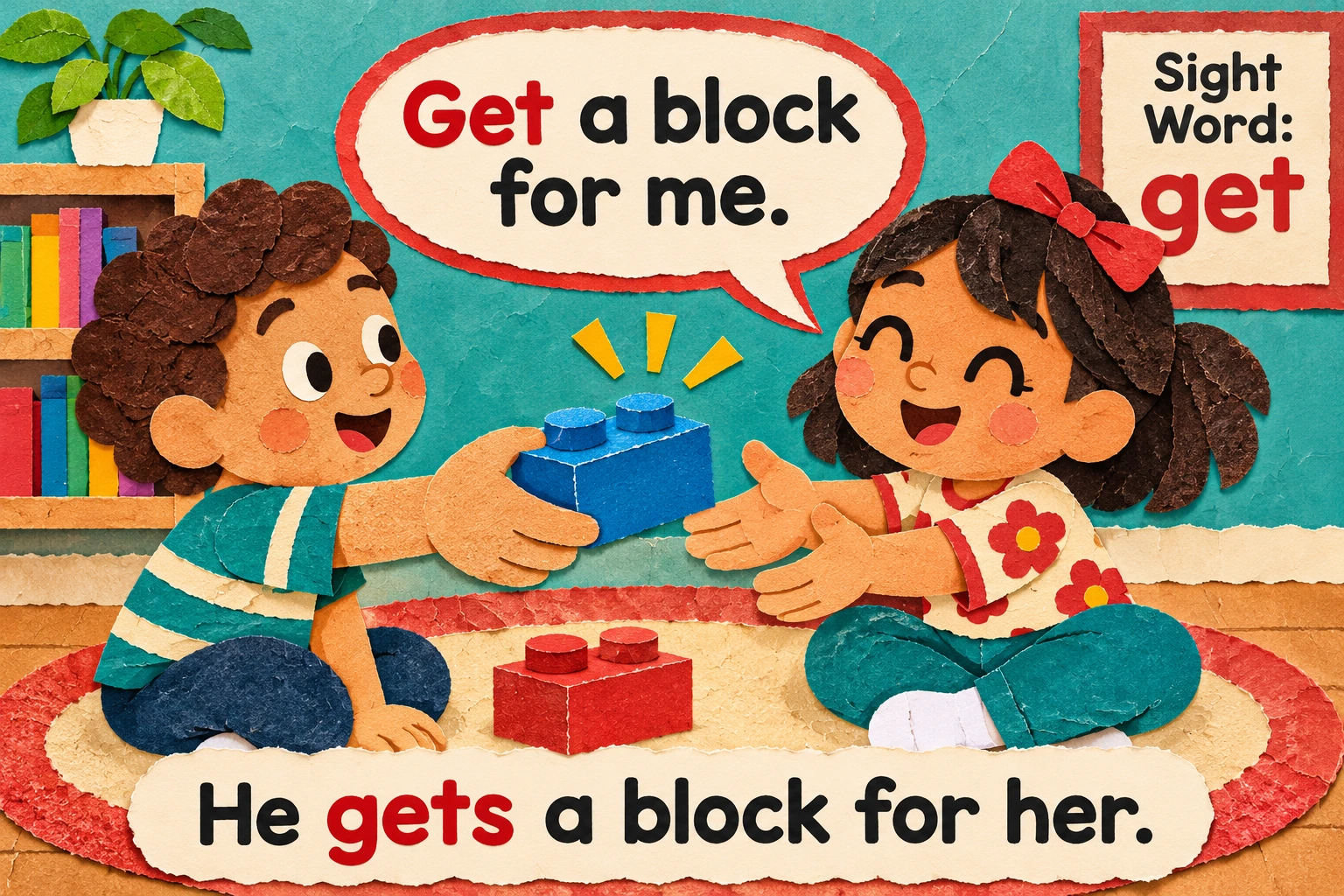
Get has other everyday meanings, but these examples focus on obtaining or fetching a block. Keep the first explanation tied to that clear action. The same relationship can later be explored with another familiar object instead of turning the target into a permanent block label.
Get Sight Word reading begins with roles
Introduce a speaker and listener before sharing the first line. For the second, make clear who I refers to and which block collection is under discussion. Read each message completely, then locate get in its actual sentence position.
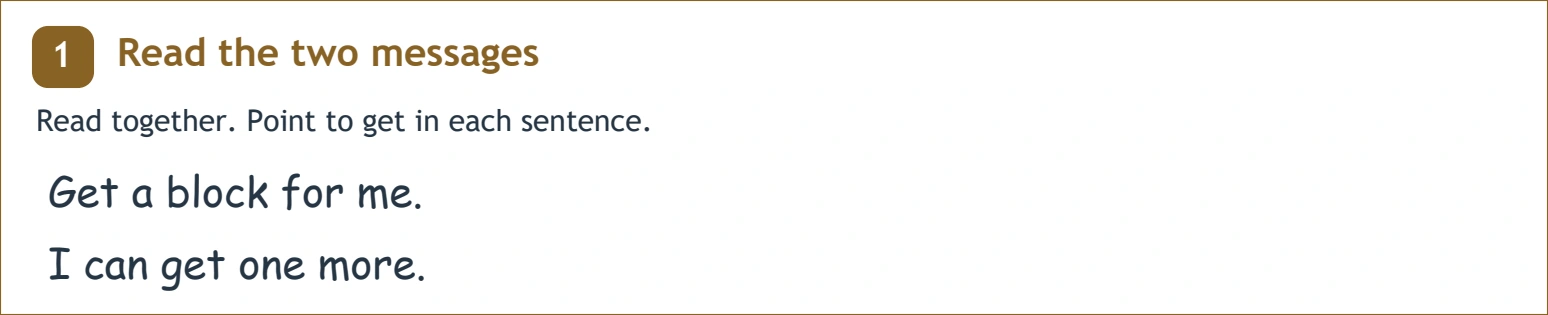
Capital Get opens the request, while lowercase get appears inside the ability statement. Compare G with g and connect both to the large model. Read the harder block-request vocabulary for the learner, then listen to an explanation of what get asks the partner to do.
Ask what a partner would do after hearing the request and what the second speaker says is possible. A child can demonstrate with toys or answer orally. Picture-based understanding is useful, but return to g-e-t so the printed word also receives attention.
Decide how to support the building visit
| A starting difficulty | A useful block activity | What to observe |
|---|---|---|
| Unclear about the request | Act out obtaining a block for an announced speaker. | A response that fits the message. |
| Does not know what one refers to | Restate that another block is being discussed. | A clear object reference. |
| Needs spelling support | Arrange g-e-t beside the large model. | All three positions in order. |
| Ready for writing | Dictate or copy an understandable get message. | A sentence with a listener or purpose. |
These are adaptation choices rather than levels a learner must pass. A sensible toy action may precede independent decoding, while a confident writer may still need help establishing who me refers to in a request.
Select g-e-t from five bank letters
The bank presents f, g, t, n and e. Reserve f and n as the two spare building-bank choices; g-e-t fills the response. The display order is not the answer sequence, so compare each chosen position with the printed model before writing.
Say get naturally and connect its spoken sounds with the complete spelling when the child is ready. A learner may name the letters for selection and then read the word as one unit in the sentence. Keep the message available so the isolated sequence remains meaningful.
The g can demand a particular handwriting demonstration. Show its form and descending part on spare paper if necessary, then return to one manageable copy. A difficult g should not become a reason to repeat every surrounding word or remove the model too soon.
Four exact matches in the search
The rows read get, yes, no; get, get, will; get, but, say. Adult get key: 1, 4, 5, 7.
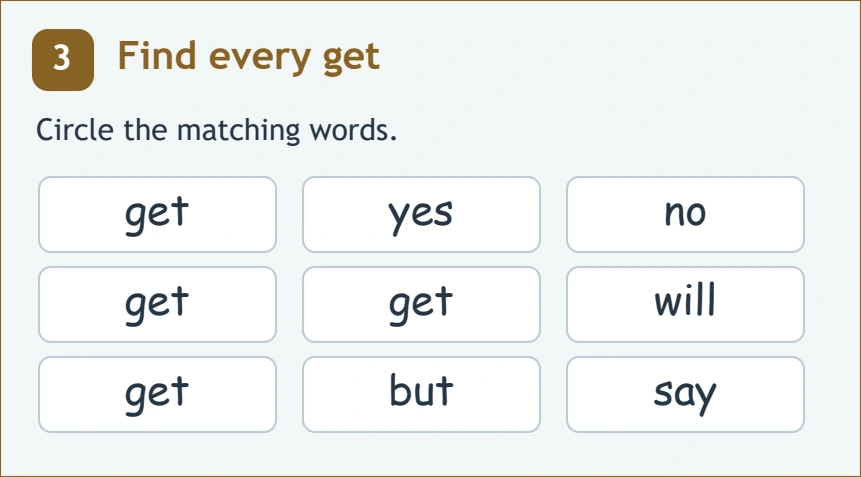
The middle row contains two adjacent matches. Let each receive a separate inspection. The other entries are different complete words, not targets that need letters added or removed. A small counter can mark the current cell when the learner jumps between rows.
Ask for one explanation using the actual letters. A child who compares the initial g, middle e and ending t has shown more deliberate attention than someone who circles a location from memory. Four circles alone do not establish that the correct spellings were selected.
The pencil stations follow a spoken building idea
Both get models show the g route; preserve its descending part when writing a separate copy. The closing task requests a sentence with get and allows a copied source message. A new idea should be rehearsed orally before unfamiliar spellings are added.
A partner can record the requested item and recipient after the learner has rehearsed the message and contributed get. Alternatively, a comfortable writer can attempt a complete source line. The amount should reflect pencil experience rather than a demand to fill every guide at one sitting.
The clean building page lets the request and ability statement lead into g-e-t selection. Its search occupies the neighbouring station; tracing then supports the larger sentence finish. Dotted work starts the retained original. The five supplied activities and original framed US Letter size remain unchanged.
Six observations from a request-and-fetch exchange
- A request has a recipient: the learner knows who is being asked to obtain the block.
- An action fits the words: the partner brings the requested object to the established speaker.
- A reference is clear: one more is connected with another block rather than an unspecified object.
- An opening changes case: capital Get starts the request; lowercase get retains its identity within the ability statement.
- A sequence is deliberate: the bank letters become g-e-t instead of their display order.
- A written contribution communicates: the final message asks or reports something understandable about obtaining an item.
Record who receives the block and how g-e-t was arranged. Following a request and preserving its middle e are different observations for the next visit.
Pia's possible home building request
A family member might set up a small pretend building site and introduce a toy builder as the speaker. The adult reads the request while Pia obtains a block for that character. They then establish who says the second message and what another block would mean in the game.
Pia finds get in a printed request, selects g-e-t and checks one grid row for complete matches. Stop this building session before more writing if her attention is tiring.
For a closing turn, Pia makes an understandable request about another familiar prop. The listener acts after hearing it, giving the speaker a reason to check the message.
Classroom possibility: a materials desk with speaking turns
At a small-group station, the teacher establishes a builder and a materials helper. The builder uses a completed get request, and the helper obtains the named object. Change roles explicitly so me has a clear reference on each turn.
Return to the two source lines and discuss the request versus the ability statement. An adult can read longer words while a learner points under get. Some children can participate through action, others through explanation or letter selection, and comfortable writers can record a new request.
Partners should leave each other's bank and grid decisions visible. A listener can point to the model without rearranging all the answer pieces. Record a particular contribution, such as a clear speaker reference or an ordered g-e-t, rather than comparing completion speed.
Five extensions for obtaining and requesting
1. Give a puppet a completed request for a familiar prop. The child responds, then explains who the object was obtained for.
2. Create a materials-helper turn in pretend play. Announce the speaker before each get message so me remains understandable to the listener.
3. Let a toy confuse e and t in get, then restore the three positions beside the completed g-e-t card.
4. Dictate a caption about a character who can get another item. Establish what one refers to before the adult records unfamiliar vocabulary.
5. Match a completed request with two acted scenes, one where the named object is obtained and one involving a different action. Discuss which response fits.
Readiness and common mismatches
For a supported learner around 4–6, fetching a block can establish get before the descending g is comfortable; let that difference guide your assistance. A child may carry out a clear request before independently reading every word in it. Another may copy accurately while needing more context for the speaker's me.
Avoid changing the requested object without explanation, treating get as a block name or copying bank letters in display order. Keep the roles and complete g-e-t model visible. If writing becomes tiring, accept a dictated message and a small target attempt rather than repeated full-line corrections.
Review can happen during another short pretend materials exchange. Appreciate a specific contribution such as obtaining the correct object for the announced speaker or retaining the middle e. The lesson can remain brief enough that another visit is welcome.
For other early words, explore the reading starter-route collection. The discovery resource for pencil work can support motor preparation, while the eat early-reading lesson provides a separate familiar action focus.
Additional shared-activity contexts can be found through NAEYC's family play materials and PBS Parents' learning pages. Choose an exchange where the child has a real reason to ask or respond.
Download the building-block lesson
Choose the free block sample for the source task order. The premium control unlocks a clean block lesson for a member whose current plan includes access. All five activities remain, with website domain text, watermarks and advertising removed. Its printed requests can then accompany a clearly introduced builder and helper without using the original tracing-first arrangement.
Check one US Letter block print for its full outer frame and the descending g in the dotted word. Toy blocks may accompany a pencil, but no additional equipment is needed. The collection card leads to a $5 file containing twenty-six clean primer sheets in sequence. Pick a new word from that file when the building conversation needs another message rather than a longer repetition of get.
Popular Worksheets
Printable resources families and teachers are downloading now.
 Free
 Free
 Free
 Free