
Like Sight Word: 2 Wonderful Cupcake Preference Messages
Continue beyond like with twenty-six clean reading-first practice sheets in one $5 printable collection.
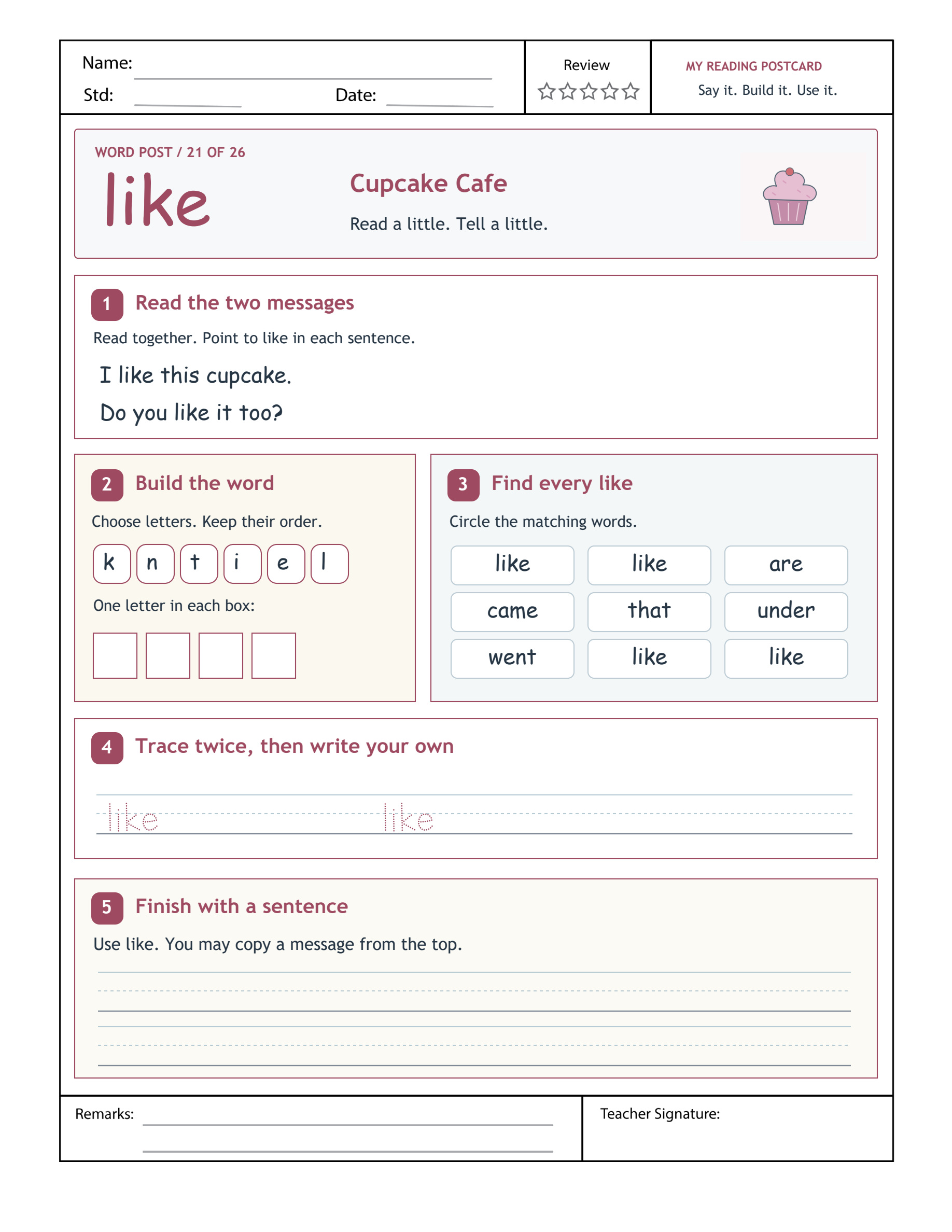
The full like sheet retains its US Letter frame.
Express a cupcake preference without assuming everyone agrees. The complete redesigned page appears without cropping.
Remy can enjoy the pictured cupcake while a friend prefers something else. That difference gives Like Sight Word practice a useful conversation: one speaker expresses a preference and then asks about another person's view. Two source messages connect that exchange with four written letters, a matching search and handwriting. The clean edition begins with reading, so the word's purpose is established before isolated practice. Adults can share unfamiliar vocabulary, accept a genuine answer and choose a comfortable writing goal. Pretend food pictures are sufficient; nobody needs to eat a cupcake to understand the lesson.
A preference belongs to its speaker
Read “I like this cupcake” as a statement spoken by a named café character. Establish which cupcake is meant and who is speaking. The statement tells us about that character's preference, not a rule that everyone should enjoy the same food.
The second source message asks, “Do you like it too?” Explain that it refers to the cupcake already discussed. The question invites another person's view. A different preference can be an accurate response, and understanding the question does not require agreeing with the printed speaker.
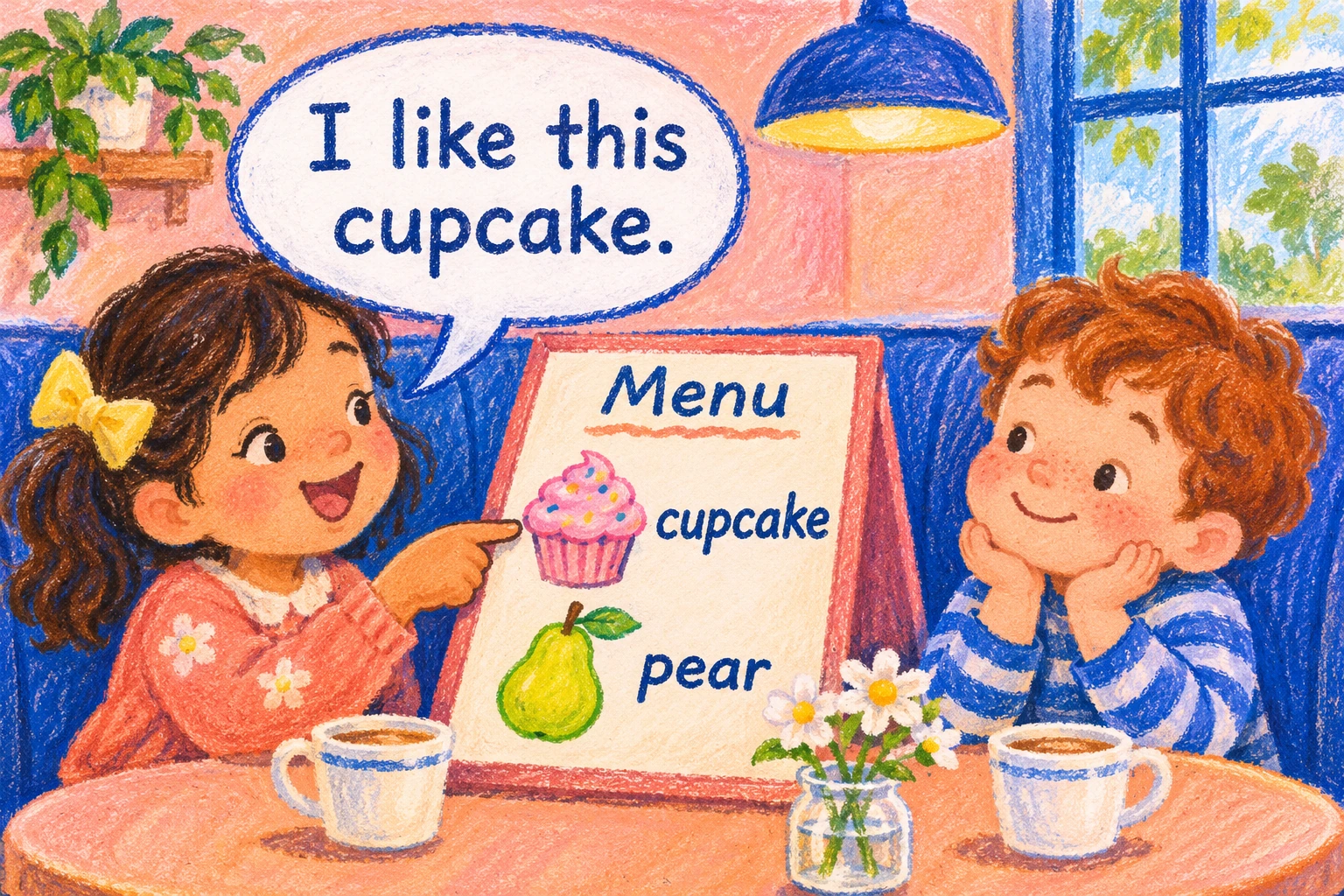
The supporting café scene uses a completed picture menu to make a choice visible. It is a conversation aid rather than a food recommendation. You can replace the pretend cupcake with a familiar book, colour or toy when extending the spoken activity beyond the supplied examples.
Like Sight Word reading leaves room for an answer
Share both printed lines as an exchange between two established partners. Pause after the question so the listener can respond. Then locate like in each sentence and compare it with the large lowercase model. Adult help with cupcake or other surrounding print is appropriate during shared reading.
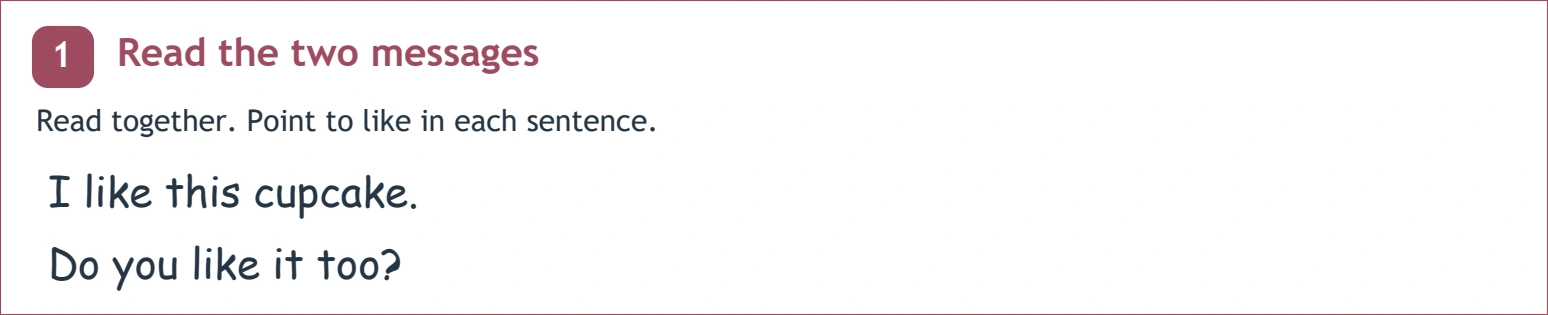
The target appears within both lines rather than opening either sentence. A learner needs to track the message to find it, instead of assuming the practised word always comes first. Pointing under each word while reading can support that inspection.
Ask whose preference is described and whose preference is being requested. A child can explain orally or through a clear picture choice. Return to l-i-k-e afterwards so that a sensible picture-based answer is not mistaken for complete evidence of written recognition.
Four letters selected from six bank options
The bank presents k, n, t, i, e and l. Choose l-i-k-e for the four response boxes, leaving n and t unused. The correct pieces are scattered, and the final displayed letter belongs at the beginning of the target. Compare each position with the model before writing.
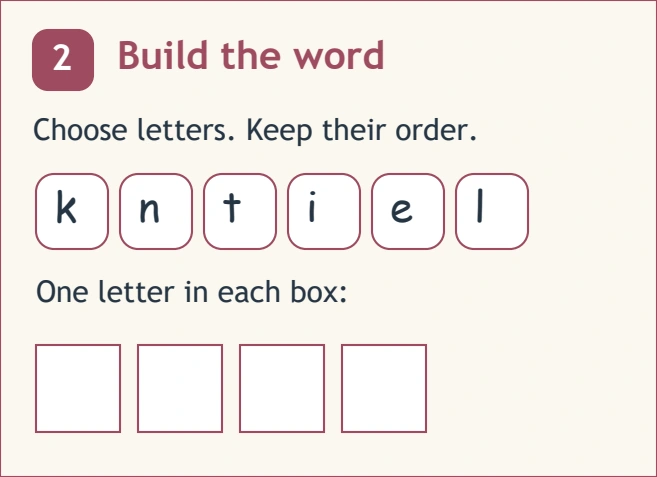
Say like naturally and name its letters in order. A learner with suitable phonics experience can notice the long vowel in the spoken word while inspecting its written ending. Keep the explanation tied to this spelling rather than requiring an unfamiliar rule before the child has heard the complete message.
If the learner selects all four pieces in another arrangement, ask where l begins the model and what follows. Loose letters can allow a careful repair before the additional movement demands of handwriting. Collecting the right alphabet pieces is only one part of building the word.
Four complete matches among nine choices
The search rows read like, like, are; came, that, under; went, like, like. Adult like key: 1, 2, 8, 9.
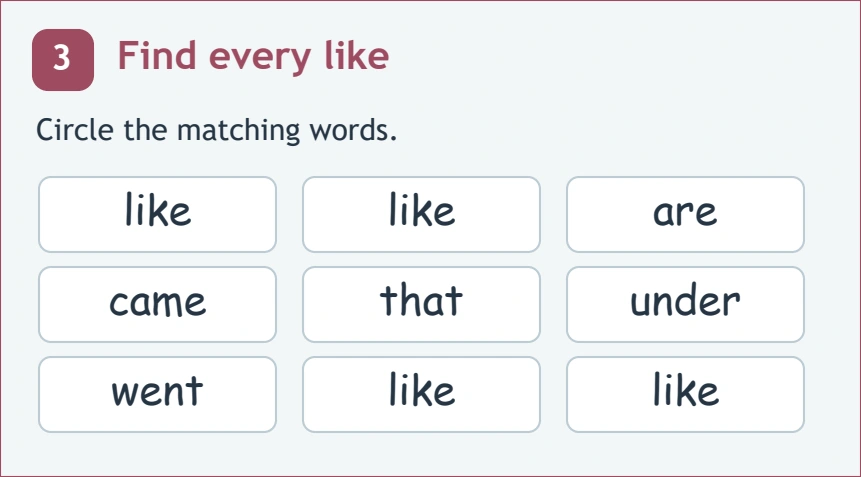
Came ends in e and has four letters, but its complete sequence differs from like. Word length and a familiar ending can support an initial observation without deciding the answer. Ask for l-i-k-e in the same order as the model before a circle is made.
The top and bottom rows each contain adjacent matches. A learner should inspect the second cell separately after identifying the first. Use a place-keeping counter when needed, and ask for one explanation grounded in the letters rather than the remembered position of a circle.
Pencil work after a preference has been spoken
Trace like with attention to the k formation, then reproduce the entire l-i-k-e sequence independently. The k may need an individual formation demonstration depending on the child's experience. Keep the large model available and select a manageable amount rather than demanding uniform adult handwriting.
The final sentence task allows copying a source message or preparing another line with like. Rehearse the idea orally first and establish the speaker. Keep the speaker's actual preference intact while an adult supplies unfamiliar words around the child's like contribution. A truthful personal preference or an announced pretend character's preference can both supply a clear purpose.
The clean café page starts with a preference and a question about another view. Letter selection shares the middle with matching, before tracing and sentence writing. The retained sample opens with dotted like work. All five tasks remain within the established US Letter border.
Six observations within a preference exchange
- A speaker's view is identified: the learner knows whose preference the first statement describes.
- A listener's view is invited: the question is understood as asking another person rather than demanding agreement.
- A reference stays clear: it points back to the established cupcake in the conversation.
- A sentence is tracked: like is located inside each line rather than assumed to be the opening word.
- A spelling is ordered: l-i-k-e is assembled despite its scattered bank positions.
- A message reaches a reader: the final written contribution expresses an understandable preference or question.
Notice whether the child allows a different partner preference, then record l-i-k-e selection separately. Agreement is not a substitute for either listening or spelling.
Remy's possible home picture-menu conversation
A family member might set out pictures of a cupcake and a familiar alternative. Remy chooses a picture and says what is liked, with an adult modelling the complete sentence when needed. The partner answers the follow-up question according to their own preference rather than trying to match Remy's choice.
They read the worksheet exchange and locate like in both messages. Remy selects the bank letters and inspects the first search row. Pause before further like writing if Remy needs a break.
For a closing turn, switch to a different non-food picture and repeat the exchange. The target remains useful because it expresses a preference, not because a cupcake is always present.
Classroom possibility: a preference interview
At a small literacy station, partners receive familiar object pictures and an established speaking turn. One learner expresses a preference, then asks the partner a suitable like question. The listener may agree or choose differently. The teacher models respectful listening while keeping the language task clear.
Return to the source messages and ask what it refers to. An adult may read longer words while children track like and explain the exchange. One learner may explain the partner's preference, another can locate like, and a comfortable writer can prepare a caption; identical independent copies are unnecessary.
During individual search work, compare complete spellings. A child who circles came after noticing its length needs a letter-sequence check, while one who always agrees needs a clearer invitation to offer their own view. Respond to the actual evidence instead of prescribing extra copying for every mismatch.
Choose a specific adjustment
| Observed response | A preference-lesson move | Recheck |
|---|---|---|
| Assumes everyone must like the cupcake | Model a different valid partner preference. | The difference between speakers' views. |
| Cannot explain it | Point back to the item already introduced. | A clear object reference. |
| Builds letters in bank order | Compare positions against l-i-k-e. | The deliberate sequence. |
| Circles came because it has four letters | Inspect each letter, not only the length. | An exact target decision. |
Five extensions for a word with a personal purpose
1. Create a completed picture menu with two familiar non-food choices. Partners express preferences and ask about each other's view without a compulsory matching answer.
2. Dictate a caption for a favourite story character's object. Establish whose preference is being voiced before the adult records unfamiliar vocabulary.
3. Build l-i-k-e with movable letters and let a puppet start with k from the bank. Repair the order through comparison with the printed model.
4. Compare like with another four-letter word on completed cards. Explain why equal length does not make the spellings identical.
5. Prepare a short preference question for a family audience. Let the listener answer, then find like inside the completed written version.
Readiness and a comfortable revisit
Preference interviews around ages 4–6 can remain spoken until the learner is ready for l-i-k-e writing; understanding another view does not require a long copy. A child can express a preference before independently decoding every word of the question. A careful copier may still need help identifying whose view is being described.
Avoid treating agreement as the only correct response, using the cupcake picture as the sole recognition cue or asking for a long written message before the idea has been spoken. Keep the target visible and appreciate a specific contribution, such as tracking like inside the line or explaining a partner's different choice.
For more short-word visits, browse the reading starter pack for early words. The pencil discovery collection can reduce motor demands before sentence copying. Another snack-related action is available on the eat early-reading activity page for a separate focus.
Adults can explore further conversation settings through PBS Parents' activity resources and shared-play ideas at NAEYC's family guidance on play. Choose a small exchange where the learner has a genuine view to communicate.
Download and print the cupcake-themed lesson
The cupcake sample remains available free in its original sequence. An eligible membership unlocks the clean premium PDF, placing the preference exchange before isolated practice. The complete activity set is preserved while the website name, domain and watermark are removed. The clean worksheet includes no advertising, leaving the child's preference conversation and writing as its content.
Use a US Letter café trial to inspect the full frame and dotted k forms before making more copies. A pencil and optional picture choices are enough. The $5 file keeps like alongside 25 clean companion lessons for later reading visits, after both partners' preferences have been heard.
Popular Worksheets
Printable resources families and teachers are downloading now.
 Free
 Free
 Free
 Free