
Did Sight Word: 5 Amazing Kite-Memory Learning Activities
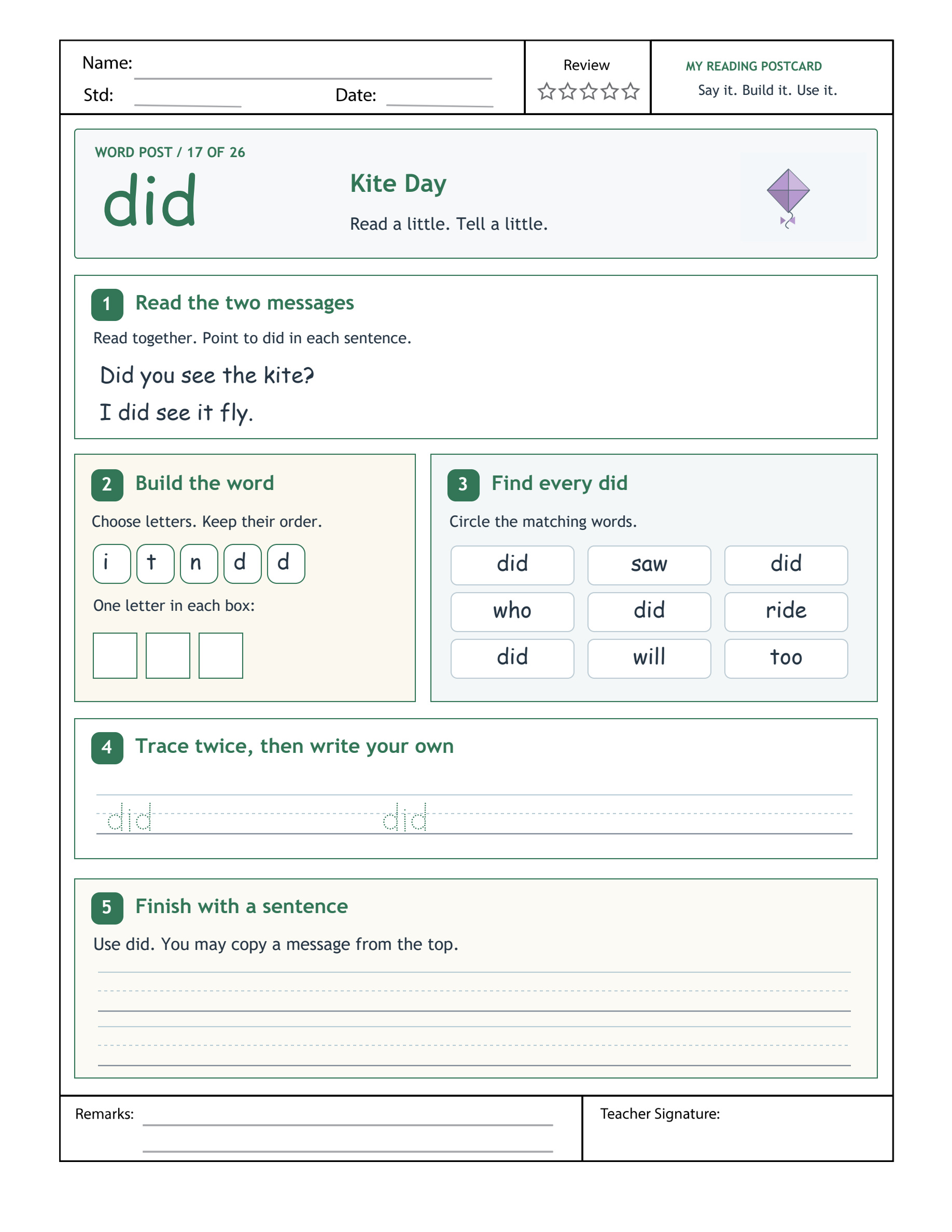
Continue beyond did with twenty-six clean reading-first practice sheets in one $5 printable collection.
The full did sheet retains its US Letter frame.
Notice a completed kite sighting and a past-tense question. The complete redesigned page appears without cropping.
The kite has already flown, but Kavi can still talk about seeing it. Did Sight Word practice gives that memory a question and an answer, then connects the spoken exchange with three written letters. Children inspect a repeated d, select four exact matches and prepare a short written message. A simple earlier-and-now story supplies the context without requiring a real kite outing. The kite question introduces the clean layout before its repeated d letters become a pencil task. An adult may read the kite vocabulary while the learner explains which event did concerns.
Establish what happened before the question
Show a picture of a child watching a kite, or act out a brief toy-kite flight. Then set that event in the past by announcing that you are talking about what was seen a moment ago. Ask the source question, “Did you see the kite?” The listener now has an experience to recall.
The answer printed on the sheet is “I did see it fly.” Read it from the point of view of the character who watched. Did connects the present conversation with the completed experience. It does not mean kite or fly by itself.
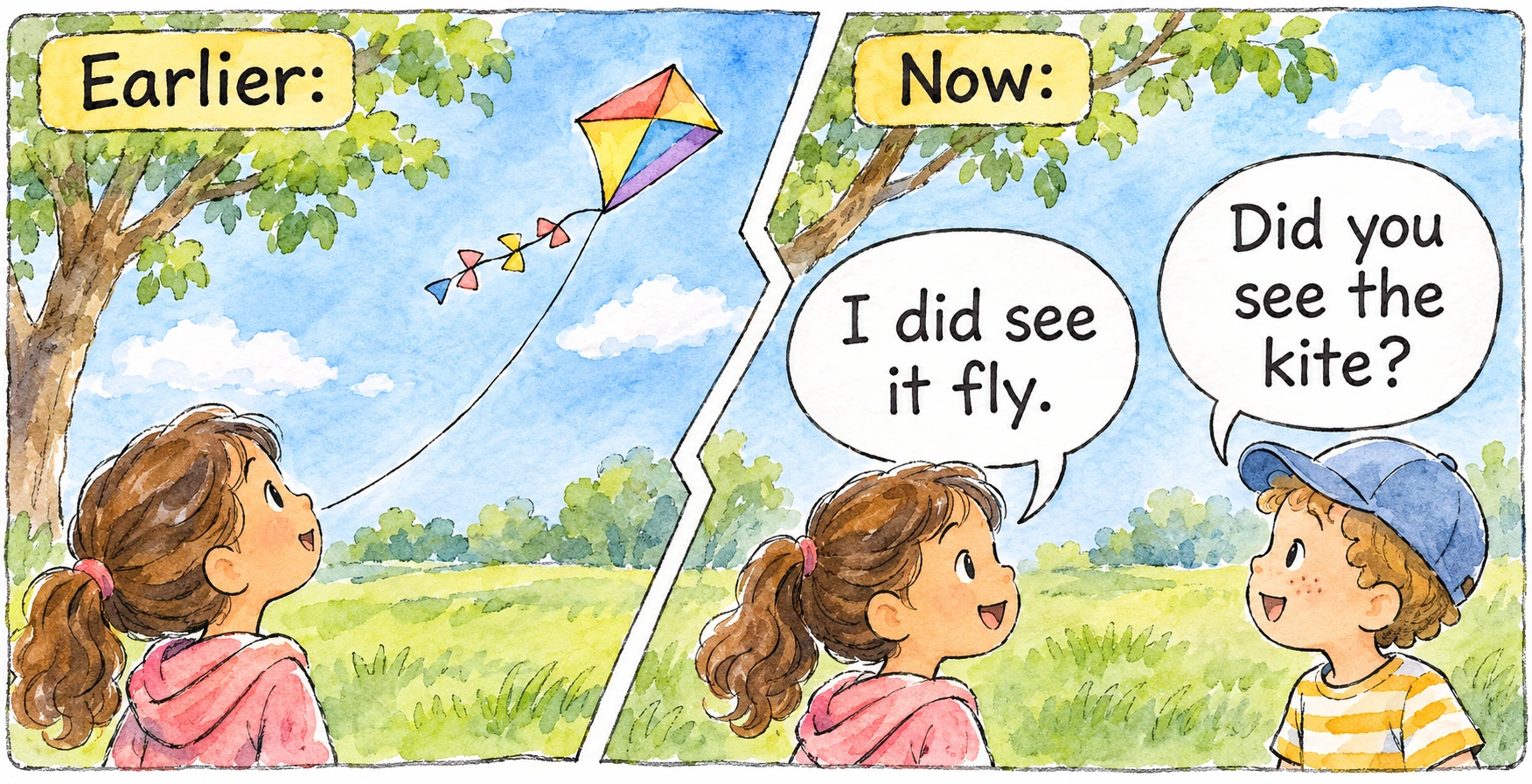
A pretend event is enough. The supporting two-panel artwork makes earlier and now visible so the child can follow the memory. The page does not depend on weather, an outdoor trip or owning a kite before its language can be explored.
Did Sight Word reading joins a question with a report
Read both source lines as an exchange between two introduced characters. One asks about the earlier sighting; the other reports that it happened. Ask the learner who saw the kite and what event is being recalled. A gesture towards the earlier picture can be part of a clear response.

In the question, capital Did opens the line. Lowercase did appears within the reply. Connect the two written forms with the large d-i-d model. Adult help with the surrounding vocabulary is appropriate while the child tracks and explains the target.
Notice that the question uses see after did: “Did you see,” rather than adding another past form there. Model the source sentence naturally without requiring a grammar lecture. The learner can hear a correct complete phrase while the spelling investigation stays small and manageable.
Two d positions around one i
The bank contains i, t, n, d and d. Select d-i-d for the three response boxes. Both d pieces are necessary, one at the beginning and another at the end. The unused t and n remain outside the answer.
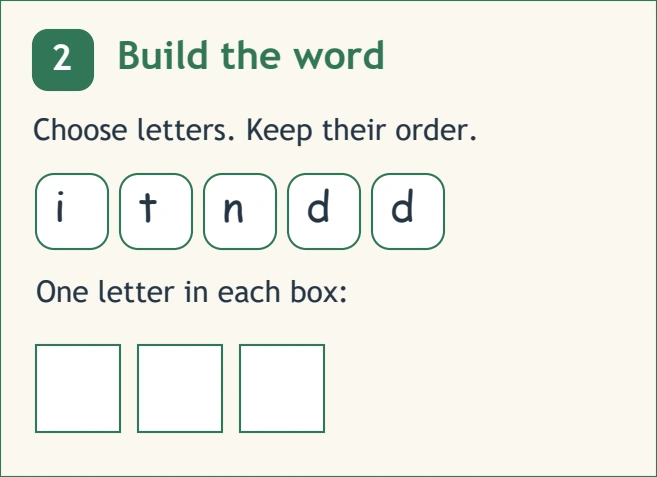
A child may find one d and i, then stop because both different letter names have been identified. Count the written positions in the model and point to its closing d. A repeated letter still needs a separate place in the spelling.
Read did naturally after building it. Use d-i-d for a brief blending demonstration only when its three sounds are already familiar to the learner. If the d formation is difficult, demonstrate the shape once on spare paper before returning to a short complete-word attempt.
A nine-word search with a useful distractor
The grid rows are did, saw, did; who, did, ride; did, will, too. Adult did key: 1, 3, 5, 7.
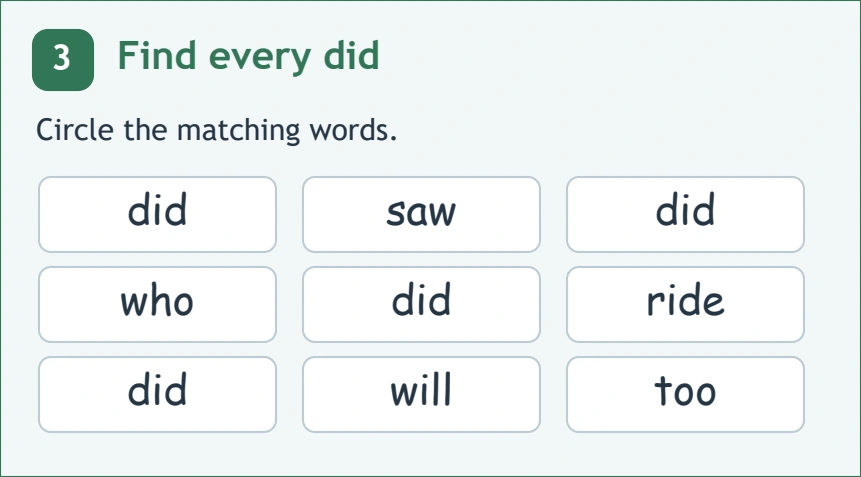
Saw concerns an earlier experience too, but that related meaning does not make it a match for did. This search asks for a specific written form. Resolve the spelling decision first, then discuss the different past-event word in a separate oral example if appropriate.
Ride contains familiar i and d letters in a longer sequence. Compare its beginning and ending with d-i-d. A child who can explain why ride does not qualify has inspected more than one feature. Keep the target visible rather than turning the grid into a memory test.
Handwriting after a remembered message
Trace did through its two d positions and central i before making an independent three-letter copy. The remaining guide offers room for an independent copy. Check that the closing d is retained rather than treating a two-letter fragment as complete.
The final task permits a sentence using did, including a copied source line. For an original message, first establish an earlier event and rehearse the sentence orally. An adult may write the longer kite report once the learner has identified the earlier event and supplied did. The written contribution can remain short when pencil stamina is limited.
The clean kite lesson establishes its question and remembered reply before d-i-d selection. The grid shares the middle; dotted copies then prepare the expanded writing area. The retained sample opens with tracing. All five source activities and the established US Letter frame remain.
Six observations for a kite-memory visit
- An earlier event is established: the learner knows which kite sighting the question concerns.
- A question has a respondent: the child identifies who is being asked about the experience.
- A reply reports something: the did-see answer is connected with the character who watched the flight.
- Repeated positions are retained: both d letters appear around the central i.
- Meaning and spelling are separated: saw is not circled merely because it also relates to the past.
- A written memory has context: the final message gives a listener or reader enough information to understand the report.
A kite note should identify the recalled event as well as the two d positions. A clear memory can be present even when one written d is missing.
Kavi's possible home memory exchange
A family member might move a paper kite across a story scene while Kavi watches. After setting it down, the adult asks the source question about that earlier movement. Kavi responds from actual memory of the pretend event, with a model answer available if needed.
They read the printed exchange, locate did in both lines and build the three-letter sequence with two d pieces. One search row or a guided word copy can follow. The adult chooses a comfortable stopping point while the remembered scene remains available to discuss.
For a later turn, recall a different brief toy action and prepare a suitable did question. The new context can show whether the word's purpose transfers.
A classroom memory station with a visible earlier scene
The teacher shows a short picture action or performs a toy movement, then marks it as earlier. A pair of learners takes the roles of questioner and witness. The questioner uses the printed kite question when it fits the scene, while the witness answers according to what was established.
Keep the event clear rather than trying to catch children with an invisible memory test. The purpose is to connect a past-question helper with an understandable experience. An adult may read the longer words while the learner supplies Did and explains the response.
At the worksheet station, some children can build d-i-d with support, while others compare did and ride or dictate a new report. Partners may listen and point to the model without taking over the marks. Record a specific observation rather than completion time.
A guide to the next useful prompt
| Observed response | A kite-memory adjustment | Check again |
|---|---|---|
| Cannot identify the recalled event | Show the earlier scene and establish when it happened. | The context for the question. |
| Builds only d-i | Count all three model positions and restore the final d. | A complete repeated-letter spelling. |
| Circles saw as a target | Separate related meaning from exact written form. | The actual d-i-d sequence. |
| Explains orally but tires writing | Accept dictation and one target attempt. | A manageable written report. |
Five further invitations to recall and report
1. Perform a brief toy action, mark it as earlier and ask a suitable completed did question. The listener answers from the established event rather than guessing an adult's hidden story.
2. Create an earlier-and-now drawing pair. Dictate a report about what the character did see before the current conversation.
3. Build d-i-d with large alphabet pieces, let a puppet remove one d and invite the learner to repair the missing position.
4. Compare did and ride on completed cards. Inspect their beginnings, lengths and endings before making an exact-match decision.
5. Ask about an event already established in a shared picture story. Help record the child's did question so a partner can offer an informed reply.
Readiness and a comfortable review habit
Kite-memory work suits supported readers aged about 4–6 when the earlier event is clear, with d formation and sentence length adapted separately. Oral experience with recalling an event may precede independent decoding of the entire question. Pencil demands should reflect the child's actual formation skills rather than the length of the printed reply.
Avoid confusing a related past-event word with a spelling match, omitting the second d or asking about an event the learner has never been shown. Use a clear earlier scene, a visible model and one manageable written goal. Appreciate the particular contribution observed, such as identifying the witness or retaining both d letters.
For other short-word work, the pre-primer pack of reading routes offers an earlier sequence. The pencil discovery activity collection can support motor needs before longer copies. A familiar action focus is available through the eat reading practice page for another visit.
Adults can find additional conversation settings in PBS Parents' learning prompts and shared-play ideas at NAEYC's family resources. Choose a small event that is easy to establish and talk about afterwards.
Download the kite-memory worksheet
Use the free kite sample for the provided activity route. Eligible membership permits a clean premium PDF whose opening station reads the question and reply. The clean kite file retains those tasks after its domain lettering and promotional marks have been removed; no advertising is included. That edition gives the earlier kite scene a clean printed companion without requiring the original tracing-first start.
Try one US Letter kite sheet and inspect its complete border plus both d positions in the dotted models. A pencil and optional picture timeline are enough to begin. For later word visits, the $5 collection supplies the twenty-six clean primer pages together in sequence, allowing the next question or report to be chosen from a single file.
Popular Worksheets
Printable resources families and teachers are downloading now.
 Free
 Free
 Free
 Free