
Do Sight Word: 2 Clever Ball Questions for Young Readers
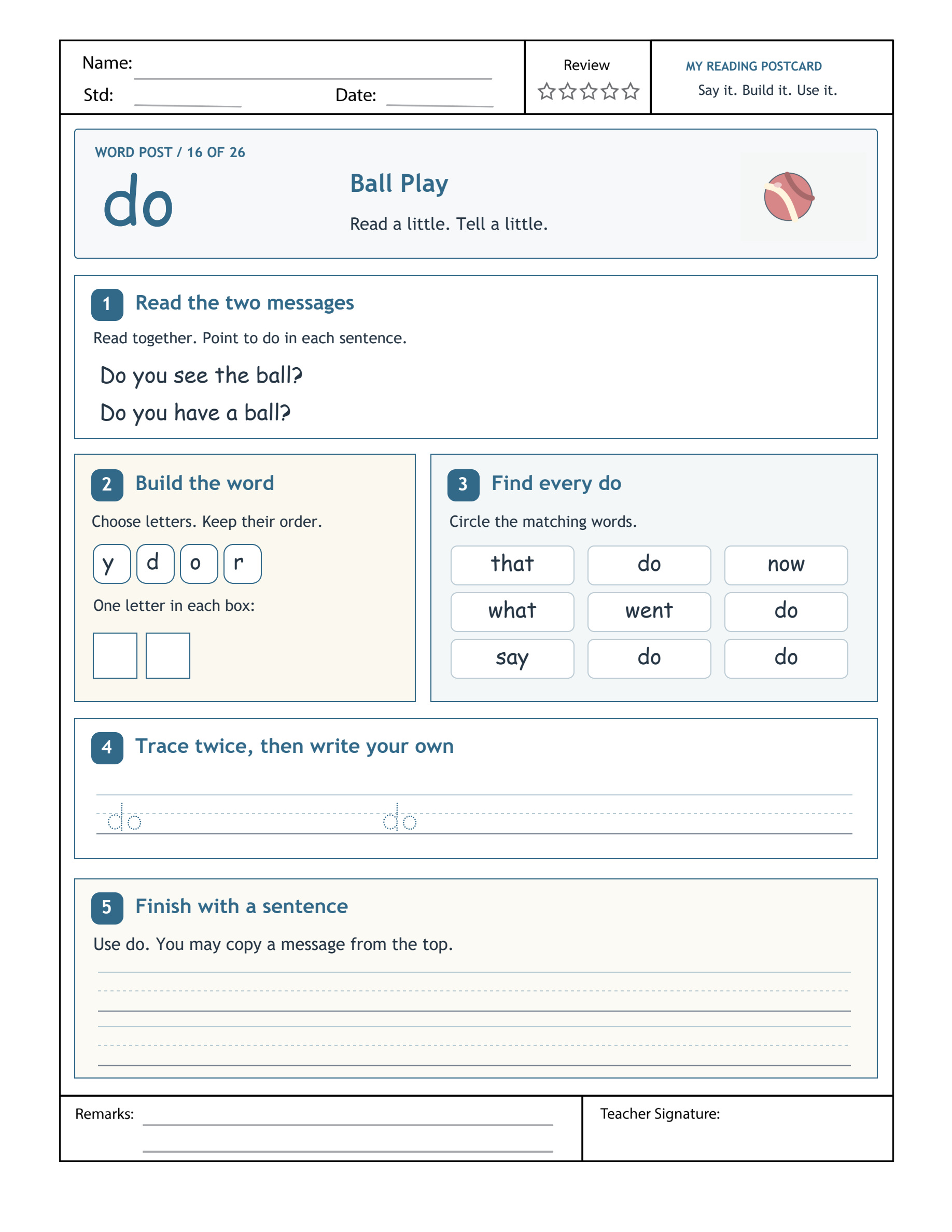
Continue beyond do with twenty-six clean reading-first practice sheets in one $5 printable collection.
The full do sheet retains its US Letter frame.
Recognise the opening helper in a present-tense question. The complete redesigned page appears without cropping.
Owen has a ball question for a partner: can the partner see it, and does the partner have one? The small opening word do helps frame those questions. Do Sight Word practice gives children two complete examples before asking them to inspect a two-letter spelling, select matches and write. A ball picture supplies a familiar subject, while the listening exchange gives the print a purpose. Reading the ball questions first gives the listener a reason to inspect their d-o opening. Adults can share the vocabulary and choose a comfortable amount of pencil work for each visit.
Ask a question that has a listener
Place a toy ball where both partners can see it. Introduce who is asking and who is answering, then read “Do you see the ball?” Give the listener time to respond. The question requests information rather than merely naming the object.
Next read “Do you have a ball?” This asks about having one, which is a different matter from seeing the ball already on display. A listener might see the shared ball without having another. The two questions should not be treated as identical simply because they begin and end similarly.
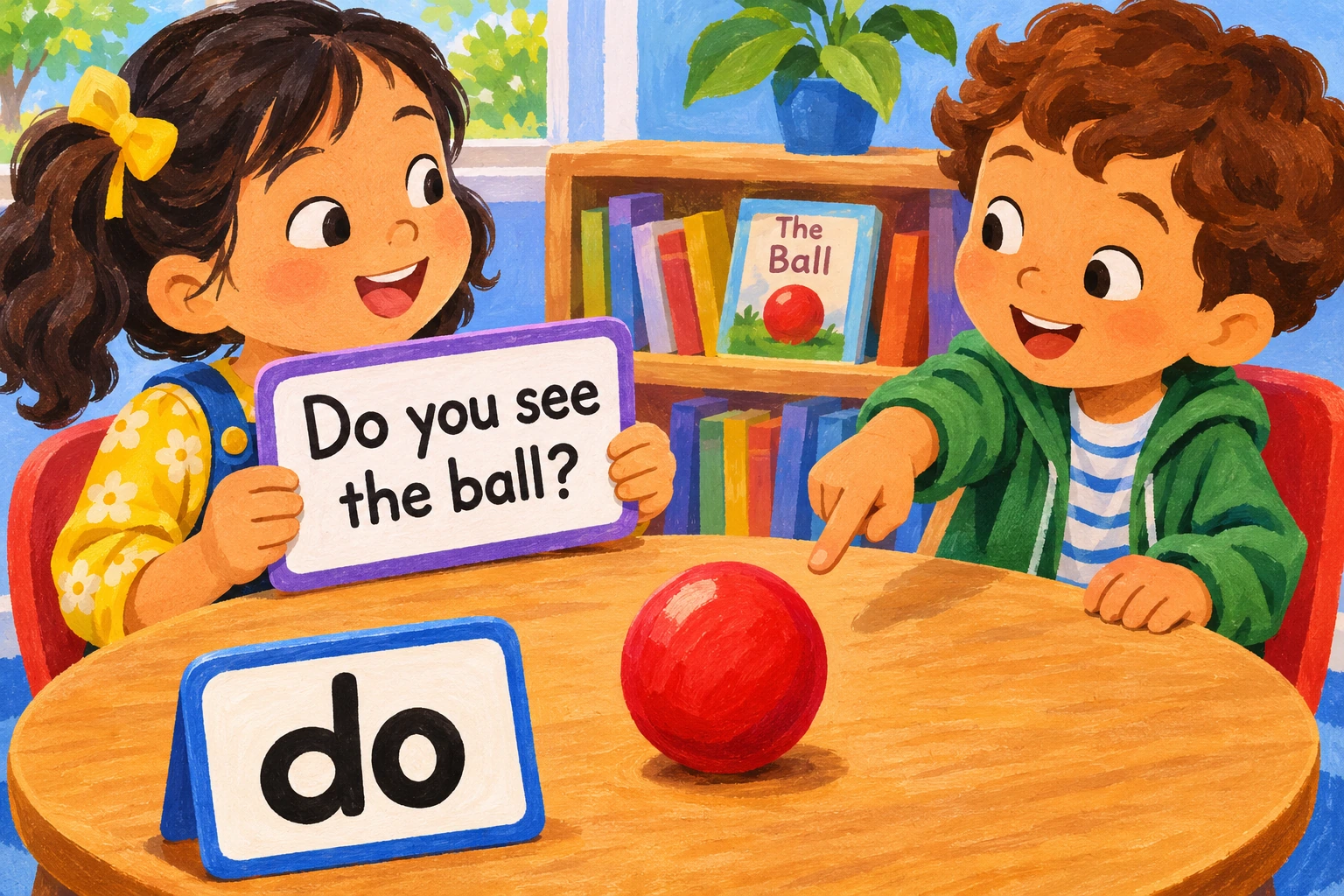
The word do serves as a question helper in these examples. It is not being used as the main action word meaning perform. A concrete exchange can show its role without requiring a beginning reader to memorise a grammatical label.
Do Sight Word reading with two distinct responses
Share each printed question naturally, with its question mark guiding the spoken phrasing. Ask the learner to explain what information the speaker wants. A gesture towards the visible ball can answer the first, while the second needs information about the listener's situation.
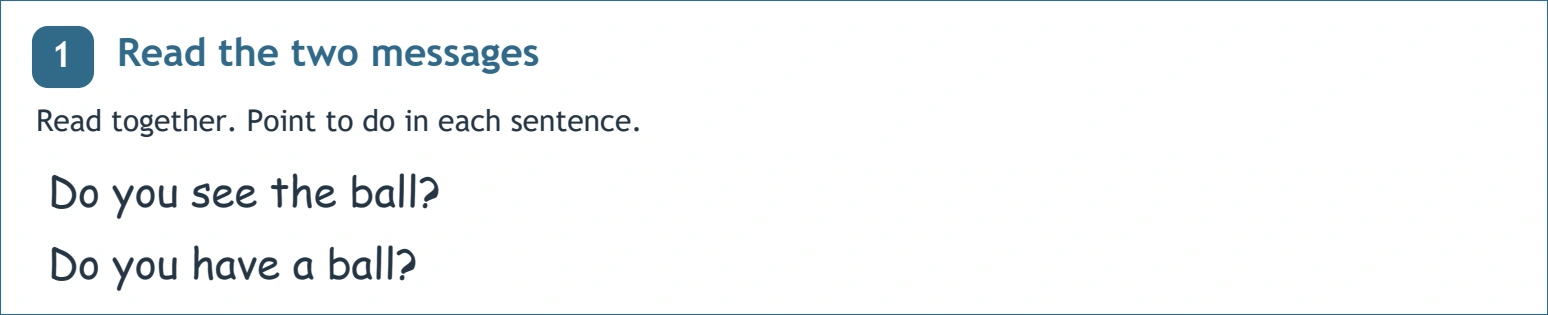
Locate Do at the opening of both lines and compare it with lowercase do in the large model. The capital changes the letter form at the start of a question, not the target's identity. An adult may read see, have or ball while the child contributes the opening word.
Do not insist on a yes response as proof of understanding. Use the actual pretend or real arrangement to decide what answer fits. If the listener has no ball of their own, the second question can receive a different response from the first. Listening belongs in the activity alongside recognising the print.
Choose a first task based on what you observe
| The learner needs | Try with the ball questions | Look for |
|---|---|---|
| A reason to read the line | Ask a partner the visible-ball question. | A response that fits the situation. |
| Help locating the target | Point under Do while sharing the complete question. | A speech-to-print connection. |
| Letter-order support | Arrange d followed by o beside the model. | A complete two-position spelling. |
| A writing purpose | Prepare another understandable do question. | A message directed towards a listener. |
Keep these choices flexible. A child may answer both questions sensibly yet need help forming d, while another may copy d-o carefully without attending to what a partner actually says.
Two required letters in a four-choice bank
The bank presents y, d, o and r. Select d-o for the response boxes and leave y and r unused. Keep the large target available while the learner points to or moves the selected letters. The bank's arrangement does not replace comparison with the model.
Say do naturally as it appears in the question. Its written o does not take the ordinary short-o sound a child may know from another word. Connect the familiar spoken helper with d-o in these examples rather than forcing a pronunciation that makes the question unnatural.
If d is reversed during writing, demonstrate that particular formation on spare paper. A short correction can be followed by one complete word attempt. Do not require the whole sentence to be copied repeatedly as a response to one letter-shape difficulty.
Search all nine entries for the complete target
The grid reads that, do, now; what, went, do; say, do, do. Adult do key: 2, 6, 8, 9.
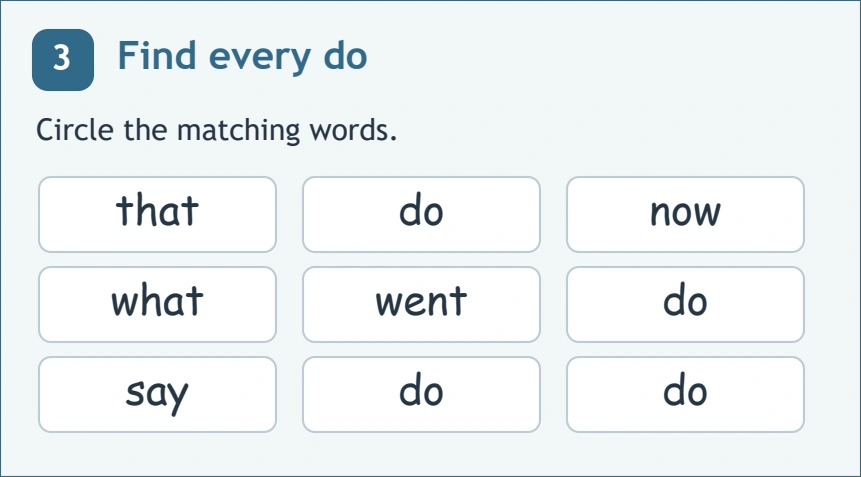
Now includes o but does not spell do. Went and what have different beginnings and endings. Ask the learner to compare the entire d-o sequence rather than treating a familiar letter or a word's meaning as enough evidence for a match.
The final two cells both qualify. A reader who stops after finding one nearby answer may miss the adjacent target. Use a small counter to hold the current place if attention jumps around. Each cell deserves its own spelling decision, and the model can stay visible throughout.
Pencil practice after an oral exchange
Follow both do guides, then check the d direction in a separate d-o attempt. The writer may copy a printed do question into the sentence area. Rehearse any original message aloud before writing it.
A child might prepare a question about seeing a toy car or having a book. Establish the listener and the relevant object so the message is understandable. Keep the listener and requested information clear while a partner helps record the words surrounding do in a new question. The handwritten question does not need to exceed the child's current pencil stamina.
The clean ball page opens with its two information-seeking questions. A d-o workshop sits beside the search, followed by tracing and the message finish. The free original begins with dotted work. Five ball practice stations remain on the preserved US Letter sheet.
Six contributions beyond reading a label
- A question has purpose: the learner recognises that the speaker wants information from a listener.
- Seeing differs from having: the two ball questions are connected with their different requests.
- An answer fits evidence: the child responds according to the actual arrangement rather than always agreeing.
- A case change is understood: Do at the opening is paired with lowercase do in the model.
- A spelling is exact: d-o is retained while longer choices with o are rejected.
- A written question is planned: the final message is spoken and understood before copying or composition.
Record whether the answer concerns seeing or having before assessing d-o. Listening to the question and copying its opening helper need separate attention.
Owen's possible home question game
A family member places a toy ball on the table and asks the first printed question. Owen points towards the ball or answers orally. The adult then asks whether Owen has a ball, allowing the response supported by the actual situation. They discuss why the questions can have different answers.
They open the reading banner and locate Do in both lines. Owen selects d and o from the bank and checks one search row.
For a closing turn, Owen asks a partner a new question about a familiar object. The listener answers before the target is found in print again.
Classroom possibility: a genuine information gap
Give a pair of learners a shared visible ball picture and individual object cards. One can see the shared ball but may hold a different private card. The teacher models the two questions, making clear that the second asks about the partner's own item rather than the common display.
Read the worksheet messages afterwards and connect them with the exchange. An adult may supply longer words while children track Do and explain what each question asks. A learner can participate through a gesture, a spoken answer, letter selection or a written contribution.
At the individual station, partners can listen and point to the model without completing someone else's sheet. Record one particular observation, such as a sensible response to the possession question or a careful d-o comparison in the grid. Speed is not the activity's purpose.
Five extensions for asking and listening
1. Prepare a completed question about seeing a familiar picture. One partner reads with support and the other responds according to what is actually visible.
2. Use individual toy cards to create a do-you-have exchange. Allow different truthful answers rather than rewarding agreement with the adult.
3. Build d-o with movable letters, reverse them for a puppet and invite the learner to repair the order against the model.
4. Dictate a new question for a story character. The adult supplies unfamiliar words while the child contributes do and identifies the question mark.
5. Match two spoken questions with different acted scenes, one involving seeing and one involving having. Discuss what information each speaker needs.
Common mistakes and a sensible age range
Avoid treating do as a ball label, using only yes responses or asking for independent decoding of every surrounding word. Keep the sentence's listening purpose available. If the learner gives an answer unrelated to the question, revisit the actual scene before adding more print demands.
Ball questions around ages 4–6 can be answered and discussed before the learner reads the whole line independently; choose pencil work from the response you observe. A child who asks a clear question may still need the spelling model. A careful writer may need another demonstration of the difference between seeing an object and having one.
For regular review, ask one useful question during familiar play, then show its completed written form. Appreciate a specific contribution such as waiting for an answer or checking the initial d. A brief exchange can be worth revisiting without requiring the whole sheet each time.
The earlier short-word reading collection provides another starting sequence. The pencil discovery resource pack can help adults reduce motor demands before longer copies. A separate action focus appears in the eat practice worksheet.
For additional partner-play ideas, explore PBS Parents' learning activities and NAEYC's resources for family play. Choose a situation where the child's question has a listener and a reason to be answered.
Download the ball-question practice
The ball-question sample stays free in the supplied arrangement. Eligible current membership opens the clean PDF through the premium control. The questions come first in that edition, with the four remaining tasks retained. Website branding, domain text and watermarking are removed, and advertising is not included within the clean worksheet's printable areas.
Check one US Letter ball print for a complete frame and readable d-o guides before preparing extras. A pencil is sufficient; the partner cards and loose letters are optional props. The associated $5 purchase gathers twenty-six clean primer lessons into one file. Use another lesson when it supplies a new conversation rather than expecting every question to be another ball question.
Popular Worksheets
Printable resources families and teachers are downloading now.
 Free
 Free
 Free
 Free