
Am Sight Word: 5 Powerful Helmet-Ready Practice Jobs
Continue beyond am with twenty-six clean reading-first practice sheets in one $5 printable collection.
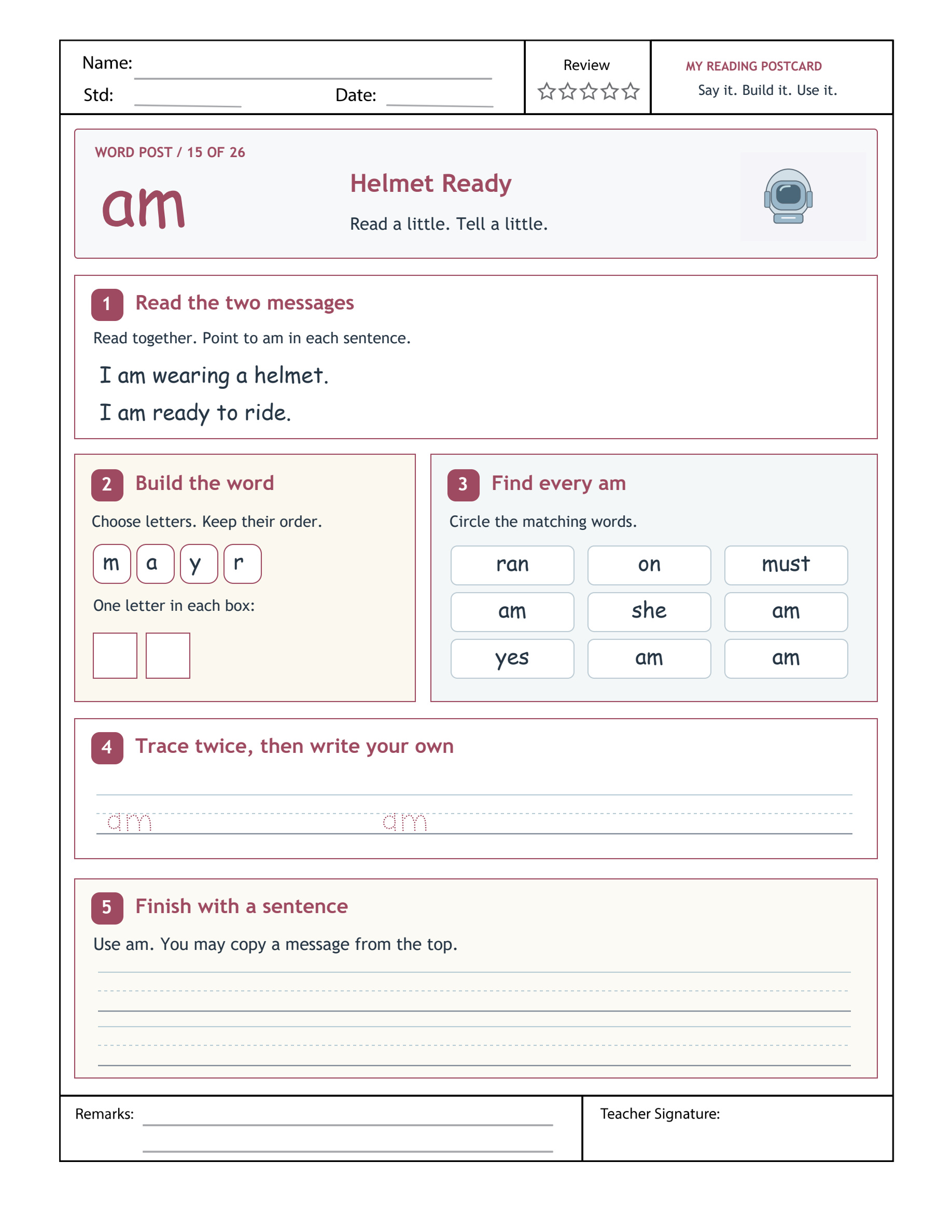
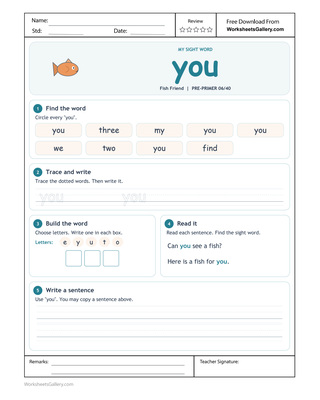
The full am sheet retains its US Letter frame.
Complete a first-person statement about readiness. The complete redesigned page appears without cropping.
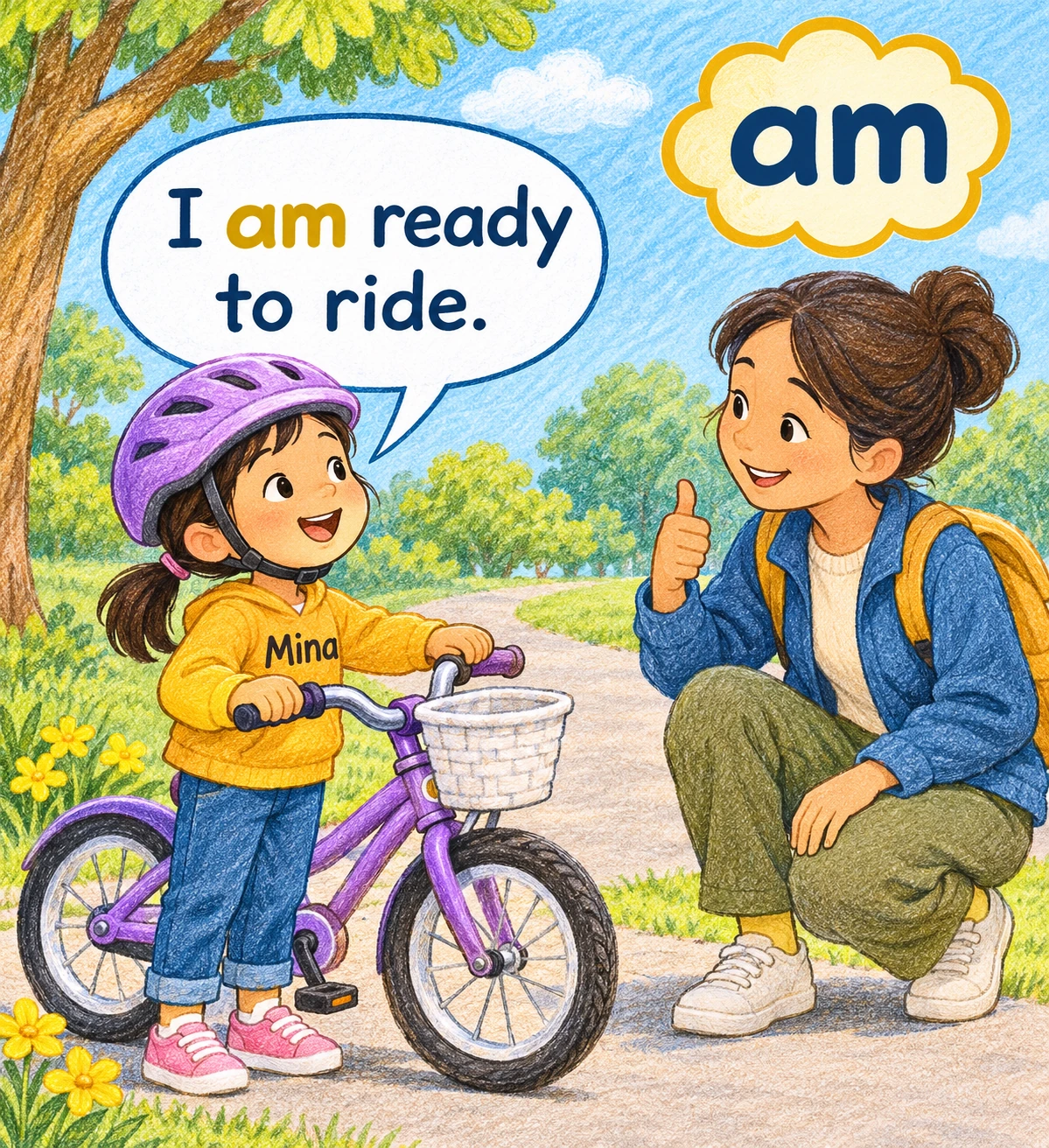
Mina is the one speaking, so “I am ready” tells us about Mina herself. Am Sight Word practice turns that self-description into a small reading and writing lesson with a helmet-ready theme. Two source messages connect I with what the speaker is wearing and how ready the speaker feels. Children then select letters, find exact matches and make supported pencil attempts. Mina's two self-descriptions lead the clean layout, with a-m copying reserved for a later station. Begin by identifying the speaker and listening to a complete idea before asking for a written copy.
Let the speaker own the statement
Introduce a toy character or the illustrated Mina and establish whose voice is being used. When Mina says “I am ready to ride,” I refers to Mina. An adult can voice the line from the character's point of view, then let the child take over that speaking role.
The same words can describe another speaker on a later turn, but announce the change clearly. A listener should not have to guess whether I means the child, the adult or the toy. Stable speaking roles make it easier to see whether am is understood in its actual sentence.
For these examples, am follows I. Read the natural phrase together rather than presenting the target as a general replacement for every form of be. The lesson does not require young readers to recite a verb chart before they can describe themselves.
The two helmet-ready messages
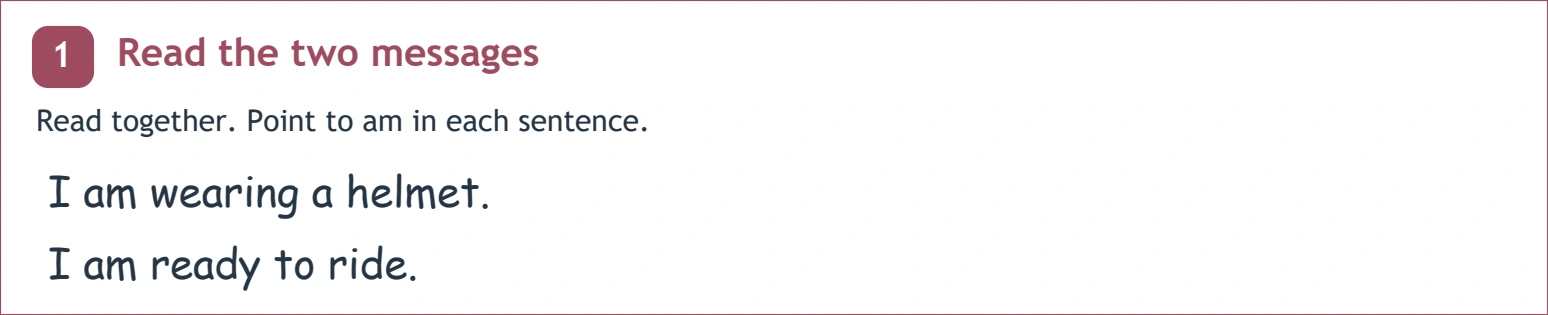
The source statements are “I am wearing a helmet.” and “I am ready to ride.” One concerns something the speaker is wearing; the other describes readiness. Read each as a full thought and invite the learner to show who is speaking and what information is added.
The webpage illustration offers a bicycle context for the readiness message. The PDF's helmet theme remains a language setting rather than a riding-instruction course. A toy or picture can supply the context without needing an actual bicycle during reading practice.
Point under am in both lines after sharing their meanings. The target follows I in each case, giving a consistent position to inspect. Adults may supply wearing, helmet or ready when those surrounding spellings are unfamiliar. A supported contribution is still meaningful reading participation.
Am Sight Word building: a before m
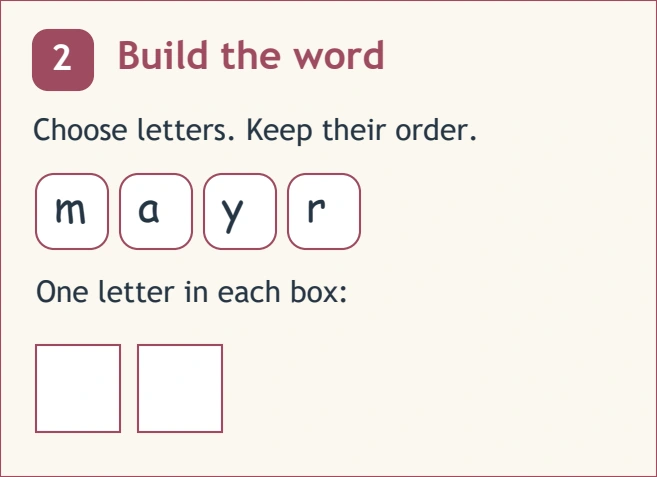
The bank presents m, a, y and r. Choose a-m for the two boxes, leaving y and r unused. The display begins with m, so copying the first two letters in their shown order would not produce the target. Compare against the large model before writing.
Say am naturally, then name a and m as you point along the spelling. If a and m sounds are familiar, model how their sequence blends into am in the self-description. Keep the complete phrase I am available so the isolated word retains its sentence purpose.
If m is selected first, ask which letter begins the printed model and let the child rearrange the pieces. This is a sequence problem, not evidence that the letters themselves are unknown. Loose copies can support the correction before another pencil attempt is made.
Four matches in a mixed nine-word grid
The search rows contain ran, on, must; am, she, am; yes, am, am. Adult am key: 4, 6, 8, 9.
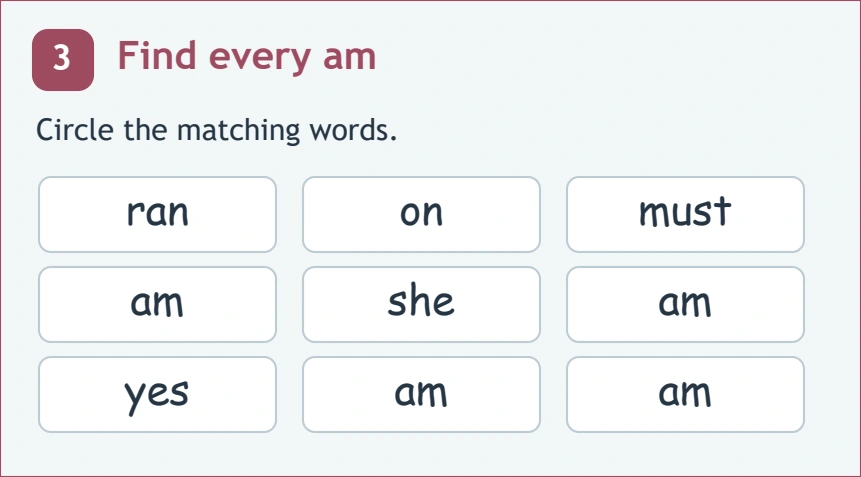
Ran contains a but has a different beginning and ending. Must begins with m but does not spell am. Encourage a complete two-letter comparison rather than a decision based on one familiar component. The large model can remain visible throughout the task.
There are two matches in both the middle and bottom rows. A child who expects one answer per row may overlook correct cells. Inspect each entry independently, using a small place-keeping counter if necessary. Ask for one explanation to learn how the choice was made.
Pencil work that follows a spoken self-description
The dotted am models begin with a, despite m leading the bank; carry that order into the copy. The m may require a short demonstration of its joined humps while the a needs its own clear form. Show one manageable movement at a time rather than correcting every mark at once.

The closing sentence task permits copying either source statement. A new self-description can also be rehearsed orally, with an adult supplying unfamiliar vocabulary. The child might describe being ready for a story or wearing a familiar item, provided the message remains true or clearly part of the pretend character's story.
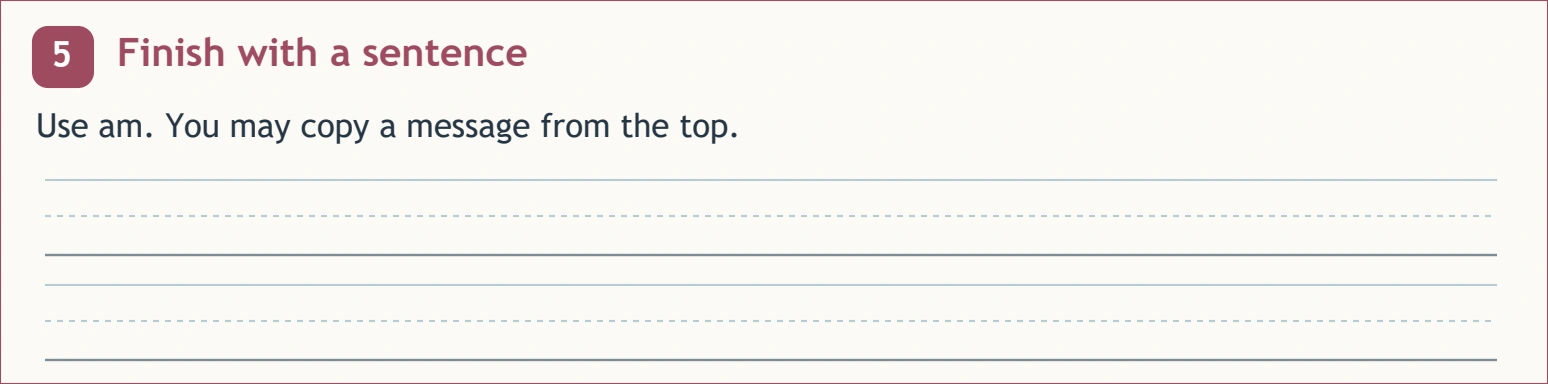
A learner who explains the message accurately may still tire during writing. Accept dictation and a small target contribution when appropriate. Neat copying alone does not establish that the child knows who I refers to or what the sentence describes.
What the supplied and clean PDFs contain
Mina's clean edition gives her self-descriptions priority, then places a-m selection beside the matching grid. The dotted band and larger sentence finish complete the route. The supplied sample starts with tracing. Every source activity remains on the same US Letter size inside the established frame.
The downloadable resource is one printable worksheet. The supporting scene and any toy-role conversation on this webpage are additional ways to discuss its language, not extra PDF pages or an interactive application. A pencil is sufficient for the printed tasks.
Choose a comfortable route before the visit. Reading first can establish the speaker's meaning, while the bank and grid hold the spelling steady for inspection. There is no requirement to complete every station in one sitting merely because all five fit on one page.
Six observations that distinguish meaning from copying
- A speaker is established: the child connects I with the character currently making the statement.
- Two descriptions differ: wearing a helmet and being ready are understood as different information about that speaker.
- A natural phrase is retained: I am remains available while the target is examined separately.
- A sequence is chosen: a precedes m despite the bank displaying m first.
- A match is checked completely: ran or must is rejected after comparison with a-m.
- A self-description is communicated: the final spoken or written message gives another person understandable information.
Note who the learner believes is speaking before judging an am response. An accurate a-m copy and a clear I reference are different pieces of evidence.
Mina's possible home turn with a story character
A family member might introduce a toy named Mina and voice the first helmet statement from the toy's point of view. The child identifies the speaker, then takes a turn saying the readiness line. The adult keeps the speaking role explicit throughout the exchange.
Mina's reader locates am in the message, builds a-m and explains one exact-match choice. Pause before further am writing if Mina needs a break. The adult may leave the full sentence task for another visit while the spoken meaning is still clear.
For a new message, the child describes a familiar personal state or an announced pretend character's state. A listener should know who I means before responding.
Classroom possibility: a speaker card changes hands
At a small-group station, a completed I card marks whose speaking turn it is. The teacher models a simple I-am statement and then passes the speaking role to a learner. Each new speaker gives a suitable self-description rather than repeating another person's statement without context.
Return to the helmet messages and ask who could be speaking in their story. Adults can read the longer words while children find am. Some learners explain the readiness idea, others select letters and comfortable writers prepare a new line. These contributions need not be identical to be useful.
The teacher can record one specific observation, such as a correct a-m arrangement or a clear speaker reference. A partner may listen and point but should not take over another learner's boxes or circles. Completion time is not the purpose of the station.
Respond to the particular mismatch
| What happens | A helpful response | Recheck |
|---|---|---|
| Cannot tell who I refers to | Announce and mark the current speaking role. | The person described by the message. |
| Copies m-a from the bank | Compare the starting letter with the large model. | The ordered a-m spelling. |
| Circles must after noticing m | Inspect all letters and the word's length. | A complete target comparison. |
| Explains readily but avoids a long copy | Accept dictation and one word attempt. | A manageable written contribution. |
Five ways to give am another speaker
1. Introduce a puppet and let it make a short I-am statement. The child identifies the speaker before taking over the puppet's voice.
2. Pass a completed speaking-role card between partners. Each speaker offers a suitable self-description while the listener checks who is being discussed.
3. Arrange a and m with large letter pieces, then let a toy reverse them. Repair the spelling by comparison with the printed target.
4. Dictate a caption for a character drawing. An adult supplies longer vocabulary, and the learner contributes am to the completed statement.
5. Match two spoken self-descriptions with clearly introduced story characters. Discuss the meaning before locating am inside a written example.
Readiness, comfort and a predictable revisit
For Mina's reader near ages 4–6, knowing who I means can be a useful first contribution even when the written m still needs a model. Choose task quantity according to oral language, letter familiarity and pencil experience. A child who can make a self-description may still need the model for both letters.
Avoid shifting I between speakers without explanation, using a helmet picture as the sole reading cue or requiring a long sentence before the learner has said an idea aloud. Keep the message and its speaker clear. Appreciate a specific contribution, such as correcting the letter order or explaining readiness in the pretend story.
For other beginning words, the starter collection of reading visits offers a separate route. The pencil-preparation discovery pack can support motor demands, and the eat worksheet activity provides another familiar action to discuss later.
Adults may adapt shared-play ideas from NAEYC's family play pages or the activities at PBS Parents' learning hub. Select an example where a child has a clear reason to speak about themselves or an introduced character.
Download and print the helmet-ready lesson
Choose the helmet-ready sample to keep the original task order. The premium membership control provides an eligible member with the clean reading-first PDF. The a-m lesson retains its complete activity set after removal of website lettering, watermarking and advertising. Select that version when preparing a clean copy for an introduced speaker's self-description visit.
Inspect Mina's whole frame on a single US Letter test, including the small a-m dotted models. A pencil is enough, with a speaking-role card or loose letters available if helpful. The $5 file keeps am with its 25 clean companion lessons in sequence. Another word can follow when it gives the learner or story character something different and understandable to communicate.
Popular Worksheets
Printable resources families and teachers are downloading now.
 Free
 Free
 Free
 Free