
Have Sight Word: 6 Brilliant Ladybug Reading Discoveries
Continue beyond have with twenty-six clean reading-first practice sheets in one $5 printable collection.
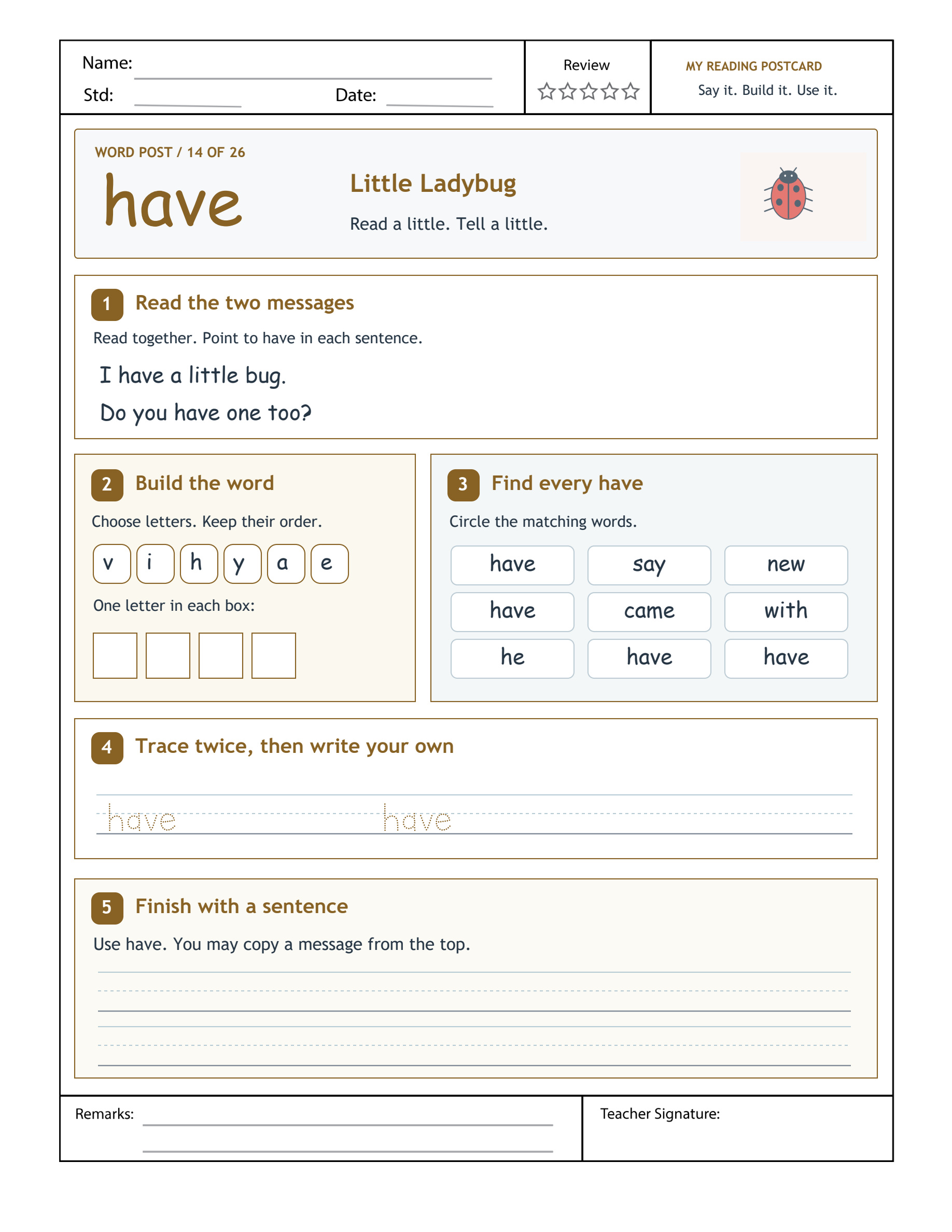
The full have sheet retains its US Letter frame.
Talk about having something and ask about possession. The complete redesigned page appears without cropping.
Luca has a little bug drawing to show a friend, and the friend may have one too. That exchange gives Have Sight Word practice a purpose: a speaker describes having something, then asks about another person. The ladybug theme connects two source messages with a four-letter bank task, an exact-match search and handwriting. Adults can use pictures or familiar objects to establish what is being discussed before the child examines the print. The clean edition begins with reading and ends with a sentence finish, preserving the original activities inside their established outer frame.
A statement belongs to one speaker
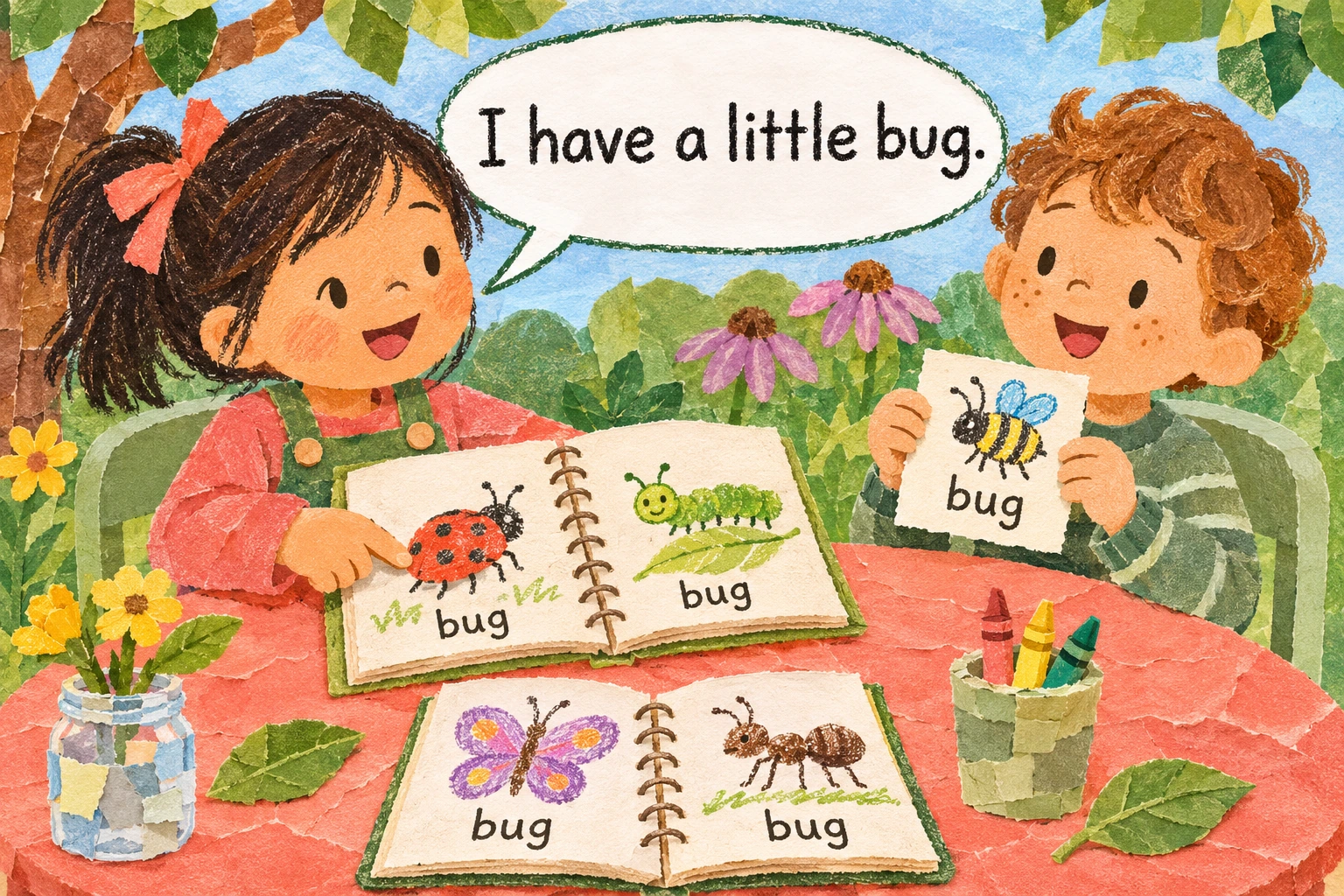
Read “I have a little bug” while an introduced toy character holds a bug picture. Establish which character I refers to, then point towards that character's picture. The word have helps express the relationship between the speaker and the thing being discussed.
The supporting illustration uses drawings in notebooks, so a family can explore the message without collecting insects. A toy bug, a paper ladybug or another familiar prop can serve the same language purpose. Explain the pretend context rather than implying the child must obtain a real animal.
Change the object after the first example is understood. A character can have a book or a block and still use have. The target is not another word for ladybug. Its usefulness becomes clearer when the relationship remains understandable across more than one object.
Turn the statement into a listening exchange
The second source sentence is “Do you have one too?” It asks whether the listener has another example of the object already discussed. Explain that one refers back to a little bug in this conversation. Without that shared reference, the listener would reasonably ask what object is meant.
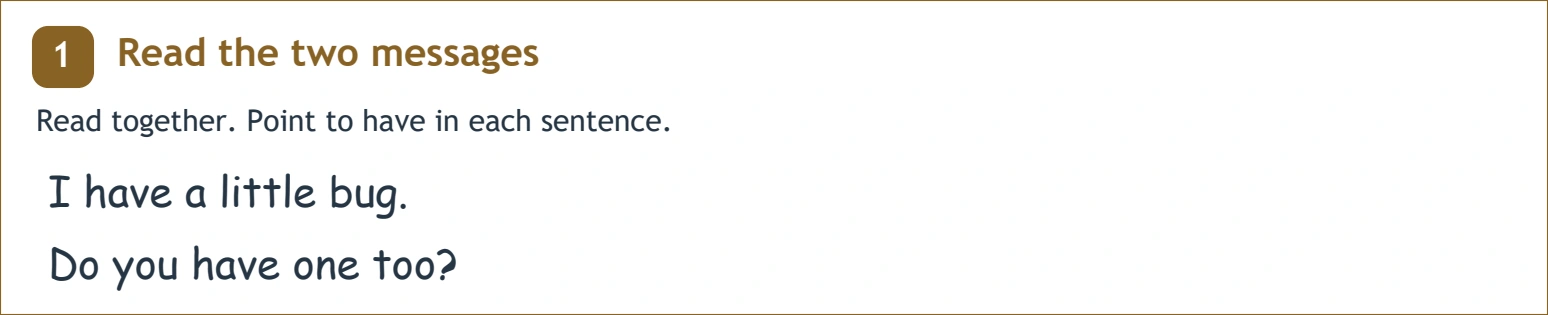
Read both messages as an exchange, with a clearly identified speaker and listener. The learner can answer the question truthfully within the pretend story. Yes is not compulsory: a character without a bug picture can say so. Understanding the question matters more than agreeing with a model response.
Record the unfamiliar object vocabulary only after the speaker and the reference of one are clear, leaving have for the learner to add. After finding the spelling, return to the complete statement or question. This keeps word recognition connected with something a person wants to communicate.
Have Sight Word building uses four ordered letters
The bank contains v, i, h, y, a and e. Select h-a-v-e for the four boxes and leave i and y unused. The required pieces are scattered rather than presented as a completed spelling. Compare each position with the large model before writing.
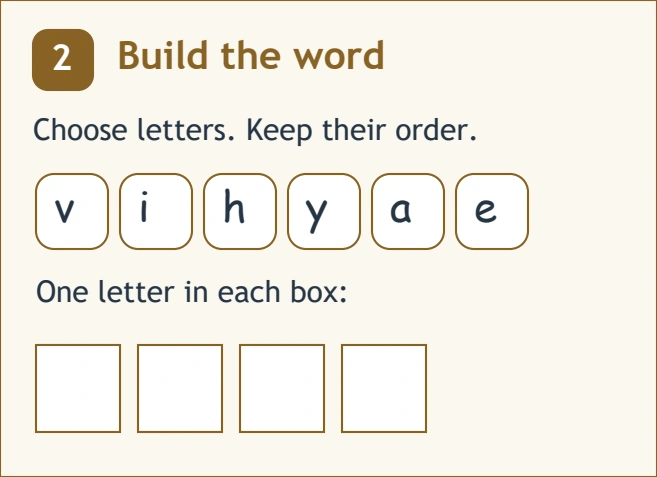
The spoken word is have, said naturally in the source sentence. Do not force a long-a pronunciation merely because the written form ends in e. Connect the complete familiar spoken word with its actual h-a-v-e spelling. A beginning reader can learn this particular correspondence without inventing a rule for every other word ending.
If the learner chooses h and e because those letters are already familiar, show the two middle positions as well. Every box belongs to the same complete word. Loose letters can allow a careful arrangement before the child has to manage four handwritten forms.
The nine-cell search includes a shorter look-alike
The choices read have, say, new; have, came, with; he, have, have. Adult have key: 1, 4, 8, 9.
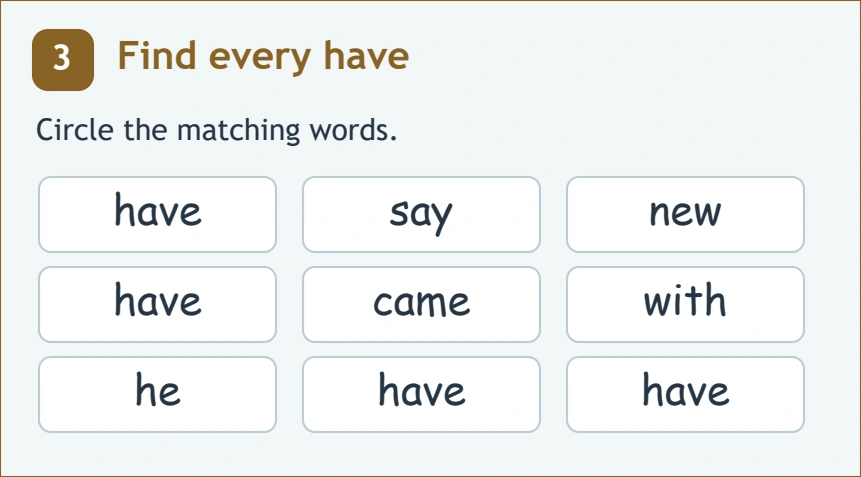
He begins with h and ends with e, but it omits the a-v middle of have. That makes it a useful contrast. Ask the child to point through all four positions before deciding whether the shorter form qualifies. Familiar outer letters alone are not enough.
Came also ends with e and has four written letters, yet its sequence differs. Word length can support an initial observation without determining the answer by itself. The learner should be able to explain at least one accepted or rejected choice using the actual letters.
Tracing and a sentence after the exchange
Trace have as a four-position spelling, keeping a-v between h and e in the independent attempt. The h and v may require individual demonstrations depending on pencil experience. Keep the model available rather than adding a memory test to a formation task.

A copied have example is an acceptable contribution to the sentence finish. For a new idea, let the child first say what a character has or formulate an understandable question. An adult can supply longer surrounding spellings while the learner contributes the target.
The clean ladybug route introduces having and asking before the h-a-v-e bank. Its search neighbours the spelling work, and tracing leads towards the final message. The original sample begins with dotted copies. All five supplied tasks remain within the established US Letter frame.
Six observations in a having-and-asking lesson
- A speaker is identified: I is connected with the character making the possession statement.
- A listener is considered: the question is directed towards another established participant.
- A reference is recovered: one is understood as another example of the object already discussed.
- A spelling remains complete: h-a-v-e includes its two middle letters rather than collapsing into he.
- A spoken form stays natural: the child hears have within a meaningful sentence instead of an invented pronunciation.
- A written message has a purpose: the final contribution describes or asks about something a character has.
Record whether one has a clear bug-picture reference and whether a-v survives in the spelling. A correct object exchange does not by itself distinguish have from he in print.
Luca's possible home picture exchange
A family member might give Luca a paper ladybug and keep a different bug drawing. Luca describes what is held, and the adult models the source statement. The adult then asks the question, with one clearly referring to the established picture category.
They read the messages and find have in each. Luca selects h-a-v-e from the bank and examines a few search choices, including he. A small written contribution can follow if pencil energy remains. The adult can save the longer sentence area for another visit without treating the unfinished sheet as a failure.
For a closing turn, change to a familiar toy object and repeat the having-and-asking exchange. The target transfers while the reference remains explicit.
Classroom possibility: a pair of object-picture holders
At a literacy station, give partners completed picture cards of familiar objects. Establish the object category and who is speaking. One learner says what is held, then asks whether the partner has one too. The listener answers according to the actual picture rather than guessing the teacher's preferred response.
Return to the ladybug messages and compare their roles. The teacher can read the longer vocabulary while a learner tracks have. Another child can explain what one refers to. These different responses reveal comprehension without requiring every child to copy the full question independently.
During bank and search work, watch whether the middle a-v is retained. A partner can point to the model while the learner decides, but should not rearrange all the letters or circle the answers on the other child's behalf. Each reader needs an opportunity to inspect the spelling.
A response guide for a specific difficulty
| Observed response | Adjust the picture exchange | Check afterwards |
|---|---|---|
| Cannot explain what one means | Restate the object being discussed before the question. | A clear reference to another example. |
| Always answers yes | Use a partner card that does not match the category. | An answer based on the actual situation. |
| Circles he as a match | Inspect the missing a-v middle. | All four spelling positions. |
| Builds the right letters in another order | Compare each box with h-a-v-e. | A deliberate sequence. |
Five extensions for having and listening
1. Create a completed caption for a toy's collection. The child dictates an I-have statement from the toy's point of view and identifies the target afterwards.
2. Play a picture-card question exchange. Establish the category before asking whether a partner has one too, and accept the answer supported by the actual card.
3. Put he beside have on completed word cards. Compare their shared outer letters and the additional a-v positions without relying on card colours.
4. Arrange h-a-v-e with movable pieces, then let a puppet omit the middle letters. Invite the learner to restore the full target using its model.
5. Dictate a short question for a familiar story character. Supply enough context for one or the named object to be understandable to its listener.
Readiness, common mistakes and regular review
The ladybug exchange is intended for guided reading around 4–6, with a clear object reference before any expectation of an independent four-letter copy. A child may understand the exchange before independently reading its entire question. Another learner may trace comfortably while still needing help with what one refers to.
Avoid assuming that every ending e requires the same spoken vowel, treating the ladybug as the target's definition or accepting a shorter he because its outer letters look familiar. Keep the complete have model visible and read it naturally inside the source messages.
A later visit can begin with one familiar object and a genuine question about a partner's picture. Praise the specific contribution you observe: a clear reference, a thoughtful answer or a complete middle spelling. Brief exchanges can remain meaningful without assigning a new full page every day.
For other early words, explore the starter set of short-word routes. The discovery collection for pencil practice offers pencil preparation before the bug sentences are copied. Another everyday-action focus appears on the eat worksheet resource.
More shared-play contexts are available through NAEYC's family activity guidance and PBS Parents' learning ideas. Choose a setting in which a child's question has a listener and a useful answer.
Download the ladybug practice page
The ladybug sample retains the source arrangement as a free file. An eligible current member can select the clean premium download for the reading-first edition. Its other practice tasks are preserved, while website branding, the domain and watermark overlays are removed. The clean worksheet has no advertising within its printable frame and can sit beside the introduced bug drawings.
Use one US Letter ladybug trial to check the full frame and the complete four-letter tracing models. A pencil and optional picture cards are enough for a session. The attached collection link leads to a $5 file with all twenty-six clean primer lessons in order. Choose a later word for a new message purpose after the having-and-asking exchange has been heard.
Popular Worksheets
Printable resources families and teachers are downloading now.
 Free
 Free
 Free
 Free