
Picture Rhyme Partners: 5 Delightful Sound Matches
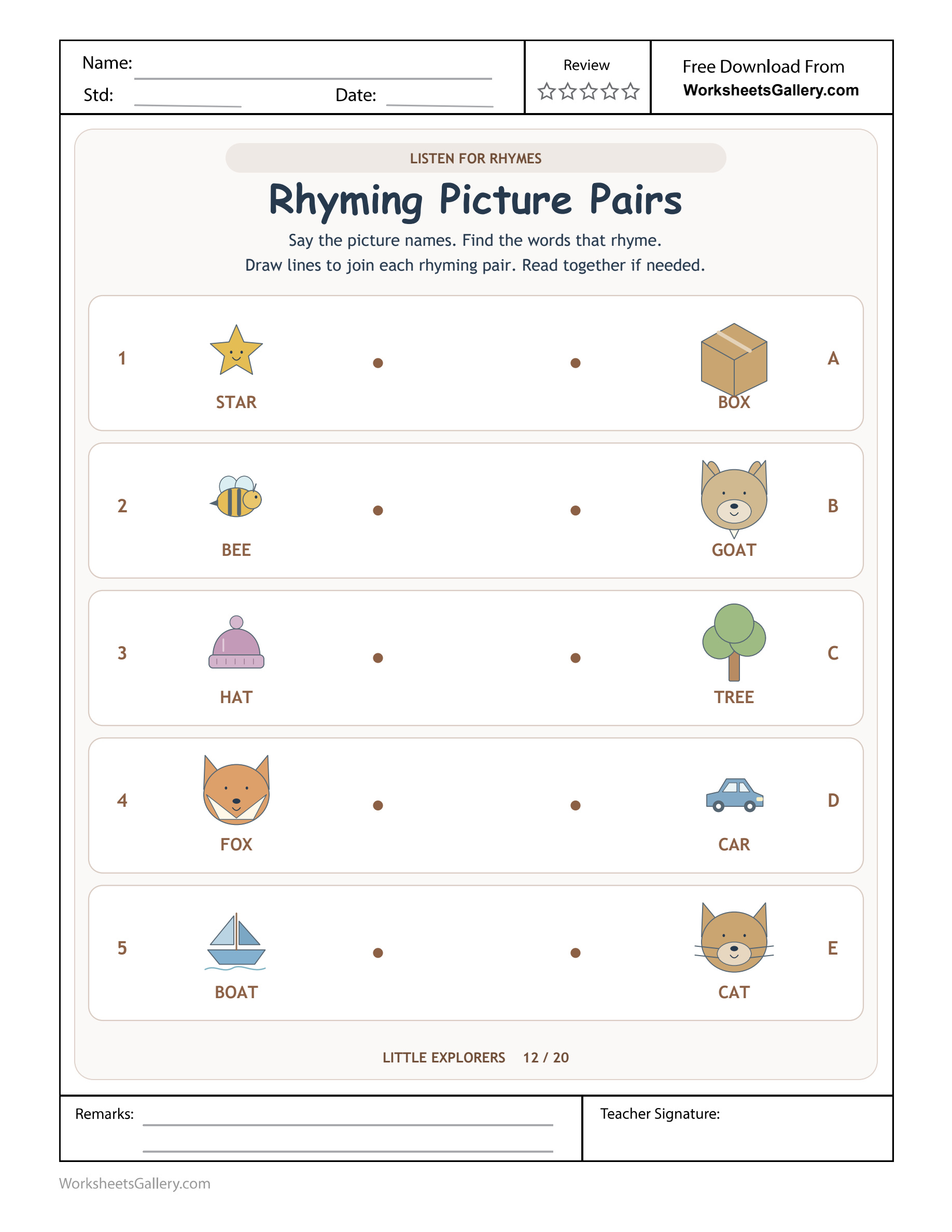
$5 collection companion: Picture Rhyme Partners. Listen to whole word endings and connect each named picture to a cross-column rhyme.
A star and a car do not belong to the same object family, but their spoken names belong together in this sound game. Picture Rhyme Partners asks children to say ten picture names and connect five rhyming partners across two columns. Printed word labels help an adult establish the intended names; independent reading is not a prerequisite for joining the pictures. The task suits supported preschool and early primary listening play. Look beyond the picture sitting directly opposite a target, listen to the word ending and draw a line only after a partner has been identified.
Opposite positions are not ready-made pairs — Picture Rhyme Partners
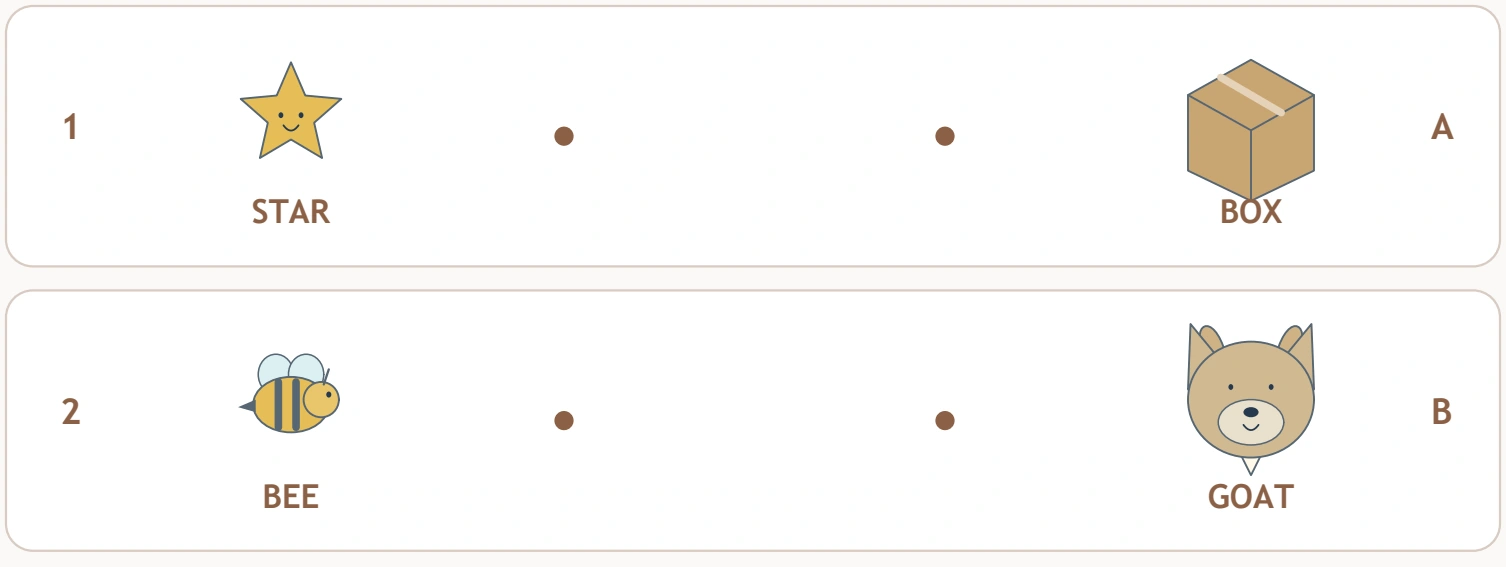
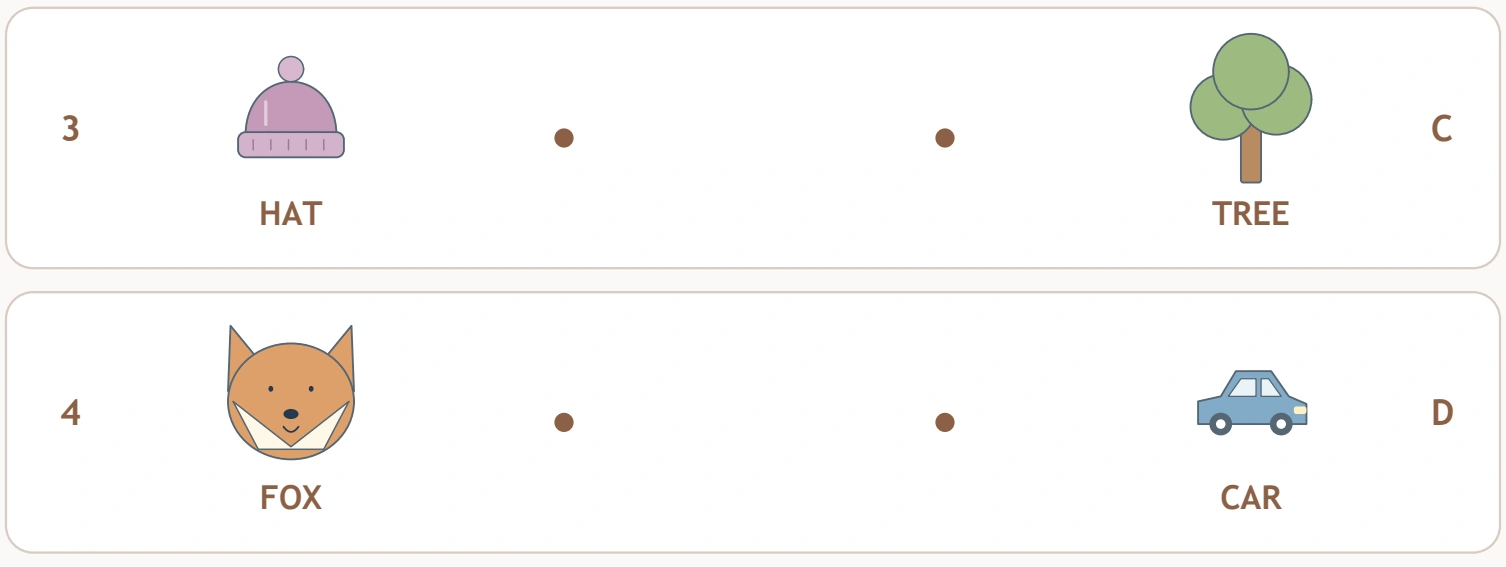
The left column of Picture Rhyme Partners contains STAR, BEE, HAT, FOX and BOAT. Across the page are BOX, GOAT, TREE, CAR and CAT, labelled A through E. Pictures placed in the same horizontal row are not automatically intended to be joined. The child has to search the other column for a spoken rhyme.
Begin by naming the pictures together. A word such as goat or fox may be unfamiliar to a learner, and a car could be described as a vehicle. The printed labels clarify which words the activity uses. Supply those names before asking the child to listen for a relationship between them.
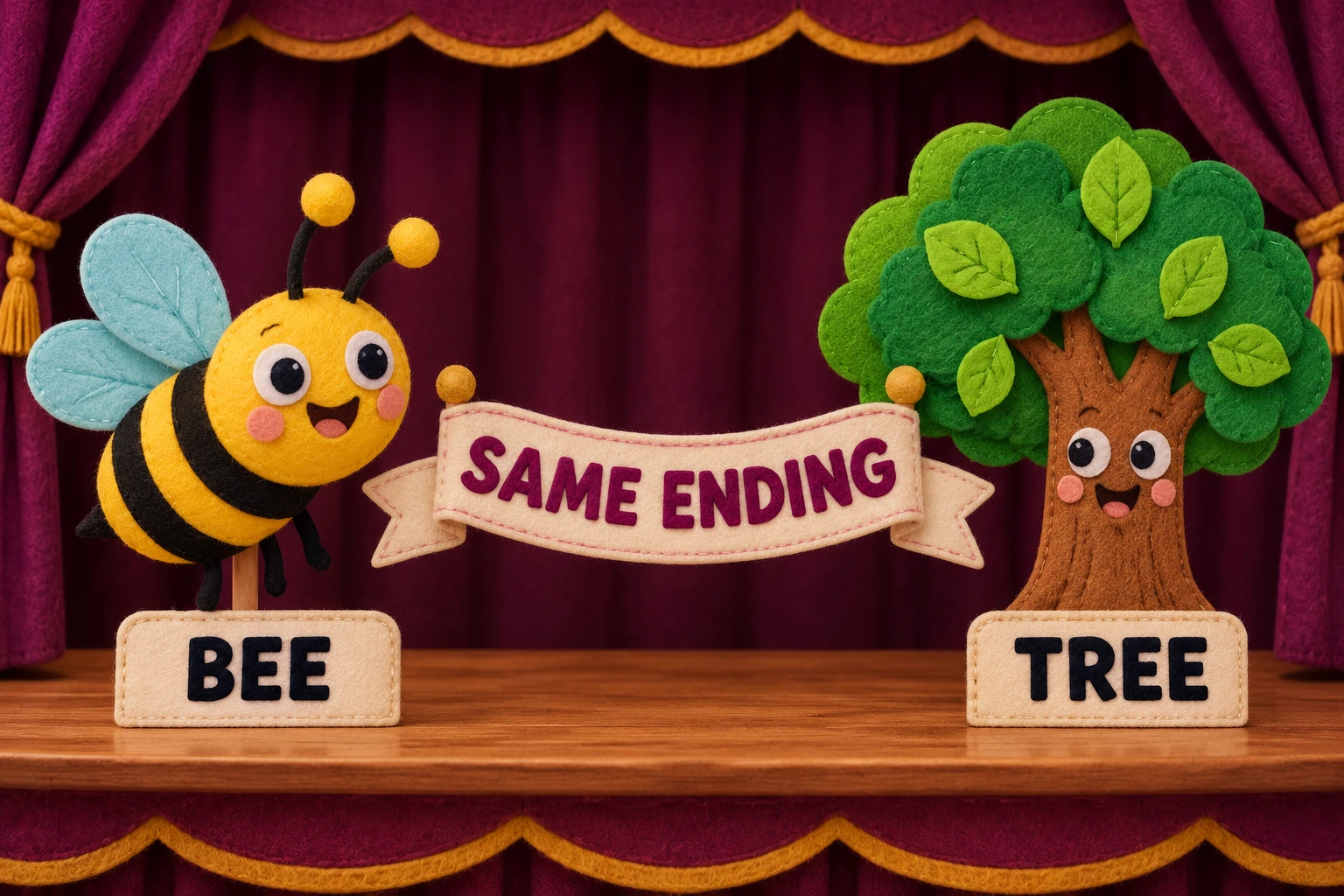
In Picture Rhyme Partners, a useful early example is bee with tree. Say both words naturally and listen to their matching endings. The objects look different, so the pair gives a clear reason to attend to speech instead of judging similarity from colour, shape or category.
Hear an ending before drawing a connection: Picture Rhyme Partners
Say the left-hand target, then a possible partner from the right. Pause long enough for Lucan to hear both. Ask whether their endings sound alike. If a candidate does not fit, try another pictured word rather than encouraging a guess based on where it sits.
The child can point to a partner before using the pencil. That separates the sound decision from drawing a line across the page. An adult can listen to the proposed pair and ask for another spoken comparison when the intended relationship is unclear.
Starting alike is a different question: Picture Rhyme Partners
Two words can begin with a similar sound and still fail to rhyme. Picture Rhyme Partners is asking about the ending relationship in the supplied pairs. Keep that purpose clear if the child has recently practised beginning sounds and naturally tries the same rule again.
There is no requirement to spell every word or explain its letters. The printed labels are useful references, but the source invites the words to be said aloud. A child can hear a rhyme before being able to read both labels independently.
The five source connections: Picture Rhyme Partners
| Left picture | Rhyming right picture | Right-hand label |
|---|---|---|
| 1 STAR | CAR | D |
| 2 BEE | TREE | C |
| 3 HAT | CAT | E |
| 4 FOX | BOX | A |
| 5 BOAT | GOAT | B |
This Picture Rhyme Partners table provides an adult reference for checking a proposed connection. Let the learner listen and choose before revealing the whole set. The instruction asks for lines joining the picture partners, not a list of answer letters written elsewhere on the sheet.
A line should still have identifiable ends
The connection points beside the pictures can help a child show which pair is intended. Lines may pass across other rows as partners are linked. A crossing by itself does not mean the rhyme is wrong; ask Lucan to point to the two endpoints and say the words he has connected.
A home exchange with a toy listener: Picture Rhyme Partners
Imagine Lucan introducing Picture Rhyme Partners to a toy cat at the kitchen table. His parent reads STAR and then names CAR from the other column. Lucan repeats the two words and decides whether their endings belong together. The toy listener is a playful audience for his explanation, not a source of hidden answers.
When Lucan chooses BOX for BEE because the box is nearer the top, the parent says both words again. They compare that proposed pair with BEE and TREE, letting the spoken endings guide the revision. The adult has made the alternatives audible while leaving the decision to the child.
After a few connections, Lucan may want to invent another pair orally. The parent can pause the source sheet and follow that interest. On returning, they identify one unfinished left-hand picture and hear its possible partners again rather than treating the earlier pause as a lost place in a test.
A classroom conversation with a name reader
For a hypothetical small group, assign one partner to read or repeat picture names with adult help and another to propose a rhyming connection. They say the pair aloud before a line is added to Picture Rhyme Partners. After checking, the children exchange roles.
The teacher can distinguish whether a learner needed the name supplied, needed the candidate words repeated or needed help controlling the line between chosen endpoints. Those supports do not all describe the same difficulty. An accurate spoken pair can remain meaningful even when the drawn connection is broad or tangled.
Encourage children to listen to one another's proposed pair instead of calling out the remaining answers. If both learners already know the sheet well, ask them to explain why one unmatched combination fails. The familiar page can support a clearer sound discussion without pretending it is a fresh independent search.
Six observations from hearing and joining: Picture Rhyme Partners
Establishing a shared word
Picture Rhyme Partners works best when the adult and child are listening to the same intended picture name. Notice when a printed label or adult model resolves an uncertain image. Naming help can make the sound question fairer without supplying the rhyme partner.
Attending to a spoken ending: Picture Rhyme Partners
A learner may begin by naming the whole picture and then notice the shared ending. Allow time for that listening. The task does not demand a formal definition of rhyme before the child can hear and demonstrate one of the supplied pairs.
Looking beyond visual similarity: Picture Rhyme Partners
A bee and tree share a sound relationship despite representing very different things. Picture Rhyme Partners gives the child a reason to explain a pair that would not be grouped by appearance or use. Ask what their names do, rather than what the objects look like.
Checking a candidate before marking
Pointing to a possible partner creates a pause for saying the two names. Notice whether Lucan uses that check or draws a line before attending to the word. An explained selection is more informative than a hurried connection.
Coordinating a meaningful line: Picture Rhyme Partners
A pencil route needs to communicate two endpoints. The child can show them with fingers first or dictate the pair while an adult records it. Keep the listening decision separate from the neatness of the finished joining mark.
Revising after another listen: Picture Rhyme Partners
A new spoken comparison can change an initial answer. Give attention to the word ending that prompted the revision. Picture Rhyme Partners offers opportunities for careful checking without making every first response a public judgment of success or failure.
When the child uses a rule from another activity: Picture Rhyme Partners
After sorting pictures by category, a learner may try to group animals together. After beginning-sound practice, they may attend only to the opening. After a matching worksheet, they may join pictures directly across the page. Each approach is understandable, but Picture Rhyme Partners asks a different question.
Return to a named pair and hear its ending. A brief contrast can help: BEE and TREE rhyme in the intended set, while BEE and BOX do not. Do not insist that visual resemblance or a shared initial letter should settle the choice.
Keep word labels supportive
An adult can read a label while pointing to its picture, then say the spoken word without spelling it aloud repeatedly. If Lucan becomes absorbed in letter naming, acknowledge that interest and bring attention back to hearing the two complete words for the rhyme decision.
Five playful sound extensions
A puppet's rhyme request: Picture Rhyme Partners
A puppet asks for a word that rhymes with cat. Offer two familiar spoken possibilities, such as hat and sun, and let the child choose after hearing both. Keep the first examples small enough that the listening relationship remains clear.
A picture pair for a visitor: Picture Rhyme Partners
Draw or select two simple pictures such as a boat and coat on separate cards. Name them together and ask the child to explain why their spoken names belong together. This extends the ending comparison without adding an unprinted answer to Picture Rhyme Partners.
Catch an opening-only pair: Picture Rhyme Partners
Say two familiar words that begin similarly but do not rhyme. Ask whether the pair answers the ending question used by the source sheet. A child can compare that pair with an obvious rhyme and explain the difference in their own language.
Dictate a tiny rhyme line: Picture Rhyme Partners
Invite a playful sentence involving one supplied pair, such as a cat with a hat. The child can speak while an adult writes if desired. A silly image can make the ending relationship memorable without requiring independent sentence writing.
Become a kind rhyme checker: Picture Rhyme Partners
An adult offers one deliberate mismatch and invites another listen. Let the child ask for the names to be repeated before deciding. This models checking as a normal part of the game, rather than requiring an immediate confident answer to every spoken pair.
A comfortable listening pace: Picture Rhyme Partners
Suggested use for Picture Rhyme Partners spans supported children aged four to seven as they compare the endings of spoken names. A child may need picture names supplied, repeated candidates or a smaller temporary choice set. Explain any adaptation and keep the intended source pairs available for later comparison.
Common mistakes include joining by horizontal position, choosing another animal, comparing only first sounds or assuming that a crossed line is necessarily wrong. Revisit the intended words and the endpoints of the proposed connection. Make the reason for a correction audible and visible.
For another visit, Lucan can select a left-hand picture and offer a rhyming introduction to a toy listener. Once all five source pairs are remembered, a new off-page word can make the listening fresh. A short sound conversation can be a useful return even when no additional pencil marks are needed.

Save the whole two-column page
The original Picture Rhyme Partners sample is offered independently from the premium clean download. Members whose active plan qualifies can save the clean single-sheet PDF, which removes website watermark and domain promotion and carries no embedded advertising. Select the intended file through its own download control.
In portrait print preview, preserve every picture label, joining point and right-hand letter. The lower BOAT and CAT row must remain fully visible. Purchase the $5 Little Explorers collection to obtain the rhyme sheet together with nineteen different activities in a clean combined PDF, accessed through the bundle purchase.
Other ways to connect words and pictures
After Picture Rhyme Partners, explore Garden Picture Crossword beside Picture Rhyme Partners, Farm Word Searching after Picture Rhyme Partners, Toy Picture Crossword beyond Picture Rhyme Partners. Keep each new instruction separate from Picture Rhyme Partners.
For adult ideas beyond this pair set, explore PBS Parents' collection of playful literacy experiences and consult NAEYC's suggestions for supporting children's early expression. In Picture Rhyme Partners, recognise a shared name, a heard ending and a connection the learner can explain aloud.
Popular Worksheets
Printable resources families and teachers are downloading now.
 Free
 Free
 Free
 Free