
Toy Picture Crossword: 5 Brilliant Word-Bank Wins
Place the toy crossword beside other child-sized challenges. For $5, download the clean 25-page selection as a single PDF. Word-bank practice sits among the provided mazes, matching sheets and counting puzzles, making the next activity easy to choose.
Knowing the name of a toy and knowing how to spell it are different achievements. Toy Picture Crossword brings them together with picture clues and a visible five-word bank. Children locate a numbered start, check across or down and place one capital in each square. BALL, CAR, KITE, TRAIN and BLOCK offer useful differences in length, including pairs that still need a picture clue to distinguish them. An adult can support reading while the child counts cells, selects letters and checks how two entries meet.
Toy Picture Crossword: directions, lengths and toy words
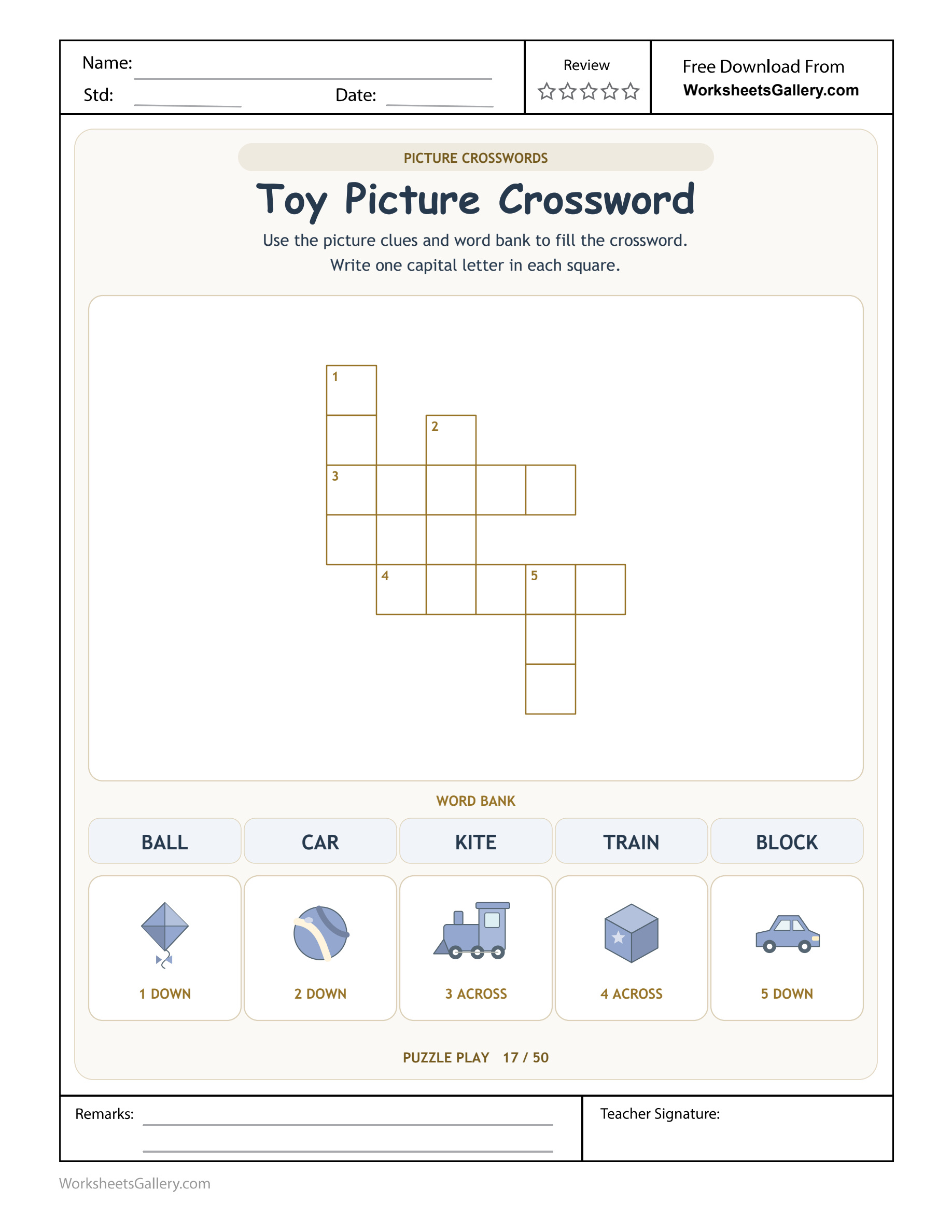
Five toy entries use BALL, CAR, KITE, TRAIN and BLOCK. The child uses numbered picture clues and the visible word bank, placing one capital letter in each crossword square. The task does not require unsupported spelling from memory.
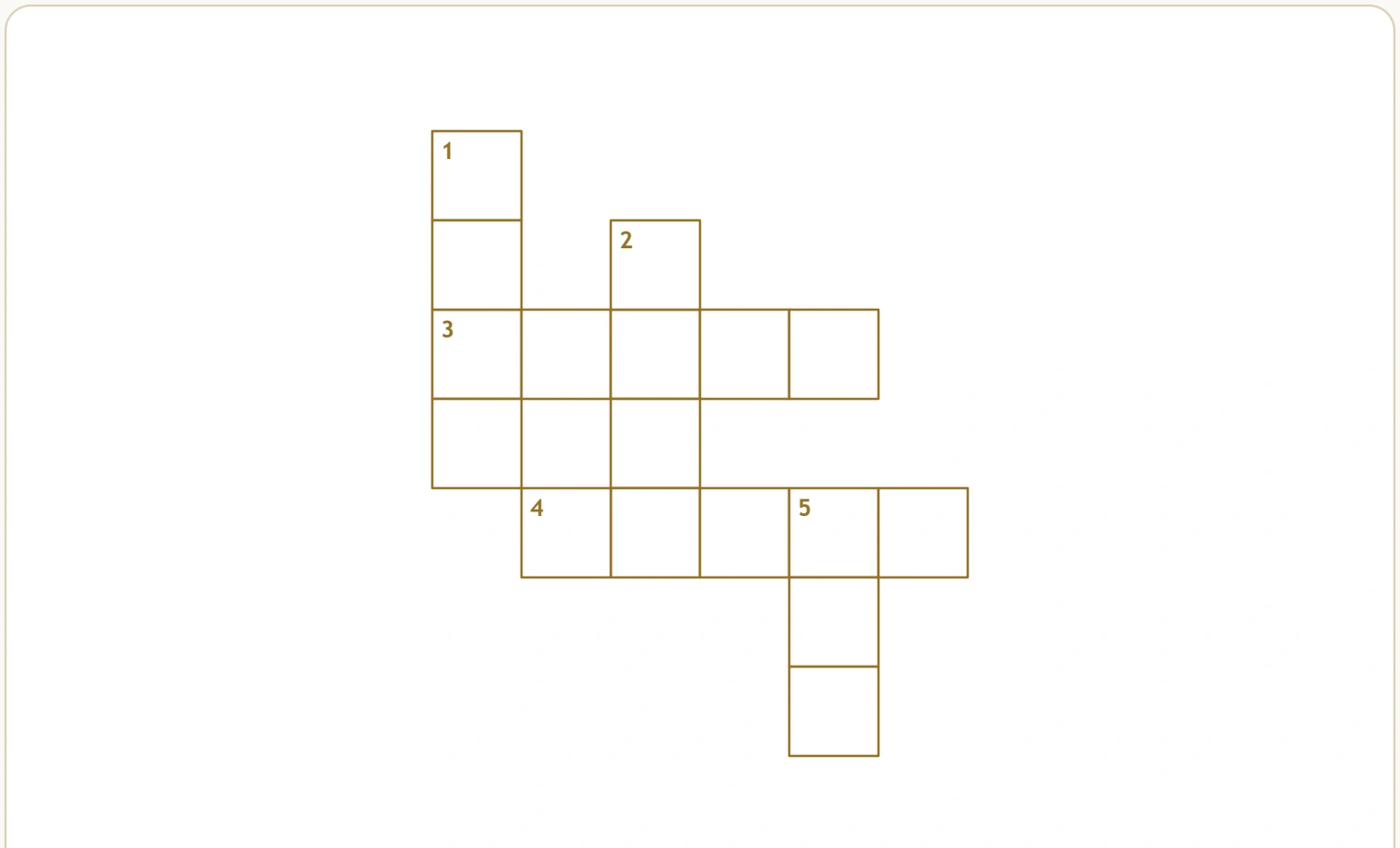
The down clues are 1 KITE, 2 BALL and 5 CAR. Across clues are 3 TRAIN and 4 BLOCK. Locate the number and direction before writing, since the same picture name must occupy its intended connected run of squares.

What five-letter entries reveals
Word length offers an early check: CAR has three letters, BALL and KITE four, TRAIN and BLOCK five. Counting letters can narrow candidates, but the picture clue is still needed when two words share a length.
Crossing squares belong to both an across and a down word. Reread the visible bank when a shared letter does not agree. A mismatch is a reason to inspect placement or copying, not to invent a new spelling.
A practical Toy Picture Crossword sequence
Three-letter entry with Sana
Begin Toy Picture Crossword: three-letter entry. CAR belongs to clue 5 DOWN. Ask Sana, “Which toy does this clue show?” The reading partner and Sana can inspect three-letter entry together.
Four-letter entries with Sana
Next inspect Toy Picture Crossword: four-letter entries. KITE is 1 DOWN and BALL is 2 DOWN. Ask Sana, “Where is that word in the bank?” The reading partner and Sana can inspect four-letter entries together.
Five-letter entries with Sana
Then confirm Toy Picture Crossword: five-letter entries. TRAIN is 3 ACROSS and BLOCK is 4 ACROSS. Ask Sana, “How many squares does this entry need?” The reading partner and Sana can inspect five-letter entries together.
Capital placement with Sana
Finally record Toy Picture Crossword: capital placement. Write one capital per cell and compare shared letters. Ask Sana, “Which way does this numbered clue go?” The reading partner and Sana can inspect capital placement together.
A source check for toy clues
| Printed clue | Source check |
|---|---|
| Three-letter entry | CAR belongs to clue 5 DOWN. |
| Four-letter entries | KITE is 1 DOWN and BALL is 2 DOWN. |
| Five-letter entries | TRAIN is 3 ACROSS and BLOCK is 4 ACROSS. |
| Capital placement | Write one capital per cell and compare shared letters. |
Count letters and squares together
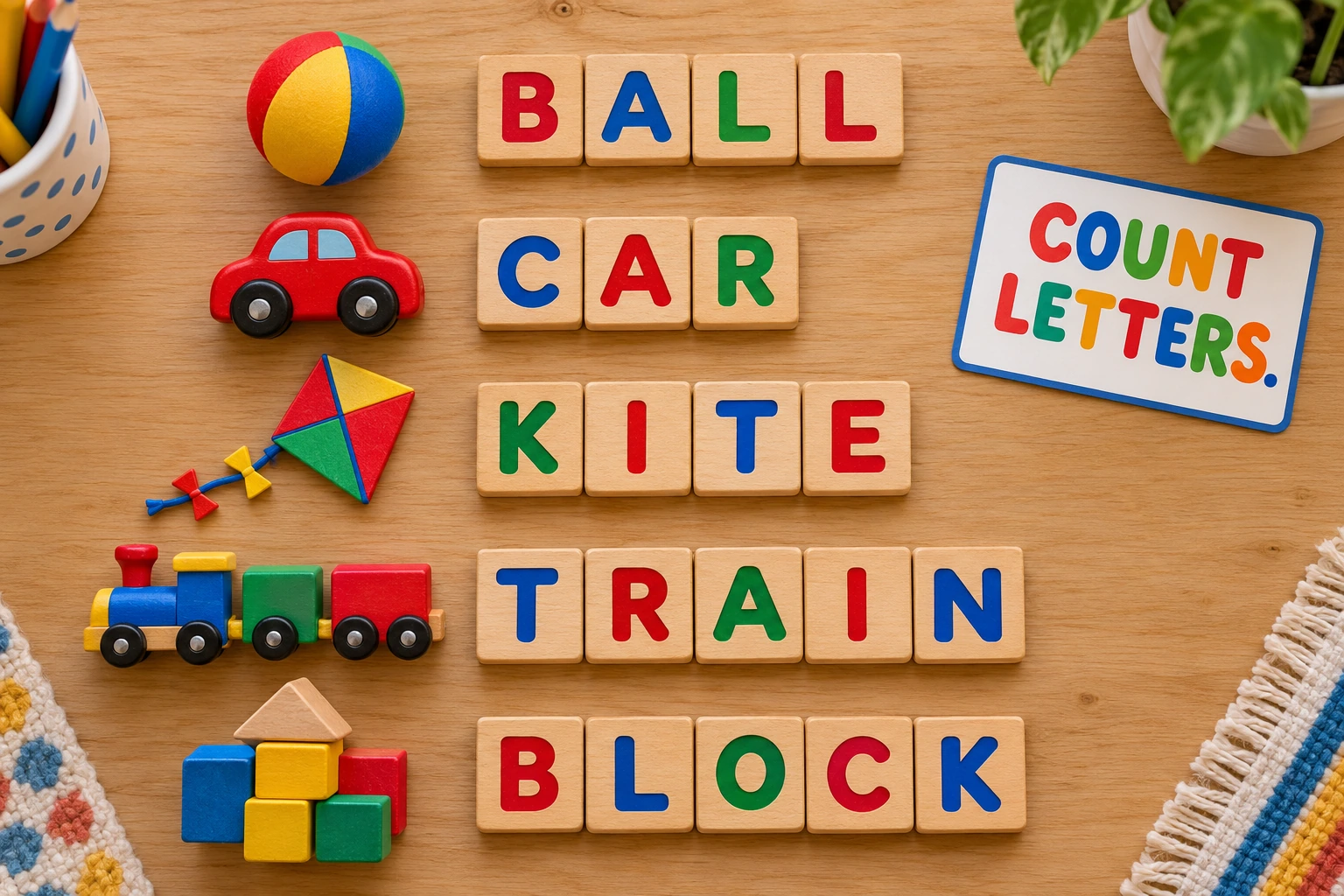
CAR has three capitals, while BALL and KITE each have four. For Toy Picture Crossword, TRAIN and BLOCK each need five. Touch the model letters and intended cells in order before writing. Length can narrow the choices, but it cannot distinguish two words with equal length by itself. Return to the numbered picture clue whenever two bank words would occupy the same number of squares.
Classroom partners inspect four-letter entries
A teacher gives one partner the picture-naming role and another the direction-checking role. They count the intended squares together and consult the bank, ensuring that vocabulary confidence does not hide an across-versus-down placement error. For a Toy Picture Crossword partner visit, word-bank use is this toy picture crossword partnership focus.
The clue direction controls placement
Locate the printed number and read ACROSS or DOWN with an adult before copying the first letter. For Toy Picture Crossword, A correct spelling in the wrong orientation still fails the intended crossword entry. Separating locating from writing can make this clearer: first point to the start and direction, then consult the word bank. The child has two manageable decisions rather than one rushed copying action.
Toy Picture Crossword: five-letter entries mistakes
Children may put an entire word in one square, write beyond its run or start at the wrong number. Touch each square while counting, then follow the clue direction. BALL contains two final L letters; do not shorten it to BAL. Invite Sana to discuss five-letter entries with the reading partner.
6 observations in Toy Picture Crossword
Picture vocabulary: Which toy does this clue show
Here, a toy image identifies the word needed. The prompt “Which toy does this clue show?” gives Sana a way to explain picture vocabulary to the reading partner.
Word-bank use: Where is that word in the bank
Here, a complete spelling remains available for consultation. The prompt “Where is that word in the bank?” gives Sana a way to explain word-bank use to the reading partner.
Letter counting: How many squares does this entry need
Here, the number of letters can be compared with available cells. The prompt “How many squares does this entry need?” gives Sana a way to explain letter counting to the reading partner.
Direction language: Which way does this numbered clue go
Here, across and down determine the writing route. The prompt “Which way does this numbered clue go?” gives Sana a way to explain direction language to the reading partner.
Copying with attention: Which letter comes after this one
Here, each capital occupies a separate intended square. The prompt “Which letter comes after this one?” gives Sana a way to explain copying with attention to the reading partner.
Cross-checking: Does this letter fit the other word too
In Toy Picture Crossword, a shared square must agree with both intersecting words. The prompt “Does this letter fit the other word too?” gives Sana a way to explain cross-checking to the reading partner.
Five play invitations after Toy Picture Crossword
Open a toy-word delivery desk
Spell BALL, CAR or KITE with letter tiles beside the matching toy. A child delivers the finished word to its picture, using the visible model rather than guessing spelling. After this Toy Picture Crossword play round, ask the reading partner which clue Sana chose to explain.
Sort by letter count
Put CAR in a three-letter area, BALL and KITE in a four-letter area, TRAIN and BLOCK in a five-letter area. Discuss why equal length alone cannot choose between the two five-letter words. Let Sana demonstrate this example before another Toy Picture Crossword visit; ask the reading partner to listen for Sana’s reasoning.
Walk across and down
Lay a completed word horizontally, then another vertically on separate paper strips. Point along each reading direction before returning to the crossword labels. On a later Toy Picture Crossword visit, ask Sana what changed; the reading partner can discuss Sana’s evidence.
Check the double-L parcel
Build BALL with tiles and remove one L. Ask the child to compare it with the complete bank word and identify the missing repeated letter. Ask Sana how this example relates to Toy Picture Crossword; the reading partner can follow the clue that Sana identifies.
Be a clue-number messenger
An adult says 3 ACROSS and the child points to the start square before any letter is placed. Switch roles with another clue to separate locating from spelling. Keep Sana’s own explanation central in this Toy Picture Crossword game. Let the reading partner hear what Sana observed.
Repeated letters remain separate letters
BALL ends with two L capitals, each occupying its own square. For Toy Picture Crossword, A child who recognises the spoken word may still omit one when copying. Compare the written model letter by letter and give the repeated letter its own place. The correction can focus on the visible spelling rather than asking the child to guess how a familiar toy name ought to look.
Imagine Sana at a home puzzle table
Sana names the train easily but is unsure how to write it. Her reading partner points to TRAIN in the bank and counts its five letters with her. They locate the across clue before placing capitals one by one. Here, Toy Picture Crossword gives Sana a reason to discuss picture vocabulary using the Toy Picture Crossword clues.
A crossing can test a copied word
After placing an entry, follow a word that crosses it and inspect the shared square. Both spellings must accept the same capital there. If they disagree, check the clue number, direction and bank model before changing several letters. This keeps the repair local and evidence-based, showing how the crossword layout provides information beyond a simple list of toy words.
A fresh Toy Picture Crossword reason to return
Revisit one crossing or one word length rather than demanding the full crossword again. Ask the child to explain how the bank or shared square helped confirm the spelling. Sana can show the reading partner a new capital placement observation during that short toy picture crossword visit.
Readiness for Toy Picture Crossword at ages 5–7
This page often suits supported learners around five to seven who can identify some capitals and copy a short model. An adult can read the word bank and clue direction while the child places selected letters. Suggested range for Toy Picture Crossword: ages 5–7. Begin with picture vocabulary and adult support.
For a comfortable Toy Picture Crossword visit, let Sana show three-letter entry before the reading partner requests another response. Discuss copying with attention using the printed Toy Picture Crossword example.
Save a printable Toy Picture Crossword copy
Eligible active members can obtain the clean Toy Picture Crossword printable through the premium download. The website watermark and domain are removed from the PDF, which has no embedded advertisements. Its word bank, numbered clues and letter cells remain intact; an original sample is separate. Before printing, ensure that the five toy pictures and every bank word are visible with the complete grid. The $5 twenty-five-sheet collection provides this crossword within its paid combined file.
Another pencil task after toy spelling
Extend the picture vocabulary conversation beyond Toy Picture Crossword with Three-letter entry before a road-width task; Letter counting and picture-detail tracing; Direction language beside a car-and-flag maze.
Explore Toy Picture Crossword alongside NAEYC family-writing ideas and PBS Parents reading play beside the toy crossword. Keep three-letter entry, direction language and cross-checking connected to the pictured puzzle.
Popular Worksheets
Printable resources families and teachers are downloading now.
 Free
 Free
 Free
 Free