
Farm Word Searching: 5 Clever Straight-Line Finds
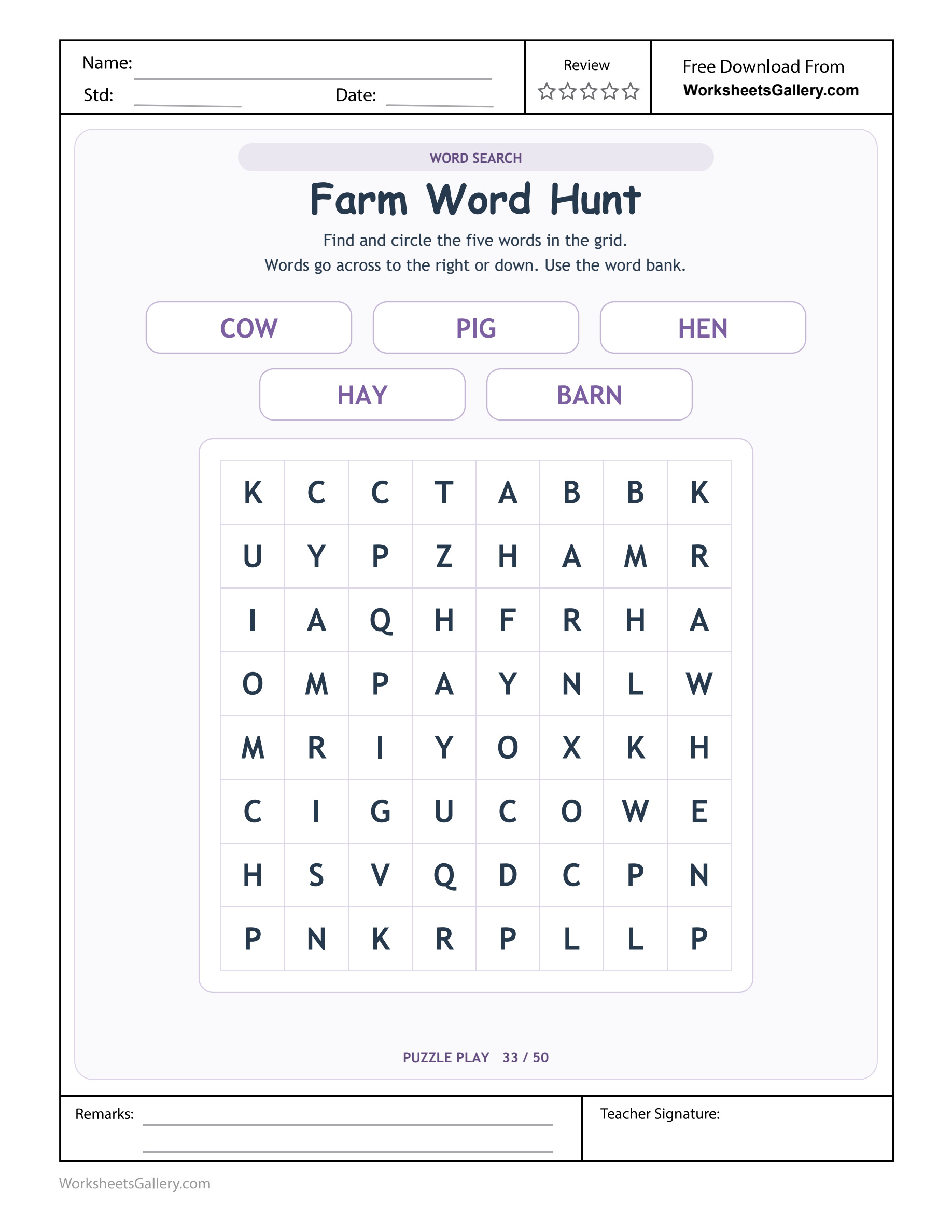
$5 · 25 supplied sheets: Farm Word Searching. Track letters in a straight rightward or downward line and verify the whole bank word.
A farm word can begin convincingly and still take the wrong turn. Farm Word Searching asks children to find five complete words in an eight-by-eight letter grid. The bank supplies COW, PIG, HEN, HAY and BARN, and the printed directions allow movement right or down. Introduce one target at a time and compare each candidate letter with the bank before circling. An adult may read the word aloud while the child searches its written form. Careful straight-line checking makes the discovery more meaningful than recognising an isolated first letter.
Farm Word Searching: read the actual puzzle
Farm Word Searching: The bank mixes animal names with HAY and BARN. Read the five entries before searching so their meanings are clear. The target is the exact sequence of capitals shown in the bank, not any farm-related word a child can invent.
Words run to the right or downward. A candidate cannot turn a corner midway through a word. Once a direction is chosen from a possible first letter, continue along that same row or column while checking the remaining letters.

Straight direction deserves a second look
The grid contains many distractor letters, including repeated starting letters. A promising C must still be followed by O and W in the chosen direction. Rejecting an incomplete run is part of a sensible search, not a failed attempt.
Circle the entire completed word as one visible run. The loop should show its first and last letters without swallowing an adjacent entry. Cross-check the bank after a find to keep track of the remaining targets.
Five play invitations after candidate start
Farm word builder with Farm Word Searching
Make COW with large letter tiles, then ask a partner to copy its order from a separate model.
Straight or turning with Farm Word Searching
Lay two simple letter routes on a table, one straight and one bent. Identify which could match this word-search rule.
Near-match judge with Farm Word Searching
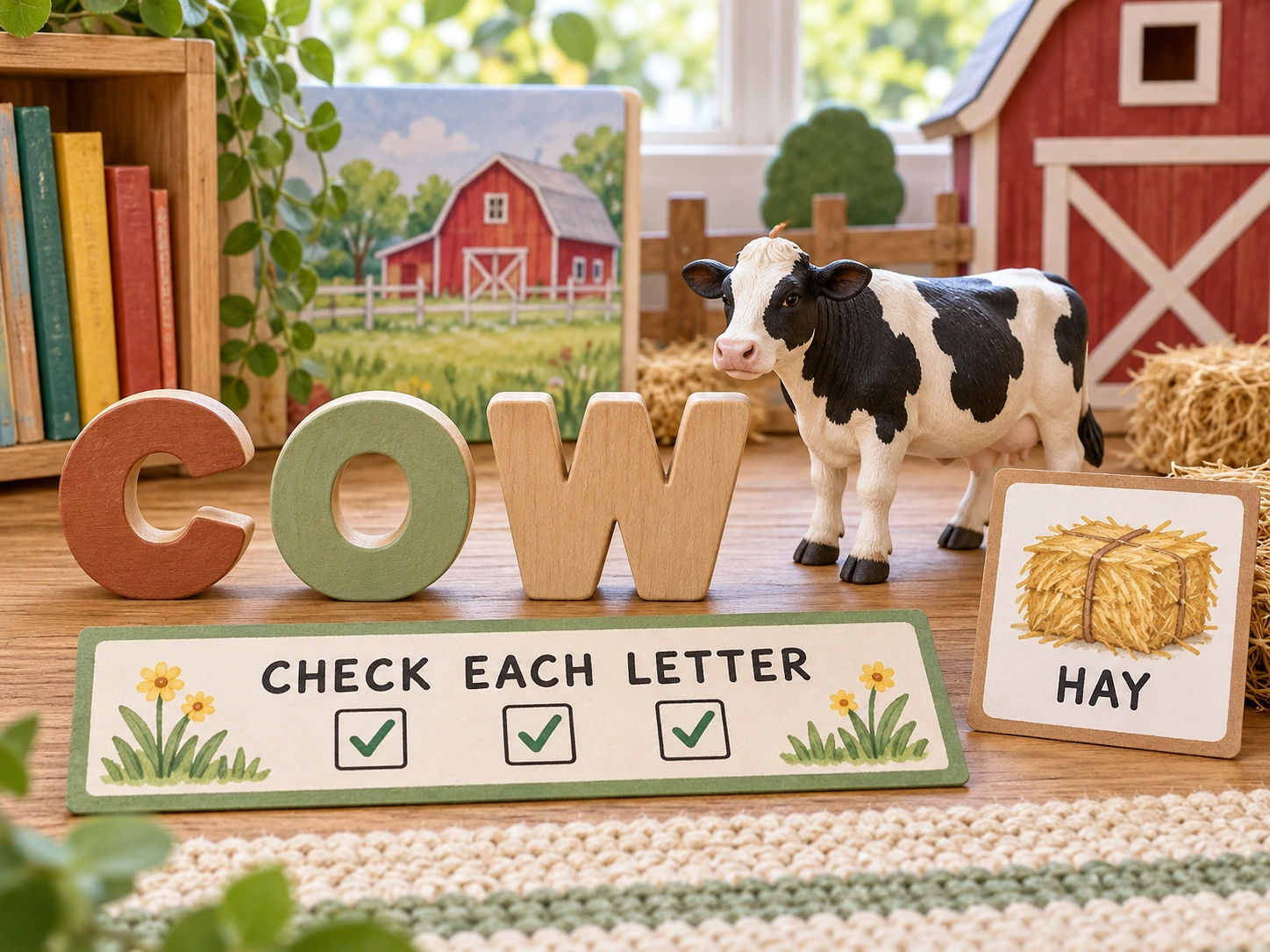
Offer COW and COT strips beside the target bank card. Explain which final letter settles the comparison.
Starting-letter sweep with Farm Word Searching
Look for all instances of one capital in a short homemade grid before deciding which can begin the chosen word.
Word-bank monitor with Farm Word Searching
Search a tiny invented grid while a partner tracks the completed targets on a fully written word list.
Distinctions behind straight direction
Bank word — the Alma discussion
Knowing what a cow looks like and recognising COW in capitals are different forms of knowledge. A short oral vocabulary conversation can prepare the topic, but the search still depends on the visible letters in the bank.
Candidate start — the Alma discussion
A systematic sweep reduces repeated effort. Agree on a row to inspect, test plausible starts and move on once that row has been considered. Keep the method simple enough that the child can describe where to resume after looking away.
Straight direction — the Alma discussion
The page does not require reverse or diagonal hunting. Introducing harder directions too early changes the problem and may make a correct printed word appear absent. Preserve the source rule first; create an explicitly different search for later challenge.
Revisit the straight direction difficulty
A child may connect familiar letters through a turn, producing the right spelling along an invalid route. Trace the candidate with a finger and check the printed directions. Also avoid crossing out every distractor letter; that can make the remaining search harder to see.
Return to Farm Word Searching evidence by asking “Can the whole word stay on this line?” Separate pencil execution from Alma’s bank word reasoning.
Imagine Alma investigating at home
Alma’s teaching assistant models a single candidate C on a home-learning call. Alma checks the next letter rather than immediately circling it. They agree that a near-match can be left alone and search another starting point without erasing a large guess.
Try “Which letters are we trying to find?” during this imagined Farm Word Searching visit. Let Alma explain bank word before recording.
Readiness for candidate start
Offer a small paper window that reveals a few rows while leaving the bank accessible. Read the target aloud, but keep exact-letter matching visible rather than replacing it with an adult’s pointing.
Suggested Farm Word Searching range: ages five to seven. Alma’s readiness depends on letter sequence recognition and interest in candidate start. Shorten this Farm Word Searching visit when needed.
Four checkpoints for Farm Word Searching
| Pause here | Inspect this clue |
|---|---|
| Bank word | Identify the exact target and its spelling. |
| Candidate start | Locate a possible first letter in the grid. |
| Straight direction | Continue only rightward or downward. |
| Complete enclosure | Circle from the first target letter to its last. |
Bank word — Alma’s inspection
For Farm Word Searching, ask “Which letters are we trying to find?” Identify the exact target and its spelling.
Candidate start — Alma’s inspection
For Farm Word Searching, ask “What should follow this letter?” Locate a possible first letter in the grid.
Straight direction — Alma’s inspection
For Farm Word Searching, ask “Can the whole word stay on this line?” Continue only rightward or downward.
Complete enclosure — Alma’s inspection
For Farm Word Searching, ask “Does the loop contain every letter of the word?” Circle from the first target letter to its last.
Six observations from bank word
Letter sequence recognition — bank word
Farm Word Searching invites comparing an exact written word with a candidate run. Notice Alma’s letter sequence recognition explanation: “Which letters are we trying to find?”
Systematic search — candidate start
Farm Word Searching invites scanning available rows and columns without repeatedly restarting everywhere. Notice Alma’s systematic search explanation: “What should follow this letter?”
Directional discipline — straight direction
Farm Word Searching invites maintaining one permitted direction for an entire target. Notice Alma’s directional discipline explanation: “Can the whole word stay on this line?”
Spelling attention — complete enclosure
Farm Word Searching invites noticing a near-match that differs at its second or final letter. Notice Alma’s spelling attention explanation: “Does the loop contain every letter of the word?”
Loop control — bank word
Farm Word Searching invites enclosing a letter run with a clear pencil boundary. Notice Alma’s loop control explanation: “Which letters are we trying to find?”
Progress monitoring — candidate start
Farm Word Searching invites using the bank to distinguish found words from remaining targets. Notice Alma’s progress monitoring explanation: “What should follow this letter?”
Another visit through progress monitoring
Return for one still-unfound word on another day. Let the child choose the target and explain a candidate that was rejected, acknowledging careful checking as well as a successful find.
Revisit Farm Word Searching through complete enclosure. Recognise explanations about complete enclosure from Alma.
Partners explore systematic search
At a farm reading table, partners use reader and finder roles. The reader holds attention on one bank word while the finder tests a straight grid run. They change jobs after a verified word, making both spelling and searching active contributions.
A Farm Word Searching classroom note can describe maintaining one permitted direction for an entire target. Record the actual candidate start prompt, too.
Eight closer readings of bank word
Name the farm words first
Read the target bank and discuss any unfamiliar word before searching. HAY and BARN refer to farm surroundings rather than animal names. That conversation clarifies the vocabulary, while the written capitals still specify what must be found in the field. Knowing the topic does not replace comparing the exact spelling. This Farm Word Searching distinction supports letter sequence recognition.
A candidate is a question
Treat a possible first letter as a place to investigate, not a finished find. Check the next required capital along a permitted direction. If the run fails, leave it unmarked and test another start. Rejection of a near-match is a purposeful decision that helps narrow the search.
Keep the direction straight
A child who locates the correct letters through a corner has found a different kind of route. Point out the source rule allowing rightward or downward words, then compare the candidate with that rule. Preserve the useful letter recognition while correcting the direction of the proposed run. This Farm Word Searching distinction supports directional discipline.
A concrete cow example
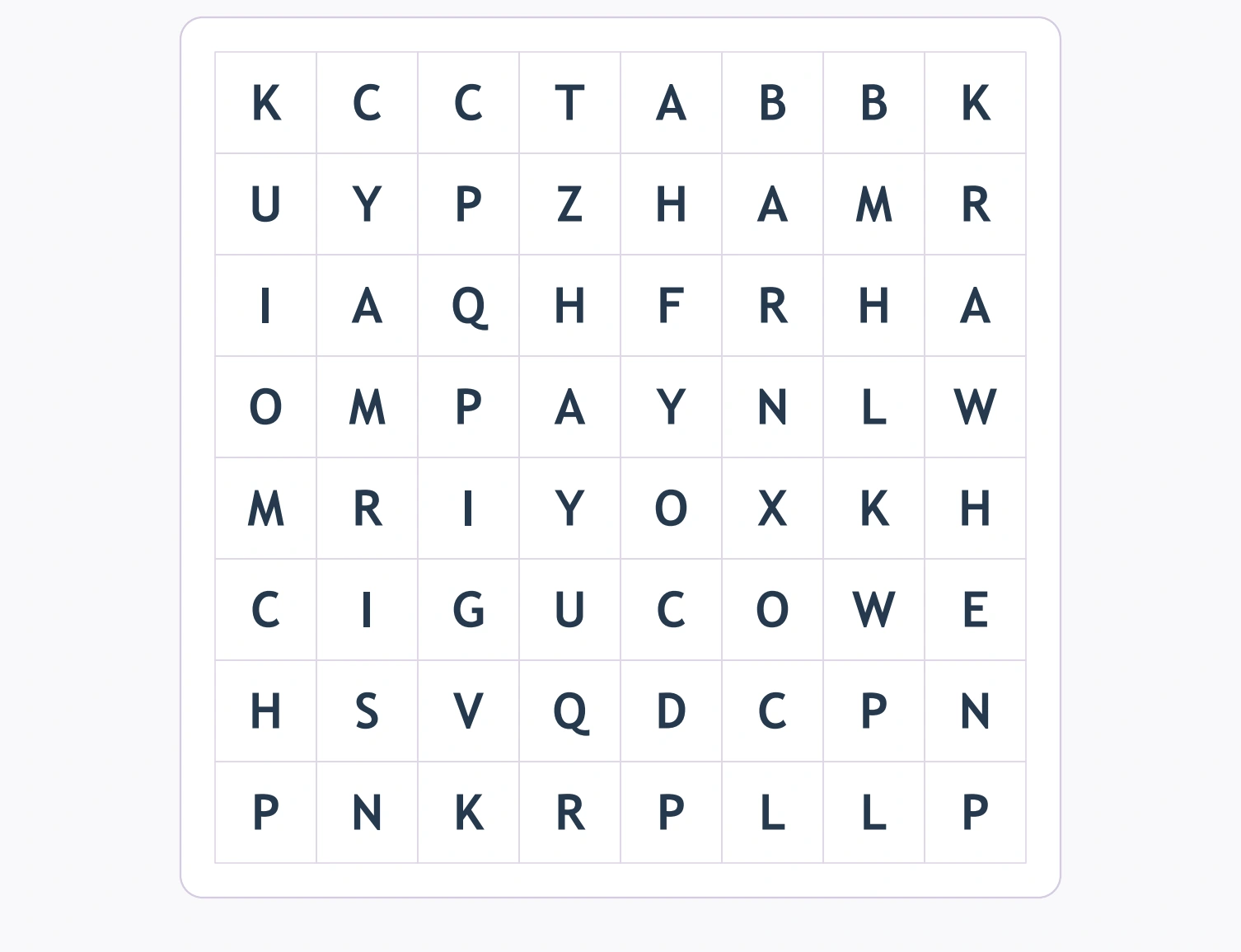
The complete COW run appears horizontally in the sixth grid row. An adult can use it as one worked example after allowing independent exploration. Point through its three consecutive letters and compare them with the bank before demonstrating a narrow loop around the whole word.
A bank entry is a reference
Keep the chosen target visible when looking across to the field. A small written copy beside the current row can reduce repeated long eye movements. The copy should preserve all capitals and their order, supporting comparison rather than revealing the starting cell of the hidden word. This Farm Word Searching distinction supports loop control.
Loop from first to last
Before circling, touch each letter of a confirmed run and identify its endpoint. A single controlled loop should make the selected word understandable to another reader. If the pencil line includes nearby letters, ask what was intended and clarify the record without dismissing the successful search.
Track what remains to be found
A light mark beside a found bank word can distinguish finished targets from unfinished ones. Keep those bank marks separate from the loops in the grid. On returning after a pause, the child can select an outstanding word instead of searching repeatedly for an entry already located. This Farm Word Searching distinction supports letter sequence recognition.
A method can transfer without an answer
Try a smaller homemade grid using a new arrangement and the same right-or-down rule. Ask the child to describe the search method rather than recall where a farm word appeared previously. This distinguishes systematic checking from remembering the original field’s positions.
Save and print Farm Word Searching
Membership eligibility unlocks the clean Farm Word Searching PDF through the premium download control. That edition preserves the farm bank and letter field while removing domain lettering and website watermark; it has no embedded advertising. A distinct sample holds the original upload. In portrait print preview, inspect the complete eight-by-eight grid and all five farm words.
Other choices beyond letter sequence recognition
For Farm Word Searching, the saved catalog suggests road-following after farm word searching; aiming-and-stopping after farm word searching; picture-recipe drawing after farm word searching. Read each linked activity’s rule with Alma; its bank word response may differ.
For Alma, browse NAEYC writing ideas alongside farm word searching or PBS Parents activities beyond farm word searching. Watch letter sequence recognition with directional discipline, then revisit bank word.
Popular Worksheets
Printable resources families and teachers are downloading now.
 Free
 Free
 Free
 Free