
Pirate Code Reading: 4 Brilliant Hidden Word Finds
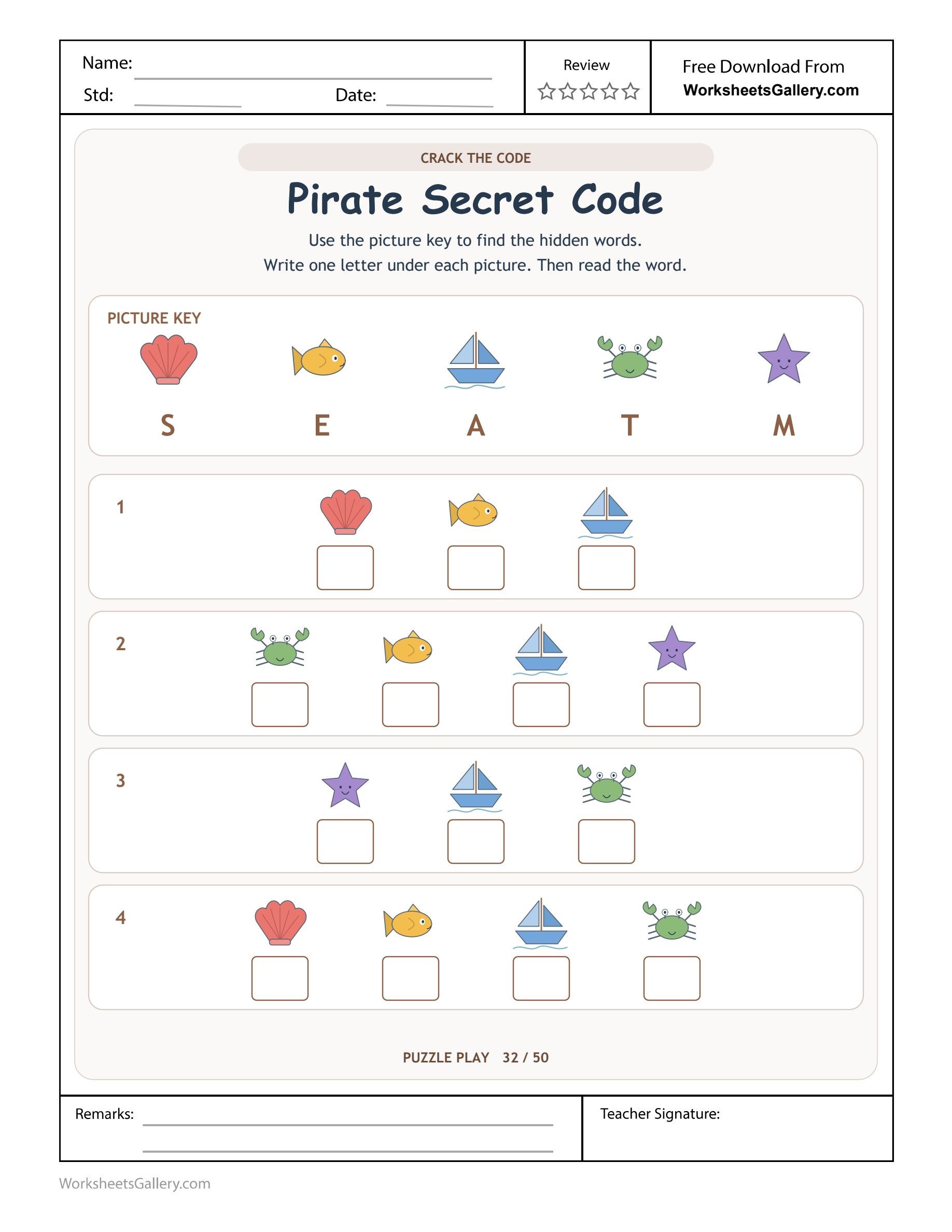
$5 · 25 supplied sheets: Pirate Code Reading. Keep one stable symbol-to-letter key while decoding sea-themed messages of different lengths.
A small picture key turns the pirate theme into a reading investigation. Pirate Code Reading uses shells, fish, boats, crabs and stars to represent five letters. Children translate one symbol at a time, keep the positions in order and read the word that emerges. An adult can guide a finger back to the key while the child chooses the corresponding capital. The four messages vary in length, offering a reason to count their boxes before writing. Enjoy the treasure-story atmosphere, but let the printed code determine every letter in the message.
Pirate Code Reading: read the actual puzzle
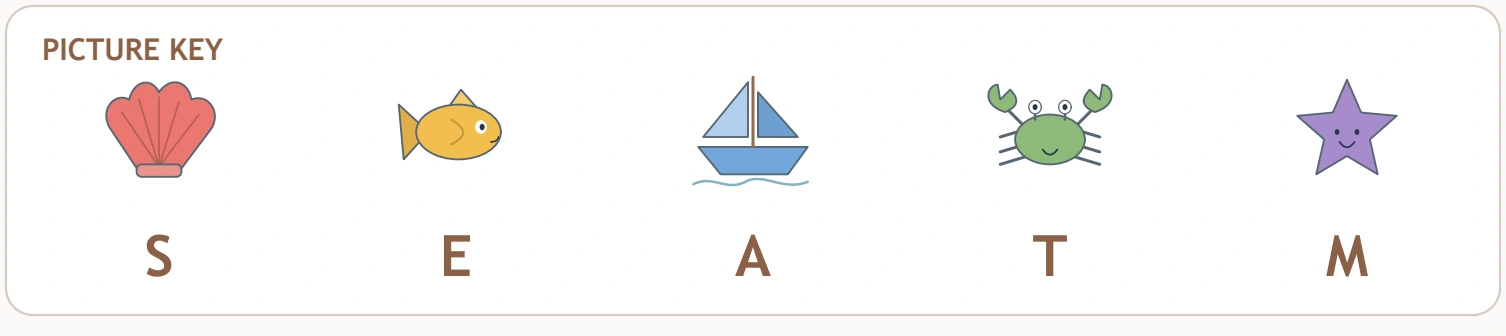
Pirate Code Reading: The complete key is shell S, fish E, boat A, crab T and star M. Read those pairings aloud while pointing. Familiarity with the pictures supports finding entries, but their everyday names do not supply the assigned letters.
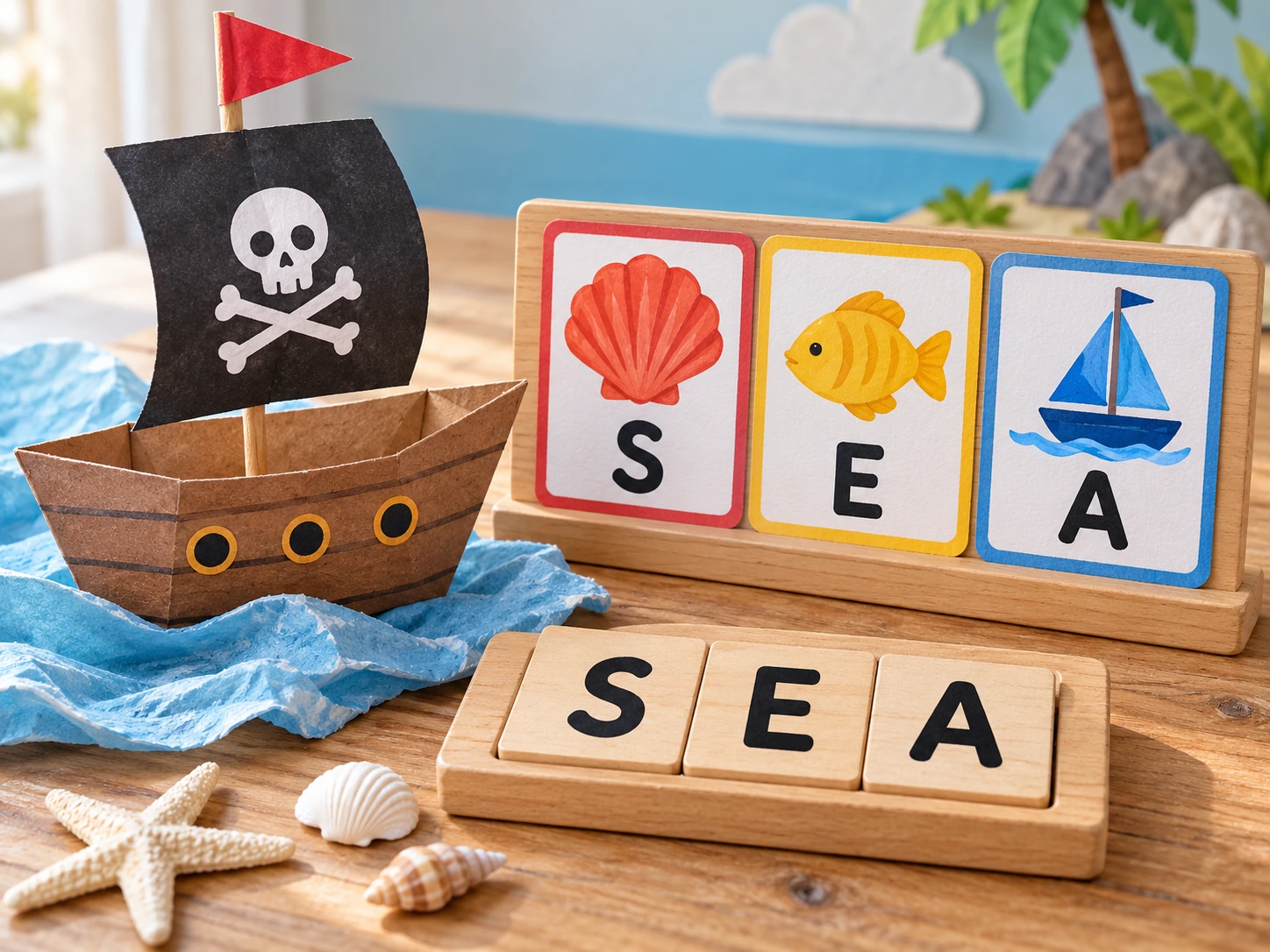
The opening shell-fish-boat string produces SEA. Its three picture positions map onto three letter boxes. Compare the written result with the original symbols, keeping a finger below the current position to avoid a sideways shift.
Position pairing deserves a second look
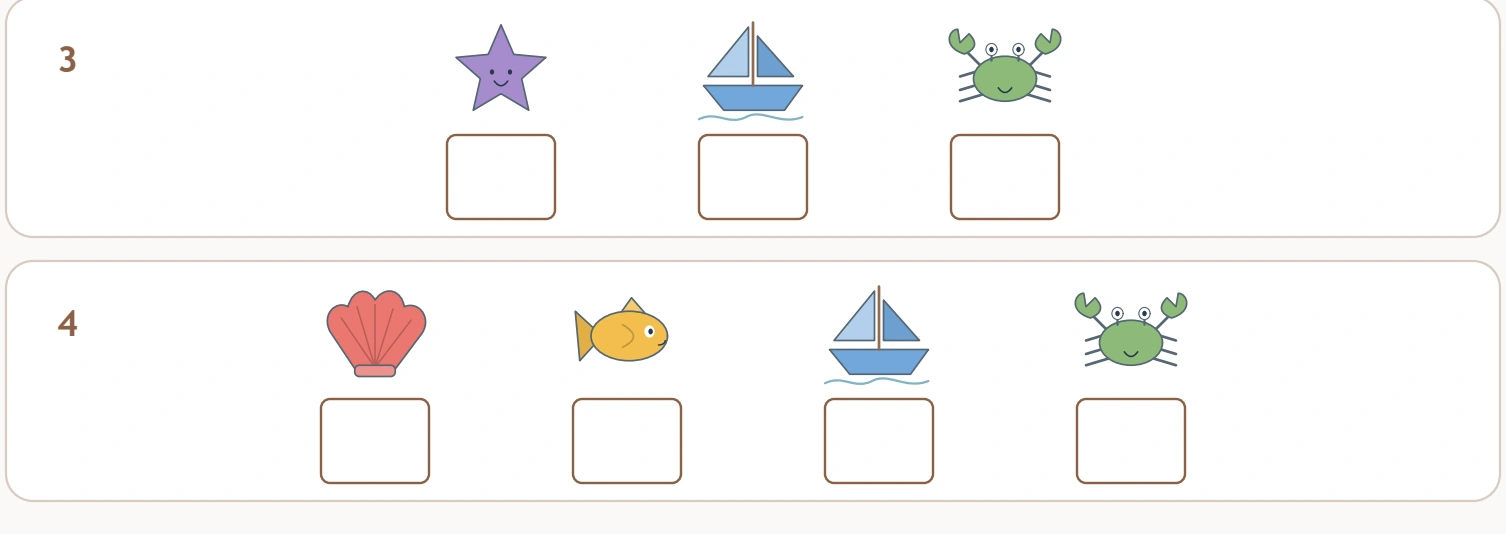
A four-symbol message can share letters with a shorter message without sharing its word. The order of T, E, A and M matters. Reading the letters as an unordered collection would hide the information carried by their positions.
The lower messages reuse the same key. A star remains M even when it starts a new row, and the boat remains A wherever it appears. The challenge changes through order and length rather than through new associations.
Eight closer readings of pirate key
Pictures do not promise a sea word
The nautical symbols create a pirate setting, yet the decoded answers include ordinary words as well. Encourage translation before guessing from the theme. A resulting word need not describe a boat or beach to be correct; its letters must agree with the key in their printed order. This Pirate Code Reading distinction supports symbolic reading.
One shell keeps one meaning
Locate the shell at the beginnings of different strings. Its code remains S on each occurrence. Invite the child to compare the recorded capitals before reading the words. This cross-row inspection can catch an inconsistent lookup without needing an adult to supply the complete decoded answer.
Length is part of the message
Three symbols and four symbols require different numbers of written positions. Count the pictures with a finger before recording any letters. If a child produces a familiar shorter word, check whether every source symbol received a response rather than assuming the missing position is unimportant. This Pirate Code Reading distinction supports reference checking.
A fish carries an assigned vowel
The fish represents E in this key. Its spoken name therefore cannot supply the code through initial-sound matching. Read the pictured association explicitly, then return to the current string. This helps separate ordinary picture naming from the agreed substitution used by the pirate puzzle.
Track the next untranslated position
Keep a finger below the current symbol while looking up its letter, and move that finger only after the corresponding box has been filled. This supports a smooth return from the key. Without a place keeper, a child may translate the same picture twice or skip its neighbour. This Pirate Code Reading distinction supports writing organisation.
A familiar ending still needs checking
A child may recognise a possible word after two letters and rush through its ending. Ask which symbol supplies the next capital. The aim is not to discourage recognition, but to keep the complete translation available as evidence. A plausible word and a correctly decoded string are not always identical.
Reverse the communication role
Once the key makes sense, let the child become a sender for an adult. Build a short string from a few existing associations and ask the adult to show each lookup. Checking someone else’s response introduces another perspective without requiring a longer or more difficult printed message. This Pirate Code Reading distinction supports symbolic reading.
Keep invented codes clearly separate
A new assignment is a useful extension only when it is announced as a new game. Use another card or sheet and show the changed key. Writing a different meaning onto the original messages would make their shared associations inconsistent and confuse whether the source puzzle had been solved.

Distinctions behind position pairing
Pirate key — the Zubin discussion
A key is an agreement between writer and reader. Inventing a new assignment is a fine extension when both participants know it has changed. Quietly switching the code while marking the original worksheet would make its messages inconsistent.
Message length — the Zubin discussion
Counting boxes is not a substitute for translating, but it is a useful recording check. A four-picture row needs four letters even if the child expects a shorter word. This visual count can catch an omitted symbol before the completed word is read.
Position pairing — the Zubin discussion
Keep the pleasure of discovery without making reading speed a contest. A child who checks the key repeatedly is using an effective available tool. Independence can gradually mean finding the right entry without an adult pointing, rather than avoiding references altogether.

Five play invitations after message length
Shared-key post with Pirate Code Reading
Create a two-symbol key and send a tiny message to another person. Compare whether both readers used the agreed assignments.
Long and short notes with Pirate Code Reading
Build messages with three and four symbol cards. Count positions before translating them into separate letter strips.
Boat-letter patrol with Pirate Code Reading
Locate each boat in an invented string and check that every occurrence produces the same capital.
Scrambled treasure word with Pirate Code Reading
Reorder a few translated letter tiles and listen to how the reading changes. Restore the symbol order to recover the intended message.
Captain’s correction with Pirate Code Reading
An adult deliberately changes one association halfway through decoding. Let the child explain why a shared key must remain stable.
Partners explore position awareness
A classroom treasure-post station has one child translate and another point back to the source symbol for each written letter. Partners read the completed string together, then swap sender and checker roles on the next row.
A Pirate Code Reading classroom note can describe returning to a printed key when an association is uncertain. Record the actual message length prompt, too.
Another visit through shared communication
Deliver a short message to a toy pirate during another play session. Invite a check of the recipient’s translation, giving an authentic purpose to the repeated lookup.
Revisit Pirate Code Reading through reused association. Recognise explanations about reused association from Zubin.
Six observations from pirate key
Symbolic reading — pirate key
Pirate Code Reading invites treating a picture as a sign with an agreed meaning. Notice Zubin’s symbolic reading explanation: “What does the fish represent in this code?”
Position awareness — message length
Pirate Code Reading invites keeping letters in the sequence carried by the symbols. Notice Zubin’s position awareness explanation: “How many letters does this message need?”
Reference checking — position pairing
Pirate Code Reading invites returning to a printed key when an association is uncertain. Notice Zubin’s reference checking explanation: “Which symbol supplied this letter?”
Length comparison — reused association
Pirate Code Reading invites distinguishing three-letter and four-letter message structures. Notice Zubin’s length comparison explanation: “Has the boat kept its assigned letter?”
Writing organisation — pirate key
Pirate Code Reading invites fitting one capital into each intended response space. Notice Zubin’s writing organisation explanation: “What does the fish represent in this code?”
Shared communication — message length
Pirate Code Reading invites making a message readable to another person using the same key. Notice Zubin’s shared communication explanation: “How many letters does this message need?”
Imagine Zubin investigating at home
Zubin’s uncle sets a toy boat beside the code page. Zubin wants the boat symbol to mean B. They enjoy that invented code briefly, then return to the worksheet’s A assignment so both people can read the same printed message.
Try “What does the fish represent in this code?” during this imagined Pirate Code Reading visit. Let Zubin explain pirate key before recording.
Revisit the position pairing difficulty
Assuming every nautical picture must decode to a sea-related word can encourage a guess before translation. Allow a surprising result, then test it against the key. A correctly translated message is stronger evidence than the story an adult expected.
Return to Pirate Code Reading evidence by asking “Which symbol supplied this letter?” Separate pencil execution from Zubin’s pirate key reasoning.
Four checkpoints for Pirate Code Reading
| Pause here | Inspect this clue |
|---|---|
| Pirate key | Say the symbol-letter pairs without using first sounds. |
| Message length | Count picture positions and available writing boxes. |
| Position pairing | Keep each translated capital beneath its own symbol. |
| Reused association | Compare repeated pictures across different messages. |
Pirate key — Zubin’s inspection
For Pirate Code Reading, ask “What does the fish represent in this code?” Say the symbol-letter pairs without using first sounds.
Message length — Zubin’s inspection
For Pirate Code Reading, ask “How many letters does this message need?” Count picture positions and available writing boxes.
Position pairing — Zubin’s inspection
For Pirate Code Reading, ask “Which symbol supplied this letter?” Keep each translated capital beneath its own symbol.
Reused association — Zubin’s inspection
For Pirate Code Reading, ask “Has the boat kept its assigned letter?” Compare repeated pictures across different messages.
Readiness for message length
Let the child select large letter tiles before writing small capitals. Keep the source key visible, and offer shared word reading after the symbol lookup is complete.
Suggested Pirate Code Reading range: ages five to seven. Zubin’s readiness depends on symbolic reading and interest in message length. Shorten this Pirate Code Reading visit when needed.
Save and print Pirate Code Reading
Two Pirate Code Reading file controls distinguish the original upload from the clean member edition. Premium eligibility depends on an active qualifying plan. That printable omits website watermark and domain branding, with advertising also absent. Save the pirate PDF, then inspect the whole symbol key and four code rows in portrait print preview before sending a copy to your printer.
Other choices beyond symbolic reading
For Pirate Code Reading, the saved catalog suggests road-following after pirate code reading; aiming-and-stopping after pirate code reading; picture-recipe drawing after pirate code reading. Read each linked activity’s rule with Zubin; its pirate key response may differ.
For Zubin, browse NAEYC writing ideas alongside pirate code reading or PBS Parents activities beyond pirate code reading. Watch symbolic reading with reference checking, then revisit pirate key.
Popular Worksheets
Printable resources families and teachers are downloading now.
 Free
 Free
 Free
 Free