
Robot Picture Cipher: 4 Amazing Decoding Missions
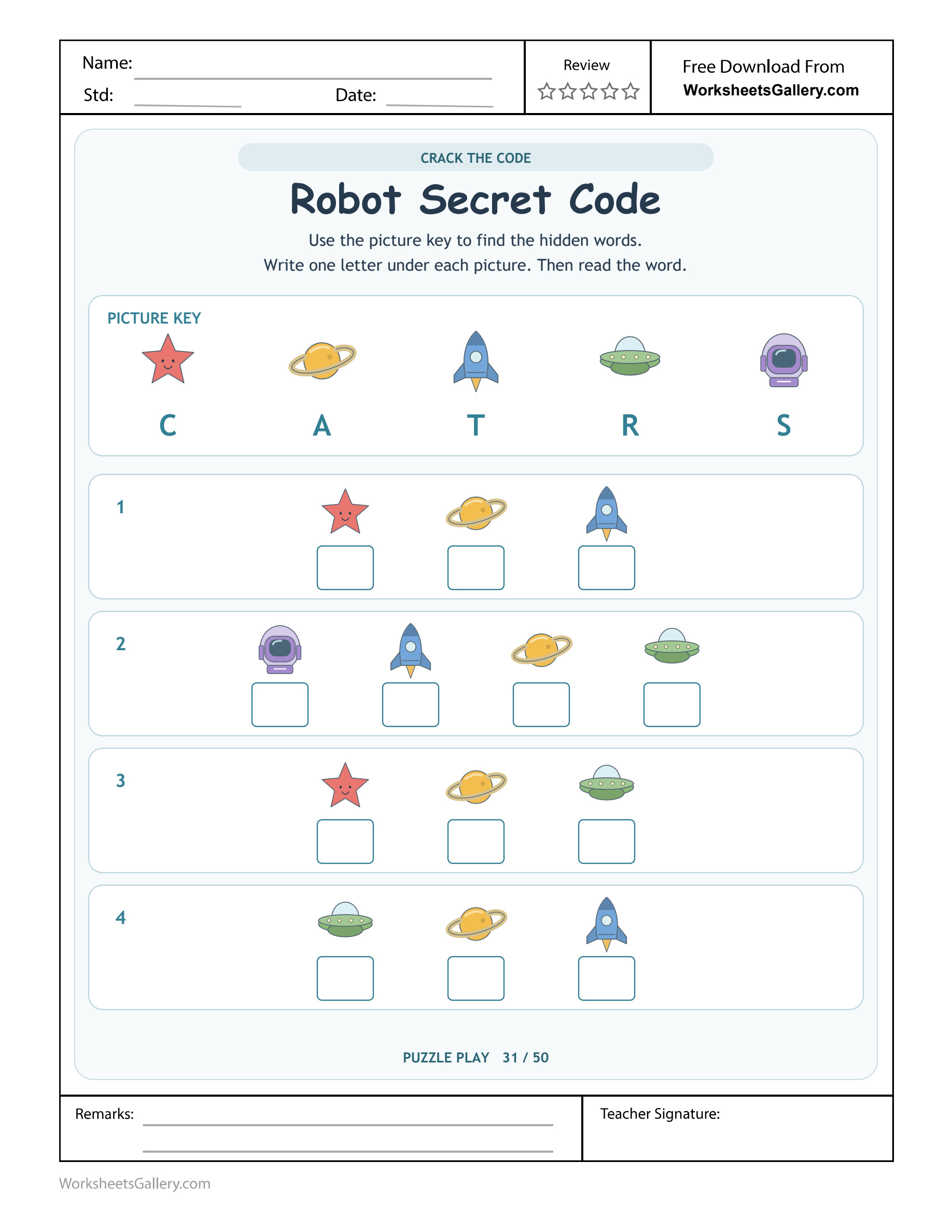
$5 · 25 supplied sheets: Robot Picture Cipher. Translate each symbol through the supplied key; picture names do not provide the letters.
The star in this message does not ask for the first sound in star. Robot Picture Cipher gives each space picture a letter and asks children to translate the symbols in order. Four short messages share one visible key, so a familiar symbol keeps its meaning across the page. Work together on finding a symbol before writing its code beneath it. An adult can help read the completed word after the letters are recorded. The rewarding discovery is that a little row of pictures can carry a message someone else can read.
Robot Picture Cipher: read the actual puzzle
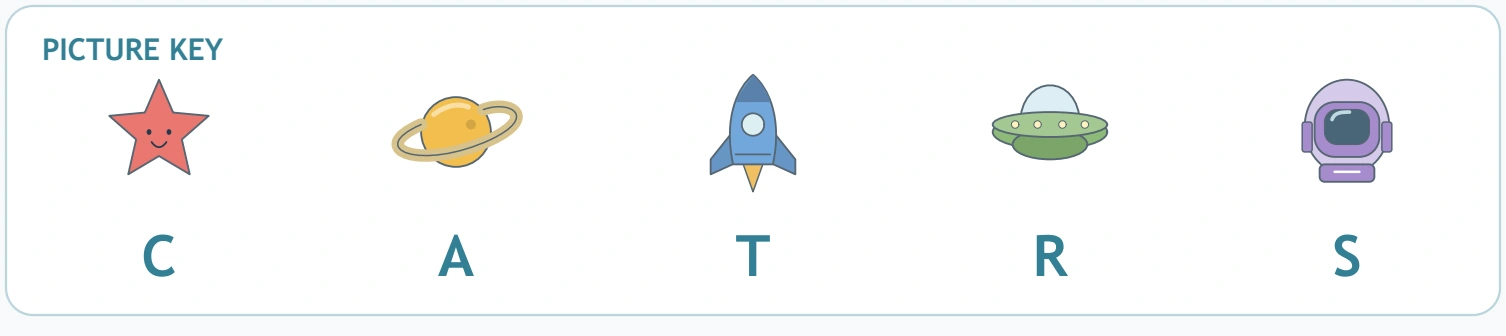
Robot Picture Cipher: The five-symbol key associates star with C, ringed planet with A, rocket with T, UFO with R and helmet with S. These are assigned relationships. Guessing an object’s initial would produce a different result from consulting this particular key.
Every message has one intended letter box beneath each symbol. Keep that vertical pairing visible as the child translates. A correct letter placed under the next picture changes the message, even when every individual symbol was recognised accurately.
Letter sequence deserves a second look
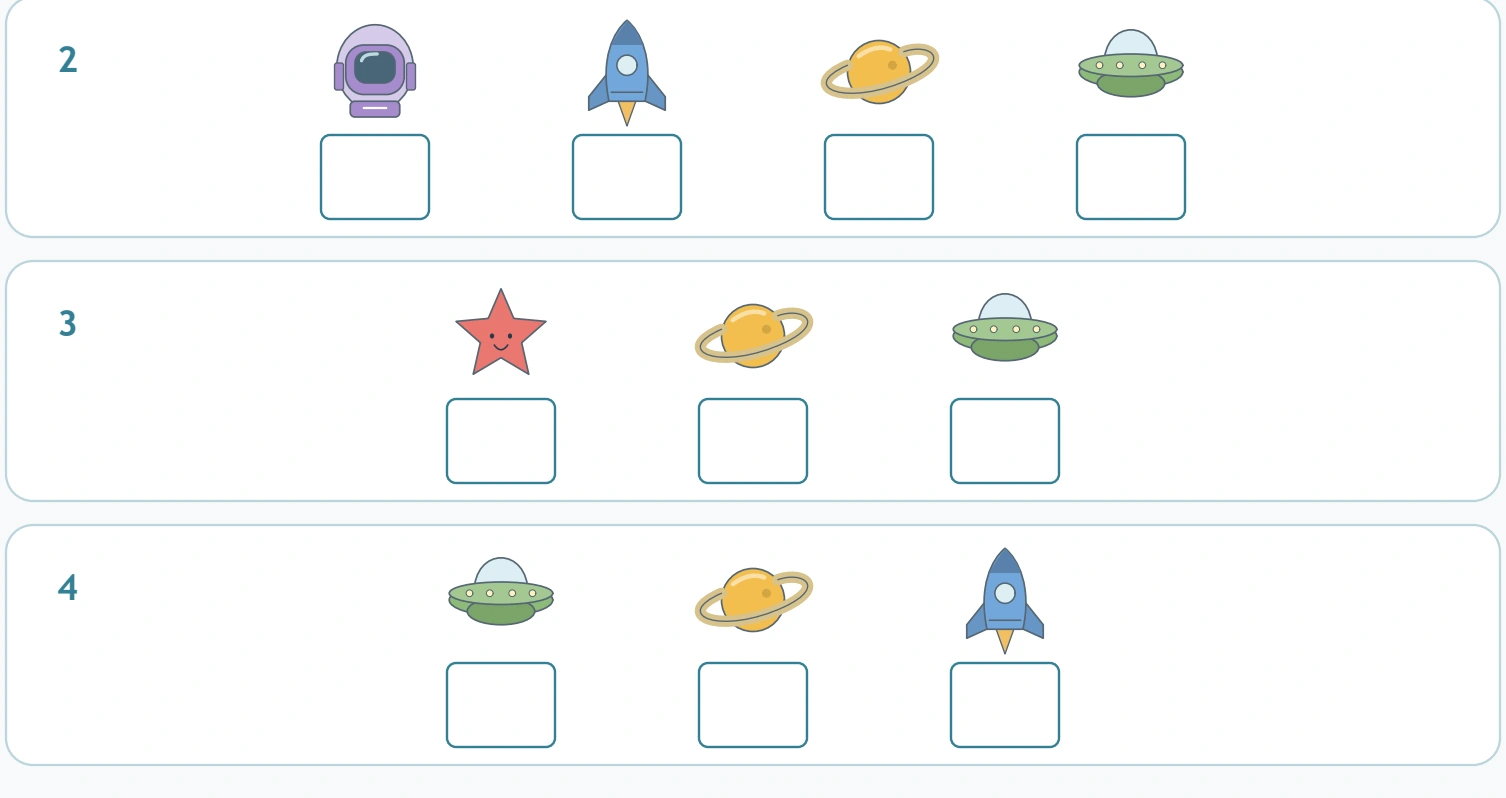
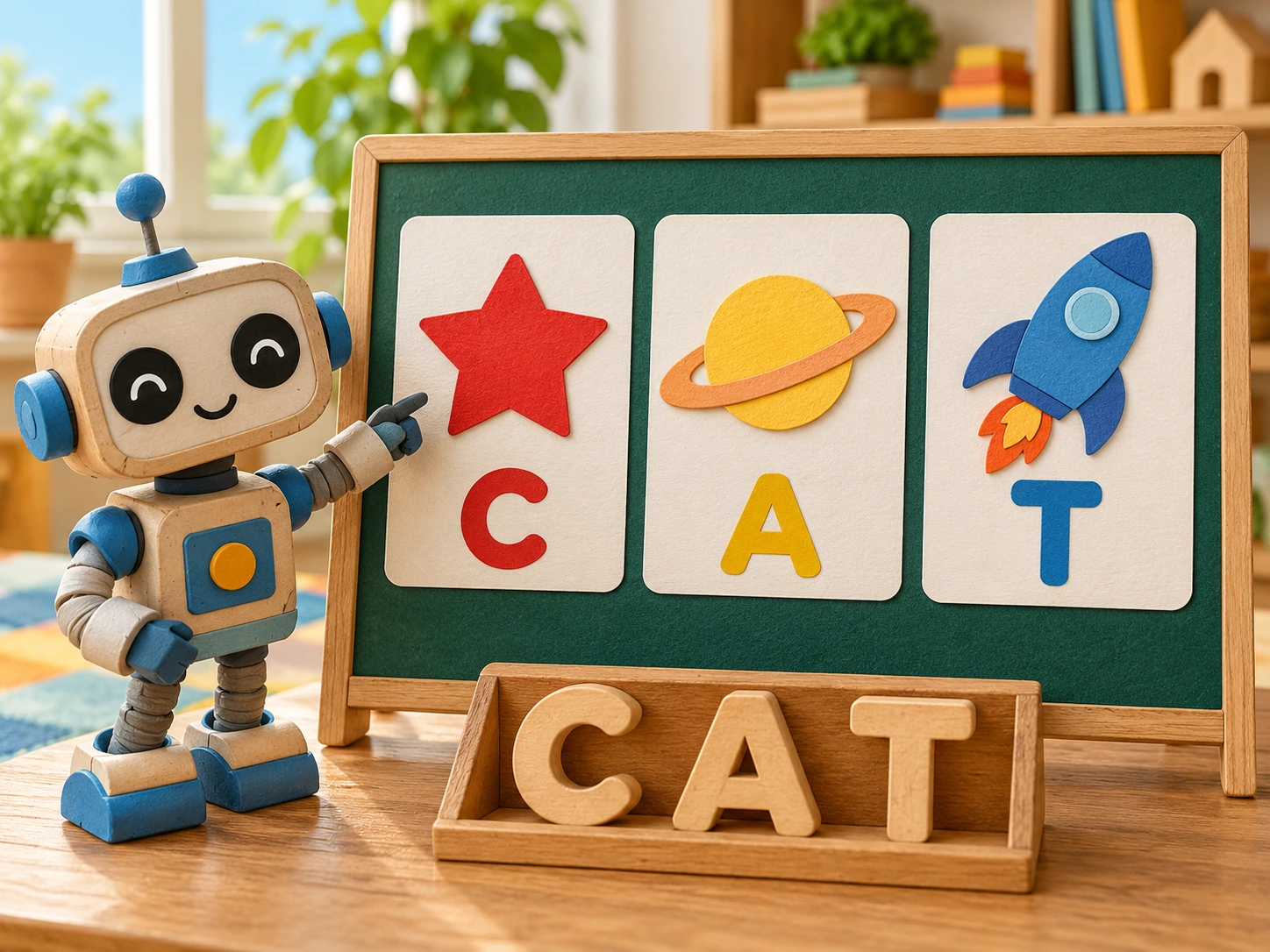
The first three pictures decode to C-A-T. Blend or read the completed word only after checking those translations. The next message has four positions, so do not assume every row will produce a three-letter word.
Repeated symbols create useful checks. The planet always supplies A and the UFO always supplies R on this page. A child can revisit an earlier occurrence when uncertain, while keeping the printed key as the final reference.
Eight closer readings of symbol lookup
The key outranks a familiar sound
A child may sensibly offer S for star after practising initial sounds elsewhere. Name that different strategy, then read the code’s C assignment together. The worksheet asks for an agreed substitution. Explicitly changing the task rule preserves the child’s useful sound knowledge while clarifying why it does not determine this message. This Robot Picture Cipher distinction supports reference use.
Pair one picture with one box
Point from a symbol straight down to its intended response space before consulting the key. Return to that same box with the chosen letter. This little vertical pairing can prevent an entire string of answers shifting sideways, a recording slip that otherwise makes correct translations look like mistaken code knowledge.
Keep repeated symbols stable
Find the planet in more than one message and compare its associated capital each time. It remains A regardless of its row or neighbouring pictures. A repeated association provides a built-in check: if two identical symbols have different recorded letters, consult the key before trying to read either word. This Robot Picture Cipher distinction supports left-to-right tracking.
Read only after translating
The first row supports a short completed C-A-T reading. Let the child check the three symbol assignments before an adult blends the word. Guessing a plausible word too early can encourage changing an accurate letter to fit the guess. Translation supplies the evidence from which the reading should follow.
Notice the four-position message
One row contains four symbols rather than three. Count its spaces and compare them with the intended letters before recording. The extra position is information, not a printing mistake. A child who expects every answer to be short can use this visible count to avoid dropping a symbol. This Robot Picture Cipher distinction supports word construction.
Support capital production separately
A child can choose T correctly yet find a small written capital difficult. Offer a letter tile or record the named code temporarily. Then practise the intended written form as a separate action. This keeps a handwriting need from obscuring a successful use of the picture reference.
Let the decoder consult freely
Leaving the key visible supports the printed purpose. Do not turn the task into a memory test by covering entries unless a different recall game has been announced. A useful observation is whether the child can find the relevant association, not how rarely the reference is needed. This Robot Picture Cipher distinction supports reference use.
A message needs a shared agreement
For invented codes, show the receiver the new key before sending a string. If the writer silently changes a symbol’s meaning, the reader cannot interpret the message consistently. Discovering that problem through play gives the child a practical reason to preserve the printed page’s stable assignments.

Revisit the letter sequence difficulty
Using initial sounds is a sensible reading strategy in another setting, but it bypasses this code. Return to the symbol-letter association. Also check whether a child has shifted every answer one box sideways before reteaching the entire key.
Return to Robot Picture Cipher evidence by asking “What letters have you written in this order?” Separate pencil execution from Cora’s symbol lookup reasoning.
Another visit through self-correction
Offer the child an opportunity to send an adult a short invented symbol message. Being its author gives a reason to check whether the receiver can use the same key.
Revisit Robot Picture Cipher through word reading. Recognise explanations about word reading from Cora.
Six observations from symbol lookup
Reference use — symbol lookup
Robot Picture Cipher invites consulting an external key rather than guessing from a picture name. Notice Cora’s reference use explanation: “Which letter does this symbol represent here?”
Consistent mapping — box alignment
Robot Picture Cipher invites giving a repeated symbol the same letter every time. Notice Cora’s consistent mapping explanation: “Does this box belong to the symbol you checked?”
Left-to-right tracking — letter sequence
Robot Picture Cipher invites preserving the order of letters across a message. Notice Cora’s left-to-right tracking explanation: “What letters have you written in this order?”
Capital formation — word reading
Robot Picture Cipher invites placing one legible letter within each symbol’s response box. Notice Cora’s capital formation explanation: “Does each letter still agree with the key?”
Word construction — symbol lookup
Robot Picture Cipher invites noticing how individual translations combine into a readable word. Notice Cora’s word construction explanation: “Which letter does this symbol represent here?”
Self-correction — box alignment
Robot Picture Cipher invites checking a doubtful letter against a stable visible reference. Notice Cora’s self-correction explanation: “Does this box belong to the symbol you checked?”
Four checkpoints for Robot Picture Cipher
| Pause here | Inspect this clue |
|---|---|
| Symbol lookup | Match the whole picture to its entry in the key. |
| Box alignment | Record the translated letter directly under its picture. |
| Letter sequence | Keep the left-to-right message order unchanged. |
| Word reading | Recheck translations before reading the resulting word. |
Symbol lookup — Cora’s inspection
For Robot Picture Cipher, ask “Which letter does this symbol represent here?” Match the whole picture to its entry in the key.
Box alignment — Cora’s inspection
For Robot Picture Cipher, ask “Does this box belong to the symbol you checked?” Record the translated letter directly under its picture.
Letter sequence — Cora’s inspection
For Robot Picture Cipher, ask “What letters have you written in this order?” Keep the left-to-right message order unchanged.
Word reading — Cora’s inspection
For Robot Picture Cipher, ask “Does each letter still agree with the key?” Recheck translations before reading the resulting word.
Distinctions behind letter sequence
Symbol lookup — the Cora discussion
This is substitution, not an illustration of initial sounds. Keeping those purposes separate protects a useful early-reading habit while introducing a different representational rule. The adult can explicitly announce when the code game begins and ends.
Box alignment — the Cora discussion
A stable key reduces memory demands. Leave it uncovered rather than testing recall by hiding it too soon. The instructional question is whether the child can locate and apply the reference, not how many associations can be memorised at once.
Letter sequence — the Cora discussion
A copied capital can be reversed or difficult to read without invalidating a correct symbol choice. Ask the child to name the intended code, then support its written form. That distinction identifies whether the next prompt concerns translation or handwriting.
Readiness for box alignment
Read the finished word together if decoding a word is harder than translating its symbols. Choosing the correct code letters and blending those letters are distinct achievements.
Suggested Robot Picture Cipher range: ages five to seven. Cora’s readiness depends on reference use and interest in box alignment. Shorten this Robot Picture Cipher visit when needed.
Imagine Cora investigating at home
Cora’s reading partner points at the star and asks where its letter is recorded. Cora first says S, then finds C below the key star. They name the difference between calling a picture star and using its assigned code before decoding the rest.
Try “Which letter does this symbol represent here?” during this imagined Robot Picture Cipher visit. Let Cora explain symbol lookup before recording.
Five play invitations after box alignment
Code librarian with Robot Picture Cipher
Draw two familiar symbols with assigned letters and have a partner retrieve the relevant entry before translating a short string.
One-symbol repeat with Robot Picture Cipher
Make a message containing the same symbol twice. Invite the child to check that both recorded letters agree.
Message repair with Robot Picture Cipher
Write one wrong letter under a homemade symbol string. Ask the key-keeper to identify the conflicting entry.
Picture name or code with Robot Picture Cipher
Say a symbol’s ordinary name, then its assigned letter. Discuss the two different answers without treating one as a mistake outside the code.
Decoder swap with Robot Picture Cipher
Let a child dictate a tiny key to an adult, compose a message and check the adult’s translation.
Partners explore consistent mapping
Partners alternate decoder and key-keeper jobs. The key-keeper shows an entry only after the decoder identifies the symbol being translated. They compare the completed first word, then exchange roles before attempting the four-position row.
A Robot Picture Cipher classroom note can describe preserving the order of letters across a message. Record the actual box alignment prompt, too.
Save and print Robot Picture Cipher
The premium Robot Picture Cipher button supplies a clean PDF to members whose active plan qualifies. Its five-symbol key and four messages remain complete; website branding, domain lettering and advertising are absent. Inspect the unchanged original with its separate sample control. Before making a paper copy, check the portrait boundary around the symbol key and every coded message.
Other choices beyond reference use
For Robot Picture Cipher, the saved catalog suggests road-following after robot picture cipher; aiming-and-stopping after robot picture cipher; picture-recipe drawing after robot picture cipher. Read each linked activity’s rule with Cora; its symbol lookup response may differ.
For Cora, browse NAEYC writing ideas alongside robot picture cipher or PBS Parents activities beyond robot picture cipher. Watch reference use with left-to-right tracking, then revisit symbol lookup.
Popular Worksheets
Printable resources families and teachers are downloading now.
 Free
 Free
 Free
 Free