
There Sight Word: 2 Powerful Planet Picture Messages
Continue beyond there with twenty-six clean reading-first practice sheets in one $5 printable collection.
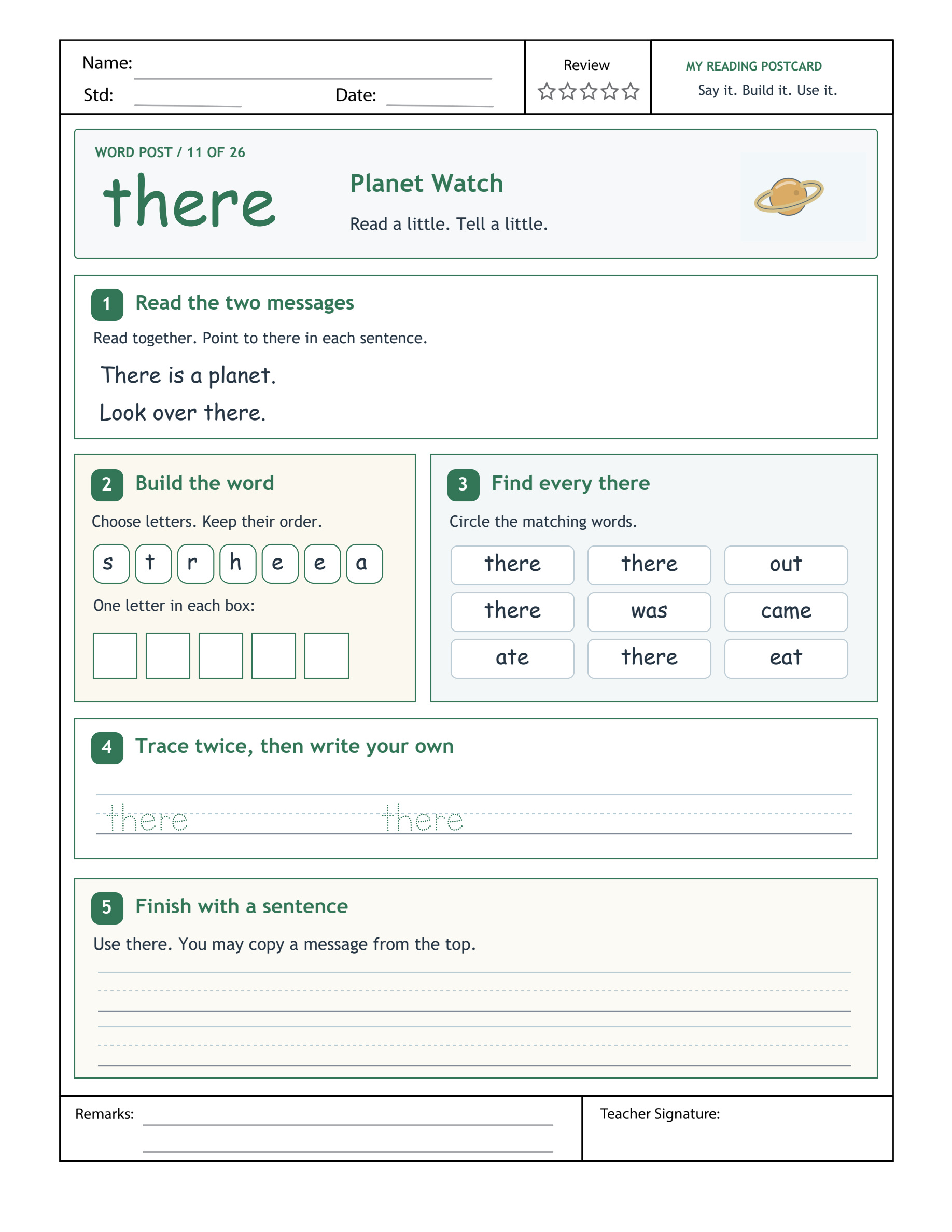
The full there sheet retains its US Letter frame.
Introduce a planet and direct attention towards a place. The complete redesigned page appears without cropping.
Theo spots a planet in a storybook sky and wants someone else to notice it. A short “Look over there” message directs the listener's gaze, while “There is a planet” introduces what can be seen. There Sight Word practice explores both examples before children examine the five-letter spelling. The lesson adds a shuffled bank, nine search choices, dotted models and a sentence finish. Adults can read the surrounding vocabulary and keep the conversation clear. The clean layout begins with the messages, giving a small written word a useful purpose before the pencil work starts.
Two messages that should not be flattened into one rule
In “Look over there,” the word directs attention towards a place. You can demonstrate it by pointing to a planet picture across the room. The listener needs enough shared context to know which direction or location the speaker means.
“There is a planet” works differently. It introduces something into the conversation. The opening there does not have to name a particular location by itself. Read the whole statement while revealing the planet picture and explain that the speaker is announcing what is present.
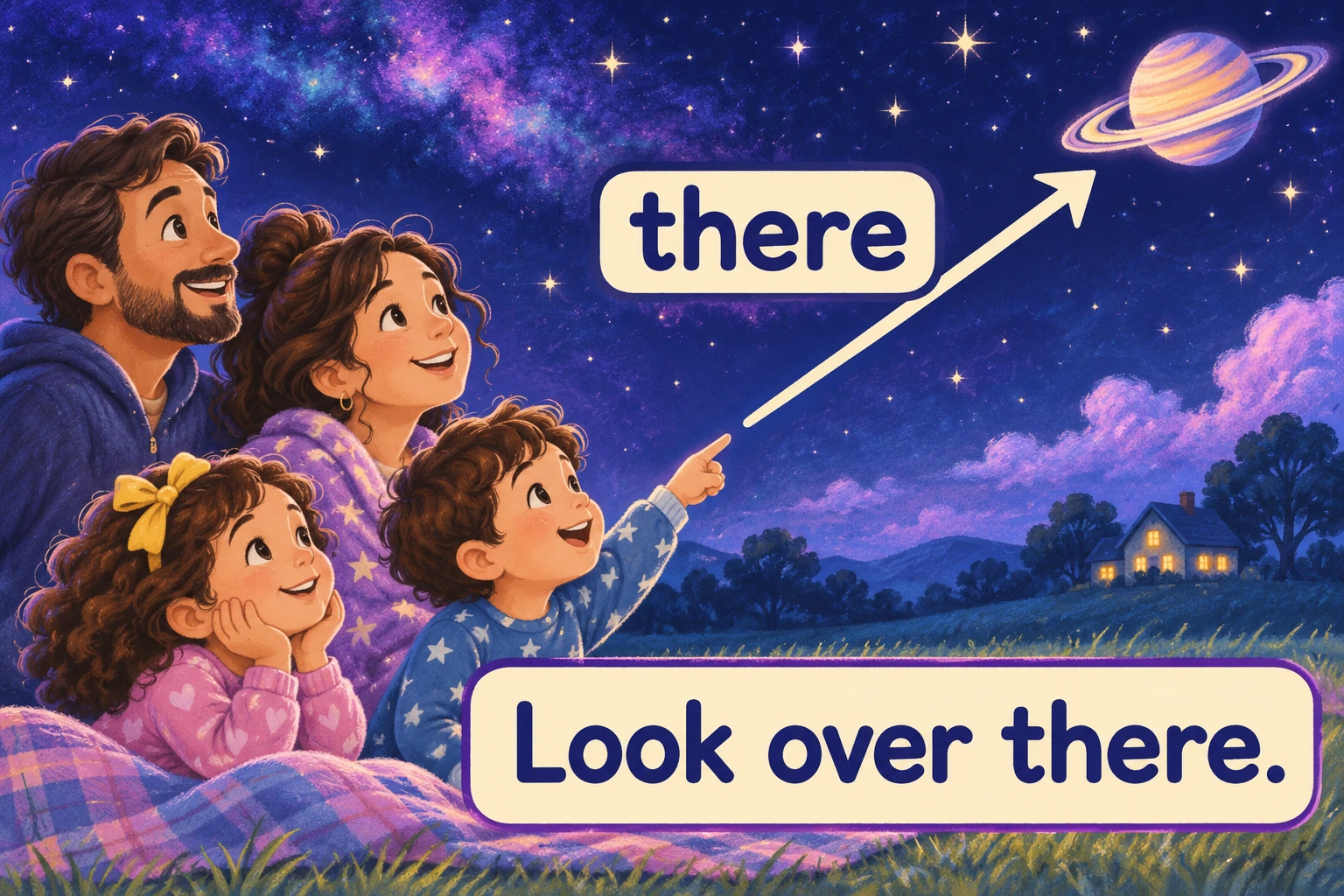
For a young learner, those two practical demonstrations are enough. Formal grammar labels can wait. Avoid saying that there always means a faraway place, since the first source example would then receive an incomplete explanation. The illustrated sky is a story setting for language; its large planet is not an astronomy observing diagram.
There Sight Word reading starts with a reveal
Show a planet drawing and read “There is a planet.” Invite the child to say what has been introduced. Next, place the drawing somewhere visible and read “Look over there.” Let the learner direct attention towards it. The two responses give each sentence its own purpose.
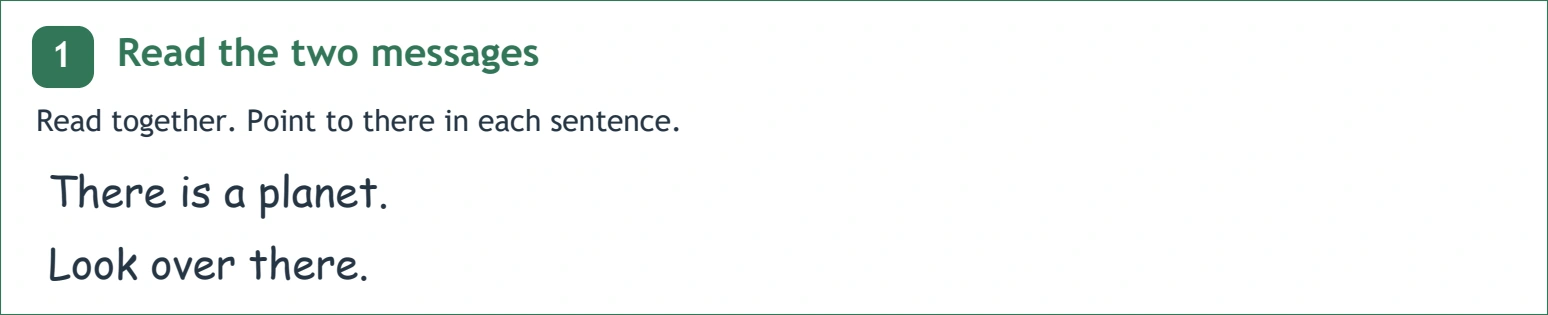
Track the target in both lines after the messages are understood. The capital T in There begins the announcement, while the direction sentence uses lowercase there later in the line. Connect these forms with the large lowercase model rather than assuming the case change is already familiar.
An adult can supply planet, look or other surrounding print. The learner may contribute by locating there, pointing appropriately or explaining what the announcement introduces. Accurate participation does not require independently reading every sentence word on the first visit.
Five positions, including two e letters
The bank presents s, t, r, h, e, e and a. Choose t-h-e-r-e to fill the five boxes. Both e copies belong in the target, in its third and fifth positions. The unused s and a are distractors rather than missing parts of another activity.
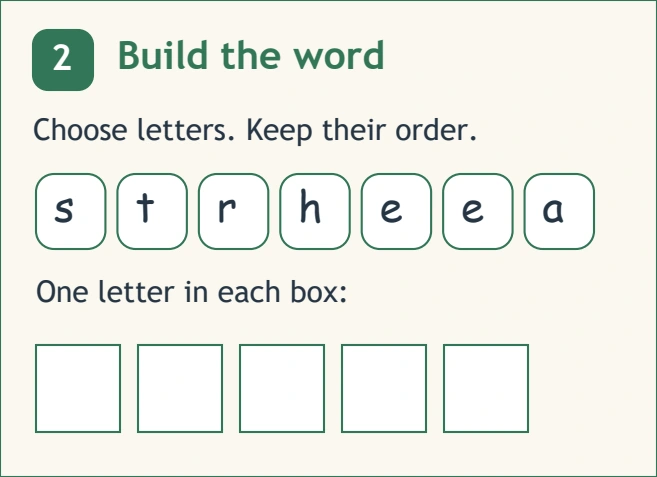
A learner who selects t, h, e and r may have collected the different letter names while omitting the repeated e. Point through the five positions in the model, then restore the final piece. Say the completed word again after building it so the spelling remains tied to speech.
Pronunciation of there varies with accent, especially around r. Use a natural spoken example from your own speech and keep the spelling stable. Do not require a child to pronounce each written letter separately as a definition of reading the whole word.
Nine choices and four complete matches
The search rows read there, there, out; there, was, came; ate, there, eat. Adult there key: 1, 2, 4, 8.
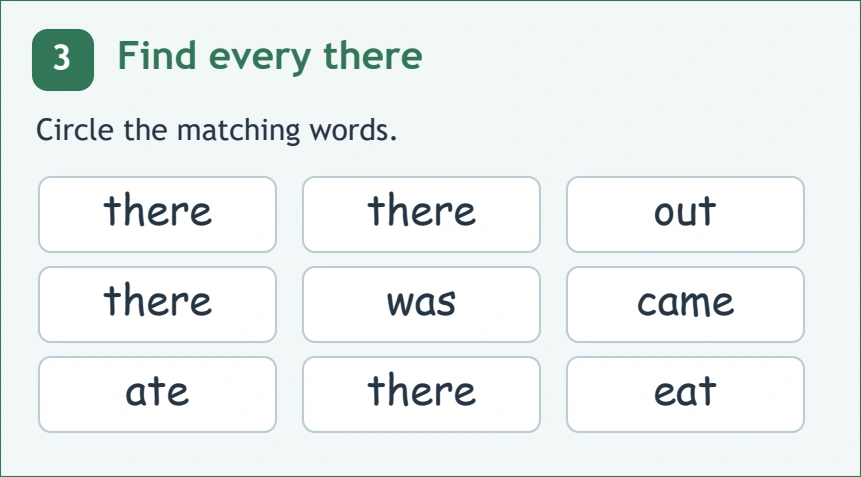
The longer target can be checked in manageable parts: its th beginning, middle e-r and final e. Keep the complete model visible throughout. A child should not have to hold all five letters in memory before being allowed to compare a candidate.
The first row contains two adjacent matches. Inspect the second independently after identifying the first. Came shares an e ending but is a different spelling, and eat uses some familiar letters in another order. Ask what agrees or differs rather than rewarding a quick visual guess.
Trace a sequence that is already meaningful
The dotted there models repeat e in two places; keep the final e when copying without dots. Follow from t through the closing e, then try a separate version on the available guide. Five letters can demand more pencil stamina than a two-letter target, so adjust the quantity attempted.

The final task accepts a sentence containing there and permits copying either source example. For an original message, first decide whether the child wants to introduce something or direct attention to a place. Rehearsing that purpose helps prevent a random string of remembered words.
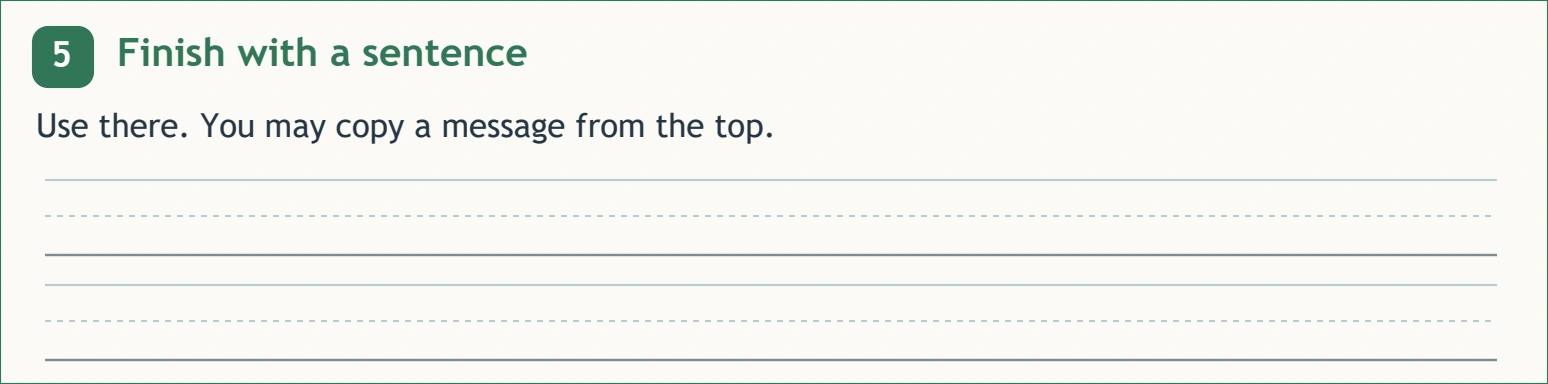
Let the learner decide between an announcement and a direction, then support the longer words around there in that chosen message. A clear oral statement with a supported spelling is a useful contribution. Do not turn one difficult r or e formation into a demand to rewrite the entire sentence several times.
What is included in the two editions
The clean planet route puts the announcement and direction ahead of letter work. Its workshop and grid share the centre, then tracing supports the expanded sentence area. The original sample starts with the dotted word. Planet practice keeps its US Letter border and all five original activity jobs.
This planet PDF contains one framed practice page. The illustrated family and sky on this webpage provide another conversation context, not extra PDF pages or a telescope activity. A simple planet drawing or another familiar picture can serve as an optional prop.
Choose a layout before the session begins and explain its route briefly. The spelling, search entries and source messages remain the same. The redesign changes how those tasks are encountered, giving meaning a place at the start rather than removing source practice.
Six useful observations from a planet conversation
- An introduction is understood: the child can identify what the there-is announcement brings into the conversation.
- Attention is directed: the look-over-there message leads towards the intended picture location.
- Context matters: the learner recognises that the two source sentences do different jobs.
- Repeated letters are retained: e appears in both required positions of the built spelling.
- Comparisons stay complete: an e ending alone does not make came a target match.
- A writing intention is prepared: the final sentence has a clear purpose before it is copied or composed.
Write down whether the child explains the announcement, follows the direction or retains both e positions. Each points towards a different next teaching move.
Theo's possible home reveal game
A family member might hide a planet drawing behind a book, reveal it and read the announcement sentence. Theo identifies the newly introduced object. The adult then places the picture across the room and uses the direction message. The change in activity makes the distinction easier to hear.
They locate there on the worksheet and build the five-letter spelling with two e pieces. Theo may inspect one grid row before attempting a single guided copy. The adult chooses a stopping point while the conversation is still comfortable rather than requiring every task in one sitting.
For a final turn, Theo reveals a different drawing and dictates a there-is message. A listener should understand what has been introduced.
Classroom possibility: announcement and direction partners
At a small-group station, give one learner a picture to introduce. The child or teacher announces its presence with a there-is sentence. A second learner places it on a visible display and gives a look-over-there direction. Establish the picture's location before expecting another partner to respond.
Return to the source messages and ask which activity each resembles. The teacher can read longer vocabulary while learners track the target. This keeps the work accessible to children whose oral comprehension is ahead of independent reading.
During individual practice, listen for different needs. A missing final e calls for a spelling-position comparison; an unclear direction calls for better shared context. Respond to those specific issues rather than treating them as one general reading failure.
A small guide to the next helpful prompt
| What happens | Try with the planet picture | Revisit in print |
|---|---|---|
| Explains every there as a far place | Reveal the drawing with a there-is announcement. | The complete first sentence. |
| Cannot follow the direction | Make the intended location visible and point clearly. | The look-over-there message. |
| Builds only four letters | Count all five positions and restore the closing e. | The two e locations. |
| Recognises the model but tires writing | Accept dictation and one supported word copy. | A manageable complete spelling. |
Five extensions for introducing and pointing
1. Reveal a familiar toy and announce it with a completed there-is statement. The child can supply the object name orally before finding the target in print.
2. Place a picture at a known display spot and let a speaker direct a partner's attention towards it. Make the reference clear enough for the listener to act.
3. Build t-h-e-r-e with movable pieces, then let a puppet remove the final e. Ask the learner to compare and repair the incomplete spelling.
4. Prepare one announcement card and one direction card. Match them to two acted scenes after reading the completed messages together.
5. Dictate a caption for a drawing the child has just revealed. An adult writes unfamiliar words while the learner contributes there and helps reread the result.
Readiness and a comfortable return to the word
The two there contexts can be explored around ages 4–6 through a reveal and a gesture, while five-letter writing may still need substantial support. The five-letter target can need sustained visual support. Understanding either spoken message does not require memorising the spelling immediately.
Avoid using a vague gesture, changing the hidden object without explanation or asking for long independent copies too soon. Keep the intended reference visible and the word model available. Appreciate a specific contribution, such as retaining both e letters or explaining what the announcement introduces.
For another early-word sequence, explore the pre-primer starter reading pack. A separate everyday-action visit is available through the eat activity for young readers. The pencil discovery practice set can offer a shorter writing demand before sentence copying.
Adults can adapt activity ideas from PBS Parents' learning collection or explore NAEYC's resources about play for another meaningful reveal or listening game.
Download and print the planet lesson
The planet page's free option delivers the supplied source arrangement. Eligible current membership allows the clean premium download instead. Its interior introduces the two messages before the other four tasks, while website branding, domain text and watermarks are removed. The printable clean sheet contains no advertising and can accompany a clearly established reveal or pointing game.
Check a single US Letter planet copy for the full frame and all five dotted letters before making more. A pencil is enough, with a picture reveal and loose letters optional. The related $5 collection supplies twenty-six clean primer sheets together, allowing an adult to choose a different sentence job after there has been explored in both of its source contexts.
Popular Worksheets
Printable resources families and teachers are downloading now.
 Free
 Free
 Free
 Free