
Out Sight Word: 5 Joyful Butterfly Direction Activities
Continue beyond out with twenty-six clean reading-first practice sheets in one $5 printable collection.
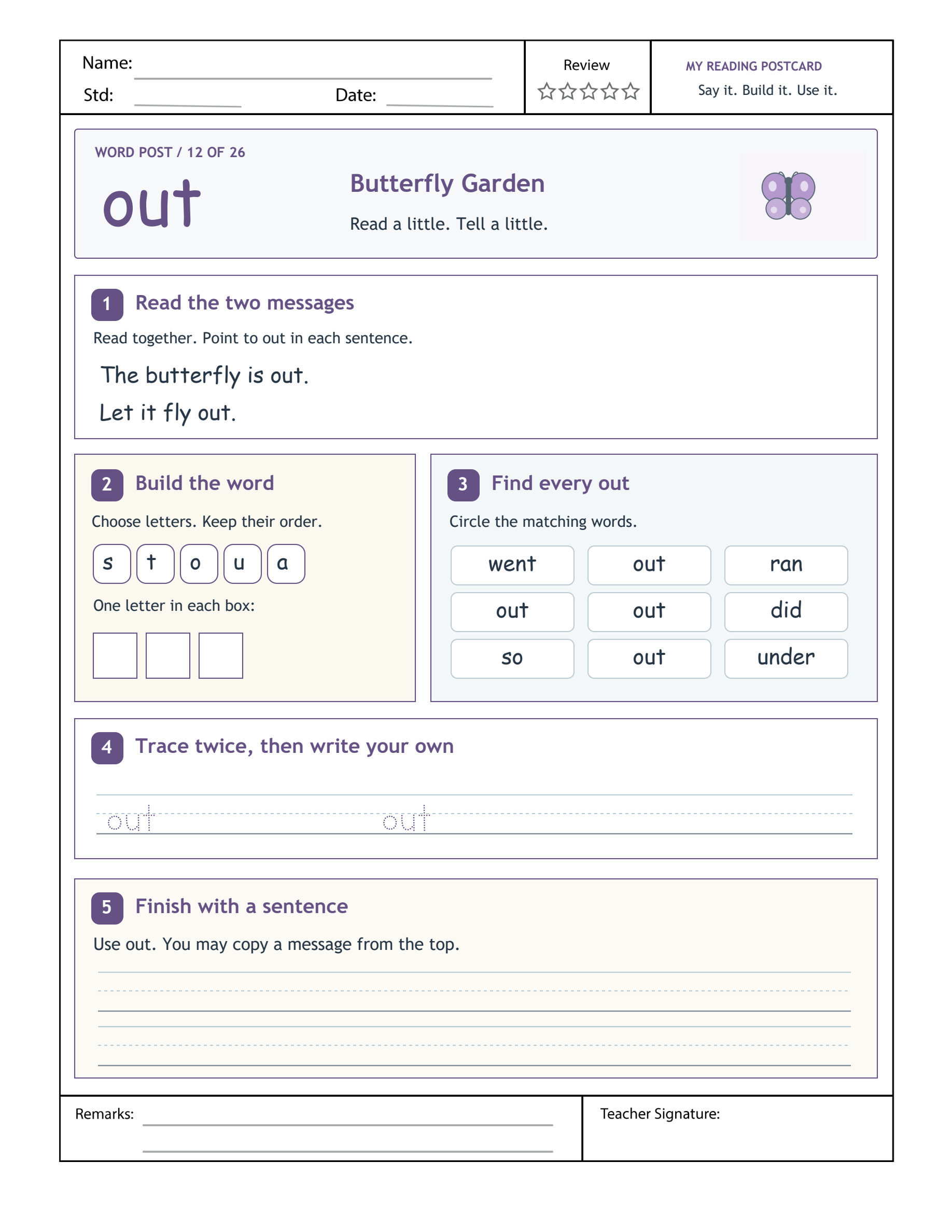
The full out sheet retains its US Letter frame.
Follow movement from an enclosed place to the outside. The complete redesigned page appears without cropping.
Esme moves a paper butterfly through an open garden gate. Inside becomes outside, and out gives the movement a clear direction. Out Sight Word practice pairs that idea with two butterfly messages, a three-letter bank task, a matching grid and handwriting. A reader can act on the spoken meaning before inspecting the same word in print. The clean edition begins with the sentences, while the free original preserves the provided activity arrangement. Use a simple pretend boundary, a pencil and a little conversation to make the worksheet's short target worth reading.
Give out a boundary the child can see
Draw a garden outline on paper and mark an opening. Place a paper butterfly inside it, then move the butterfly through the opening to the outside. Say out during that movement. The visible boundary supplies the reference a listener needs to understand what has changed.
Moving sideways on an open tabletop does not automatically show out unless a starting enclosure or area has been established. The same direction on the table could mean something else in another game. Make the inside space clear before asking the child to interpret the word.
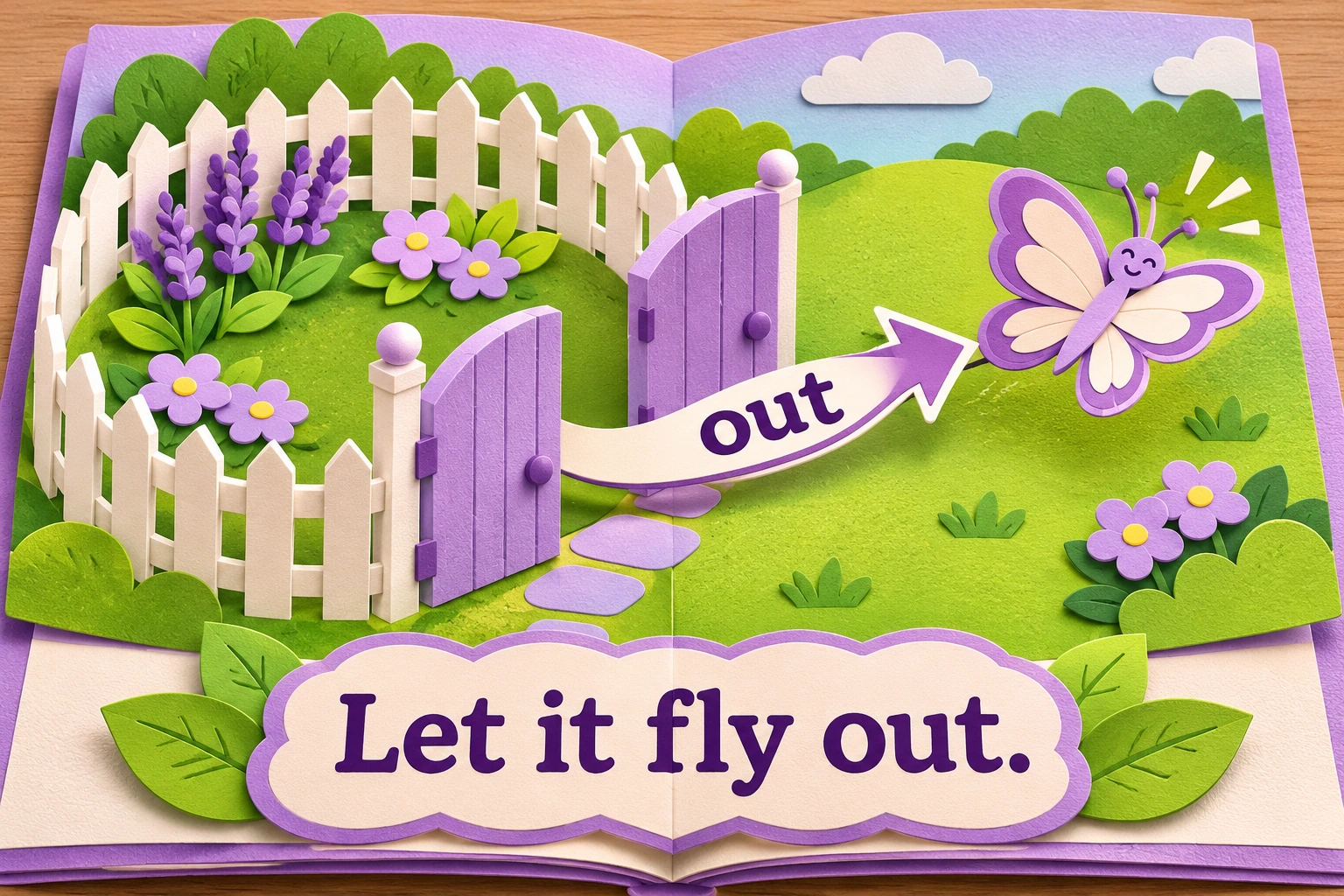
The supporting art uses an illustrated butterfly and gate, and the teaching game can use paper throughout. There is no need to confine a real insect. A toy leaving a box or a card sliding from an envelope can later provide another understandable example of the same direction.
Two butterfly messages with different purposes
The first source sentence, “The butterfly is out,” describes a state: the butterfly is now outside the established area. The second, “Let it fly out,” asks that an outward movement be allowed. Read each completely and demonstrate the appropriate moment in your pretend garden.

Point to out after the meaning is clear. It appears at the end of both printed messages. Ask what it refers to in the second sentence and identify the butterfly as the subject already under discussion. Supply surrounding vocabulary aloud when needed rather than requiring the child to guess longer words.
A learner may say fly when shown the target because flying is the obvious action in the picture. Separate the action from its direction: a butterfly could fly inside the garden too. Out tells us something additional about where that movement leads relative to the boundary.
Out Sight Word: choose the right first step
| The learner currently needs | A useful butterfly task | A response to notice |
|---|---|---|
| A clearer spoken meaning | Move the paper butterfly through the marked opening. | Explains the inside-to-outside change. |
| A connection between speech and print | Find out at the end of a shared sentence. | Points to the complete target. |
| Help with letter order | Arrange o-u-t beside the large model. | Maintains all three positions. |
| A writing purpose | Dictate a message about a toy leaving a box. | Uses out in an understandable new context. |
These options are ways to adapt a visit, not a sequence of levels a child must pass. Leave room to return to the movement demonstration even when the printed target has been recognised once.
A three-letter spelling among five bank choices
The source bank supplies s, t, o, u and a. Select o-u-t for the response boxes and leave s and a behind. A child can move loose copies into position or identify the printed letters before making a written attempt.
Say out naturally. The written ou works together to represent the vowel sound in this word, followed by t. Naming the letters in spelling order and reading the completed word are related tasks, but they do not require sounding o and u separately as though each always keeps its isolated sound.
If the learner selects the right pieces in another order, compare the first, middle and last positions against the model. The bank is a group of choices, not a prearranged answer. A small start marker can support left-to-right placement without adding another memory demand.
Nine choices in the butterfly search
The grid rows are went, out, ran; out, out, did; so, out, under. Adult out key: 2, 4, 5, 8. Keep that adult checking information separate from the initial task so the learner has a reason to inspect the cells.
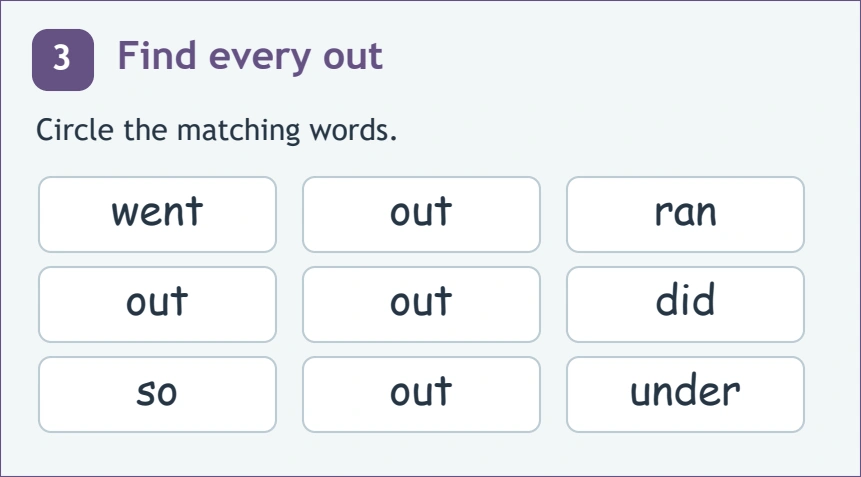
Under includes a u and describes another kind of relationship, but its written form does not match out. So includes o without supplying the same sequence. Ask for the whole o-u-t comparison rather than a decision based on a familiar letter or a related idea.
The middle row contains two adjacent matches. Read the instruction as a request to find every exact spelling, then make a decision about each choice. A counter can hold the current position when attention jumps between rows. It should not be used to reveal which cell is correct.
What the handwriting stations contribute
Follow o-u-t across both dotted out models, then attempt the whole direction word on its own. After o-u-t has been followed, leave a visibly independent version beside the models. A difficult u or t formation may need a short adult demonstration, while the whole word remains available as a reference.
The final activity asks for a sentence containing out and permits copying a source message. Rehearse an original idea aloud before writing it. If the child describes a toy coming out of a box, establish that starting space clearly so a reader can understand the direction. An adult can record the container or movement vocabulary after the child has explained the boundary and supplied out.
The butterfly's clean sheet reads the outward-direction messages before its spelling and search decisions. Tracing then bridges to sentence writing. The free original puts the dotted words first. This reading-first interior preserves every source activity and the established outer frame on the same US Letter page.
Six observations for an outward movement lesson
- A boundary is understood: the learner identifies what counted as inside before the butterfly moves.
- Direction adds information: out is distinguished from the action fly in the spoken example.
- Sentence purpose is heard: a state description and an instruction are connected with different moments of the game.
- A spelling is ordered: o, u and t occupy the same positions as the model.
- A match is exact: shared letters in under or so do not qualify those cells.
- A message is planned: the final written or dictated sentence gives its reader enough context for the direction.
An out observation should state what boundary the child understood. Record o-u-t selection separately from whether the paper butterfly crossed that boundary correctly.
A possible family visit with a paper gate
Esme and an adult might draw a garden with an obvious opening and place a paper butterfly inside. The adult speaks the instruction sentence while Esme moves the butterfly outward. After it reaches the other side, they read the state description. The two statements now correspond to visible moments in the pretend story.
They open the worksheet, locate out in each message and choose o-u-t from the bank. One search row or a single written copy may be enough for this visit. The adult can stop before the child becomes tired and preserve the remaining tasks for another day.
To close, Esme dictates a new out message about a toy leaving a box. The listener first sees the box and the toy. This suggested home route is an example of possible use, not evidence that the same sequence produces a particular result for every reader.
A classroom station with clear starting spaces
A teacher can provide a box, an envelope and a drawn garden for a small group. Select one starting space at a time and establish what is inside it. One learner describes or directs an outward movement while another acts with the chosen toy or paper piece.
Bring the group back to the butterfly messages. Ask which sentence fits before the movement and which describes the result. The adult may read most of the text while a child tracks the target. Pointing and oral explanations can reveal comprehension even when sentence copying is not yet comfortable.
During written work, watch for the specific need. A reversed sequence calls for a model comparison, while an unclear direction calls for a better boundary. Partners can listen and check, but should leave the actual selection and marks to the child whose sheet is being used.
Five extensions for a useful direction word
1. Slide a completed picture card out of an envelope and dictate a message about what happened. Keep the starting container visible while the learner explains.
2. Draw inside and outside positions for a toy character. Read a completed out sentence and choose the scene that fits its meaning.
3. Give a puppet the letters for out, let it confuse u and t, and ask the reader to restore the complete direction word.
4. Create a short paper-theatre scene in which a character leaves an established room. The child supplies the outward direction as part of a complete spoken message.
5. Compare two pretend butterfly flights, one remaining within the garden and one crossing its gate. Discuss why fly out fits only the second movement in that setup.
Avoid easy misunderstandings and excessive copying
Do not point vaguely across a table and expect out to be self-explanatory. Establish an inside area first. Likewise, avoid treating the butterfly illustration as the spelling cue or accepting any search word containing u. Return to the actual relationship and the complete letters when a decision is uncertain.
A butterfly direction visit for ages roughly 4–6 can be mostly oral at first; the visible boundary is more important than completing every pencil line. An oral direction can be meaningful before a full written sentence is realistic. A careful tracer may still need help explaining the starting boundary.
For regular review, choose a brief everyday pretend movement and show a completed out message afterwards. Appreciate an observable contribution: a clear boundary explanation, an ordered spelling or a carefully rejected distractor. The lesson can remain small enough that the child is willing to return.
The earlier reading-route collection offers other short-word work. The discovery set for pencil preparation can support a writer before extended copying. A different everyday action can become the focus through the eat printable reading lesson on a later visit.
For more playful contexts, browse NAEYC's family play ideas or PBS Parents' everyday learning pages. Choose an activity with a direction the child can actually explain.
Download a clean page or keep the original sample
For the butterfly lesson, the free sample preserves the provided order. A currently eligible member can obtain the clean PDF via the premium download. Reading introduces that edition, and the bank, matching, tracing and sentence tasks remain. Website domain lettering and watermarking are removed, and advertising does not appear within the clean practice sheet.
Preview a full US Letter butterfly page, checking that the border and dotted ou sequence are visible on a trial copy. Bring a pencil; a paper gate and movable letters are optional adult materials. The collection card offers twenty-six clean primer lessons together for $5, giving another word a place in the next conversation while today's out still has a clear boundary.
Popular Worksheets
Printable resources families and teachers are downloading now.
 Free
 Free
 Free
 Free