
Pretty Sight Word: 5 Joyful Woodland-Pattern Tasks
Explore pretty here, then choose the complete now-to-please Word Maps collection: 26 clean printable sheets together for $5.
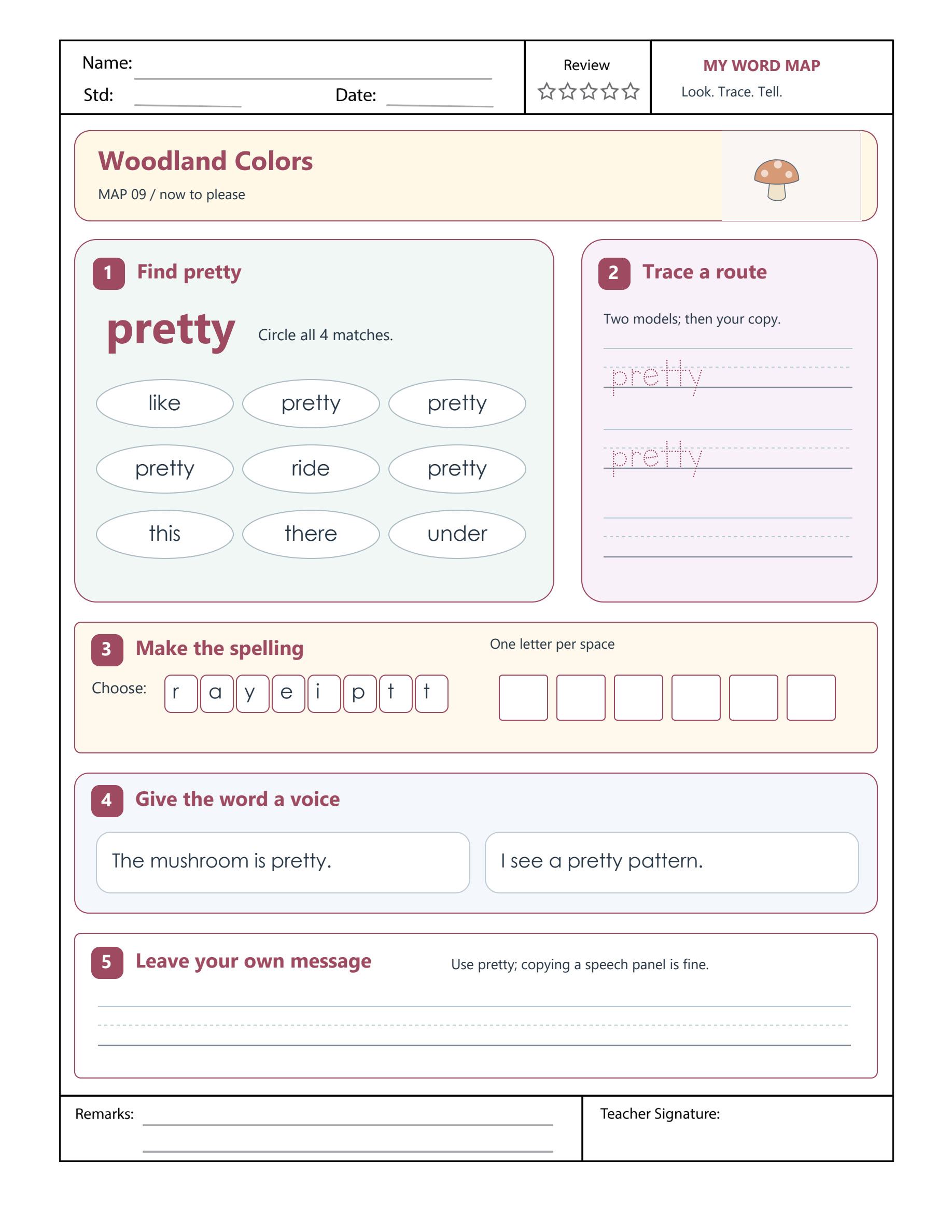
The whole pretty map remains uncropped.
Woodland Colors combines its pretty search hub, tracing side route, spelling rail, speech panels and message strip.
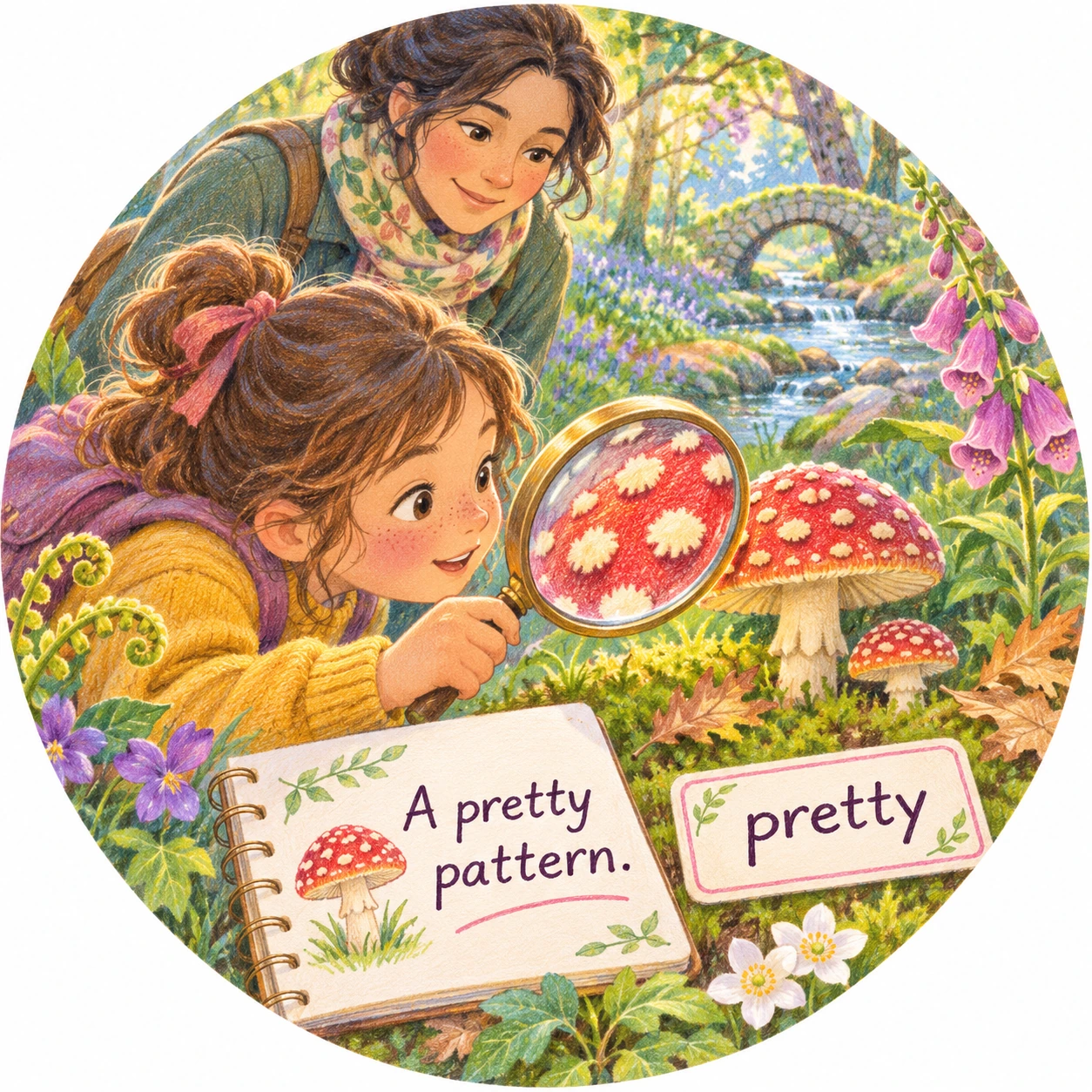
Kira notices spots on a woodland mushroom picture and calls the pattern pretty. Another observer may describe the same pattern differently, which gives the word a useful conversational purpose. This Pretty Sight Word worksheet pairs two descriptive messages with a six-letter spelling, a nine-choice search and supported handwriting. The clean map preserves the original activities within the familiar frame while giving them a fresh arrangement. Use a drawing or photograph for the woodland discussion, invite an honest observation and keep the printed model nearby as the learner explores its repeated letters.
A description can belong to an observer
Pretty expresses a judgement about appearance in these sentences. Ask Kira which feature caught her attention: the spots, the colours or their arrangement. The child need not agree with the printed character's opinion to understand the message. A different preference is an opportunity to listen, not an error to erase from the conversation.
The first source sentence describes the mushroom. The second describes a pattern being seen. Notice that the target can apply to a whole object or to one visible feature. A picture supports the setting, but pretty is not another name for mushroom. Use another completed pattern drawing later to see whether the description transfers.
The spelling p-r-e-t-t-y includes two t letters. They occupy separate written positions even though reading the word naturally does not mean saying a separate syllable for each t. An adult can model the spoken form and discuss the letter sequence without turning the lesson into a demand for exaggerated pronunciation.
A picture conversation at home
Choose an illustrated woodland scene and let Kira point to one detail worth discussing. An adult offers a description and invites another response. Keep the exchange about the picture; no collecting, touching or tasting real mushrooms is needed. The source messages can then be read aloud while the child finds pretty within them.
Lay out the shuffled bank as large letter pieces. Kira can select both t copies before writing anything. Compare the finished p-r-e-t-t-y sequence with the model and ask which positions repeat. If six-letter handwriting is tiring, accept construction plus an oral sentence and revisit the dotted route later. A clear description should not be lost beneath an excessive copying demand.
Six observations from a patterned picture
- Specific noticing: Kira identifies a feature rather than offering an unexplained label.
Perspective: two viewers can understand pretty while making different judgements. - Transfer: the description moves from the mushroom to another pattern.
- Repeated-letter reasoning: both t positions are retained in a six-letter sequence.
- Attentive search: long and short distractors are judged by their complete spellings.
- Written communication: a spoken observation can be copied, dictated or composed in the message strip.
Assemble p-r-e-t-t-y on the spelling rail
The pretty bank presents r, a, y, e, i, p, t, t. Make 6 positions for p-r-e-t-t-y; leave a and i unused. Kira selects the pretty sequence rather than transcribing the woodland colors display order. Movable pretty pieces can reduce Kira's pencil load during this woodland colors spelling decision.
Point from pretty's large model to each p-r-e-t-t-y position. If Kira misplaces a pretty letter, move that piece while the woodland colors materials remain adjustable. Name p-r-e-t-t-y for the written sequence; read pretty naturally within its woodland colors message. Check Kira's completed construction, then offer a pretty pencil copy.
A pencil route for the woodland colors word
Two dotted pretty examples sit on separate woodland colors guides. Follow p-r-e-t-t-y once while Kira watches a useful demonstration. The third pretty band is for an untraced woodland colors attempt. Choose a quantity of pretty practice that fits Kira's hand control, rather than asking Kira to fill the entire woodland colors sidebar.
Understanding the woodland colors message and writing pretty are different questions. Kira may explain pretty correctly while its pretty letters still need motor support. Dictating pretty can preserve a woodland colors idea when independent pretty writing is tiring. Keep pretty's model visible for Kira; offer formation help on pretty separately instead of turning woodland colors sentence practice into repeated correction.
The pretty speech windows
Read the first woodland colors message: “The mushroom is pretty.” Its pretty companion says “I see a pretty pattern.” Share the woodland colors meaning before asking Kira to locate pretty in print. An adult may supply other woodland colors vocabulary, leaving Kira to inspect the pretty positions. If Kira guesses pretty from the picture, cover that woodland colors illustration briefly and point back to p-r-e-t-t-y.

A woodland colors message using pretty
The pretty finish accepts a copied woodland colors example or a new pretty sentence. Let Kira speak the woodland colors message before writing pretty. Check how the listener understands Kira's idea. Supply unfamiliar spellings around pretty if Kira needs them. Preserve this woodland colors thought while helping Kira with print. Provide Kira with spelling help that preserves pretty.
Pretty Sight Word inspection on the woodland colors map
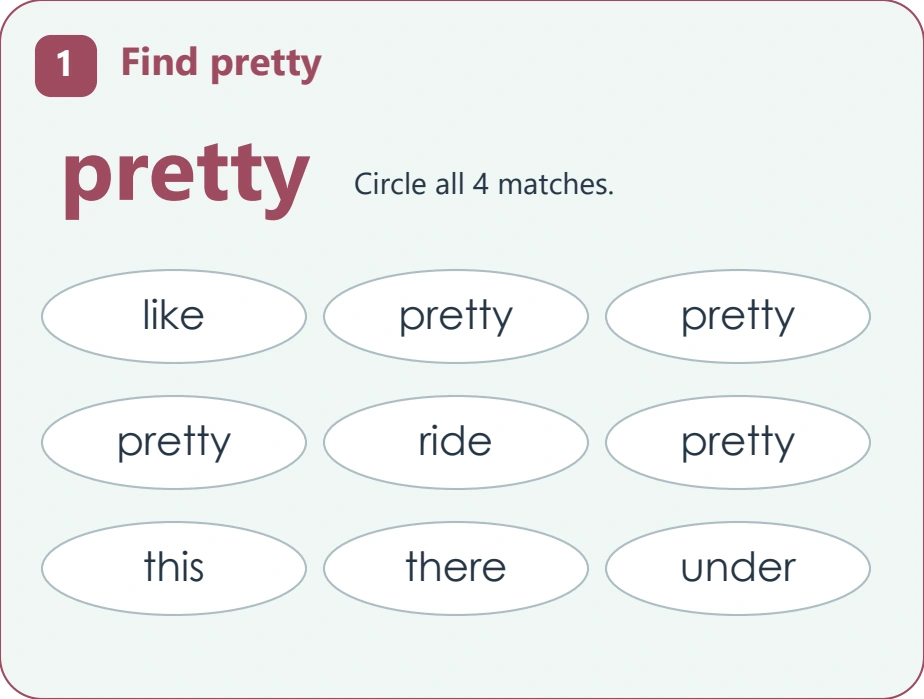
The woodland colors search contains nine ovals. Begin at pretty's large model, then compare each pretty choice. For pretty, number the top row 1–3; continue the woodland colors middle row 4–6, then the pretty bottom row 7–9. Review these woodland colors notes after Kira's own pretty attempt; reveal answers when that pretty comparison needs support.
| Pretty cell | Choice | Pretty check |
|---|---|---|
| 1 | like | Kira: reject like when searching for pretty. like has l at position 1; pretty needs p there. Compare p-r-e-t-t-y before ruling out like on this woodland colors map. |
| 2 | pretty | Pretty is complete at cell 2: p-r-e-t-t-y. Kira can compare its final y with pretty's ending before making this woodland colors circle. |
| 3 | pretty | Cell 3 holds another exact pretty. Let Kira inspect pretty's neighbours too; one successful pretty find does not decide adjacent woodland colors choices. |
| 4 | pretty | This p-r-e-t-t-y matches pretty. Ask Kira to show each pretty position before circling the entry on the woodland colors map. |
| 5 | ride | Kira: reject ride when searching for pretty. ride has r at position 1; pretty needs p there. Compare p-r-e-t-t-y before ruling out ride on this woodland colors map. |
Finish checking the woodland colors choices
| Pretty cell | Choice | Pretty check |
|---|---|---|
| 6 | pretty | The fourth matching pretty occupies cell 6. Its p-r-e-t-t-y agrees with the model; Kira can point to every pretty position before including it. |
| 7 | this | Kira: reject this when searching for pretty. this has t at position 1; pretty needs p there. Compare p-r-e-t-t-y before ruling out this on this woodland colors map. |
| 8 | there | Kira: reject there when searching for pretty. there has t at position 1; pretty needs p there. Compare p-r-e-t-t-y before ruling out there on this woodland colors map. |
| 9 | under | Kira: reject under when searching for pretty. under has u at position 1; pretty needs p there. Compare p-r-e-t-t-y before ruling out under on this woodland colors map. |
Four ovals match pretty. If Kira circles a different quantity, revisit the woodland colors choices. Compare each selection against p-r-e-t-t-y before adding a pretty circle. Ask Kira to explain a selected pretty and a rejected woodland colors candidate. Listen to Kira's comparison as well as counting pretty marks.
A classroom pattern gallery with no winning opinion
Display several completed paper patterns and invite small groups to describe one. A teacher can model pretty as one possible response, while also accepting words such as busy, bright or interesting. The goal is explaining a description and connecting the target to print, not voting for the best-looking picture or the child with the neatest page.
After discussion, locate pretty in the worksheet's two messages and build its spelling. If Kira selects only one t, point to the model's two positions and let her repair the arrangement. If the spelling is accurate but the target is treated as a mushroom name, change the picture. Those responses call for different support.
Five pattern conversations beyond the map
1. Give a tile arrangement a caption
Create a pattern with large paper shapes and let Kira dictate a description. An adult writes a completed caption containing pretty if that is the child's chosen word. Another viewer can offer a different description, keeping the exchange respectful and grounded in visible features.
2. Change one feature at a time
Show the same pattern in two colour combinations and discuss whether the observer's judgement changes. There is no correct preference to guess. Return to the stable printed spelling afterwards, separating a changeable opinion from the written word used to communicate it.
3. Find the repeated positions
Build p-r-e-t-t-y with loose letters, then move one t aside and compare the result with the model. Let the child explain what is missing. Restore the word before reading it in a sentence, avoiding an unnecessary memory test on all six positions at once.
4. Share a description without the picture
Kira tells a puppet about the pattern before showing it. The listener asks which feature the speaker means. This creates a reason to make the observation clear, while the adult can supply unfamiliar surrounding vocabulary without taking over the child's judgement.
5. Revisit a familiar design later
Keep one completed paper pattern and return to it after a gap. Ask whether Kira would still choose pretty and why. Reread the earlier caption if appropriate. The activity links remembered language with a fresh response rather than requiring identical answers on every visit.
Make room for the long spelling and the child's idea
Around four to six, supported learners may be ready to discuss descriptions before writing a six-letter target comfortably. Offer dictation or movable construction when needed. Demonstrate a difficult p or y separately if formation is the obstacle, and keep the full model visible during an untraced attempt.
Avoid requiring agreement with an adult's taste, using pretty to rank children's work or assuming that the woodland image teaches the spelling by itself. A later visit can use fabric, paper tiles or a decorated toy. Notice a particular achievement, such as explaining a feature or restoring the second t, then stop while the conversation remains enjoyable.
Explore another kind of personal description
The like worksheet about preferences provides a related discussion. A gentler reading route appears in the pre-primer twenty-word pack, and the prewriting activities collection can separate pencil practice from descriptive talk. For other shared experiences, see NAEYC's family play guidance and PBS Parents' everyday learning resources.
Prepare the woodland-pattern printable
Use the free option for the supplied original or the account's eligible active membership for the clean premium map. The clean PDF excludes website watermarks, domain names and advertising panels. The linked collection offers all twenty-six now-to-please sheets together for a separate $5 purchase.
Inspect one US Letter print for every frame edge, the six response spaces and both t letters in the dotted models. Keep the selected pretty file within the adult's reach for the next pattern conversation, without making a large printing commitment before the learner's needs are clear.
Related Topics
Popular Worksheets
Printable resources families and teachers are downloading now.
 Free
 Free
 Free
 Free