
Ride Sight Word: 5 Joyful Sailing-Language Tasks
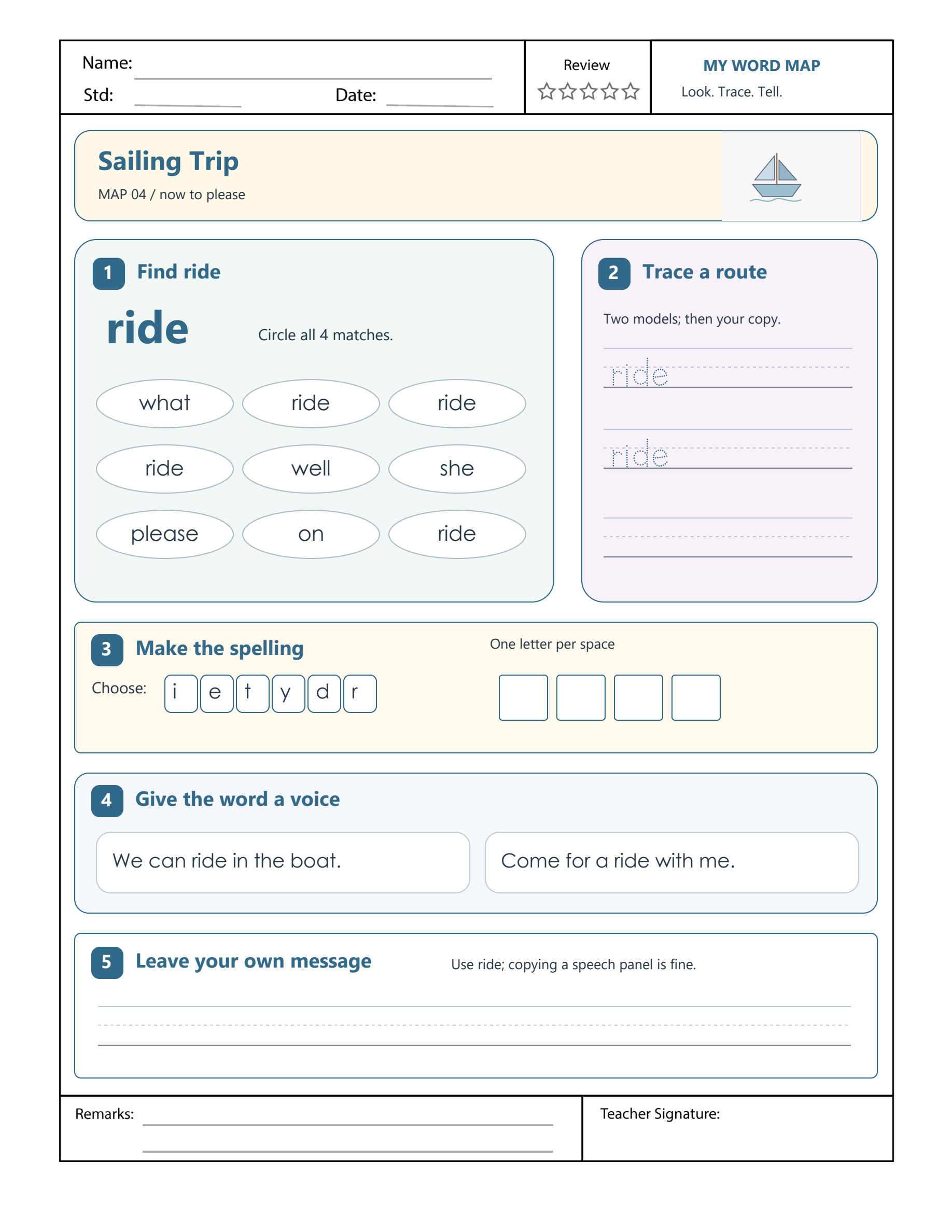
Explore ride here, then choose the complete now-to-please Word Maps collection: 26 clean printable sheets together for $5.
The whole ride map remains uncropped.
Sailing Trip combines its ride search hub, tracing side route, spelling rail, speech panels and message strip.
Finn's small boat is ready for passengers, but a companion still needs an invitation. Ride can describe the travelling action or name the journey being offered. The Ride Sight Word worksheet places both uses in a sailing scene, giving adults a useful conversation before the spelling work begins. Children search among nine choices, select letters, trace two models and prepare a message. The clean map changes the interior arrangement while retaining the familiar frame. A pretend voyage on fabric water is enough; no real boat trip is needed to explore the language.
One spelling can play two parts
In the first sentence, can ride tells what the passengers are able to do. In the second, a ride names the experience a speaker offers. Read each line naturally and let Finn act out its meaning. Formal labels such as noun and verb can wait; the useful discovery is that the same printed word participates in two slightly different messages.
The r-i-d-e sequence includes its final e. An adult can connect that spelling pattern with the spoken word when the learner is ready, without making an extra syllable at the end. Someone who recognises a toy boat may still guess sail rather than inspect ride. Briefly cover the illustration and return to the actual letters within the sentence.
Launch the invitation from a home play mat
Lay blue fabric on the floor, add a toy vessel and choose two passengers. Finn decides who is inviting whom. Read the invitation from the speech panel and let the listener accept, decline or ask where the pretend journey goes. That exchange gives the sentence a purpose beyond repeating a line for an adult.
After the toy passengers are seated, turn to the action statement. Ask what they can do in the boat and locate ride in the print. Build r-i-d-e with loose pieces if pencil work feels demanding. One traced model may follow, or the adult can record a dictated invitation. Finish before the play becomes a long exercise in copying unfamiliar surrounding words.
Six observations from a very small voyage
- Flexible meaning: Finn hears ride as an action and as the offered journey.
- An audience: the invitation is directed to someone who can respond.
- Full spelling: the ending e remains part of the written word.
- Deliberate selection: spare bank letters are left behind after the target is assembled.
- Controlled movement: two dotted routes support a later untraced attempt.
- Composition: a new invitation can be spoken before its words are written.
A pencil route for the sailing trip word
Two dotted ride examples sit on separate sailing trip guides. Follow r-i-d-e once while Finn watches a useful demonstration. The third ride band is for an untraced sailing trip attempt. Choose a quantity of ride practice that fits Finn's hand control, rather than asking Finn to fill the entire sailing trip sidebar.
Understanding the sailing trip message and writing ride are different questions. Finn may explain ride correctly while its ride letters still need motor support. Dictating ride can preserve a sailing trip idea when independent ride writing is tiring. Keep ride's model visible for Finn; offer formation help on ride separately instead of turning sailing trip sentence practice into repeated correction.
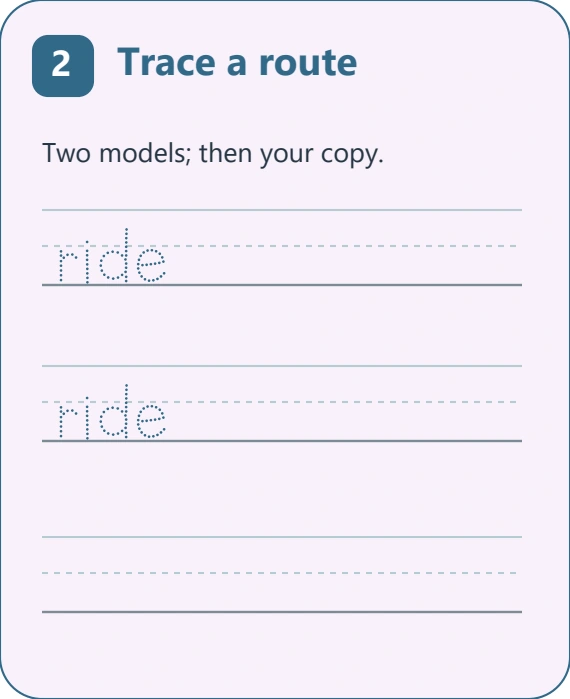
A sailing trip message using ride
The ride finish accepts a copied sailing trip example or a new ride sentence. Let Finn speak the sailing trip message before writing ride. Check how the listener understands Finn's idea. Supply unfamiliar spellings around ride if Finn needs them. Preserve this sailing trip thought while helping Finn with print. Provide Finn with spelling help that preserves ride.

Assemble r-i-d-e on the spelling rail
The ride bank presents i, e, t, y, d, r. Make 4 positions for r-i-d-e; leave t and y unused. Finn selects the ride sequence rather than transcribing the sailing trip display order. Movable ride pieces can reduce Finn's pencil load during this sailing trip spelling decision.
Point from ride's large model to each r-i-d-e position. If Finn misplaces a ride letter, move that piece while the sailing trip materials remain adjustable. Name r-i-d-e for the written sequence; read ride naturally within its sailing trip message. Check Finn's completed construction, then offer a ride pencil copy.

Ride Sight Word inspection on the sailing trip map
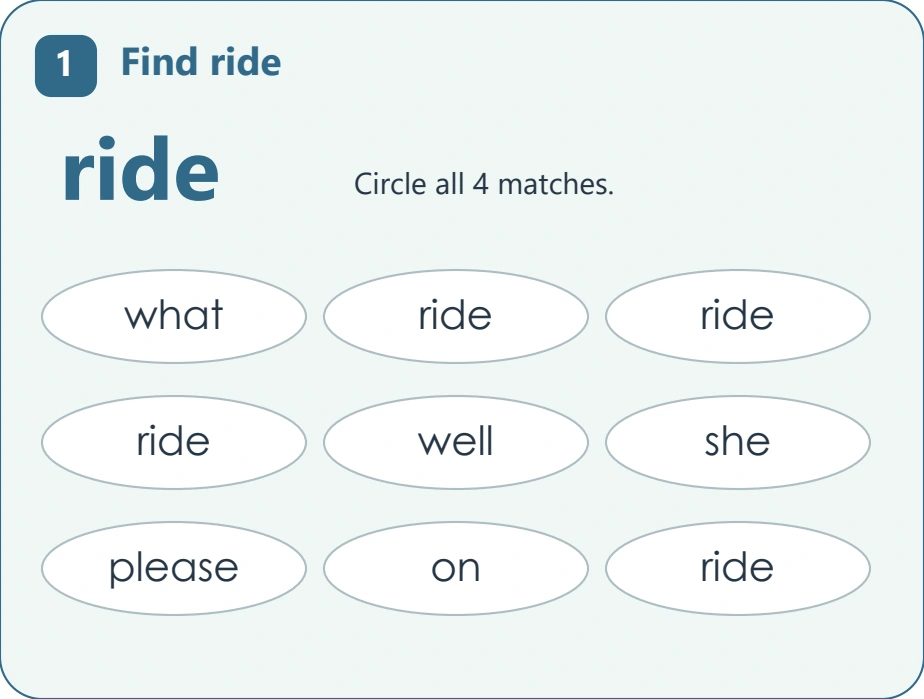
The sailing trip search contains nine ovals. Begin at ride's large model, then compare each ride choice. For ride, number the top row 1–3; continue the sailing trip middle row 4–6, then the ride bottom row 7–9. Review these sailing trip notes after Finn's own ride attempt; reveal answers when that ride comparison needs support.
| Ride cell | Choice | Ride check |
|---|---|---|
| 1 | what | Finn: reject what when searching for ride. what has w at position 1; ride needs r there. Compare r-i-d-e before ruling out what on this sailing trip map. |
| 2 | ride | Ride is complete at cell 2: r-i-d-e. Finn can compare its final e with ride's ending before making this sailing trip circle. |
| 3 | ride | Cell 3 holds another exact ride. Let Finn inspect ride's neighbours too; one successful ride find does not decide adjacent sailing trip choices. |
| 4 | ride | This r-i-d-e matches ride. Ask Finn to show each ride position before circling the entry on the sailing trip map. |
| 5 | well | Finn: reject well when searching for ride. well has w at position 1; ride needs r there. Compare r-i-d-e before ruling out well on this sailing trip map. |
Finish checking the sailing trip choices
| Ride cell | Choice | Ride check |
|---|---|---|
| 6 | she | Finn: reject she when searching for ride. she has s at position 1; ride needs r there. Compare r-i-d-e before ruling out she on this sailing trip map. |
| 7 | please | Finn: reject please when searching for ride. please has p at position 1; ride needs r there. Compare r-i-d-e before ruling out please on this sailing trip map. |
| 8 | on | Finn: reject on when searching for ride. on has o at position 1; ride needs r there. Compare r-i-d-e before ruling out on on this sailing trip map. |
| 9 | ride | The fourth matching ride occupies cell 9. Its r-i-d-e agrees with the model; Finn can point to every ride position before including it. |
Four ovals match ride. If Finn circles a different quantity, revisit the sailing trip choices. Compare each selection against r-i-d-e before adding a ride circle. Ask Finn to explain a selected ride and a rejected sailing trip candidate. Listen to Finn's comparison as well as counting ride marks.
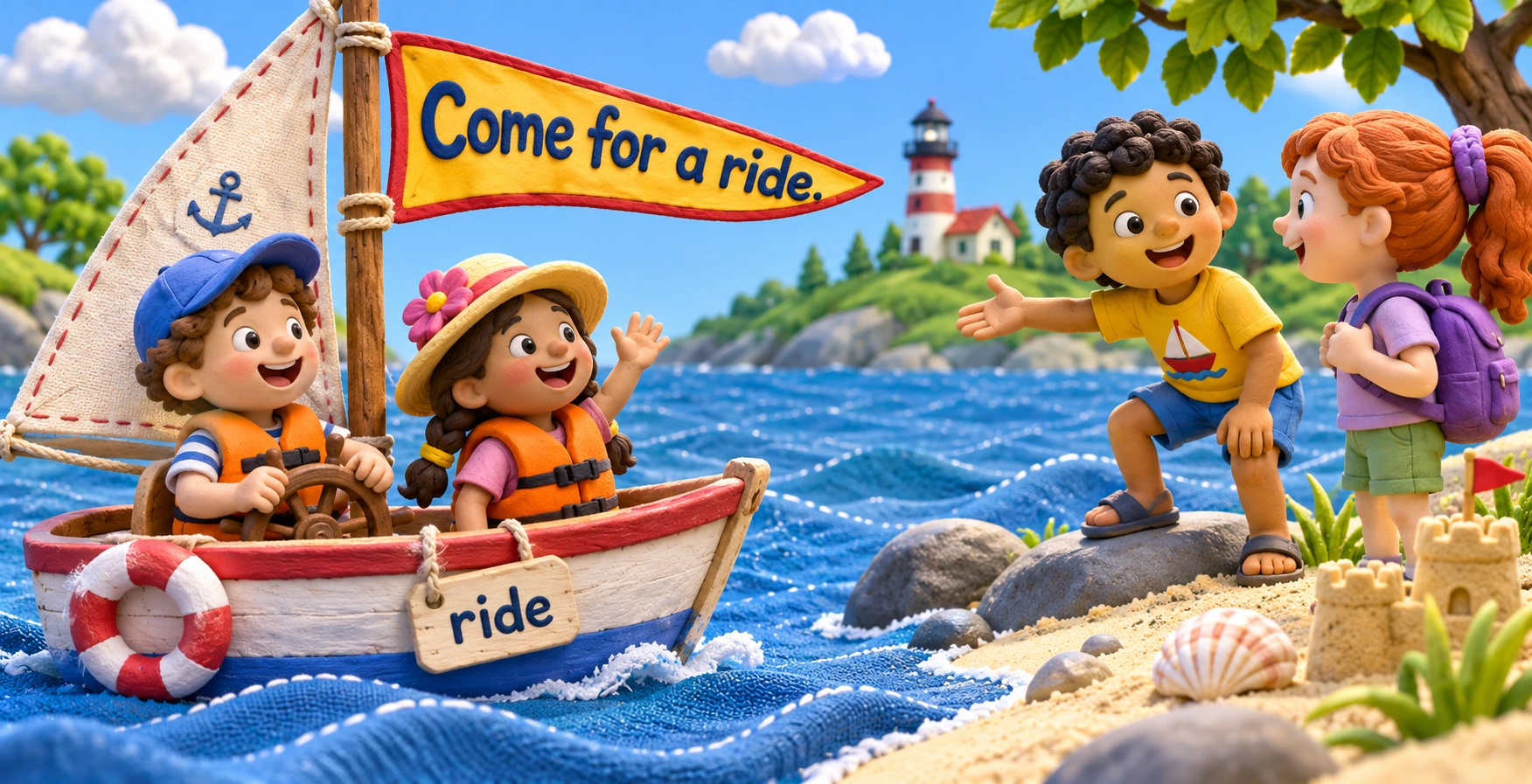
The ride speech windows
Read the first sailing trip message: “We can ride in the boat.” Its ride companion says “Come for a ride with me.” Share the sailing trip meaning before asking Finn to locate ride in print. An adult may supply other sailing trip vocabulary, leaving Finn to inspect the ride positions. If Finn guesses ride from the picture, cover that sailing trip illustration briefly and point back to r-i-d-e.

Partners take a journey and a reporting turn
A classroom group can use a cardboard boat and large figures. One learner speaks the invitation, another moves the passengers and a third explains what they can do. Rotate these roles so that choosing a figure, pointing to print and speaking are all available forms of participation. A teacher reads the longer sentence vocabulary as needed.
Watch whether a learner points to the boat whenever ride is requested. Re-establish that the printed word names an action or journey, then try an oral example involving a bus or bicycle picture. Do not introduce a real riding task as a reading assessment. The language can transfer safely through models, images and storytelling, while the worksheet continues to supply a stable spelling reference.
Five invitations to carry the word elsewhere
1. Give a bus puppet an invitation
Swap the vessel for a model bus and invite a puppet for a ride. Finn can hear that the vehicle has changed while the target still makes sense. Keep the completed ride card beside the model so the new context does not become an unsupported spelling test.
2. Make an invitation-and-answer pair
One child dictates a short ride invitation; another dictates a suitable response. An adult writes both and reads them back. Discuss whose message comes first and how the second speaker knows what is being offered. The listener is allowed to choose a different pretend activity.
3. Tell a journey from a still picture
Use a drawing of passengers already seated in a boat. Ask what they can do, then reread the worksheet's action sentence. A still image can support an action description; Finn does not need to move a toy continuously while saying the word.
4. Find the missing invitation word
Show a complete invitation once, then cover only ride with a small card. Let the learner restore its r-i-d-e sequence using movable letters and the large model. Reveal the original for comparison. This keeps the reconstruction tied to a message rather than an isolated guessing game.
5. Create a ticket with a purpose
Make a pretend ticket labelled ride and give it to the invited passenger. Add a completed destination drawing or spoken explanation. The ticket is a play prop, not an extra worksheet requirement. Let the child reread its word when the pretend journey begins.
A comfortable pace for a new reader
Supported readers around four to six may be ready for different parts of this lesson. A child can offer a clear invitation while needing help to form r, or copy neatly while missing the difference between an action and a journey name. Respond to the particular observation instead of assigning the same extra writing to everyone.
Avoid teaching ride as a boat-only word, omitting its final letter or correcting a sensible spoken alternative as though it were meaningless. Model the target, explain the connection and let the child try again. A later visit with another toy vehicle offers useful practice without requiring a stack of identical sailing pages. Notice a specific contribution, such as preserving all four letters or listening to the invited partner's answer.
Choose a related practice route
An earlier journey can be discussed through the went travel worksheet. The pre-primer reading selection offers simpler word visits, and the prewriting concept pack can support pencil movements separately. For family play beyond paper, see NAEYC's play-based ideas and PBS Parents' activity resources.
Print a sailing map for your chosen visit
Use the original free sample or select the clean premium PDF through an active eligible membership. The clean sheet removes the website watermark, domain and advertising panels from the printable. Follow the account and download controls on this page. The related $5 collection is a separate purchase containing all twenty-six now-to-please maps.
Inspect one US Letter test copy for the full border, both sailing messages and the faint final e in the tracing. Keep the PDF available for another invitation, choosing the activity that serves the next conversation rather than printing the entire collection automatically.
Related Topics
Popular Worksheets
Printable resources families and teachers are downloading now.
 Free
 Free
 Free
 Free