
Into Sight Word: 5 Powerful Bag-Packing Discoveries
Explore into here, then choose the complete now-to-please Word Maps collection: 26 clean printable sheets together for $5.
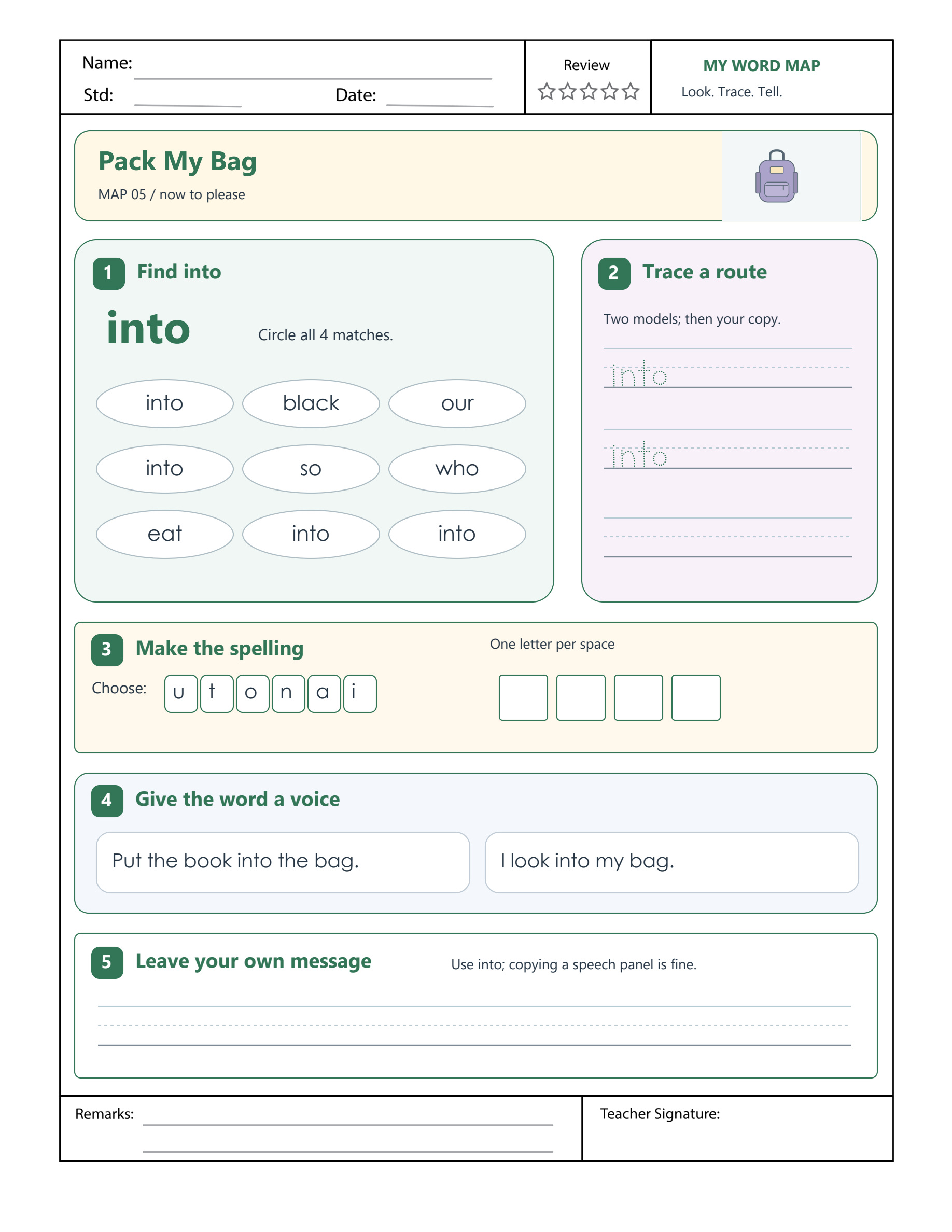
The whole into map remains uncropped.
Pack My Bag combines its into search hub, tracing side route, spelling rail, speech panels and message strip.
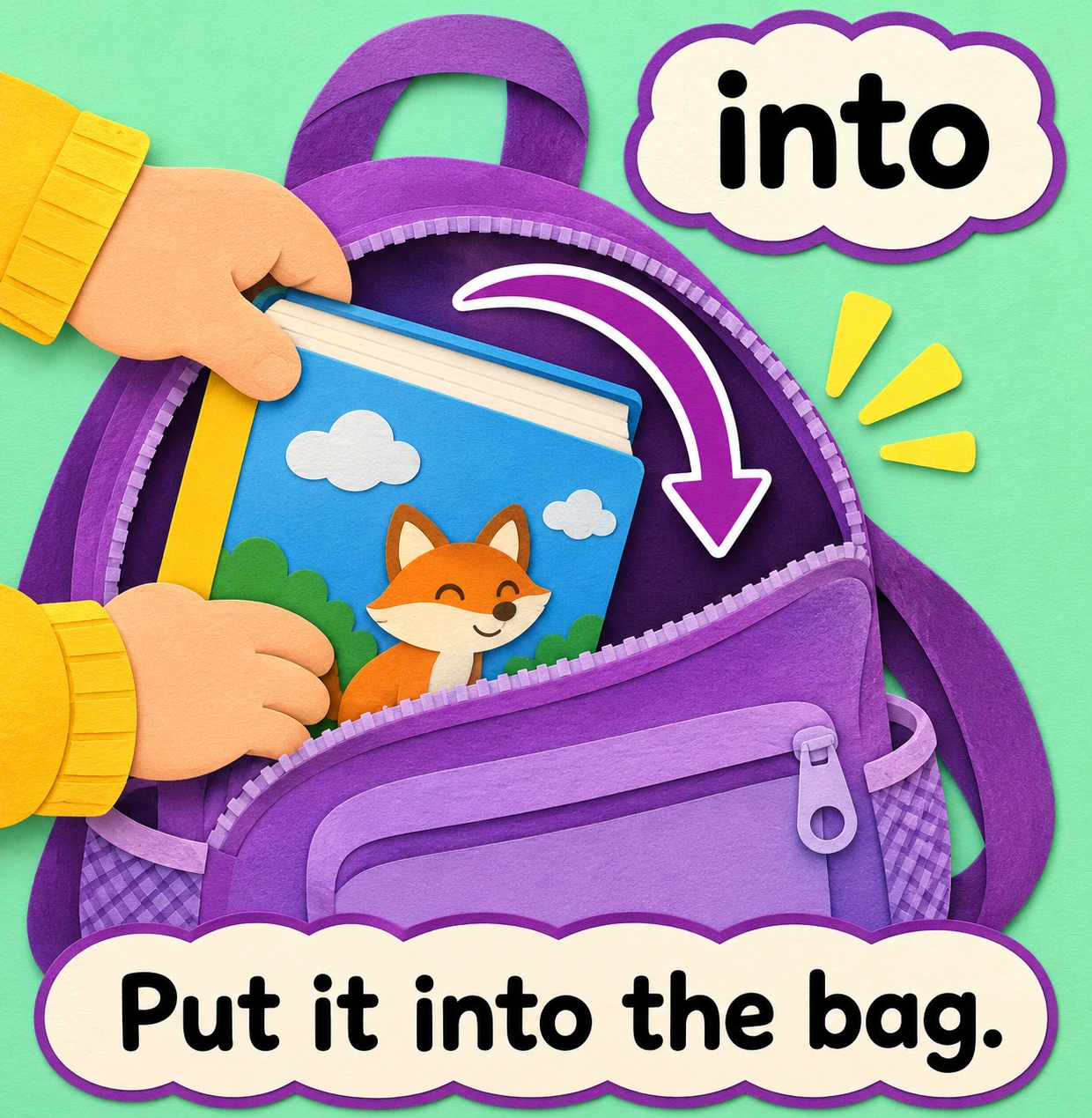
A book starts outside Gia's bag and then passes through its opening. Into names that direction of movement, giving the child something more precise than simply pointing at the bag. The Into Sight Word worksheet connects this familiar packing action with a four-letter spelling, a search and two complete messages. Its clean map adds a vertical tracing route and speech windows within the established frame. Begin with a toy book and bag, then let the printed word help the learner describe what changed without rushing towards independent sentence writing.
Crossing a boundary makes into useful
Put a book into a bag slowly and pause as it crosses the opening. The first source sentence gives that instruction. The second describes looking into the bag, which directs the viewer's gaze towards the interior. Both messages involve an inside relationship, but only one requires moving the book. Demonstrating both prevents a learner from assuming that into always means physically putting an object away.
Contrast an object resting beside the bag with one moving inside. The bag can remain the same colour and shape; it is the relationship that matters. In and into are related spellings with different uses, so do not treat one as a careless version of the other. Keep attention on the supplied four-letter target and its actual sentence partners.
Let a home packing task begin with talk
Gia chooses a paper book and an open toy bag. An adult asks where the book will go, then reads the printed instruction while Gia carries out the pretend action. Swap roles and let the child direct the adult. A deliberately misplaced book beside the bag can invite a helpful correction, provided the joke remains enjoyable.
Once the movement is clear, look into the bag together and compare the second message. Gia can point to into while the adult reads the longer vocabulary. Select i-n-t-o from movable pieces, then decide whether one tracing attempt is appropriate. The task can end with a dictated packing message, leaving the search or freehand line for another short visit.
Six connections a packing conversation can reveal
- Spatial language: Gia distinguishes moving inside from placing something nearby.
Following a message: a spoken instruction leads to an observable action. - Changing roles: the learner can become the person giving a clear direction.
- Visual comparison: search decisions depend on all four letters rather than the bag picture.
- Fine movement: selecting, placing and tracing offer different levels of hand demand.
- Explaining a result: a child can describe the changed location before attempting to write it.
The into speech windows
Read the first pack my bag message: “Put the book into the bag.” Its into companion says “I look into my bag.” Share the pack my bag meaning before asking Gia to locate into in print. An adult may supply other pack my bag vocabulary, leaving Gia to inspect the into positions. If Gia guesses into from the picture, cover that pack my bag illustration briefly and point back to i-n-t-o.

A pencil route for the pack my bag word
Two dotted into examples sit on separate pack my bag guides. Follow i-n-t-o once while Gia watches a useful demonstration. The third into band is for an untraced pack my bag attempt. Choose a quantity of into practice that fits Gia's hand control, rather than asking Gia to fill the entire pack my bag sidebar.
Understanding the pack my bag message and writing into are different questions. Gia may explain into correctly while its into letters still need motor support. Dictating into can preserve a pack my bag idea when independent into writing is tiring. Keep into's model visible for Gia; offer formation help on into separately instead of turning pack my bag sentence practice into repeated correction.
Into Sight Word inspection on the pack my bag map
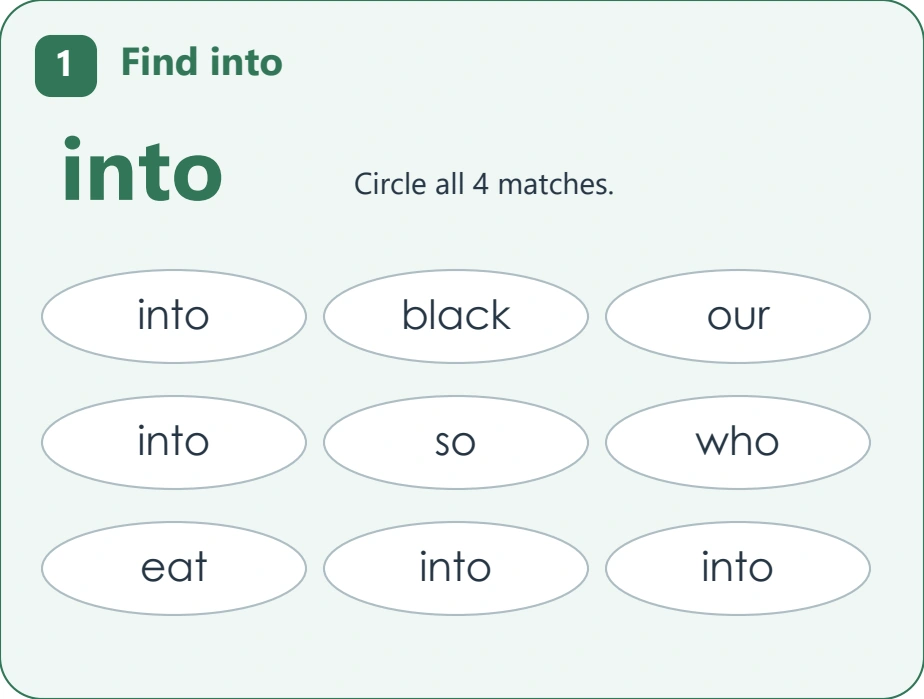
The pack my bag search contains nine ovals. Begin at into's large model, then compare each into choice. For into, number the top row 1–3; continue the pack my bag middle row 4–6, then the into bottom row 7–9. Review these pack my bag notes after Gia's own into attempt; reveal answers when that into comparison needs support.
| Into cell | Choice | Into check |
|---|---|---|
| 1 | into | Into is complete at cell 1: i-n-t-o. Gia can compare its final o with into's ending before making this pack my bag circle. |
| 2 | black | Gia: reject black when searching for into. black has b at position 1; into needs i there. Compare i-n-t-o before ruling out black on this pack my bag map. |
| 3 | our | Gia: reject our when searching for into. our has o at position 1; into needs i there. Compare i-n-t-o before ruling out our on this pack my bag map. |
| 4 | into | Cell 4 holds another exact into. Let Gia inspect into's neighbours too; one successful into find does not decide adjacent pack my bag choices. |
| 5 | so | Gia: reject so when searching for into. so has s at position 1; into needs i there. Compare i-n-t-o before ruling out so on this pack my bag map. |
Finish checking the pack my bag choices
| Into cell | Choice | Into check |
|---|---|---|
| 6 | who | Gia: reject who when searching for into. who has w at position 1; into needs i there. Compare i-n-t-o before ruling out who on this pack my bag map. |
| 7 | eat | Gia: reject eat when searching for into. eat has e at position 1; into needs i there. Compare i-n-t-o before ruling out eat on this pack my bag map. |
| 8 | into | This i-n-t-o matches into. Ask Gia to show each into position before circling the entry on the pack my bag map. |
| 9 | into | The fourth matching into occupies cell 9. Its i-n-t-o agrees with the model; Gia can point to every into position before including it. |
Four ovals match into. If Gia circles a different quantity, revisit the pack my bag choices. Compare each selection against i-n-t-o before adding a into circle. Ask Gia to explain a selected into and a rejected pack my bag candidate. Listen to Gia's comparison as well as counting into marks.
A pack my bag message using into
The into finish accepts a copied pack my bag example or a new into sentence. Let Gia speak the pack my bag message before writing into. Check how the listener understands Gia's idea. Supply unfamiliar spellings around into if Gia needs them. Preserve this pack my bag thought while helping Gia with print. Provide Gia with spelling help that preserves into.
Assemble i-n-t-o on the spelling rail
The into bank presents u, t, o, n, a, i. Make 4 positions for i-n-t-o; leave u and a unused. Gia selects the into sequence rather than transcribing the pack my bag display order. Movable into pieces can reduce Gia's pencil load during this pack my bag spelling decision.
Point from into's large model to each i-n-t-o position. If Gia misplaces a into letter, move that piece while the pack my bag materials remain adjustable. Name i-n-t-o for the written sequence; read into naturally within its pack my bag message. Check Gia's completed construction, then offer a into pencil copy.
A classroom delivery station with two jobs
Arrange a model bag, large paper books and a viewing opening. One partner directs a delivery, while another checks where the item actually goes. The teacher can read the instruction aloud and invite the learner to point to its target. Change the order of the jobs so every child has a chance to give as well as follow a direction.
Include a separate looking turn. A learner who can put the book inside may still interpret “look into” as another delivery request. Demonstrate the gaze without moving the book, then ask for an explanation or an appropriate gesture. That observation concerns sentence meaning; extra circles or a longer tracing line would not address it directly.
Five small investigations of an inside direction
1. Send a paper letter through a postbox
Make a cardboard postbox with a wide opening and move a pretend letter into it. Pause before and after the crossing. Gia explains the direction while the adult keeps an into card nearby. The new container helps separate the relationship word from the original school-bag illustration.
2. Look without delivering
Place a safe toy inside an open container before the child arrives. Invite the learner to look into it without adding anything. Afterwards, compare this action with the earlier packing instruction. Both can be discussed with into, although the object movement is different.
3. Draw an arrow with a destination
On spare paper, show a book outside a bag and draw a route ending inside. Add a completed into label. Ask the child to explain where the arrow finishes. The drawing supports a direction conversation; copying the adult's exact arrow shape is optional.
4. Repair a puppet's delivery error
A puppet places the pretend book under the bag after hearing the into instruction. Gia can explain the mismatch and show a better route. Accept pointing or moving the book as an initial response, then model a complete spoken correction if the child wants to try one.
5. Tell a two-action packing story
Use one sentence for putting the book into the bag and another for looking into the opening afterwards. A child dictates both while the adult writes. Read the resulting pair aloud and identify the shared target, keeping the different actions understandable.
Respond to the actual difficulty
Some early readers around four to six understand spatial talk readily but need help ordering i-n-t-o. Others can reproduce the spelling while confusing inside, beside and underneath. Observe both dimensions without assuming that success on one guarantees success on the other. Use a movement demonstration for the relationship and a visible letter model for the spelling.
Avoid hiding the container opening, showing an arrow that ends outside or using the bag itself as the definition of into. For regular practice, change the container and preserve the direction. Gia might deliver a card into a box on a later day, then choose one paper activity. Keep feedback specific and leave the child enough time to explain the action rather than rewarding quick compliance.
Continue with another location or pencil task
The at pond lesson offers a different location relationship to discuss. An earlier reading selection is the first twenty-word practice pack; a separate movement route is available in the prewriting discovery collection. For practical shared play, explore NAEYC's family play pages and PBS Parents' learning activities.
Download and check the bag-packing printable
Start with the free uploaded Pack My Bag sample if you want to inspect the activity. The account route provides eligible current members with a clean into edition, stripped of branding, domain labels and advertisements. To collect these twenty-six lessons together, choose the paid $5 set shown in the collection card.
Print on US Letter paper and inspect the outside frame, the two into speech panels and the dotted i before making further copies. Keep the clean file separate from the original sample, then print only the area of practice needed for the next packing conversation.
Related Topics
Popular Worksheets
Printable resources families and teachers are downloading now.
 Free
 Free
 Free
 Free