
Four Sight Word: 5 Amazing Cookie-Counting Tasks
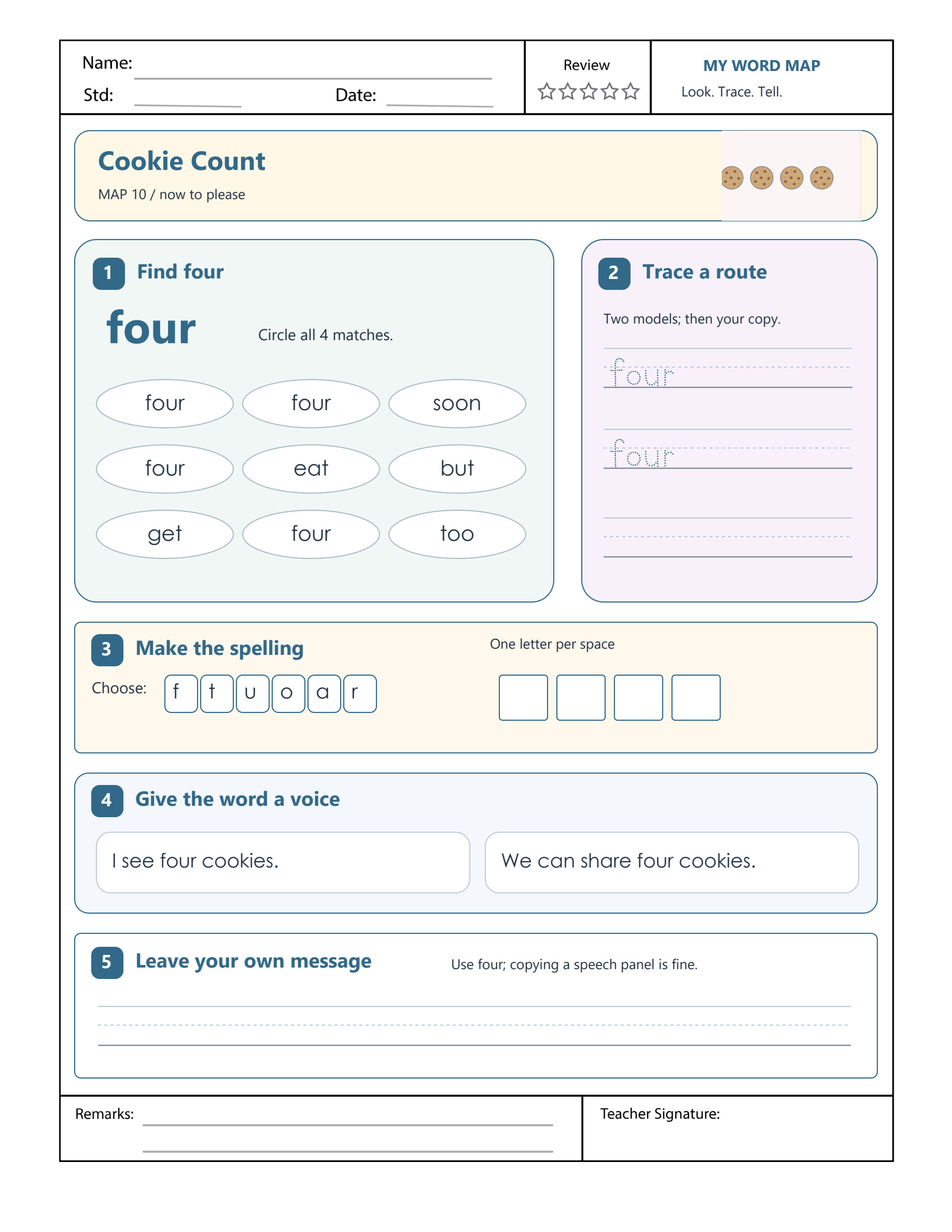
Explore four here, then choose the complete now-to-please Word Maps collection: 26 clean printable sheets together for $5.
The whole four map remains uncropped.
Cookie Count combines its four search hub, tracing side route, spelling rail, speech panels and message strip.
Leon counts the cookie counters once, moves them into two pairs and finds that the total has not changed. Four names that amount, while the written word gives the number a different form from the numeral 4. This Four Sight Word worksheet connects quantity, conversation and a four-letter spelling through a familiar pretend snack. Its clean map retains the source search, letter selection, tracing and sentence work inside the original frame. Begin with a visible collection of exactly four objects, then choose the print activity that supports the learner's next useful comparison.
Keep quantity, numeral and word connected
Count each cookie counter once while moving a finger or another marker in a steady route. The final count tells how many counters belong to the collection. Then show the numeral 4 and the spelling four. These are different ways to represent the same amount; recognising one form does not automatically establish knowledge of the others.
The source sentences describe seeing four cookies and sharing four cookies. Neither specifies how many people share them or how the cookies must be divided. Avoid inventing an equal-sharing answer as though it were printed on the worksheet. A sharing discussion can be an optional oral extension with clearly stated participants and pretend counters.
It is a coincidence here that four has four written letters. Do not teach number words by assuming that their lengths always match their quantities. Count the objects for the amount and inspect f-o-u-r for the spelling. Keep those two investigations related but distinct.
Count a pretend snack at home
Use four large paper cookies or other safe counters rather than requiring food. Leon arranges them as a line, counts them and then moves them into a small cluster. Ask whether any counter was added or removed. The child can explain the unchanged amount before seeing the printed four message.
Read the seeing sentence together and locate the target. Build f-o-u-r from the bank, then compare its order with the model. Leon can dictate a cookie-sharing idea for an adult scribe, then choose either an explained search row or a dotted four attempt. Leave the remaining paper work for another counting visit if attention is fading.
Six connections around four cookie counters
- One-to-one counting: Leon gives each object one count rather than counting a favourite counter twice.
- Total quantity: moving the counters does not change the amount when none are added or removed.
- Representations: the spoken number, numeral 4 and written four refer to the same collection.
- Spelling order: f-o-u-r differs from the shuffled order of the available pieces.
- Search decisions: complete word inspection is kept separate from counting pictures.
- Language expression: seeing and sharing provide two purposes for a number-word sentence.
A pencil route for the cookie count word
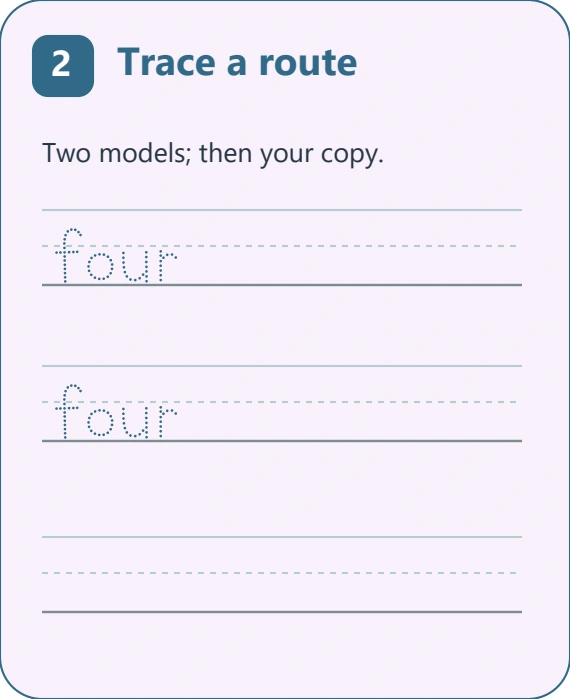
Two dotted four examples sit on separate cookie count guides. Follow f-o-u-r once while Leon watches a useful demonstration. The third four band is for an untraced cookie count attempt. Choose a quantity of four practice that fits Leon's hand control, rather than asking Leon to fill the entire cookie count sidebar.
Understanding the cookie count message and writing four are different questions. Leon may explain four correctly while its four letters still need motor support. Dictating four can preserve a cookie count idea when independent four writing is tiring. Keep four's model visible for Leon; offer formation help on four separately instead of turning cookie count sentence practice into repeated correction.
Four Sight Word inspection on the cookie count map
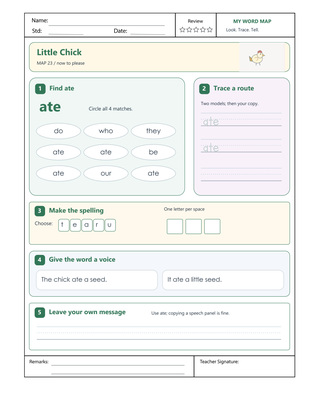
The cookie count search contains nine ovals. Begin at four's large model, then compare each four choice. For four, number the top row 1–3; continue the cookie count middle row 4–6, then the four bottom row 7–9. Review these cookie count notes after Leon's own four attempt; reveal answers when that four comparison needs support.
| Four cell | Choice | Four check |
|---|---|---|
| 1 | four | Four is complete at cell 1: f-o-u-r. Leon can compare its final r with four's ending before making this cookie count circle. |
| 2 | four | Cell 2 holds another exact four. Let Leon inspect four's neighbours too; one successful four find does not decide adjacent cookie count choices. |
| 3 | soon | Leon: reject soon when searching for four. soon has s at position 1; four needs f there. Compare f-o-u-r before ruling out soon on this cookie count map. |
| 4 | four | This f-o-u-r matches four. Ask Leon to show each four position before circling the entry on the cookie count map. |
| 5 | eat | Leon: reject eat when searching for four. eat has e at position 1; four needs f there. Compare f-o-u-r before ruling out eat on this cookie count map. |
Finish checking the cookie count choices
| Four cell | Choice | Four check |
|---|---|---|
| 6 | but | Leon: reject but when searching for four. but has b at position 1; four needs f there. Compare f-o-u-r before ruling out but on this cookie count map. |
| 7 | get | Leon: reject get when searching for four. get has g at position 1; four needs f there. Compare f-o-u-r before ruling out get on this cookie count map. |
| 8 | four | The fourth matching four occupies cell 8. Its f-o-u-r agrees with the model; Leon can point to every four position before including it. |
| 9 | too | Leon: reject too when searching for four. too has t at position 1; four needs f there. Compare f-o-u-r before ruling out too on this cookie count map. |
Four ovals match four. If Leon circles a different quantity, revisit the cookie count choices. Compare each selection against f-o-u-r before adding a four circle. Ask Leon to explain a selected four and a rejected cookie count candidate. Listen to Leon's comparison as well as counting four marks.
The four speech windows
Read the first cookie count message: “I see four cookies.” Its four companion says “We can share four cookies.” Share the cookie count meaning before asking Leon to locate four in print. An adult may supply other cookie count vocabulary, leaving Leon to inspect the four positions. If Leon guesses four from the picture, cover that cookie count illustration briefly and point back to f-o-u-r.

Assemble f-o-u-r on the spelling rail
The four bank presents f, t, u, o, a, r. Make 4 positions for f-o-u-r; leave t and a unused. Leon selects the four sequence rather than transcribing the cookie count display order. Movable four pieces can reduce Leon's pencil load during this cookie count spelling decision.
Point from four's large model to each f-o-u-r position. If Leon misplaces a four letter, move that piece while the cookie count materials remain adjustable. Name f-o-u-r for the written sequence; read four naturally within its cookie count message. Check Leon's completed construction, then offer a four pencil copy.

A cookie count message using four
The four finish accepts a copied cookie count example or a new four sentence. Let Leon speak the cookie count message before writing four. Check how the listener understands Leon's idea. Supply unfamiliar spellings around four if Leon needs them. Preserve this cookie count thought while helping Leon with print. Provide Leon with spelling help that preserves four.
A classroom counter tray with a checking partner
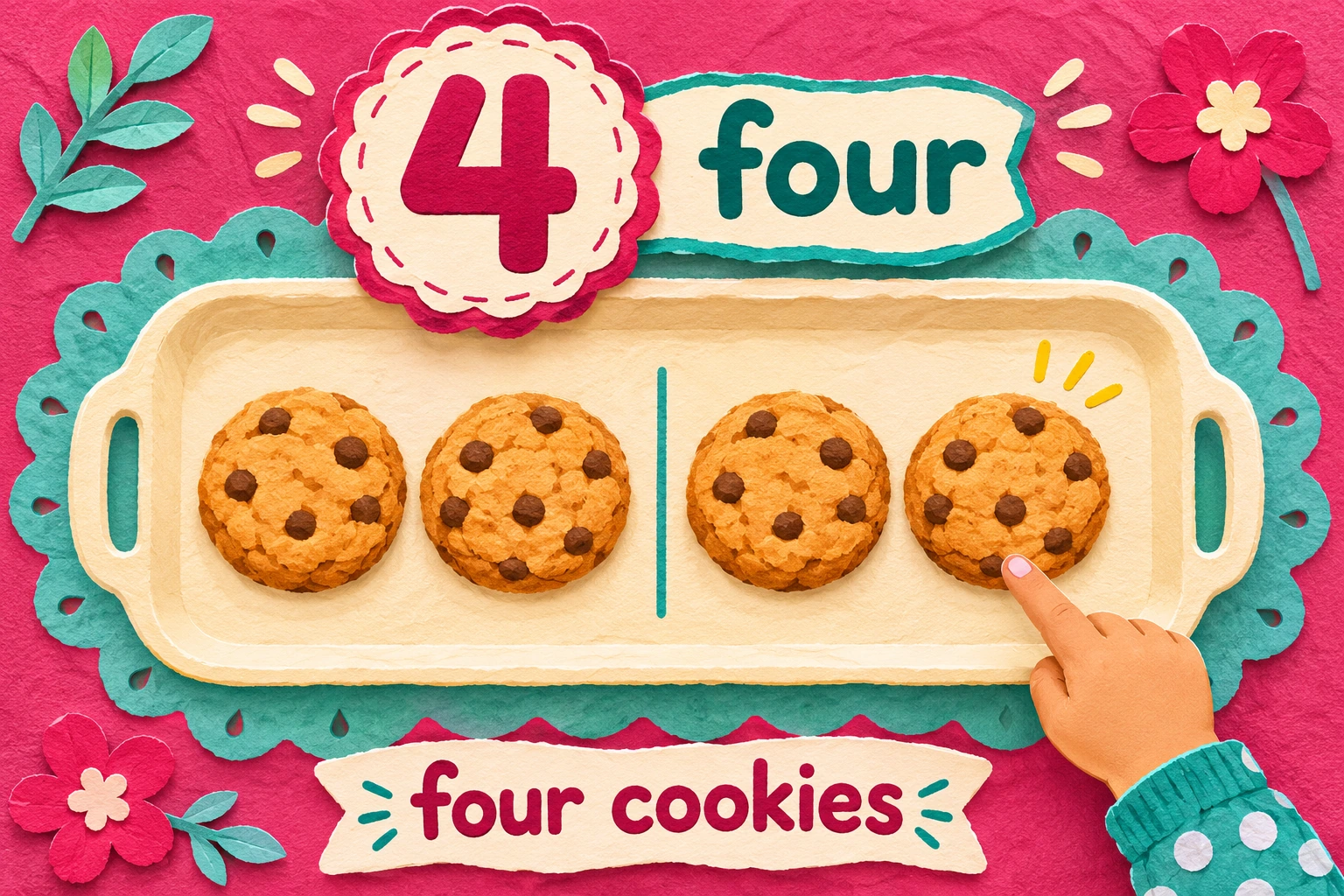
Give a small group a tray containing exactly four paper cookies. One learner counts, another rearranges and a third checks whether the collection changed. Rotate jobs and allow pointing or moving counters as well as speaking. The teacher can connect the final amount with a completed four card before opening the worksheet.
After the practical task, partners locate the target in both speech panels. A learner who circles the right words but counts five objects needs a counting revisit. A learner who counts four reliably but spells f-u-o-r needs a position comparison. Do not treat the two skills as one undifferentiated success or failure, and do not add a timed race to decide who understands first.
Five ways to investigate the same amount
1. Change the arrangement
Place the four counters in a square, then in a long line. Leon checks whether the total stayed the same and explains why. Show the written four card after each arrangement. The changing spacing provides a useful contrast with the stable amount.
2. Give the counter a different material
Replace the paper cookies with four large blocks. Count again and match the set with its word label. The target should transfer beyond a snack picture; four describes how many objects are being considered, not what kind of object they are.
3. Spot an added object
Begin with four counters, add one visibly and ask whether the four label still fits the whole set. Let the child explain before restoring the original amount. This is a concrete comparison, not an invitation to guess a hidden change without enough information.
4. Make a clearly stated sharing story
Choose two toy people and say that they will share the four paper cookies. Explore possible allocations orally without claiming that the worksheet specifies one. Count the entire collection again afterwards. The number-word caption continues to describe the total even when the counters occupy separate places.
5. Send a collection message
Leon dictates a four sentence for a listener who has not seen the tray. The listener prepares a matching set from the message. An adult can write the surrounding words, then invite the child to check the target. The sentence now has a practical purpose beyond filling a line.
Correct the particular counting or spelling issue
Adult-supported preschool and kindergarten learners around four to six can enter through objects, spoken language or print according to experience. If a child double-counts, provide a clearer moving route. If the final r is omitted in writing, compare the four written positions with the large model. Extra tracing is not a substitute for a counting demonstration.
Keep practice pleasant by choosing different safe objects on later visits and limiting the amount of pencil work. Avoid making actual food consumption a reward for finishing the page. Notice an explained decision, such as preserving the total after rearrangement, and give the learner time to communicate how the collection was checked.
Link quantity talk with another reading purpose
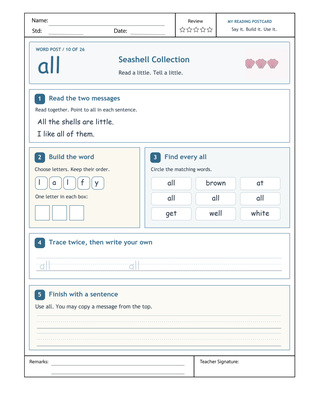
The all shell-collection lesson offers a useful contrast: every member of a group rather than a fixed amount. Earlier print practice appears in the pre-primer first-twenty collection, while the prewriting concept sheets support a separate movement visit. Explore NAEYC's practical family play ideas and PBS Parents' activity suggestions for additional shared experiences.
Choose a printable for your counter tray
Cookie Count has a free original and a clean four edition for eligible membership accounts. Use the appropriate page control after signing in to an active plan. The premium sheet omits site branding, domain printing and promotion. The collection card leads to a $5 combined purchase covering every map from now to please.
Make one US Letter test and check the full frame, the four-cookie illustration and the dotted f-o-u-r models. Keep the intended file easy to find for a later counting conversation, and print more only when the chosen activities will be useful.
Related Topics
Popular Worksheets
Printable resources families and teachers are downloading now.
 Free
 Free
 Free
 Free