
Mango Moments: 6 Powerful Letter M Games for Happy Kids
♫ Feel the beginning, then study the shape
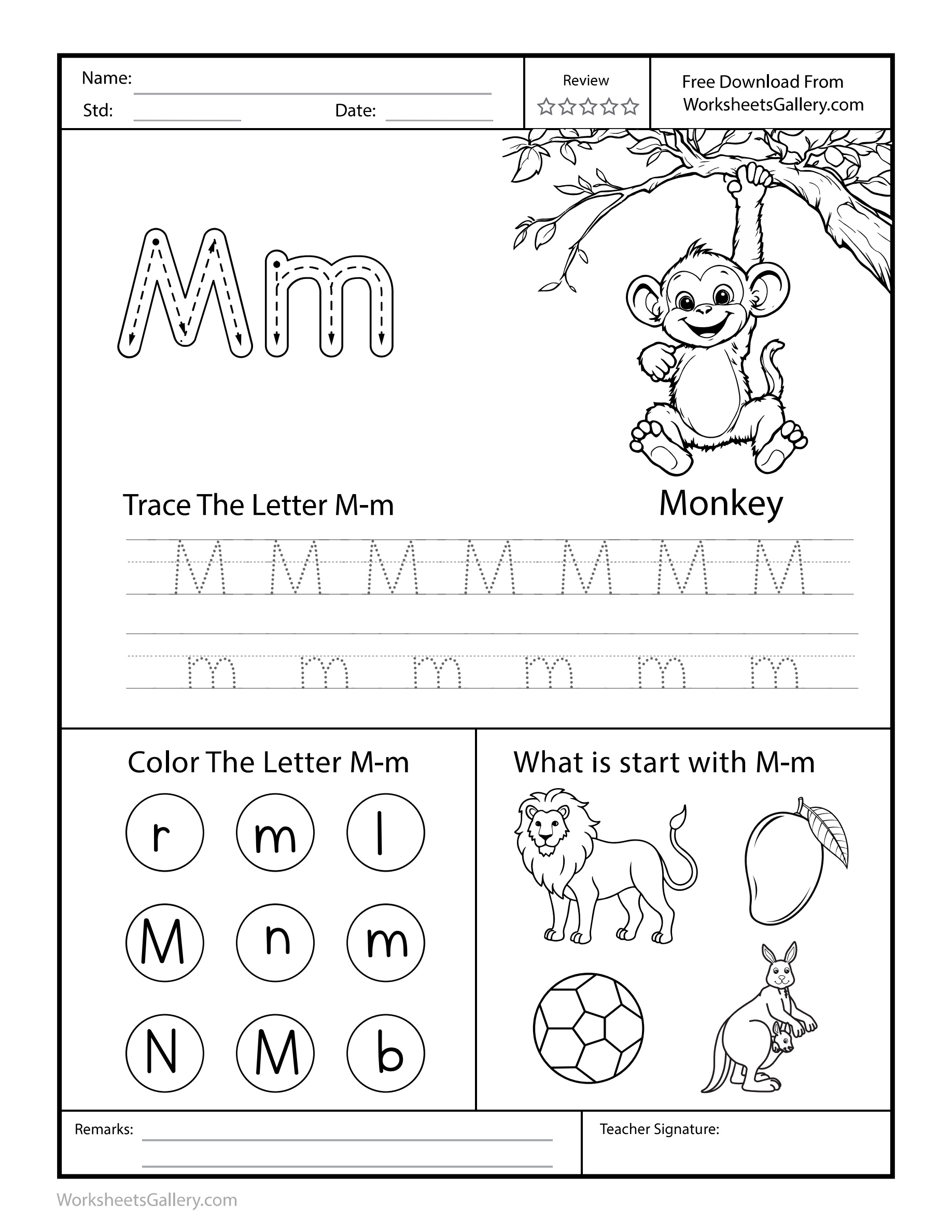
Mmmm is a sound you can feel with your lips together. Try it before saying monkey, then look for a printed M or m. This Letter M worksheet connects that familiar beginning with two very different routes: a capital with a pointed middle and a lowercase form with two arches. Seven capital guides and six lowercase guides leave room for a short, chosen practice session. Four matching circles and a mango picture offer other ways to respond. Use the repeated arches as a looking clue, then let the child decide what to try first.
Hear Letter M in monkey and mango
Say monkey naturally, drawing brief attention to the /m/ at its beginning. The lips close for the Letter M sound. Avoid adding a separate “uh” after it when demonstrating; the beginning should lead into the word rather than become another syllable. Let the child listen or join in without demanding an exaggerated performance.
The large introduction picture is a monkey hanging from a branch. In the lower picture area, the mango at the upper right is the Letter M choice. Lion, ball and kangaroo are the other main objects. Name them before asking the learner to select a matching beginning, particularly if mango is an unfamiliar fruit word.
There are two useful jobs here: connecting spoken words with /m/, and identifying the written Letter M forms. You can work on one while supporting the other. A child who recognizes m but cannot yet name the fruit needs vocabulary help, not another handwriting row.
Pointed M and rounded m carry the same name
| Look at | Find this feature | Ask a useful question |
|---|---|---|
| Capital M | Straight strokes with a pointed middle valley. | Where does the middle dip reach? |
| Lowercase m | A short form with two rounded arches. | Have we seen both arches? |
| The n distractor | One arch, rather than two. | What would a second arch change? |
Use the dotted Letter M rows for writing-line comparisons. Capital M fills the taller space; lowercase m sits in the smaller middle-to-bottom area. The large arrow drawings are movement references and need not be treated as a size chart.
The uppercase Letter M guide and the lowercase partner take different routes. Follow the printed arrows together with your usual handwriting teaching approach. Describe the points or arches before moving a pencil so the learner has a feature to anticipate.
Look across the two Letter M arches
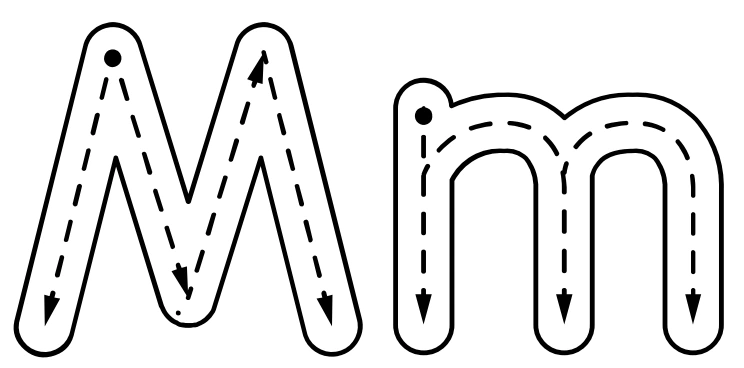
Touch the first arch and then the second without hurrying. A child may recognize the beginning of m and stop looking too soon, especially when n is nearby. The Letter M comparison rewards attending to the whole shape rather than accepting its first familiar part.
Lowercase m is not a pair of unrelated circles. Its curved tops connect to downward strokes. Finger-following can make that continuous relationship visible before pencil pressure becomes another demand. When Letter M is difficult to steer, enlarge one model on spare paper and return to a single dotted example afterward.
The page contains seven capital examples and six lowercase examples, thirteen altogether. All are guided; there is no separate empty handwriting strip. Save untouched Letter M models for another visit instead of treating every printed space as a same-day requirement.
Six kinds of progress can appear on one sheet
A useful Letter M session gives you something specific to notice. The quality of a decision can tell you more than the number of filled spaces.
These are opportunities for observation, with room for different levels of support.
- Whole-shape attention. Looking for the second arch encourages a child to inspect all of lowercase Letter M rather than guessing from the opening stroke.
- A remembered comparison. Holding “two arches” in mind while searching separates m from n. The target rule has a visible reason the learner can revisit.
- Controlled direction changes. Tracing Letter M offers turns through pointed or curved routes. Looking ahead supports a deliberate change rather than a rushed wobble.
- Cooperation between the hands. Steadying the paper lets the writing hand follow the model with less unwanted page movement. Notice the setup as well as the mark.
- A meaningful sound connection. Monkey and mango give Letter M a spoken reference. Understanding each picture name makes the beginning-sound question clearer.
- Language for an explanation. Words such as pointed, rounded, first and second let the child describe a Letter M choice. A gesture can provide the starting explanation.
A classroom pause makes the missing arch noticeable
A teacher begins a large lowercase m on a board but pauses after one arch. The group is asked whether the Letter M model is finished. Children point to the second arch on their sheets, and the teacher completes the comparison. Nobody needs to copy the unfinished version; it is a brief looking question before writing.
Then children finger-follow a full lowercase Letter M and choose a few dotted guides. The teacher demonstrates from the same viewing direction, names the start and watches the second arch. One learner may point while another traces. Both can explain the Letter M feature being studied.
This activity can suit adult-supported preschool and kindergarten learners, often about three to six years old. Select the pencil demand from current control and attention. Age alone does not decide how many Letter M examples a child should finish, and a clear pointing response can be enough for the first encounter.
Four Letter M circles are the complete search answer
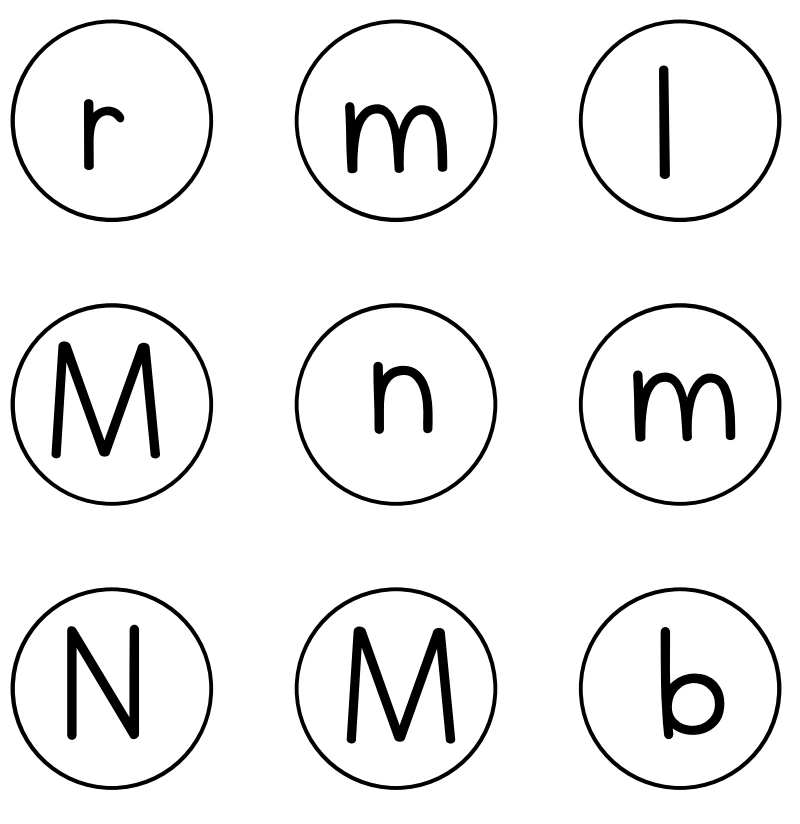
Top row: middle m. Middle row: left M and right m. Bottom row: middle M. The four choices include both cases equally.
The exact rows are r, m, l; M, n, m; and N, M, b. Ask the child to touch Letter M matches before picking up a crayon. That gives you a recognition response without the additional job of filling a circle.
At the center, n has only one arch. Compare it with either lowercase m target and ask what changes. Capital N is also a distractor, so a tall straight-sided letter is not automatically Letter M. Return to the pointed middle rather than relying only on overall height.
Four matches is a check on the decisions, not an instruction to color four arbitrary circles. If counting is difficult, an adult can do the tally after the learner has selected the Letter M forms. For Letter M, discuss recognition, counting and coloring as different responses.
At home, open a tiny mango museum
Sofia chooses a mango picture for a pretend museum exhibit with her grandfather. She dictates, “It has yellow inside,” and he writes the sentence beneath a large m. She compares the museum label with the worksheet and notices both arches. Then they say mango and trace one Letter M example together.
A home session can begin with that picture conversation or with the monkey. Name the object, choose one case and model a short route. Offer a few guided attempts, then let the learner return to a Letter M circle or describe the fruit again. A paper drawing or the illustration below is enough for the museum; real food is optional.
If broad pencil movements need attention first, use prewriting line paths. The separate M tracing resource provides another page format. For a later case comparison, choose a small part of the complete alphabet collection.
Six mango invitations beyond Letter M tracing
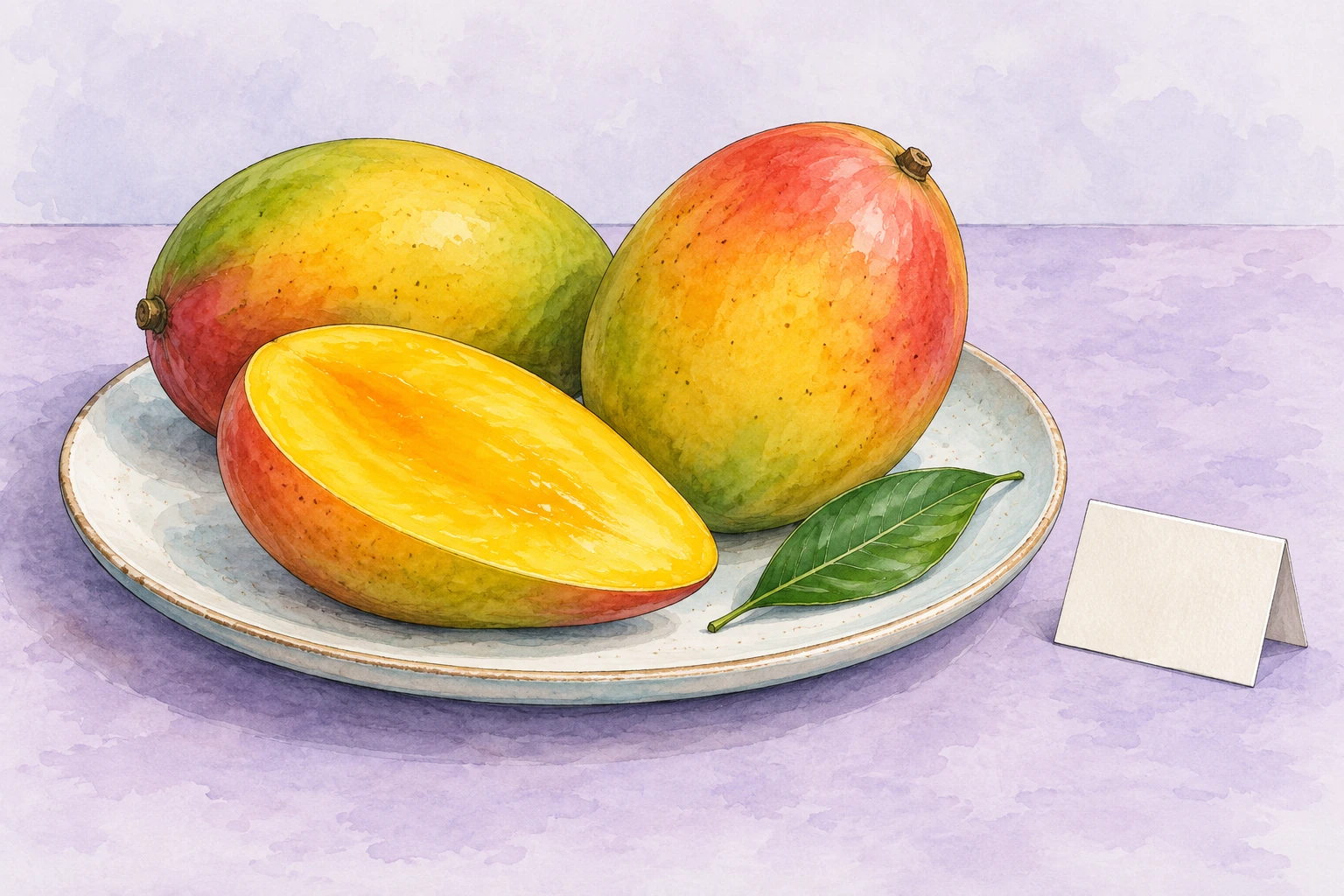
Exhibit captioner
Let the learner dictate one detail about the mango image. An adult records it and adds the word mango, then shows the initial Letter M. Read the child's own sentence back.
Two-arch stamp design
Sketch a large pretend museum stamp containing m. The child decorates around it and explains why one arch would not be enough for the Letter M model. Keep the letter itself recognizable.
Inside-and-outside guide
Compare the whole fruit with the open cheek in the artwork. Ask the child to describe what can be seen inside. Say mango afterward and reconnect that name with Letter M.
A visitor's question
A puppet asks, “Why is this in your M exhibit?” The child can name mango, point to its adult-written label or find m on the worksheet. Any of those makes the connection visible.
Case-pair tickets
Give the museum two large paper tickets, one marked M and one m. The learner matches both with the exhibit's beginning and shows how the two Letter M shapes differ.
A spoken display list
Help the child propose another M object, such as a mug, for a pretend display. Say the proposed names together and listen to their beginnings before deciding what belongs.
These are choices for different days. A learner who enjoys giving a museum tour may prefer conversation, while another wants to design a stamp. Each invitation can return to one Letter M observation without requiring a complete second worksheet.
Make a short routine easier to repeat
For regular Letter M practice, use a familiar quiet moment and offer a choice: inspect an arch, trace a model or explain a circle. Stop when you have a useful response to discuss. An untouched part of the page can supply the next visit's starting place.
Common difficulties include stopping lowercase m after one arch, making it as tall as the capital, or rushing through the pointed capital middle. Show the specific feature again at a larger size. Avoid correcting several things simultaneously; the child needs to know which Letter M change the new demonstration is meant to clarify.
Encouragement works best when it names evidence. “You checked for the second arch” tells the learner what went well. Enjoyment can come from the monkey drawing, the hum of /m/ or the chance to invent an exhibit. Preserve that interest by allowing a successful Letter M response to be small.
Get the Letter M PDF ready for printing
The original branded source is offered as the free sample. For the clean Letter M premium PDF, use the membership option with a qualifying active plan. That premium edition is free of the website watermark, with no advertisements added to the PDF pages. The original learning tasks are retained.
- Choose the free sample for the original version, or sign in to an eligible current membership and request the clean premium file.
- Open the saved PDF in a reader. The document is a single US Letter sheet, 8.5 inches across and 11 inches high, arranged vertically.
- Preview the entire border. Use actual size when the sheet fits; otherwise fit it to the printer's available page area and check the dotted guides.
- Print one trial copy and inspect the seven capital models, six lowercase models, search circles and mango choice. Then choose the first Letter M task for your learner.
Popular Worksheets
Printable resources families and teachers are downloading now.
 Free
Free
 Free
Free
 Free
Free
 Free
Free