
Reading Trail: 20 Brilliant Dolch First Grade Sight Words
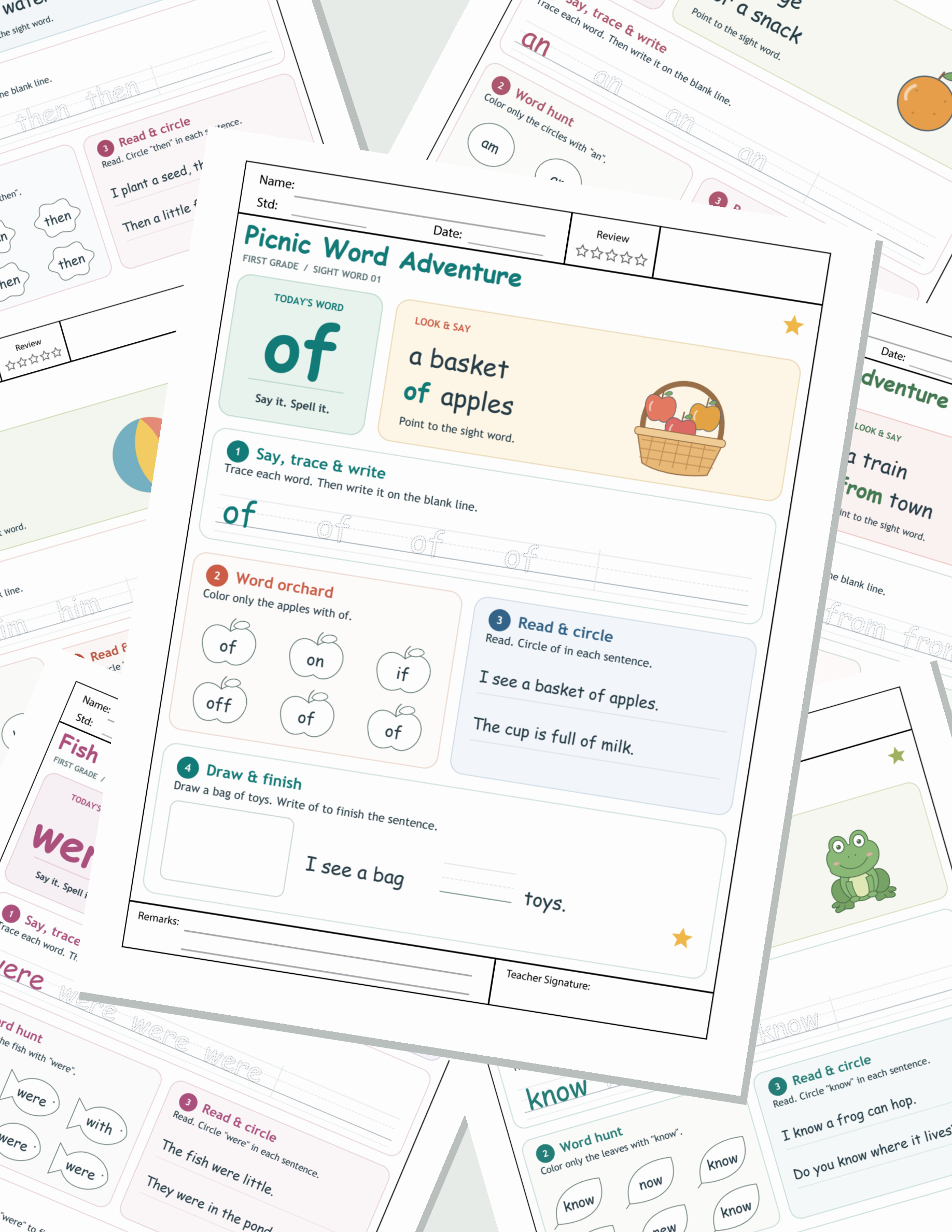
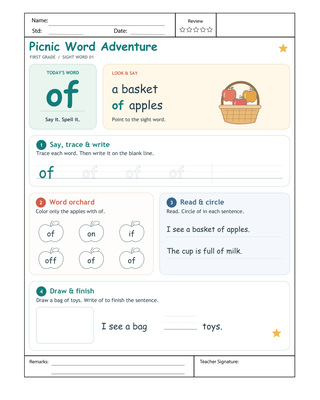
The front picnic sheet shows the layout repeated through the twenty-page selection.
The preview stacks seven actual collection pages, with the of page complete and the other pictured sheets partially visible.
Dolch First Grade Sight Words can do very different jobs in a short sentence. At a reading table, one learner uses of to say what fills a cup, another uses then to give a planting direction, and a third asks what a frog watcher knows. This printable collection gives each of those words its own page. The twenty sheets run from of through know in source order. Choose a single word for a short lesson or print the set to keep a shared record of the words your group has tried.
See which Dolch First Grade Sight Words are in this PDF
| PDF pages | Printed words | Reading discussion |
|---|---|---|
| 01–05 | of, his, had, him, her | Containers and contents, ownership, past descriptions and who receives an item. |
| 06–10 | some, as, then, could, when | Amount, comparison, sequence, possible actions and timing. |
| 11–15 | were, them, ask, an, over | Past descriptions, group references, requests, vowel sounds and position. |
| 16–20 | just, from, any, how, know | A limit, a starting point, available choices, a method and what someone knows. |
Keep this list nearby when choosing a lesson. The printed numbers refer to the source sequence. Page 01 opens with a picnic basket, and page 20 ends with a frog observation. The matching word is printed prominently near the top of every sheet.
The page number also helps a group find a related word for a second turn. Try his and her together for ownership, or then and when for different jobs in a sentence about events. Each stays on its own lesson sheet, so you can put both models on the table without asking a beginner to practice both at once.
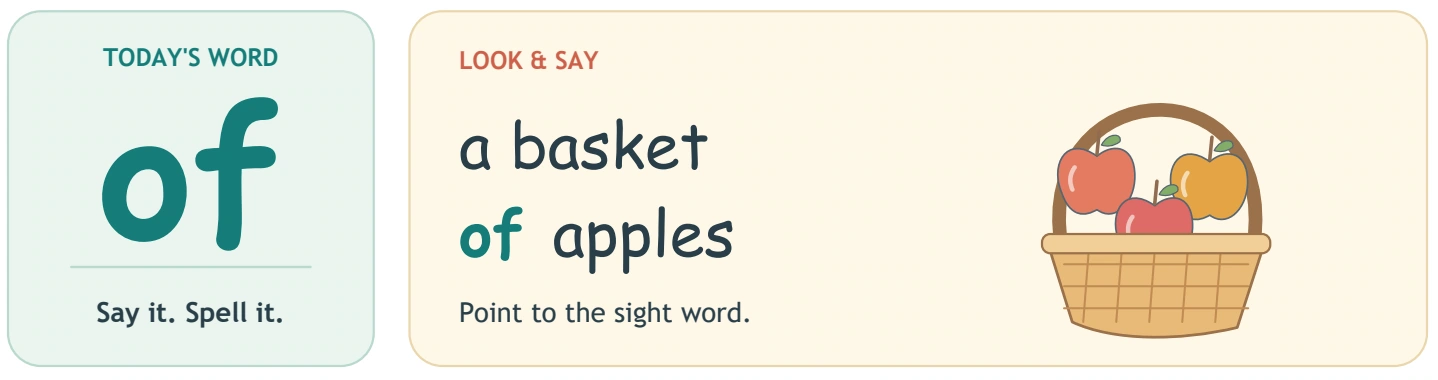
Choose a word for the message it helps a child read
Start with a sentence someone might actually say. A note about his kite points to an owner. An invitation to let him play points to a person in a different way. Show a named character before asking a child to read either example. If a learner can say whose kite was found but has trouble reading the written word, use that clear meaning as the starting point for a spelling discussion.
Timing words give a different kind of help. Then moves a short story along, while when can tell someone what event triggers an action. Put the seed and watering pictures on the table for then. Try the umbrella sheet for when. Ask the child to explain one order and act out one cue. The different tasks help a reader hear two jobs before looking at the near-matching spellings.
For a third pairing, use any and some around a small supply tray. Someone who may choose any crayon has an open choice. Someone who asks for some crayons has left the count open. Let a child choose one real color and offer a small quantity in a second turn. A partner can listen for the difference and say which scene fits a new sentence.
Give the pencil a small, clear job
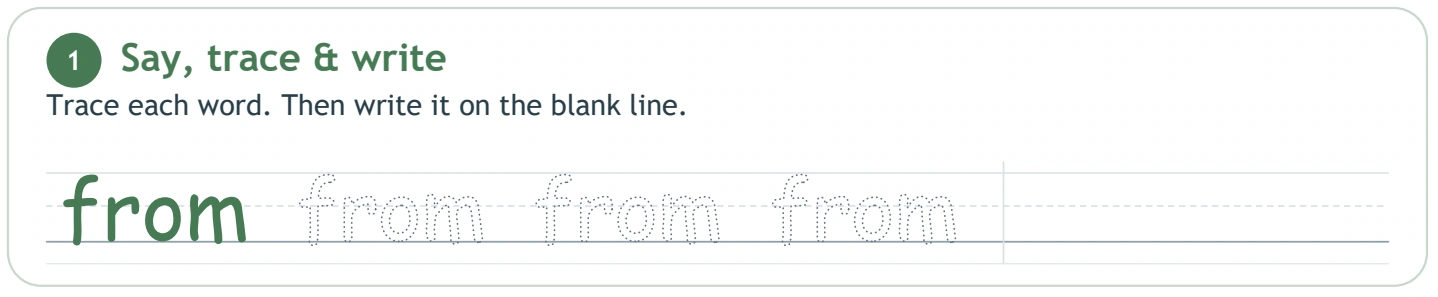
The wide practice panel on each sheet has a solid model, three pale models and room for an independent attempt. Say the word once while pointing under the letters. Trace one example at a steady pace and let the child tell you which part they want to check before choosing another. A short writing turn can leave the other guides ready for a later visit.
Choose a different point to watch for each word. In ask the s comes before k. In from the r comes before o. In could the l stays in the written word even though it is quiet. In know the first letter is quiet, and the same spoken sound can be written no for a different word. Read the rest of each spelling aloud so the unusual part is connected to a complete label.
Let a reader compare a fresh attempt with the larger model. Check one concrete detail, such as the position of h in when or the final n in then. Let the learner mark one small success, then give them a chance to read their copy back to someone else. An adult can help with grip or paper position if the letter shapes are taking so much attention that the child loses the word.
Make the word hunt a reading check
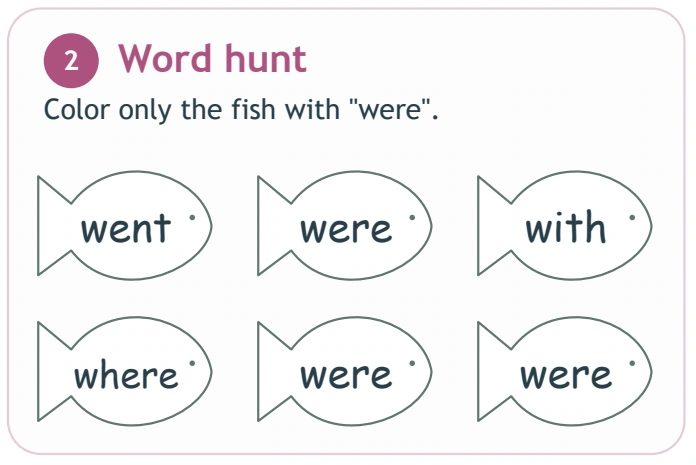
There are six choices and three exact matches on each sheet. A learner can read and point across the two rows before picking up a crayon. Because all the labels sit inside similar pictures, the child needs to attend to the print. Encourage a soft color that keeps the letters readable for a final check.
Some hunts use words with several letters in common, such as from and form, or know and now. The two sets call for different checks: in the first, keep track of order; in the second, look for a letter that is present in only one. Elsewhere the contrast may be much wider, as on the some sheet. Let the reader name what they checked instead of treating every nonmatch as the same kind of mistake.
Try dividing the jobs between two learners. One scans the top row and reads a candidate; one verifies it against the title word. Have both listen before selecting a label. In the second row, swap the jobs. A reader who chooses a first-letter match can look at the middle and end next.
Listen for the job a word does in a whole sentence
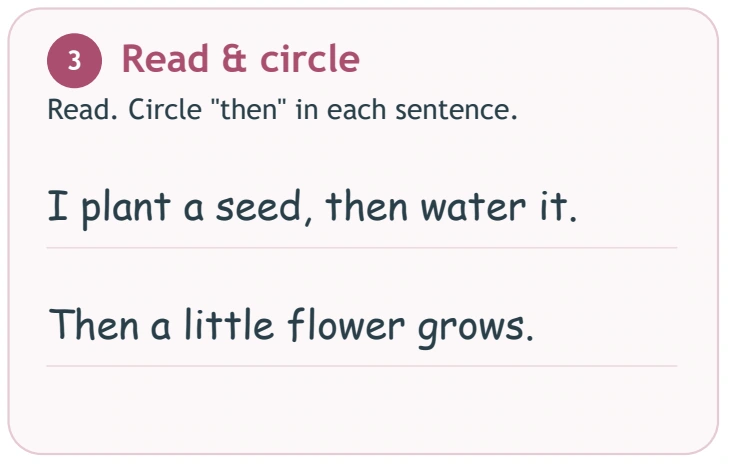
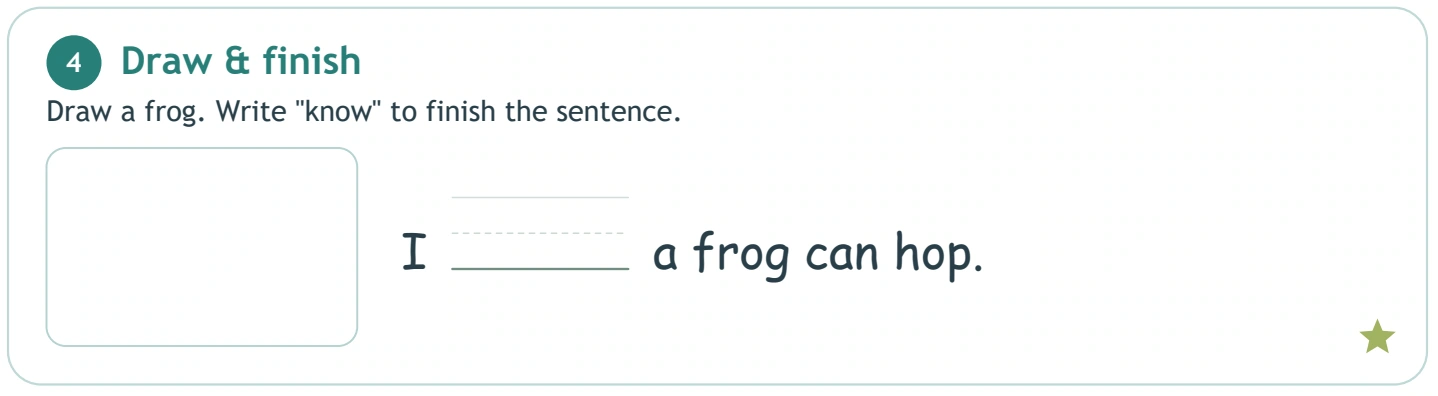
The two printed sentences on each sheet give a change of context. For were, a reader describes what the fish looked like and then where they were. For know, the first example makes a statement and the second asks a question. The short word can keep its spelling even as the speaker changes the purpose of the line.
Read one sentence to a listener with the worksheet facing away. Ask the listener to act out the instruction, point to the group it refers to or tell what was said about a character. For example, put them in the bucket only when the group of shells has been named. If the answer is unclear, return to the complete printed sentence and add a quick spoken setup.
Then turn to the final prompt and let a learner read it aloud before drawing. Ask whether the picture supports the complete message after the missing word has been written. A child who needs help writing a longer caption can dictate one on separate paper. The worksheet itself asks for one short word in the printed line.
Five ways to carry the practice into another reading turn
- Label two things. Give two containers different contents. Have a partner read a label with of and use it to select the correct one.
- Fix a reference. Put two groups on the table and give an instruction with them. Let the learner add a naming sentence to identify the group.
- Retell an order. Use two scene cards for then. Reverse the cards and decide what the new sentence would say.
- Swap the first sound. Make an orange into a sweet orange by adding the adjective in front. Let a reader choose the article again after listening.
- Ask for a method. Get a partner to show how to stack two blocks. Try a what question afterward and compare the information supplied by each answer.
Plan a small group or family reading session
At home, choose a word that can be used around the table or during a game. Read the top phrase on that sheet, let the child find one of its printed choices, and return to the sentence panel after a break. If they ask to color everything, give them a separate drawing to decorate after they have shown which labels the source activity asks them to mark.
In a classroom, make the words available to a reader, a listener and a writer. Give them each a definite turn. For the print check, have the reader point to the selected spelling and the listener verify the whole word. Give the writer the closing line only after the other two can say the sentence clearly. Rotate the jobs before choosing a second sheet.
These sheets are intended for first grade practice, often around ages six and seven. A learner who already reads many short words may move quickly into the sentence or drawing task. A learner who is still blending can start with one oral phrase and one supported written example. Compare what the child can do without help on later visits rather than timing the first try.
Notice understanding across five parts of reading
Spelling order shows up when a child explains the difference between from and form. Sound awareness appears when a reader says the last sound of of while noticing the letter f. Pencil control is visible in a legible copy with enough room between strokes. Meaning comes through when a learner moves a toy plane on the route the over sentence describes. Independent use can be as simple as completing a gap, rereading the result and letting a partner match it to the right picture.
Choose one thing to observe per session. If most of a sentence goes well but the learner misses a weakly spoken word, drive the lesson with a short reading turn rather than filling another row. On a later day, check the same word in a note or another story. A new context gives a child the chance to show that the word can travel.
Other reading practice after the collection
For a shorter practice break, try the separate practice sheet for eat. To work on sound and print with simpler spellings, share a lesson with the ap word family or a printable lesson for leg with the group before selecting another word from the table.
Adults who want additional ways to teach familiar and unusual spellings can consult UF Literacy Institute’s guidance for high-frequency words and Reading Rockets’ model for teaching common words.
Download all twenty worksheets
The $4 purchase includes one twenty-page PDF with the worksheets from of to know in order. Use the purchase button to get the protected file. Each worksheet in the PDF keeps its print frame, pictures, guided copies, sentence practice and writing spaces.
Choose US Letter portrait in the print dialog. Start with one page and check the faint traces and the outer frame on your printer. The table above helps you find a word by page number when printing only part of the file.
Related Topics
Popular Worksheets
Printable resources families and teachers are downloading now.
 Free
 Free
 Free
 Free