
Please Sight Word: 5 Brilliant Shared-Painting Tasks
Explore please here, then choose the complete now-to-please Word Maps collection: 26 clean printable sheets together for $5.
The whole please map remains uncropped.
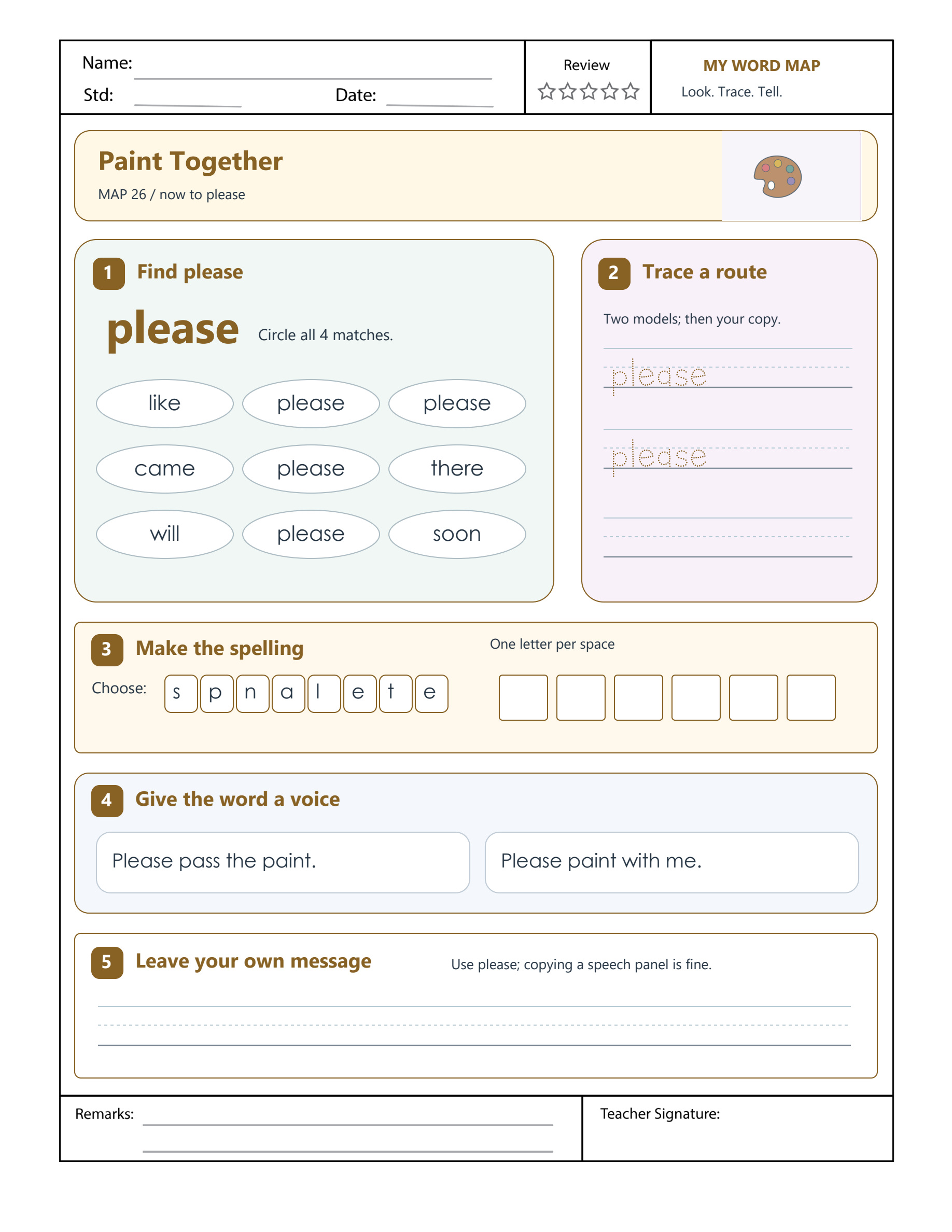
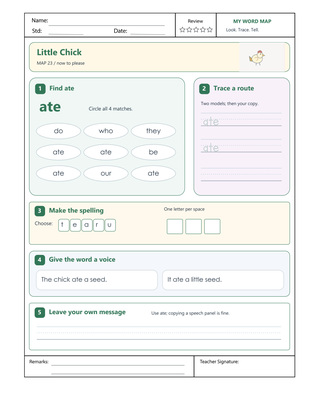
Paint Together combines its please search hub, tracing side route, spelling rail, speech panels and message strip.
Bodhi needs a shared paint pot and can make a request that leaves the listener room to respond. Please adds a courteous opening to that exchange. The Please Sight Word worksheet connects the art-table conversation with a six-letter spelling, a search and supported writing. The painting map changes how five practice areas fit together, while keeping the source's outside frame. Begin with asking and listening, then use the printed model to explore p-l-e-a-s-e without suggesting that a polite word guarantees agreement or that a child must produce perfect handwriting before a request deserves attention.
Courtesy changes the opening, not the listener's choice
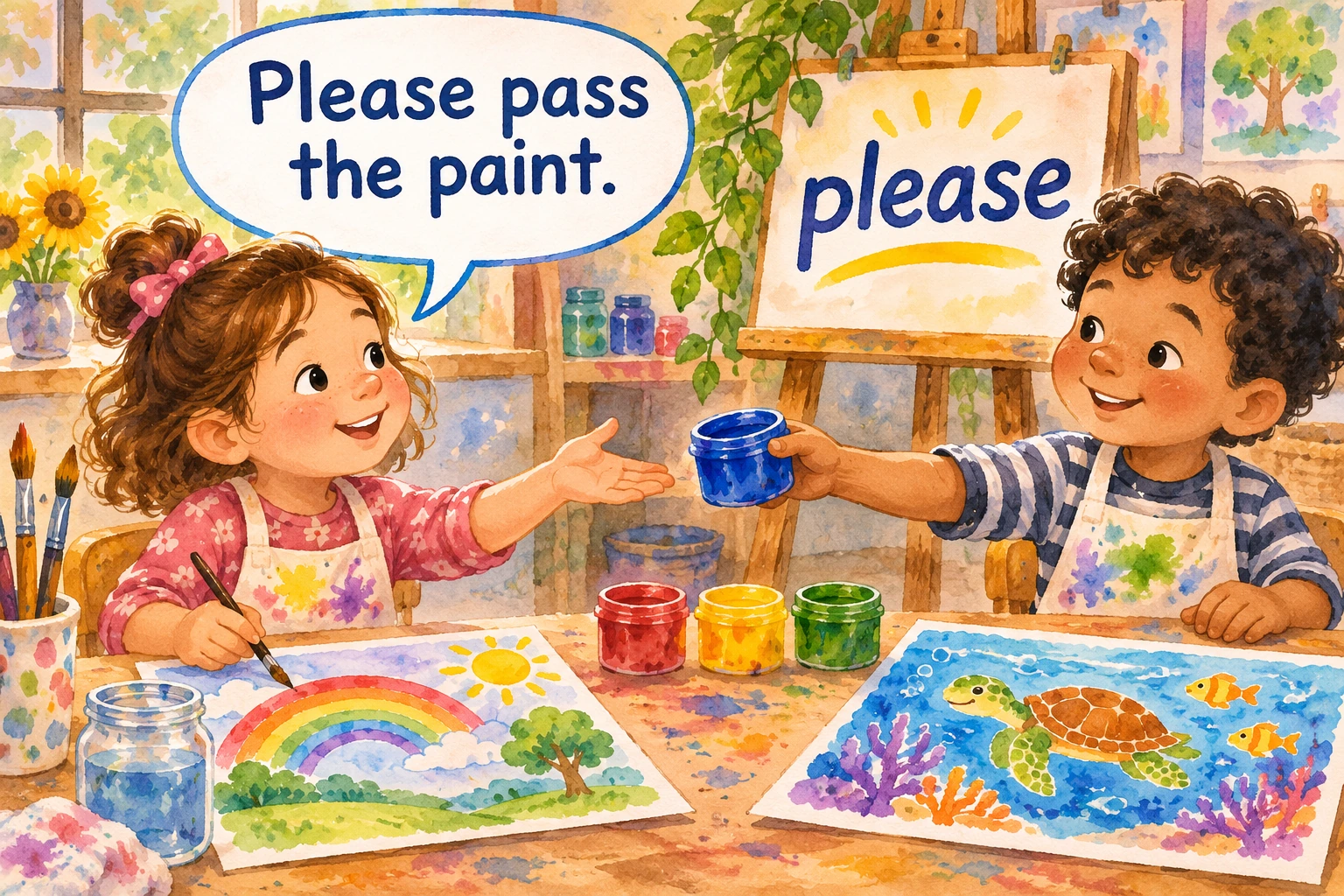
The first source sentence requests that the paint be passed. The second invites someone to paint together. Read both and establish what is being asked. A partner may agree, explain that the pot is still being used or suggest another colour. Please contributes to the social form of the request; it does not remove the other person's turn or right to decline.
Avoid teaching the word only as an adult demand for a particular response. Let Bodhi be both requester and listener, and model acknowledging the meaning before addressing the wording. An urgent or clear communication should not be ignored because a child has not yet mastered a courtesy formula.
The written target has six positions and requires e twice: p-l-e-a-s-e. Those two pieces occupy different places. Say the word naturally, then discuss the spelling at the learner's level rather than adding a separate spoken beat for every letter. The longer sequence may need movable support before independent writing is comfortable.
A home painting exchange with a genuine listener
Set up a pretend art table with two paint-colour pictures or safe play props. Bodhi chooses what to request while the adult models the first source sentence. The listener responds meaningfully rather than handing over the item automatically on cue. Swap roles so the child also hears and considers another person's request.
Read the speech windows after the exchange and locate Please at each beginning. Connect the capital form with the lowercase model, then build the six-letter sequence using the bank. A short trace or an oral new request can follow. Leave time for the chosen creative activity instead of using all the materials time for copying.
Six observations at a shared art table
- Request purpose: Bodhi identifies what the speaker is asking the listener to do.
- Reciprocity: the learner has opportunities to request and to respond.
- Respectful choice: courtesy does not imply an automatic agreement.
- Case connection: capital Please in the source messages belongs with lowercase please.
- Repeated positions: both e pieces remain in the six-letter spelling.
- Written expression: a useful spoken request can be copied, dictated or composed with support.
The please speech windows
Read the first paint together message: “Please pass the paint.” Its please companion says “Please paint with me.” Share the paint together meaning before asking Bodhi to locate please in print. An adult may supply other paint together vocabulary, leaving Bodhi to inspect the please positions. If Bodhi guesses please from the picture, cover that paint together illustration briefly and point back to p-l-e-a-s-e.

Assemble p-l-e-a-s-e on the spelling rail
The please bank presents s, p, n, a, l, e, t, e. Make 6 positions for p-l-e-a-s-e; leave n and t unused. Bodhi selects the please sequence rather than transcribing the paint together display order. Movable please pieces can reduce Bodhi's pencil load during this paint together spelling decision.
Point from please's large model to each p-l-e-a-s-e position. If Bodhi misplaces a please letter, move that piece while the paint together materials remain adjustable. Name p-l-e-a-s-e for the written sequence; read please naturally within its paint together message. Check Bodhi's completed construction, then offer a please pencil copy.

A paint together message using please
The please finish accepts a copied paint together example or a new please sentence. Let Bodhi speak the paint together message before writing please. Check how the listener understands Bodhi's idea. Supply unfamiliar spellings around please if Bodhi needs them. Preserve this paint together thought while helping Bodhi with print. Provide Bodhi with spelling help that preserves please.
Please Sight Word inspection on the paint together map
The paint together search contains nine ovals. Begin at please's large model, then compare each please choice. For please, number the top row 1–3; continue the paint together middle row 4–6, then the please bottom row 7–9. Review these paint together notes after Bodhi's own please attempt; reveal answers when that please comparison needs support.
| Please cell | Choice | Please check |
|---|---|---|
| 1 | like | Bodhi: reject like when searching for please. like has l at position 1; please needs p there. Compare p-l-e-a-s-e before ruling out like on this paint together map. |
| 2 | please | Please is complete at cell 2: p-l-e-a-s-e. Bodhi can compare its final e with please's ending before making this paint together circle. |
| 3 | please | Cell 3 holds another exact please. Let Bodhi inspect please's neighbours too; one successful please find does not decide adjacent paint together choices. |
| 4 | came | Bodhi: reject came when searching for please. came has c at position 1; please needs p there. Compare p-l-e-a-s-e before ruling out came on this paint together map. |
| 5 | please | This p-l-e-a-s-e matches please. Ask Bodhi to show each please position before circling the entry on the paint together map. |
Finish checking the paint together choices
| Please cell | Choice | Please check |
|---|---|---|
| 6 | there | Bodhi: reject there when searching for please. there has t at position 1; please needs p there. Compare p-l-e-a-s-e before ruling out there on this paint together map. |
| 7 | will | Bodhi: reject will when searching for please. will has w at position 1; please needs p there. Compare p-l-e-a-s-e before ruling out will on this paint together map. |
| 8 | please | The fourth matching please occupies cell 8. Its p-l-e-a-s-e agrees with the model; Bodhi can point to every please position before including it. |
| 9 | soon | Bodhi: reject soon when searching for please. soon has s at position 1; please needs p there. Compare p-l-e-a-s-e before ruling out soon on this paint together map. |
Four ovals match please. If Bodhi circles a different quantity, revisit the paint together choices. Compare each selection against p-l-e-a-s-e before adding a please circle. Ask Bodhi to explain a selected please and a rejected paint together candidate. Listen to Bodhi's comparison as well as counting please marks.
A pencil route for the paint together word
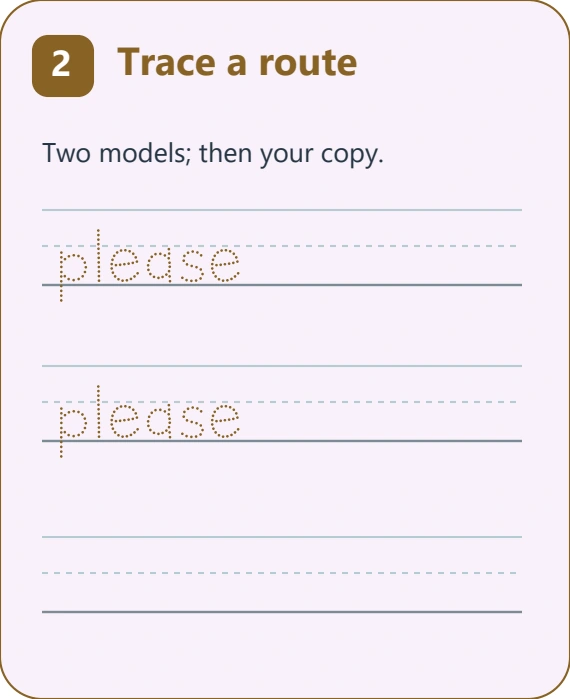
Two dotted please examples sit on separate paint together guides. Follow p-l-e-a-s-e once while Bodhi watches a useful demonstration. The third please band is for an untraced paint together attempt. Choose a quantity of please practice that fits Bodhi's hand control, rather than asking Bodhi to fill the entire paint together sidebar.
Understanding the paint together message and writing please are different questions. Bodhi may explain please correctly while its please letters still need motor support. Dictating please can preserve a paint together idea when independent please writing is tiring. Keep please's model visible for Bodhi; offer formation help on please separately instead of turning paint together sentence practice into repeated correction.
A classroom materials station with two-way language
A teacher can arrange large drawing-tool props for a small group. One learner requests a material, another answers and a third points to please in a completed caption. Change those roles so the word is not experienced only as something adults demand from children. Provide oral models and allow pointing or another clear communication choice when needed.
If Bodhi believes that please guarantees a yes, model a calm, respectful explanation of a wait or alternative. If the request meaning is clear but one e is omitted, compare the six written positions. Those observations need different help. A polished copy is not evidence that the social exchange was understood, and an understandable request does not prove independent spelling mastery.
Five ways to make courteous asking useful
1. Change the requested material
Swap the paint pot for a paper shape or a brush picture and invite a new request. Bodhi can dictate the changed message while an adult records it. The target should transfer beyond one paint illustration, while the listener still has a genuine response to offer.
2. Practise a reasonable waiting answer
A partner is still using the requested prop and explains when it can be shared. Let the child acknowledge the response or choose another option. The play shows that a courteous request belongs to an exchange rather than operating as a magic word that controls another person.
3. Restore two different e places
Build p-l-e-a-s-e with the model visible, then briefly remove one e at a time. Bodhi restores the appropriate position before rereading the word. The two written copies are necessary even though natural pronunciation does not add a syllable for each separate letter.
4. Invite a partner to create together
Use the second source message to invite someone into a shared picture. The invited person can choose a contribution or explain a different plan. Read the completed request afterwards, connecting Please with an invitation as well as a request to pass an object.
5. Send a request to an absent helper
Bodhi dictates a short please message for a puppet arriving later. An adult writes and rereads it, then the helper responds when the scene is ready. The writing has an audience, while unfamiliar surrounding vocabulary remains supported rather than becoming an extra spelling test.
Keep communication welcome while the spelling develops
Supported readers around four to six may manage the art exchange long before independently writing six letters and a complete surrounding sentence. Offer movable construction, a visible model and one manageable pencil attempt. Demonstrate a difficult p or s separately if needed, preserving the child's successful request as a language contribution.
Avoid withholding acknowledgement until please is spoken, expecting agreement from every listener or treating the long spelling as a test of politeness. Revisit through another shared play material after a gap. Notice a concrete decision, such as retaining both e positions or responding thoughtfully to a partner, then leave room for the creative activity the request was meant to support.
Related requests and early-writing routes
The get block-request page offers another practical exchange. Earlier printed words appear in the pre-primer first-twenty lessons, while the prewriting concept practice collection can support hand movements separately. For further family collaboration, explore NAEYC's ideas for family play and PBS Parents' practical learning activities.
Download a shared-painting practice sheet
The page offers the supplied original as its free sample. An eligible active membership provides a clean premium map through the account controls. Its printable page excludes website watermarking, domain names and advertising panels. The related collection separately supplies all twenty-six now-to-please maps for $5.
Inspect one US Letter test for the complete outer frame, both e positions in each dotted model and the two capitalised requests. Keep the selected PDF easy to find for another shared-materials conversation, choosing a useful amount of practice rather than requiring the whole map before anyone can paint.
Related Topics
Popular Worksheets
Printable resources families and teachers are downloading now.
 Free
 Free
 Free
 Free