
Picnic Letter Order: 4 Wonderful Apple Trail Tasks
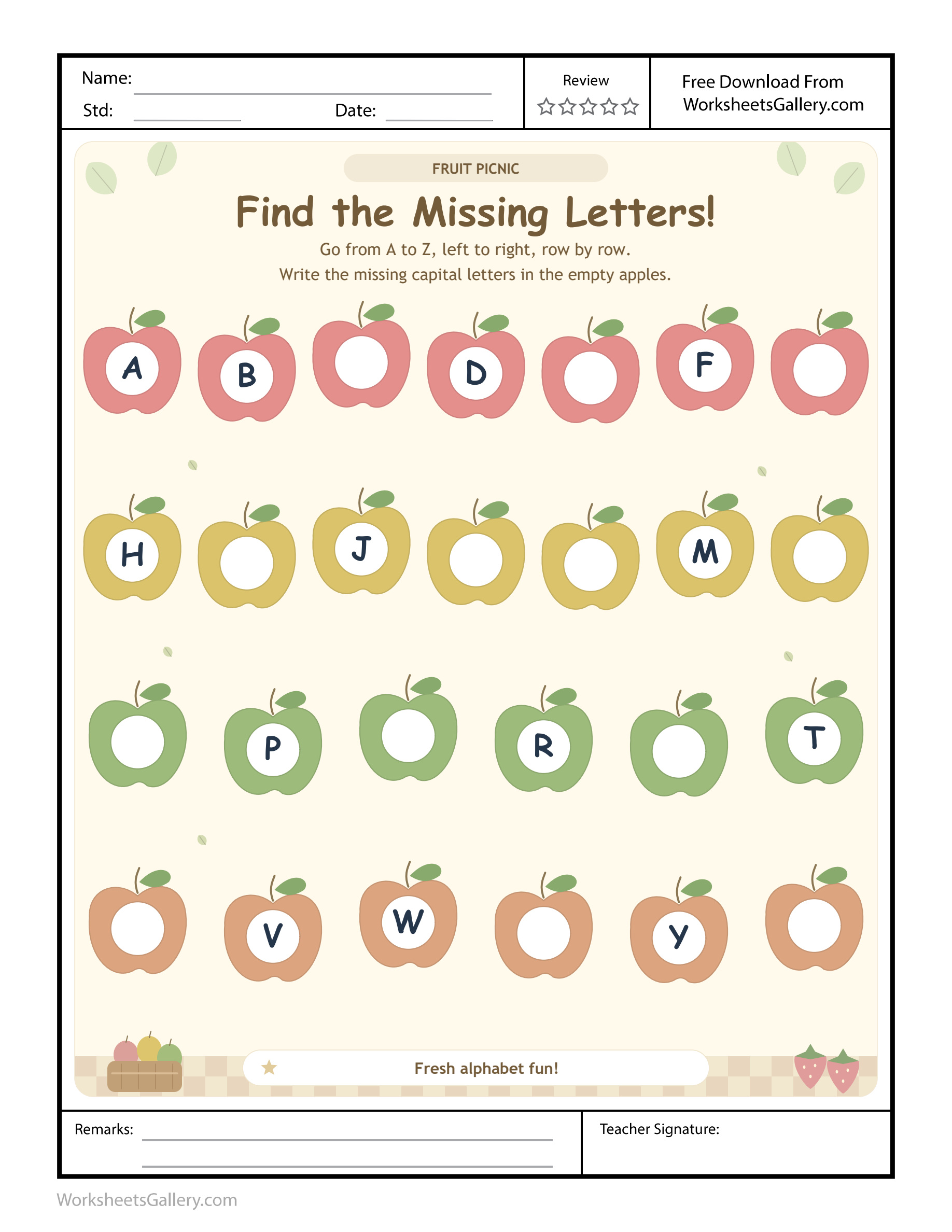
Pass the alphabet along as though each apple carries the next part of a picnic invitation. Picnic Letter Order asks children to complete thirteen missing capitals while moving across four apple-filled rows. A partner can name a letter, point to the next place, or check a printed clue. The route begins with A and B already supplied, giving learners a friendly way into the task. Before anyone writes, agree on where the pointing finger will travel when a row finishes. That small conversation can prevent a surprisingly large alphabet mix-up.
Picnic Letter Order — 🍎 A picnic relay begins with shared attention
Nessa and her father take turns naming the first few apples. He says A, she says B, and then they meet an empty center. Nessa proposes C. Her father points to the printed D beyond it, and they read the short run together. Picnic Letter Order becomes a conversation in which the next visible capital can confirm a choice. Neither partner needs to take over the whole page.
For another family, that same turn could happen on a floor mat with the sheet on a firm board. Picnic Letter Order needs a clear view and a comfortable position more than a special collection of supplies. Keep the paper within reach of both partners, and let the learner decide whether to speak or write on the first turn. A relay can move at a walking pace.
Picnic Letter Order — Read the apples before planning the turns
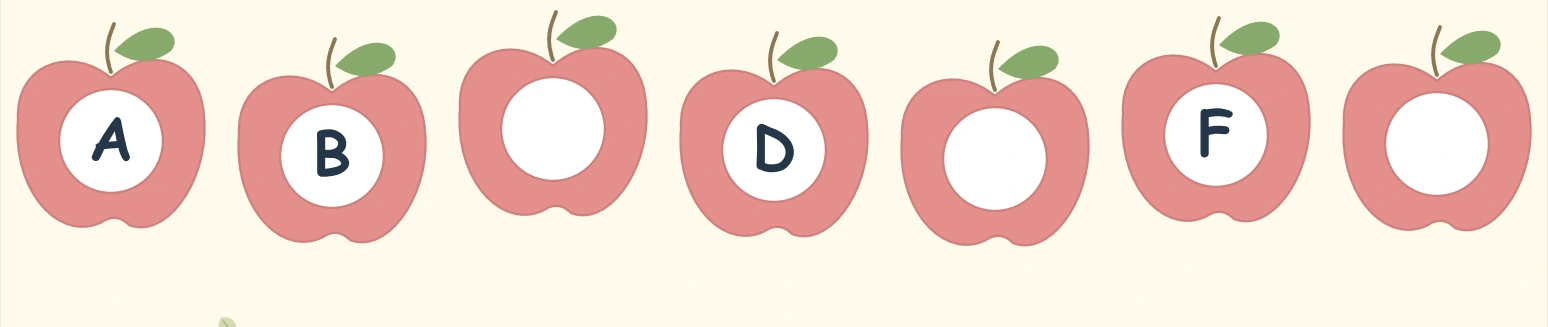
The first seven positions cover A through G. Printed A, B, D and F leave C, E and G to supply. The last apple of this row is empty, so Picnic Letter Order does not always give a printed endpoint on the same line. H, at the beginning of the next row, confirms what comes after G. Invite a fingertip to travel to that H without restarting the alphabet.
Across the entire page, there are thirteen supplied capitals and thirteen gaps. Picnic Letter Order is a sequence-completion activity with apple-shaped writing spaces. The task does not ask children to match fruit names to initial sounds. Nor are the printed capitals dotted tracing models. If the child needs a model for a missing letter, use a separate alphabet reference while keeping its place in the sequence visible.
Picnic Letter Order — Plan a partner round in four small moves
- Find an opening. Start beside a printed capital the learner recognizes.
- Propose a name. Give the child a quiet moment before supplying a clue.
- Check the route. Read forward until the proposal meets a printed anchor.
- Record or place. Write the capital, dictate it, or point to a matching card.
Use those moves for just a few apples on the first Picnic Letter Order round. The adult can model checking aloud: “B, C, D fits what we can see.” Afterward, let the child be the checker for one of your answers. Asking for a reason makes the partner role meaningful instead of merely waiting for a turn with the pencil.
Choose a precise Picnic Letter Order cue
Keep help specific. When Picnic Letter Order reaches a two-gap stretch, an alphabet strip can supply a visible sequence to compare. When the child already knows the name but struggles to form the capital, write a model elsewhere. These supports answer different needs. Offering both automatically may hide which part the learner could manage independently.
Picnic Letter Order at the double opening
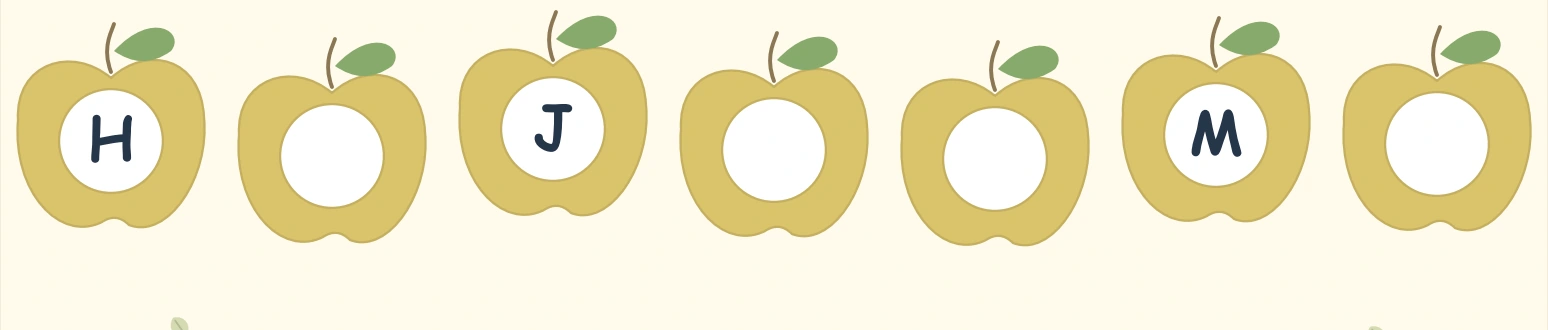
The second apple row runs H–N, with H, J and M printed. I belongs between H and J; K and L occupy the two places between J and M; N finishes the row. In Picnic Letter Order, the K–L pair is a useful shared turn: one partner names K, the other supplies L, then both check that M follows.
Children sometimes treat two empty shapes as one big invitation to write a word. Point to each apple center while saying one letter name. Picnic Letter Order requires one capital in each available position. If the sequence is clear orally, invite a capital card placement before pencil work. The number of letters and the number of writing places should agree.
Five reasons the relay is useful
Picnic Letter Order opens a turn for language
A learner can ask, “Does L go here?” or explain, “M comes next.” Those short exchanges put letter names into purposeful speech. An adult can respond to the idea without demanding a full sentence from a child who is still concentrating on the sequence.
Picnic Letter Order makes checking visible
Moving toward the next printed anchor shows what a check actually involves. The child can test K and L against M rather than relying only on an adult's expression. That habit of comparing a proposal with available information is a practical thinking skill within this task.
Picnic Letter Order supports a controlled hand movement
The apple centers provide boundaries for capitals without requiring tiny writing. One hand can steady the page while the other forms a letter. Notice comfortable grip and effort, and allow a spoken response when maintaining the pencil position is taking all the child's attention.
Picnic Letter Order brings a row return into the game
Partners must pass attention from the end of one row to the beginning of another. Saying G, then touching H at the next left edge, gives the transition a purpose. The child practices following the page's route while continuing the same alphabet sequence.
Picnic Letter Order allows helpful disagreement
Two proposed capitals need not become a contest. Put each suggestion beside the gap and read toward a printed clue. Partners can revise a choice together. The adult models an ordinary correction: a letter did not fit this place, so the team checked and changed it.
Picnic Letter Order — A classroom picnic with quieter roles
At a literacy table, give two children one working sheet and a shared alphabet strip. The first child proposes a letter; the second points to the next supplied capital. On the next gap, switch. Picnic Letter Order can be observed in short turns, so a teacher can hear individual responses instead of hearing one enthusiastic voice supply every answer.
Picnic Letter Order without a spoken performance
A child who prefers less speaking can place a card or point to a capital on the strip. Another can dictate while a partner records. With Picnic Letter Order, identify these roles clearly: selecting a capital is different from copying it. Keep observations private and descriptive, such as “selected L after checking the strip,” rather than announcing which partner needed more assistance.
For a class transition, stop after the H–N row and leave a small paper marker beside the next left edge. When the group returns to Picnic Letter Order, ask what letter the route needs next. The marker saves the location while the child still has to reason about the sequence. Remove it once the starting point is clear.
Picnic Letter Order — The last twelve apples change the rhythm
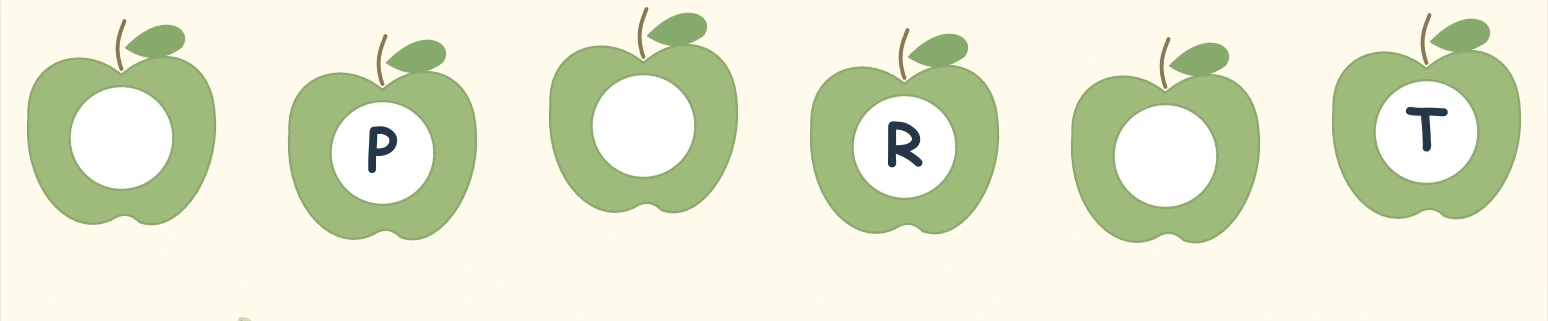
The O–T row has six positions, with P, R and T supplied. O starts it; Q and S fill the interior gaps. Picnic Letter Order therefore invites looking ahead as well as looking back: an empty place before P needs O. A learner does not have to see a printed starting letter to reason about the first apple.
Keep the Picnic Letter Order reference nearby
For an adult checking Picnic Letter Order afterward, the complete missing-letter groups are C E G / I K L N / O Q S / U X Z. Use the grouped reference to locate a difficulty, not to dictate thirteen answers. A useful next question might concern just the transition from N to O.
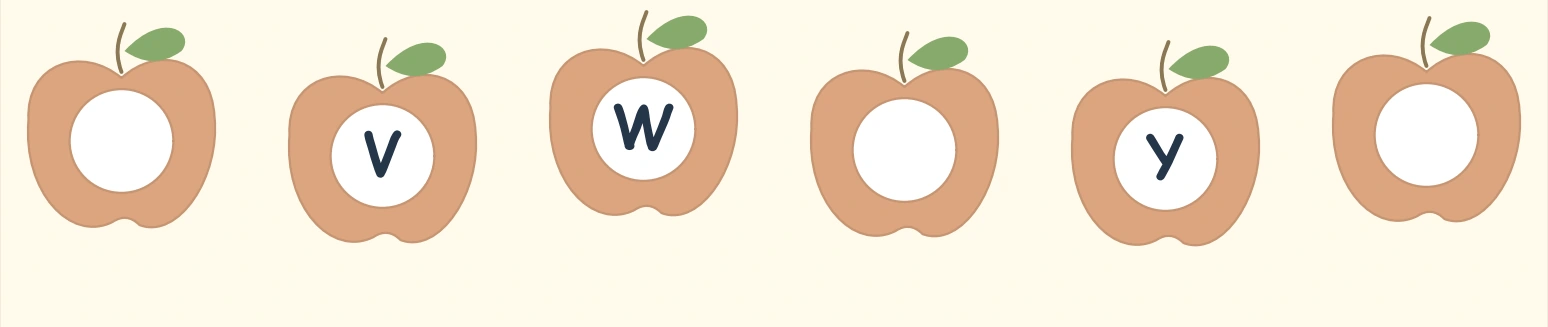
The final row covers U–Z. V, W and Y are already present; U, X and Z are absent. Picnic Letter Order ends with a missing capital, so the child supplies Z rather than copying a visible endpoint. Point to the final apple and ask what closes the alphabet route. Decorations around the activity do not add extra response positions.
| Transition | Partner action | What to notice |
|---|---|---|
| G to H | Pass the pointing turn to the left edge. | The alphabet continues on another row. |
| J to M | Share K and L between two speakers. | Two names fill two apples. |
| N to O | Name the unprinted row starter. | A preceding letter can guide the choice. |
| Y to Z | Supply the last name without a printed finish. | The endpoint is known from the alphabet. |
Four apple-trail tasks for another day
-
1. Picnic Letter Order with a basket pass
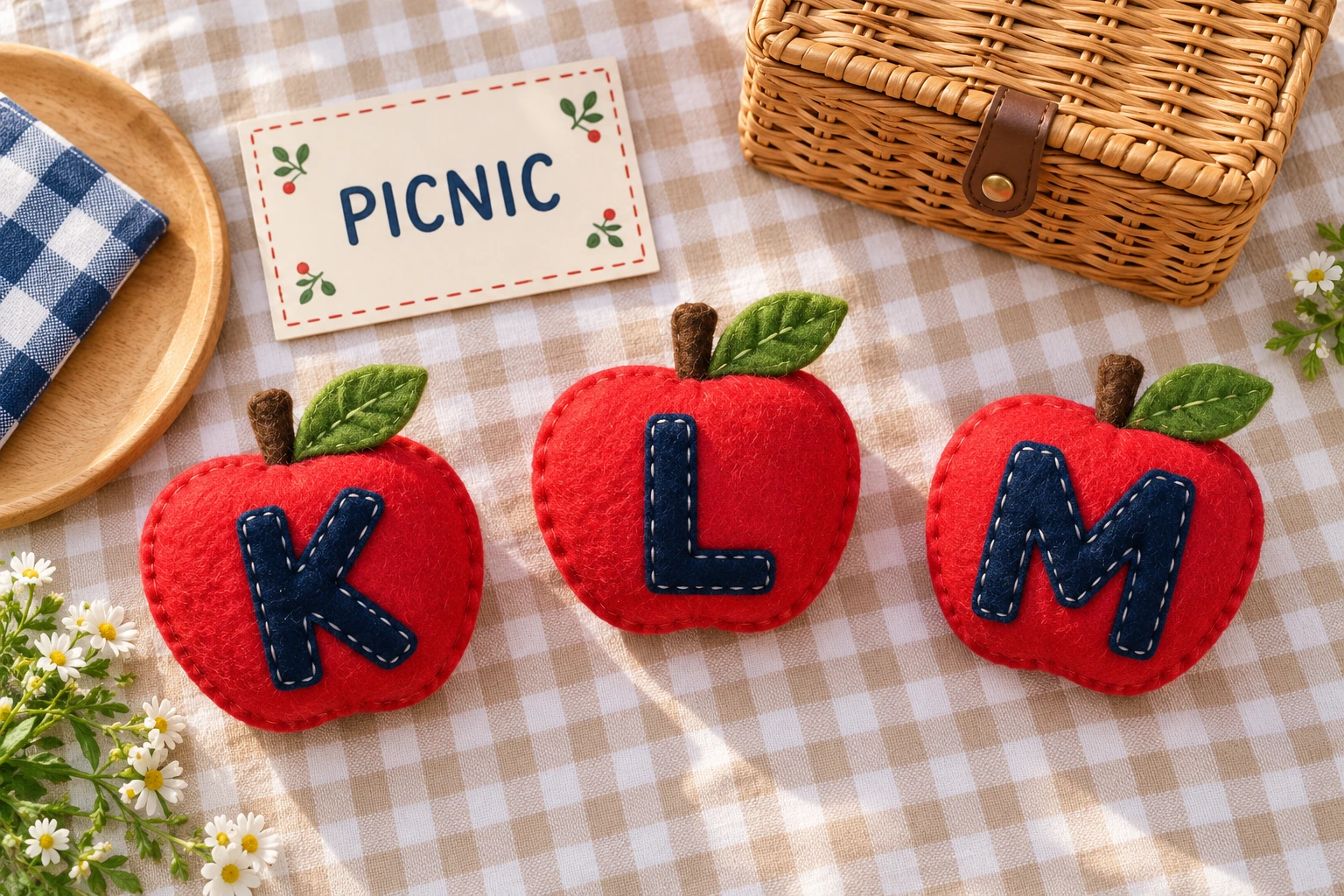
Arrange cards J, K, L and M beside a small basket. Pass the basket once per spoken letter, letting each person name the next card. After two gentle rounds, remove K and L from the arrangement and have the child restore them. Compare the result with the second worksheet row before putting the props away.
-
2. Picnic Letter Order as an invitation chain
Give a pretend picnic guest a capital name, such as G. The learner invites the next guest, H, by choosing its card from a small group. Take turns with other row boundaries. Keep the choices recognizable so that the activity explores sequence instead of becoming a difficult search through every letter card.
-
3. Picnic Letter Order in a two-voice echo
Say a short sequence such as V–W–X. The child repeats it while touching three labeled paper apples, then changes roles and leads you. An adult may make a gentle deliberate error for the child to check. A correct explanation can be a pointing gesture; the learner need not perform a long verbal correction.
-
4. Picnic Letter Order at the closing gate
Make a little picnic entrance with cards W, X, Y and Z. Ask a toy guest to travel through in order, naming each gate. Turn Z face down for one turn, then restore it together. This revisits the missing final capital without asking the child to complete the whole printed page a second time.
Picnic Letter Order — Adjust the help before changing the challenge
Around ages four to six, many learners are ready to explore selected parts of this activity. Alphabet experience matters more than the birthday alone. Picnic Letter Order is suitable when a child recognizes some capitals and enjoys a short guided turn. A younger child can join by pointing while an adult names letters, with no expectation of independent completion.
Repair a Picnic Letter Order misunderstanding
If a learner restarts A at every row, walk the G–H crossing together. If lowercase letters appear, recognize the intended identity before showing the requested capital. If a barred I is called a number, explain its alphabet role beside H and J. Picnic Letter Order provides a context for the correction; there is no need to add an unrelated drill.
Schedule another brief picnic round when the child is rested, perhaps with a different partner. Revisit one uncertain crossing, then allow a familiar success. Picnic Letter Order can become a comfortable shared routine when practice is short and the learner can choose a stopping point. Praise a useful action, such as consulting M, rather than praising speed or comparing partners.
Picnic Letter Order — Find the next tool and save your page
For a separate writing model after Picnic Letter Order, try the capital M tracing resource. A learner interested in the alphabet ending can explore focused Z formation practice. When general pencil travel needs attention, the collection of ten tracing paths changes the activity while keeping hand movement purposeful.
Read more about letter learning through the alphabet-knowledge overview from Reading Rockets. For family writing opportunities, visit NAEYC's home-writing suggestions. These are adult resources to consider alongside the child's responses on Picnic Letter Order, rather than extra assignments to complete before using it.
Download your preferred Picnic Letter Order edition
Choose the original free PDF sample if you want the uploaded edition, including its website branding. The premium Picnic Letter Order edition is a clean, no-watermark printable for eligible active members, with the website name removed and no advertisements added to the worksheet. Sign in to access that Picnic Letter Order edition through the premium controls.
Save your chosen Picnic Letter Order file, select US Letter in the printer settings, and confirm that every apple fits inside the preview. If a printer clips the border, use its page-fit option. Print a single trial before preparing classroom copies. Leave enough table space for two pointing hands: the next letter is easier to discuss when both partners can see its place.
Popular Worksheets
Printable resources families and teachers are downloading now.
 Free
 Free
 Free
 Free