
Kite Alphabet Gaps: 5 Brilliant Capital Letter Games
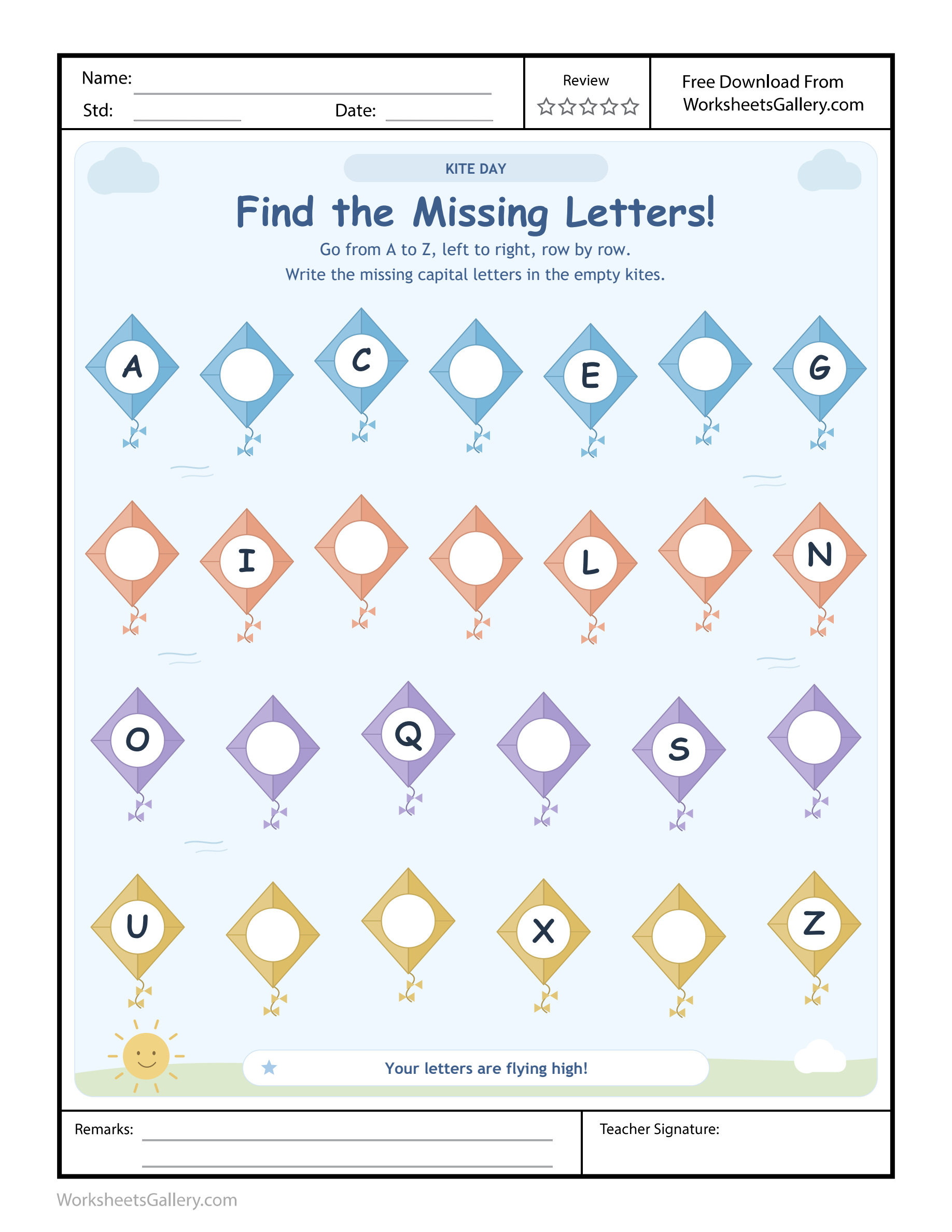
A familiar alphabet song can turn several letter names into one long sound. Kite Alphabet Gaps gives each capital a separate landing place: a kite waiting for its missing label. Children follow the alphabet across four colorful rows, use nearby printed letters as clues, and supply thirteen capitals. Start with speaking and pointing before asking for pencil work. For a child who confidently sings yet hesitates at J or K, the page offers a useful pause. One kite, one name, one written choice makes the sequence easier to discuss together.
🪁 Kite Alphabet Gaps gives the song some breathing room
Listen to the stretch around I, J, K and L. Can the child name each letter while touching a different place? Kite Alphabet Gaps turns that question into something visible. The second row includes I followed by two empty kite centers before L. Those two centers need J and K, separately. A fast chant may hide the distinction; a slow pointing rhythm exposes it without making the child start the alphabet again after every hesitation.
The sheet is about capital recognition and alphabetical sequence. Its pictures provide writing places rather than starting-sound clues. Kite Alphabet Gaps contains no tracing strokes, so demonstrate an unfamiliar capital on scrap paper if necessary. Keep the thinking question clear: which letter belongs at this position? How neatly a child writes that letter is a separate observation.
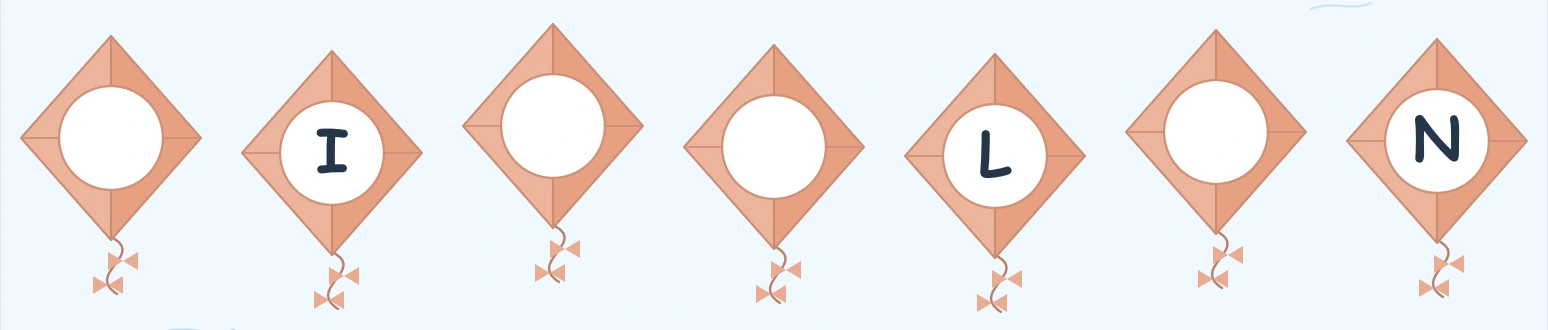
Kite Alphabet Gaps — follow the printed anchors through four rows
There are twenty-six kite positions. The first row runs A–G, the second H–N, the third O–T and the fourth U–Z. Notice the change from seven places to six. Kite Alphabet Gaps continues left to right, then returns to the left edge of the next row. The alphabet does not restart when the paper changes line.
Use this adult reference after the child has had thinking time. The slashes separate rows, not spoken words. On Kite Alphabet Gaps, the missing capitals are B D F / H J K M / P R T / V W Y. Avoid reading the whole answer list aloud before the activity; a nearby printed letter is a more useful clue than a memorized list of responses.
| Part of the route | Printed clues | Useful invitation |
|---|---|---|
| A–G | A, C, E, G | Say the name between two anchors. |
| H–N | I, L, N | Give J and K their own beats. |
| O–T | O, Q, S | Continue after N at the left edge. |
| U–Z | U, X, Z | Check V and W before reaching X. |
Six gains to notice while the pencil rests
Kite Alphabet Gaps: hearing a distinct letter name
Kite Alphabet Gaps invites a child to separate J from K in speech. Tap once per letter, leaving enough silence to hear the next name. This gives an adult a clearer picture of what the child knows than one uninterrupted performance of the song.
Kite Alphabet Gaps: recognizing a capital away from its usual poster
A printed L on Kite Alphabet Gaps may look different from a classroom display. Ask the learner to find L on a separate alphabet strip and compare both shapes. Recognition becomes useful when a child can connect examples across more than one setting.
Kite Alphabet Gaps: holding a short run in mind
For the two places between U and X, a child needs V followed by W. Kite Alphabet Gaps offers a manageable two-letter memory task. Say the little run together, then let the child indicate the first place before dealing with the second.
Kite Alphabet Gaps: moving the eyes with a purpose
Looking from a gap to a printed neighbor is a deliberate visual action. Kite Alphabet Gaps gives a reason to make that movement, while the row endings provide opportunities to practice returning left. Pointing can support the movement without covering the next useful clue.
Kite Alphabet Gaps: planning a capital inside a boundary
Writing in a kite center asks for a modest amount of hand control. On Kite Alphabet Gaps, accept a readable large capital rather than shrinking the response to match the printed type. Choosing a location and holding the paper steady are useful motor observations too.
Kite Alphabet Gaps: explaining a choice to another person
“I put M because L comes before it” reveals more than a finished page alone. Kite Alphabet Gaps gives a shared object for this conversation. Let an explanation be brief, spoken in the child's strongest language, or supported by a gesture toward the neighboring letters.
Kite Alphabet Gaps — a short home session with Rafi
Rafi sings the alphabet while his aunt clears a corner of the kitchen table. At the coral row, his voice runs J and K together. She places two fingers beside the two openings and says the names with a small pause. Rafi touches each opening, then chooses J from a few capital cards. Their Kite Alphabet Gaps session begins with that successful distinction rather than a demand to finish every kite.
At home, lay out the page, a comfortable pencil and an alphabet strip. Invite a finger walk through the first row. Let the child attempt one missing capital orally, check the next printed anchor, then write if ready. For Kite Alphabet Gaps, that order keeps spelling out a letter shape from overwhelming the sequence problem. Offer a short break before moving to another row.
An adult can write a dictated answer or let the learner place a capital card beside the gap. Kite Alphabet Gaps still offers worthwhile recognition practice with this support. Say exactly what the child accomplished: “You separated those two names.” Avoid describing a dictated response as independent handwriting; each kind of success deserves its own clear acknowledgment.
Kite Alphabet Gaps — set up a classroom kite conversation
In a small group, one learner points to an opening and another supplies a possible capital. A third child checks by naming the next printed letter. Rotate those jobs after a short segment. Kite Alphabet Gaps gives the group a common route, but each child should also have a chance to respond without being hurried by a confident partner.
During a classroom observation, cover completed rows with a loose sheet while leaving the current row and its neighbors visible. On Kite Alphabet Gaps, uncover the next left edge together when a row ends. Record whether the child needed a spoken cue, a capital card or a written model. That note is more informative than a single tick beside “alphabet complete.”
- Seat partners where both can see the same printed anchors.
- Use a separate alphabet strip as an available reference.
- Allow speaking, selecting or writing as distinct response options.
- Finish the shared turn before introducing another activity.
- Keep a child's current row available for a later return.
Five kite-club games beyond the paper
-
1. Give the kite crew three voices
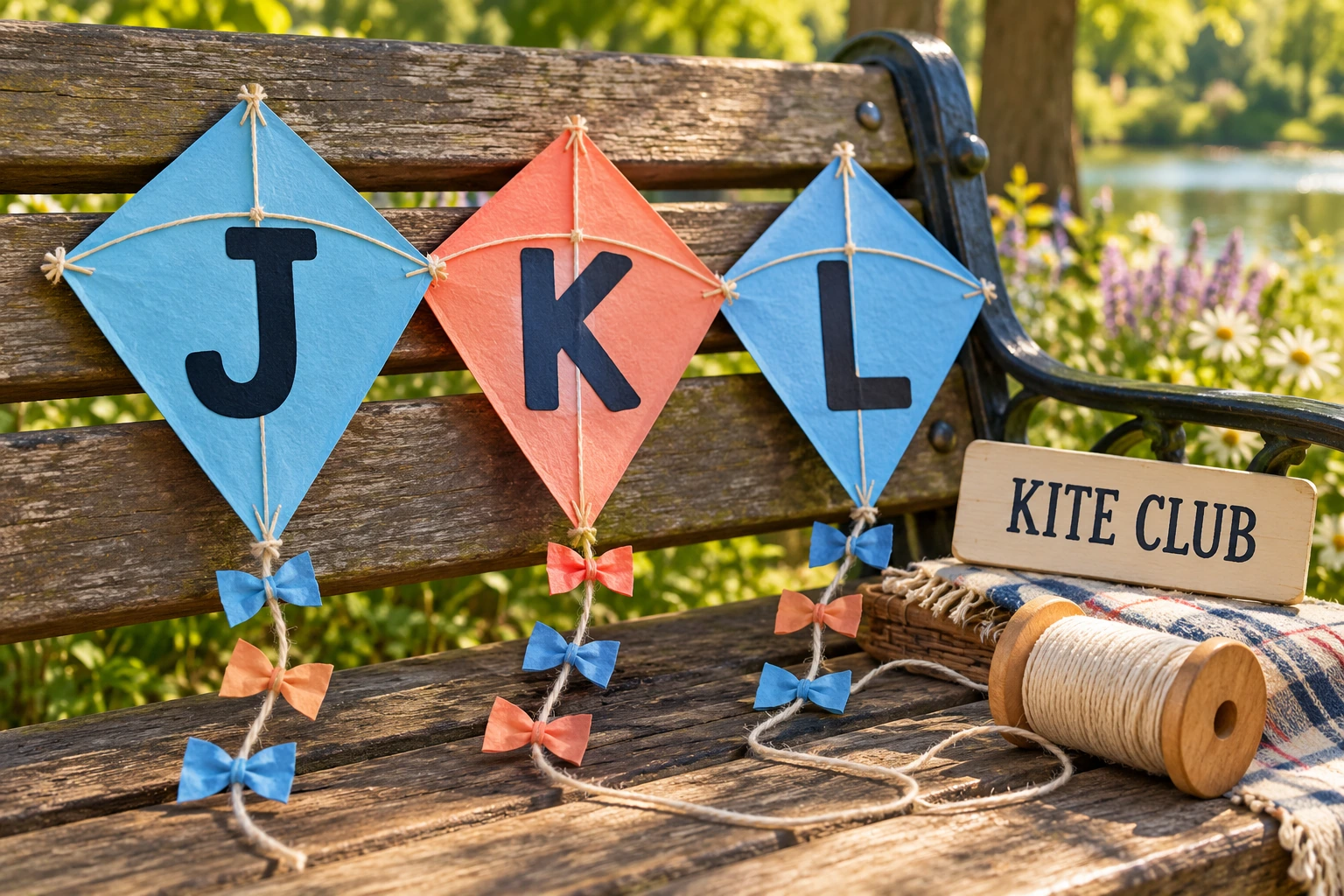
Make paper labels J, K and L. Three people each say one name when their label is touched; two people can share the roles. Bring the separate rhythm back to Kite Alphabet Gaps and ask which two names belong before its printed L. Keep the tempo slow enough for each voice to finish.
-
2. Walk a little string route
Lay a short piece of string on a table beside cards U, V, W and X. Trace the string with a finger while moving through the cards. Kite Alphabet Gaps can then stay beside the route as the learner transfers V and W to their places. No running or long string is needed.
-
3. Deliver the missing kite tag
Offer B, D and F cards with A, C, E and G already arranged. Ask the child to deliver one card at a time between the correct anchors. Return to the first row of Kite Alphabet Gaps only after the learner has tested a choice. This makes the card task preparation rather than a competing worksheet.
-
4. Whisper a landing report
One partner whispers “after L,” and the other finds or says M. Reverse the roles using a different printed anchor. With Kite Alphabet Gaps nearby, the child can verify the report visually. Skip any direction that depends on an unfamiliar letter until the partner has a useful reference.
-
5. Remember the kite at the fold
Arrange O, P and Q on three folded paper stands. Look together, turn P away, and ask which name disappeared. Restore it before checking the lower section of Kite Alphabet Gaps. The purpose is recalling one letter in a short sequence, so resist adding many hidden cards at once.
Kite Alphabet Gaps — lower rows deserve their own look
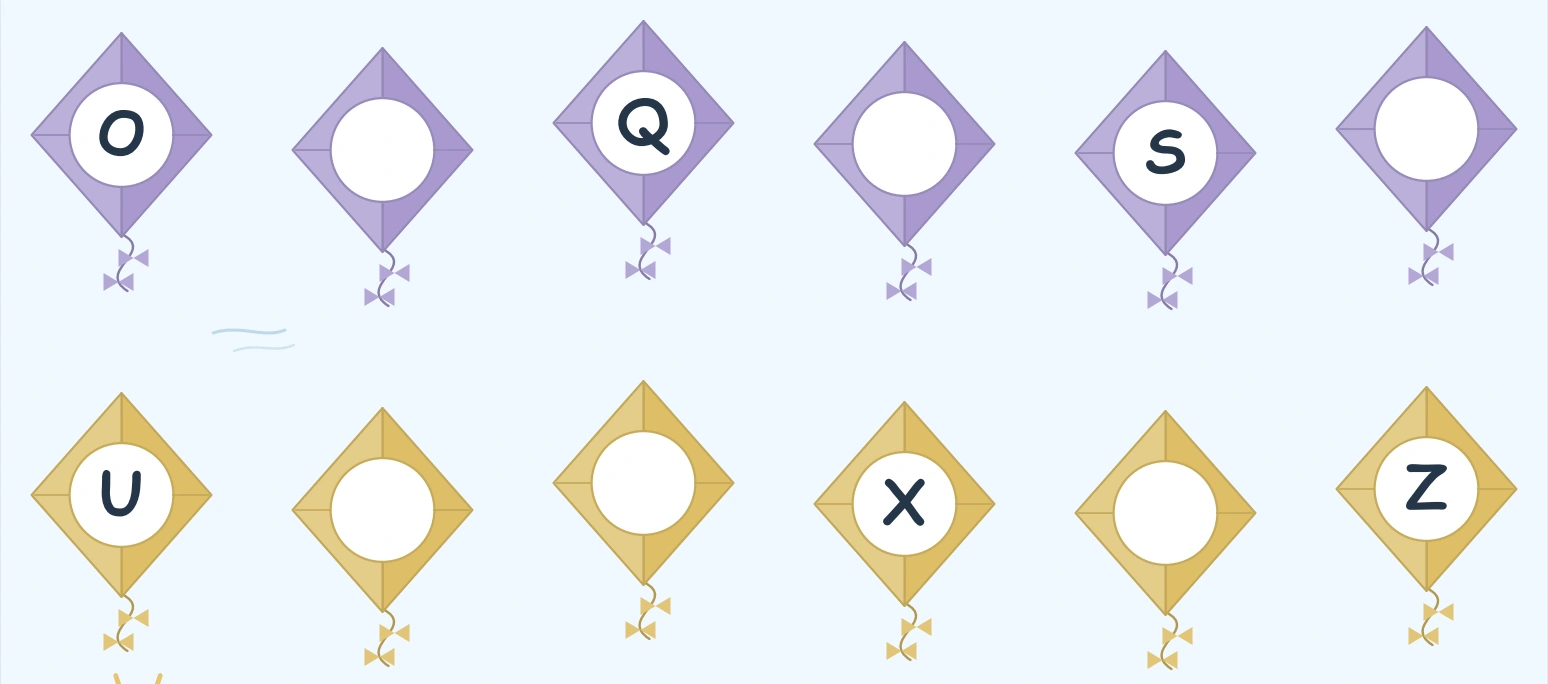
After N, the next row begins with O already printed. Kite Alphabet Gaps therefore offers a reassuring anchor at that transition. Ask the child to name O and move onward to P instead of restarting from A. The six-place row ends at T; the next begins with U. Trace that return with a fingertip before making another mark.
A learner might add a seventh imaginary place because the upper rows had seven. Point out the actual kite centers on Kite Alphabet Gaps rather than inventing an extra response area. Decorative bows and tails do not count as letter positions. If O is called zero, name the alphabet context and compare it with a separate number card without turning the whole session into a number lesson.
Kite Alphabet Gaps — readiness, repairs and a comfortable stopping place
Most children exploring this page will be around four to six, with very different alphabet experience. Kite Alphabet Gaps suits a learner who recognizes some capitals and can follow a short oral sequence. A younger interested child can point while an adult supplies names. An older learner may use selected sections for a focused review without needing the page described as a test.
If a child writes lowercase j in the J position, first acknowledge the correct letter identity. Then show the capital requested by Kite Alphabet Gaps. If J and K are exchanged, speak I–J–K–L while touching the corresponding places. If writing becomes tiring, stop at the end of the current small run. Repeated erasing is rarely a useful way to clarify a letter name.
Return briefly on another day to one previously uncertain pair. Kite Alphabet Gaps need not become a daily race through all twenty-six positions. Let the child choose which completed kite to explain to someone else, then offer a new pair only when that feels manageable. Praise the strategy of pausing and checking; it remains useful even when an answer needs revision.
Continue from a specific next need
When choosing J and K is easier than writing them, use the separate K tracing activity for a formation model. For an earlier capital, the Letter A practice page offers a different task. If pencil paths are the main difficulty after Kite Alphabet Gaps, consider five introductory line paths instead of adding more alphabet gaps.
Adults wanting broader background can explore Reading Rockets on alphabet knowledge or NAEYC's ideas for supporting writing at home. Use those resources alongside observations from Kite Alphabet Gaps. A child who can explain a letter order but needs writing assistance has given you a useful starting point for the next activity.
Choose your printable kite edition
The free sample preserves the original uploaded worksheet and its printed website branding. Eligible active members can choose the clean premium PDF of Kite Alphabet Gaps, with the website name and watermark branding removed. Both are one-page printable editions. The clean worksheet contains no added advertisements; website controls and membership information remain separate from the PDF page.
- Select the free sample or the premium edition in the download controls.
- For the clean edition, sign in with an eligible active membership.
- Open the saved Kite Alphabet Gaps PDF and examine the printing dialog.
- Match the paper setting to US Letter, checking that the page border remains visible.
- Keep an unmarked copy available for a later short session.
Before printing Kite Alphabet Gaps for a group, check one sheet for legible capitals and complete kite outlines. The complete featured preview shows the whole worksheet, while the closer images above explain particular sections. Begin with one useful letter distinction, and let the next row wait until the child has room to think.
Popular Worksheets
Printable resources families and teachers are downloading now.
 Free
 Free
 Free
 Free