
Letter A: 6 Powerful Checks for Joyful Aa Practice
⌕ Look closely • Explain a choice • Try a mark
Something is missing before pple, and your child gets to investigate. This Letter A printable brings together two forms of a familiar letter, guided pencil routes, and a picture clue with a useful job to do. Instead of racing through the rows, invite your learner to explain a choice: which shape belongs in the gap, and how could we check? The suggestions below turn Letter A practice into a conversation about noticing, remembering, and trying, with room for a child to change an answer without feeling that the whole page has gone wrong.
Let the Letter A word gap start a conversation
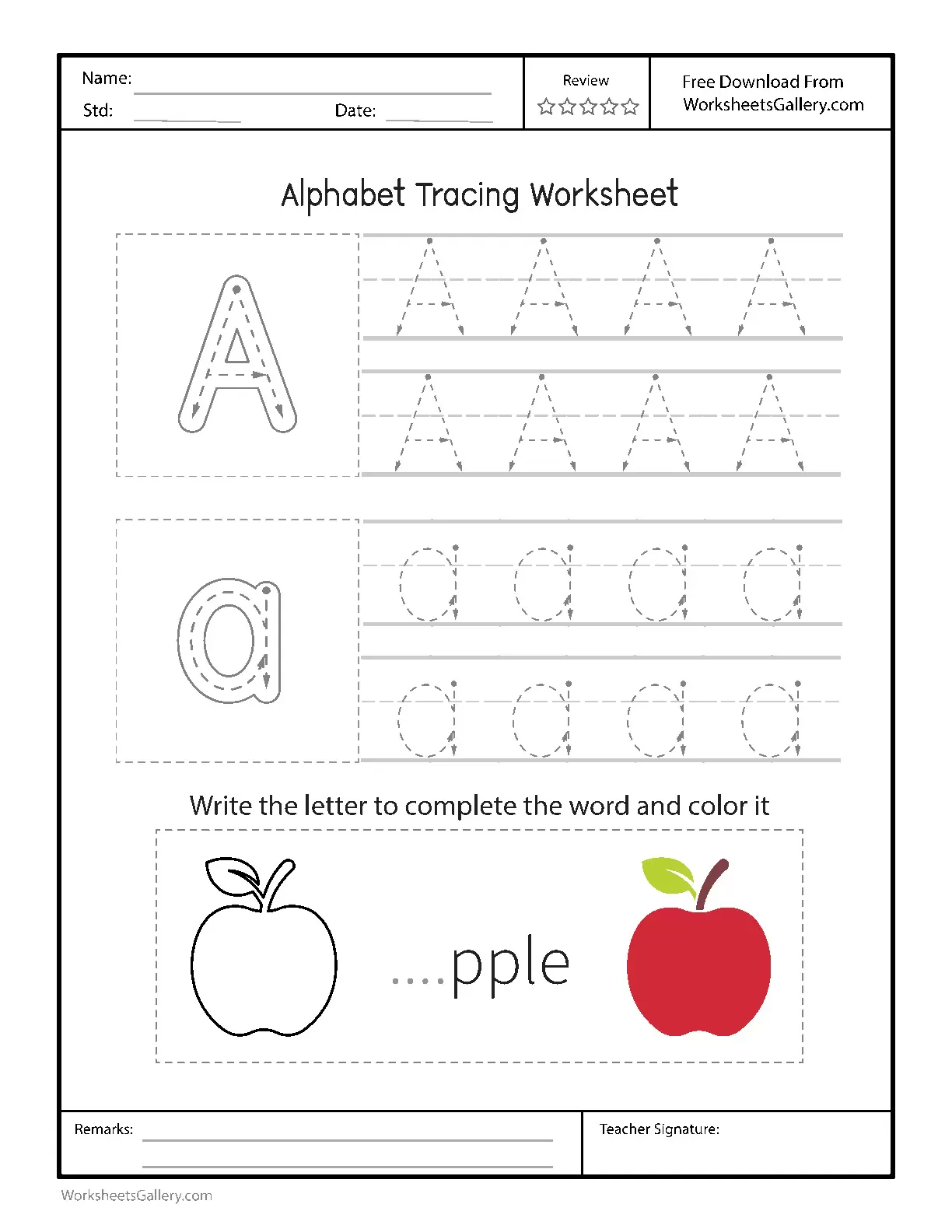
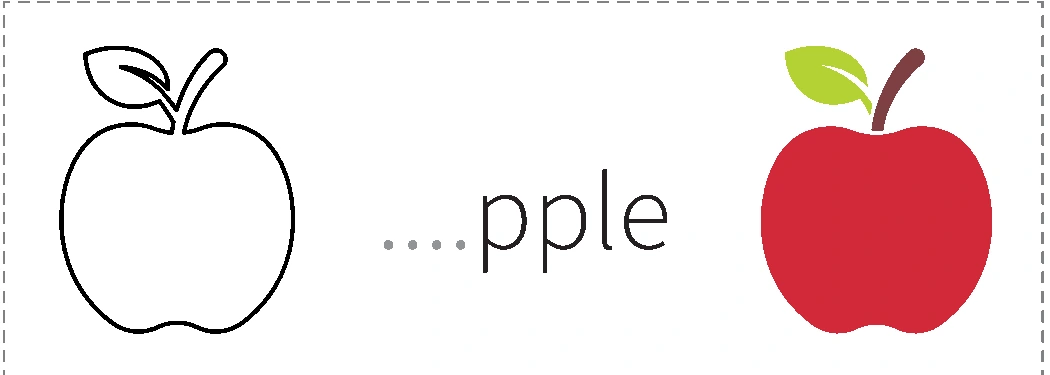
Look near the bottom of the sheet together. An apple outline appears beside an incomplete word, with a colored apple farther across. Say apple without stretching every sound. Then ask what the picture tells us and what the empty beginning might need. The aim is a small connection between spoken language and Letter A, not independent reading of the entire word.
The expected completion is lowercase a, making apple. Children can point to their choice before attempting to write it. If a learner offers capital A, acknowledge the correct letter identity and show how the surrounding lowercase letters suggest the smaller form. This Letter A conversation separates knowing an answer from having the hand control to record it.
Same identity, visibly different construction
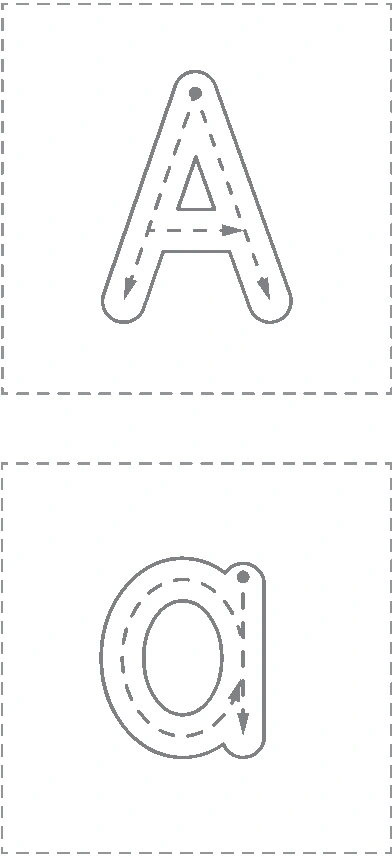
At the top of the practice area, capital A has two sloping sides and a crosspiece. Lowercase a, shown underneath, uses a rounded body and a short stem on the right. Both represent Letter A. Their appearance and movements differ, so one explanation will not cover both forms.
The printed lowercase model is the single-storey a often used in early handwriting. A storybook may show a different, double-storey version. If your child notices that difference, treat it as an observation worth discussing. Point back to the exact Letter A form being practiced here; recognizing another printed style does not require copying it during this session.
Two guided rows accompany each case, with four repeated forms in each row. The large examples have starting dots and arrows. Use them to demonstrate the printed route, following your setting's handwriting guidance consistently. Letter A practice can include looking between the large model and a smaller attempt, rather than keeping the pencil moving continuously.
A Letter A invitation for preschool and early kindergarten
Most learners exploring this Letter A sheet will be around three to five, with adult support adjusted to their experience. A three-year-old might name the picture and follow a large form using a finger. An older preschooler may trace selected examples and complete the word. Some kindergarten children will value a brief review of the difference between the two cases.
Watch for comfortable mark-making and interest in imitation before expecting repeated pencil work. If rounded movements are the main obstacle, revisit a few basic handwriting paths on another occasion. The page provides an opportunity to explore Letter A; it should not become an age-based pass-or-fail test.
A practical route through the Letter A investigation
- Let the eyes go first. Place the sheet squarely on the table and ask your child to find both Letter A forms. Cover unused areas loosely with spare paper if the whole page feels busy. Leave the current model visible.
- Show one movement, then hand over. Point out the starting mark and demonstrate the route beside the worksheet on scrap paper. Invite your child to finger-follow, then trace a few examples. Discuss capital and lowercase Letter A separately.
- Use the picture as a reason to write. Return to the apple, say its name, and invite the lowercase completion. Provide a nearby model if needed. Writing the missing Letter A can be a supported application, rather than a memory quiz.
- Finish with an explanation or some color. Ask what your child checked, then offer the apple outline for coloring. A learner may choose the printed red example or invent another apple color. Tracing every available form is optional.
At home, keep the demonstration close enough to see without reaching across the child. In a group, show the large Letter A example where everyone can see it before distributing pencils. Adults can write the name and date when those extra demands would distract from the letter activity.
Five kinds of thinking behind a Letter A mark
There is more to observe than whether a line follows the dots precisely. Letter A work combines decisions, movements, and language in ways that can be discussed without grading a young child's handwriting.
- Classifying by identity: grouping capital A with lowercase a asks a child to recognize Letter A despite a major change in shape.
- Planning and monitoring movement: looking at an arrow, beginning a stroke, and checking where it goes offers purposeful motor practice.
- Coordinating visual attention: moving the gaze from a large example to a smaller Letter A supports comparison between a model and an action.
- Linking speech with print: naming the apple and selecting its first letter connects a spoken beginning with a written symbol.
- Explaining a decision: saying why lowercase a belongs in the gap makes Letter A knowledge available to a listening adult, even when writing is still difficult.
The pencil tasks involve hand control and coordination; the comparison tasks involve memory and visual discrimination. Naming, listening, and explaining add language practice. These are opportunities for development across repeated experiences, not guaranteed results from one sheet.
At home, a visitor asks for an explanation
Nila finishes the apple gap and wants to show her grandfather. Before he arrives, an adult asks what she would tell him about Letter A. She points to the capital first, then hesitates over the curved form. They rehearse a short explanation: “These look different, but they belong together.” She chooses one example of each to show.
The adult does not insist on more rows before the visit. Instead, Nila's Letter A explanation becomes a reason to look again. When her grandfather asks about the empty beginning, she can describe her choice and show the lowercase Letter A she used. A real listener gives the marks an audience without turning the page into a performance test.
In class, the alphabet display needs a curator
A teacher puts a blank display card beside the tracing sheets and invites children to help explain the day's letter. One child points to Letter A on the worksheet, another describes the round lowercase part, and a third supplies an apple drawing. The teacher writes down the children's comments while they select a small amount of tracing.
A learner who recognizes Letter A but avoids pencils can contribute by pointing and speaking. A confident writer can supply the missing lowercase beginning independently. Keep those contributions separate in your notes: recognized both cases and traced with support describe different achievements. The shared Letter A display makes room for both.
Six Letter A checks to use as conversation prompts
Choose a single check when something feels uncertain. These prompts invite a learner to inspect evidence already on the Letter A page; they are not six extra exercises to complete after tracing.
| Check | What to ask or show |
|---|---|
| 1. Identity | Can you find two different shapes for Letter A? Point to the large examples together. |
| 2. Beginning | Where is the starting dot? Watch one demonstration before trying a fresh example. |
| 3. Shape | Does this Letter A need slants or a rounded part? Return to the matching case. |
| 4. Position | Which guides surround the form? Compare the printed top and bottom boundaries. |
| 5. Word choice | Which Letter A fits beside pple? Look at the other letters before writing. |
| 6. Explanation | What made you choose that form? Allow pointing, a short answer, or an adult-supported description. |
Four ways to take Letter A off the paper
Arrange a tiny letter exhibit
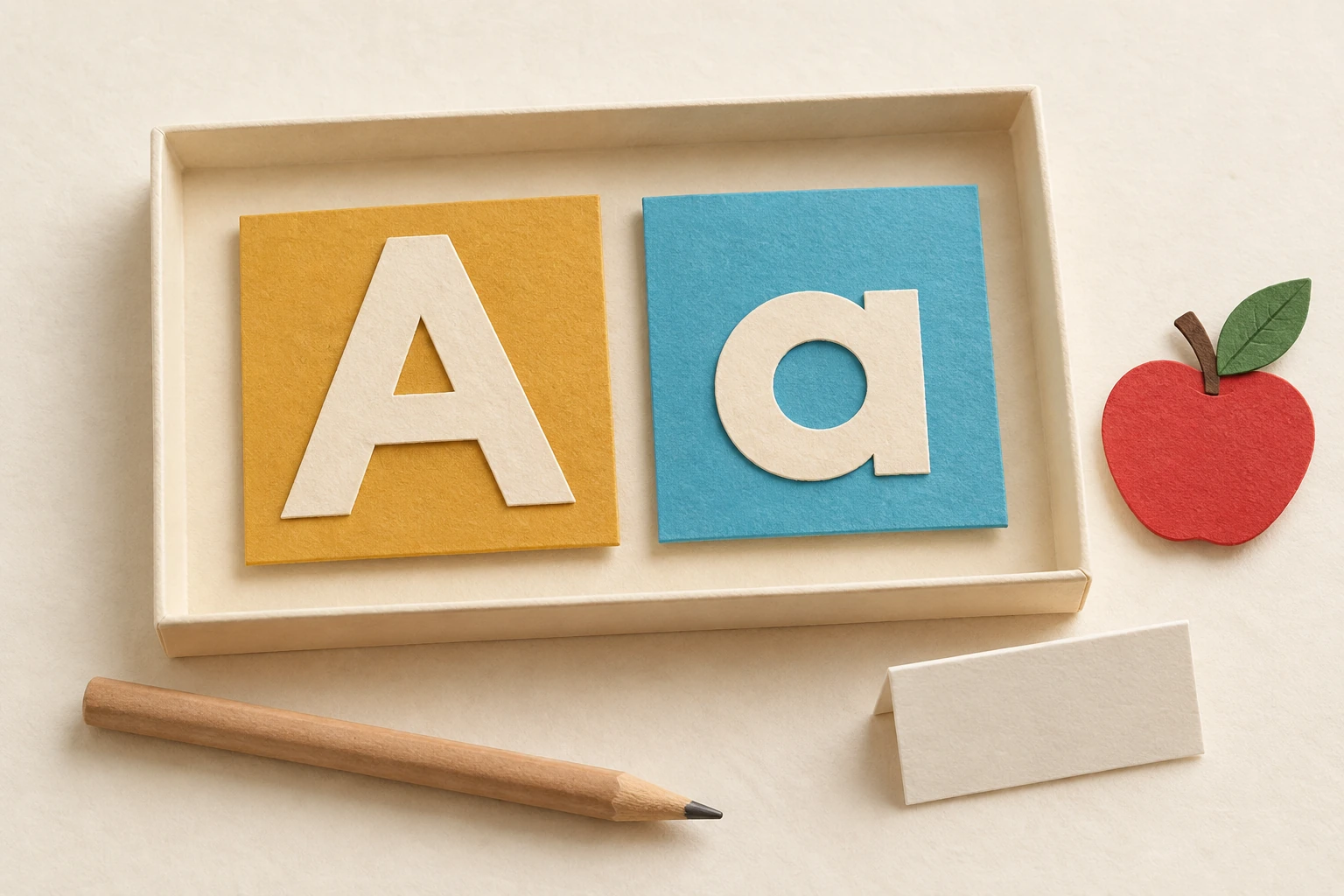
On separate cards, an adult writes capital and lowercase Letter A in the same forms as the worksheet. Place them in a shallow tray with an apple picture. Your child becomes the curator, arranging the objects and dictating a short label. Ask what belongs together and why. The display is an optional activity using separate materials.
Make a case-change window
Fold scrap paper around a card so one form is visible at a time. Slide it to reveal the other Letter A and ask what changed. Let your child control the reveal. Keep the letter identity constant while the visible shape changes.
Compare openings in a shared book
During ordinary story time, an adult can point out an A at the start of a name and an a inside another word. Ask whether either resembles the worksheet's Letter A. Explain unfamiliar print styles briefly; a book search should remain a shared reading moment.
Deliver a spoken clue
Invite your child to describe the apple without naming it while an adult guesses. After the answer, return to its first letter. For a later listening session, try comparing short vowel beginnings without combining every new sound with immediate handwriting.
Leave room for a change of mind
Common Letter A snags include using a capital in the word gap, circling without adding the lowercase stem, and treating the arrows as decoration. Respond to the particular snag. Pointing out one feature of Letter A is easier to use than asking for the entire page to be “better.”
If your child notices an error, say what the new observation offers: “Now you have another clue.” Allow a fresh attempt nearby. Heavy erasing and repeated restarts can hide the original learning question beneath concern about a clean page.
Keep a small appointment with Aa
Return to Letter A for a few purposeful attempts at a predictable time, perhaps before choosing a bedtime book. Agree on a small task in advance and finish when it is done. Familiarity can grow without requiring a fresh full sheet every day.
Let your child choose the next focus: identifying both cases, following one model, or explaining the apple gap. When another letter is welcome, V's contrasting sloping shape offers a separate comparison rather than a longer assignment.
Choose a PDF, then check the paper preview
This Letter A resource contains one portrait US Letter page, 8.5 by 11 inches. It includes both tracing cases, the apple word gap, the coloring outline, and the printed learner-information areas. The featured JPG shows the complete worksheet without cropping.
- Select the free sample if the original website-branded sheet meets your needs. For the clean Letter A edition, sign in with an active eligible membership and use the premium download option.
- Save the PDF locally and open the print preview. Choose US Letter paper; for A4, use a fitting option and confirm that the outside border remains visible.
- Print a single copy to check the light tracing marks before preparing a class set. Use the actual Letter A PDF for printing rather than a cropped content image.
The premium PDF has no watermark, no website-name or domain branding, and no ads inside the file. Its learning content is retained. The clean download is supplied through the site's membership controls, while the free sample keeps the original credits.
Before putting the page away, ask for one discovery about Letter A. A child who can point out a difference, choose a form, or explain a clue has something concrete to bring to the next visit.
Popular Worksheets
Printable resources families and teachers are downloading now.
 Free
Free
 Free
Free
 Free
Free
 Free
Free