
Find Letter D: 6 Remarkable Reasons to Feel Ready
🔎 A closer look at position
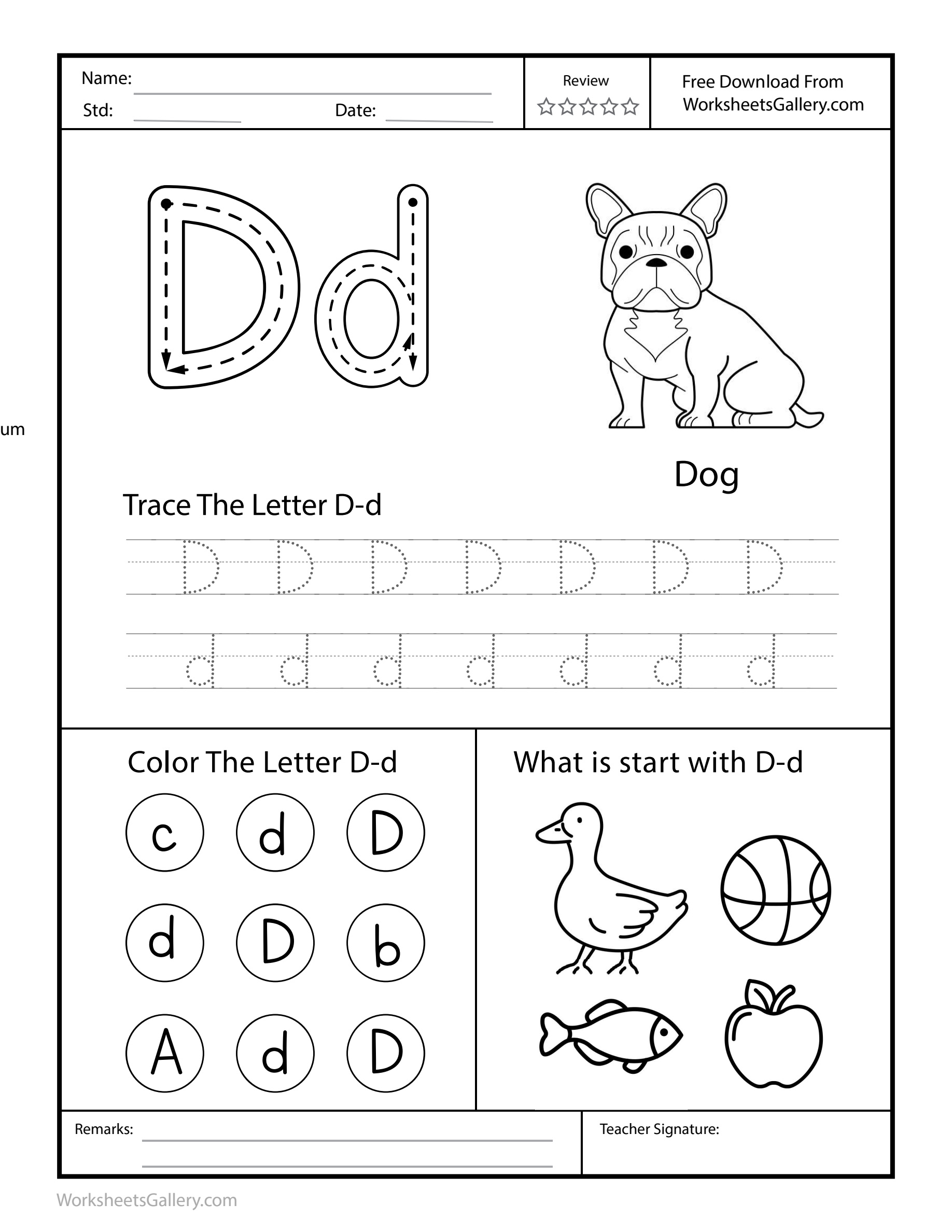
The tall line changes sides, but the letter keeps its name. That small surprise makes D and d an interesting pair to explore together. This Letter D printable gives children large guided models, shorter tracing rows, a mixed-letter search, and a duck to identify by its spoken beginning. The dog above supplies a familiar starting word. Instead of asking for a page of perfect marks, invite the learner to explain one useful detail: where does the tall stroke sit? A clear observation can give the next pencil attempt a purpose.
Know what this Letter D page is asking
The upper area introduces capital D, lowercase d, and an outlined dog labeled Dog. Underneath, Letter D tracing is arranged in two ruled strips: seven dotted capitals, then seven dotted lowercase forms. The bottom half changes the job. One panel asks children to color matching letters; the other presents duck, ball, fish, and apple as beginning-sound choices.
For Letter D recognition, there are six correct circles among nine entries. For the sound choice, duck is the intended answer. These activities can be attempted separately. A child who enjoys naming animals may start with the pictures, while another may prefer a large finger trace. Keep the original sheet upright so the position comparisons stay meaningful.
Plan supported use around ages three to six, adjusting the amount of writing to the learner rather than the birthday. A preschooler exploring Letter D may point to a target and follow one model with a finger. A kindergarten learner might trace selected examples and explain why lowercase b does not belong in the search.
Letter D changes more than its height
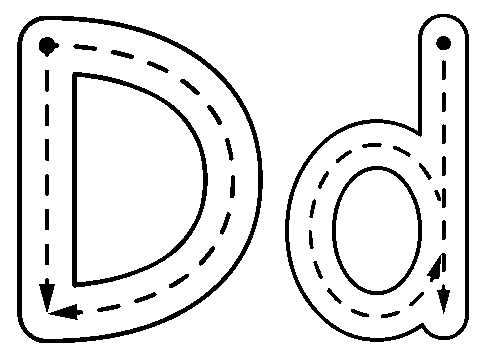
On capital Letter D, the tall straight stroke stands on the left and a broad curve reaches around to its right. The lowercase Letter D has a rounded lower body on the left of its tall stroke. It is not simply a smaller capital. Point out the difference with a finger while saying each letter's name, then let the child locate the tall part without another explanation.
The lowercase b distractor makes this Letter D search especially useful. Both d and b have a tall part and a rounded lower part, but their arrangements differ. Compare the actual printed forms side by side. Ask, “Which side has the round part on our d?” Keep the model available; this is a chance to learn from a reference, not a memory challenge.
For pencil movement, follow the large Letter D routes and the handwriting guidance used in your setting. A description of the parts does not replace a movement demonstration. Watch where the pencil goes, including how it joins the curve and straight stroke, instead of judging only the finished outline.
Six reasons Letter D practice can feel manageable
Letter D work becomes more informative when you notice a particular action. These six gains are opportunities for practice, with something concrete an adult can observe. They do not require every tracing space to be filled.
① A reference can answer a question
Looking back at the large Letter D model gives the learner a way to check independently. Using a reference is a useful working habit, even when the answer still needs adult discussion.
② Position becomes worth noticing
Comparing the curved body and tall stroke of Letter D encourages close visual inspection. The child has a reason to notice where a feature sits, rather than accepting every roughly similar shape.
③ A hand can follow a planned route
The dotted Letter D examples offer a visible path for the pencil. Eyes can look ahead as the hand moves, while the other hand holds the page in place.
④ A search can follow a system
Checking one circle at a time gives attention a repeatable job. Letter D matching invites the learner to keep a target in mind and leave unrelated entries alone.
⑤ A picture can lead to a spoken connection
Dog and duck begin with /d/. Naming those animals connects Letter D with a meaningful sound example, rather than asking children to match pictures by their appearance.
⑥ An explanation can guide the adult
“The round part is here” tells you how the child is comparing Letter D. A pointing gesture can supply the same information when a full spoken explanation is not yet comfortable.
Across these tasks, cognitive work includes holding a rule, comparing arrangements, and changing from visual matching to listening. Motor practice involves controlled direction changes and steady paper support. Language grows through naming and describing: dog, duck, tall, round, left, right. Explain position words through pointing at the actual page; do not make vocabulary recall another obstacle.
At home, a Letter D ticket for the toy dog
Priya is taking her toy dog, Daisy, on a pretend walk. Her adult offers a scrap-paper ticket and says Daisy's name aloud, emphasizing its brief beginning sound. Priya chooses one capital Letter D from the worksheet to trace before decorating the ticket. The purpose is small and believable: a mark that belongs to her game.
Afterward, the adult points to lowercase d and explains that it is another version of Letter D. Priya finds one in the circle panel, checks it against the large model, and returns to her pretend walk. The worksheet has supported a conversation and a controlled attempt without taking over the whole play session.
Nothing requires a child to read the name Daisy or write a complete ticket independently. The adult can supply the surrounding words. The Letter D task remains clear: inspect one form, try a guided movement, and recognize its partner. A short piece of purposeful play can make the page easier to revisit later.
A practical route through the Letter D sheet
- Talk before tracing. Put out a pencil and one crayon, then point to the dog. Say the name and identify Letter D together. Explore the two large models with a finger, noticing the tall stroke in each. Write the learner's name for them if that would otherwise use up their attention.
- Choose a manageable amount. Try a few Letter D examples from each strip, or work on one case today. Dotted routes are guides, not a demand to press harder. Check for a comfortable grip and a stable page, then pause to compare a chosen attempt with its model.
- Change the response. Move from pencil movement to pointing at matching circles, and then to the animal sound choice. Ask the child to show a Letter D before coloring it. Finish by inviting one comment about a feature they noticed or a picture they named.
In a classroom, these stages can occupy separate short visits to a literacy table. Keep a shared large model beside the group, while each learner has a personal sheet. An adult can watch one Letter D attempt closely instead of distributing corrections across an entire row. Save unfinished spaces so the next visit begins with an available task.
Read the Letter D search as a set of decisions
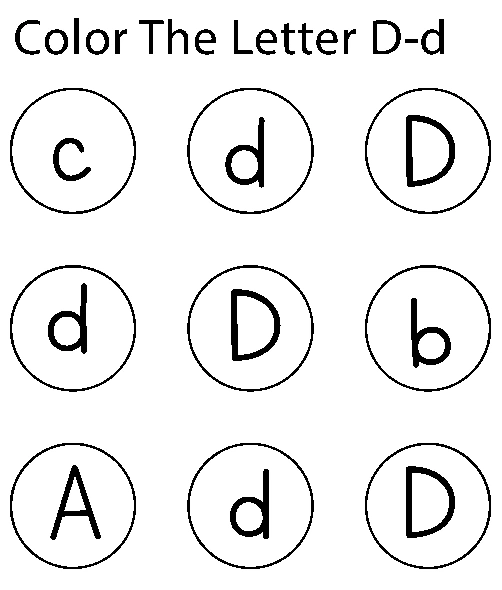
Point first and color afterward if the learner is still checking the rule. A single crayon keeps color choice from becoming a second task.
The Letter D answers are middle and right in row one, left and middle in row two, then middle and right in row three. There are three capitals and three lowercase forms. Leave c, b, and A uncolored. Keep this information for adult checking; letting the learner inspect the entries matters more than reaching a target count.
If b receives color, return to the large lowercase Letter D and locate its round body. Compare just those two printed forms for a moment. Do not introduce several more look-alike letters during the explanation. If the child colors c or A, restate the matching rule and ask for a point before the next mark.
The classroom book box brings dog and duck together
A teacher places two familiar picture books near the Letter D table: one about a dog and another about ducks. The children name each cover animal before opening the books. Later, when they reach the worksheet's picture panel, the teacher asks which printed animal begins like dog. The duck provides a new word with the same /d/ beginning.
Name the other options as ball, fish, and apple. The intended Letter D picture answer is the duck at the upper left. It is a different animal from the introduction dog, so recognizing the correct response depends on listening rather than finding an identical picture. Children can point quietly before sharing their answers aloud.
Use a short /d/ model without tacking on a drawn-out “duh.” Then say the whole word duck normally. Keep Letter D sound discussion separate from handwriting feedback: a learner may hear the beginning accurately while still needing help with pencil movement. For later alphabet variety, explore C and its open curve in a separate session.
Four ways to carry the idea into play
A tactile version of lowercase Letter D
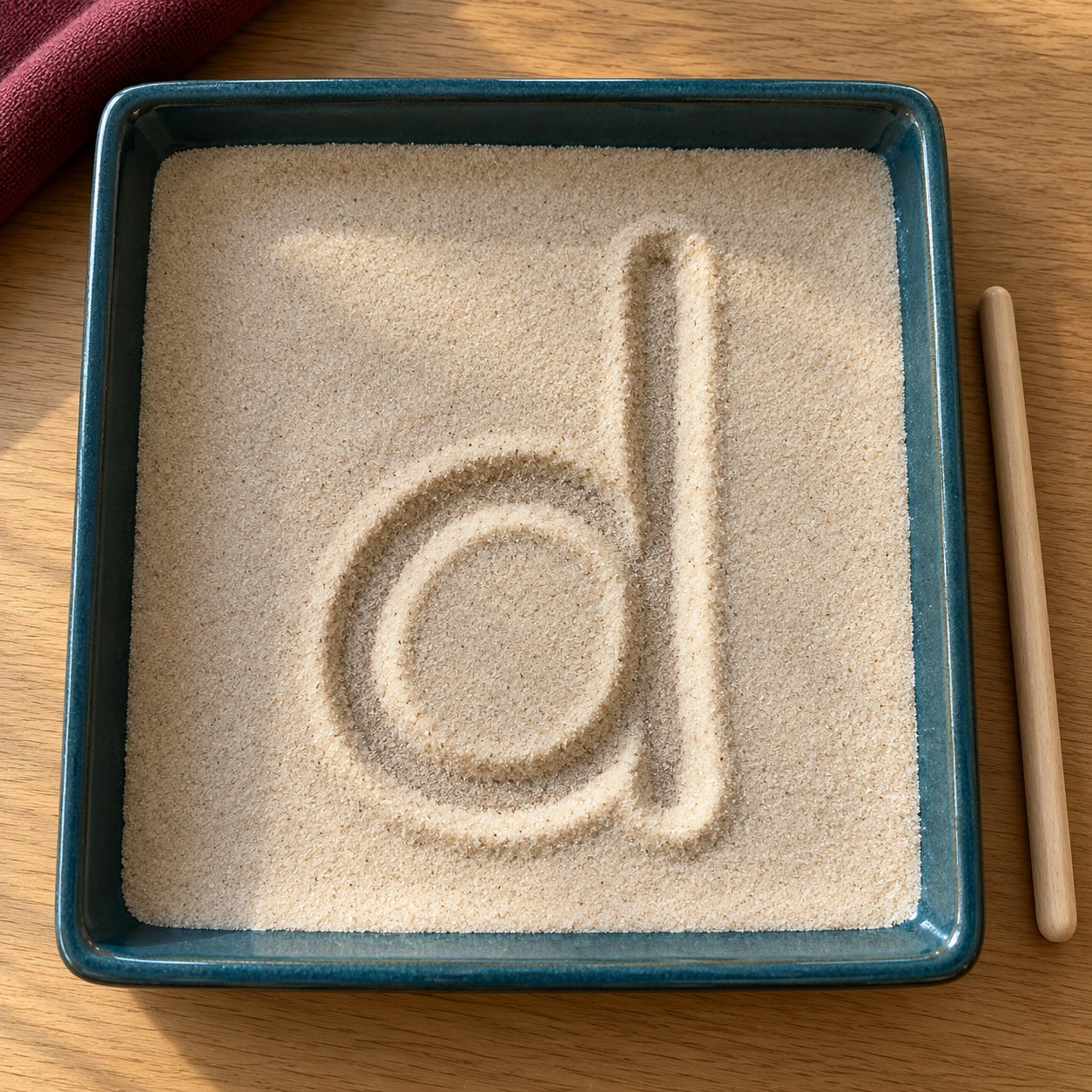
For an optional Letter D experience, smooth a shallow layer of sand in a tray and explore a large lowercase d. Notice its rounded left body and tall right side. An adult can demonstrate Letter D, then smooth the surface for another try. Keep the printed model nearby for movement guidance; the photograph shows a possible finished shape.
🐾 A dog-walk direction card
Draw a simple walking route for a toy dog on scrap paper. Add one Letter D copied with adult support from the worksheet. The child can point to that mark when the dog starts its journey. Keep route drawing playful, with no expectation of writing instructions.
🦆 Duck's tiny delivery
A pretend duck delivers a drawing to dog. Let the child invent what is inside the envelope, then say duck and dog together. Ask what their spoken beginnings share. This extends the Letter D sound idea while giving the learner control over the story.
📖 A print-size comparison
Find a large D in a book heading and a smaller d in ordinary print. Compare them with the worksheet models, keeping the book upright. Letter D may appear in different typefaces, so discuss the arrangement of its parts rather than expecting an exact tracing-font match.
Make progress visible without making it a contest
Use a dated note about one Letter D decision: “Checked the model before choosing d.” At a later visit, watch whether that action needs less prompting. This records a working habit, not a ranking against another child. Specific feedback such as “You looked for the tall part” gives the learner something repeatable.
A page covered in corrections can make a willing child hesitate. Select one Letter D feature to discuss, let them try again, and acknowledge their explanation. Practice can be regular without being lengthy. Revisit a few spaces during a familiar drawing time and let the learner choose whether to begin with tracing or naming.
If the pencil is gripped tightly or the page is sliding around, adjust the setup before requesting more letters. Larger movements may be a useful preparation; try a page of simple pencil paths. For a wider sequence after this focused work, use the alphabet tracing collection at a comfortable pace.
Check the file details, then choose your download
| Printable | One portrait US Letter PDF page. |
|---|---|
| Letter D writing support | Large arrow models plus seven capital and seven lowercase dotted examples. |
| Featured preview | A full, uncropped JPG showing the uploaded source sheet. |
| Download choices | Branded original sample, or the clean premium version for active members. |
Use the page's free button to obtain the original Letter D sample. To receive the clean copy, access your active membership account and select the premium download. The member PDF contains no website watermark, promotional branding, or ads within the printable. Both versions retain the learning activities.
In the print dialog, select US Letter and inspect the edges. Actual size works when your printer can retain the border; otherwise fit the sheet within its printable margins. Confirm that the duck panel and the lowest letter circles remain visible. Print a copy, set out your chosen tools, and begin with one Letter D detail worth noticing.
Popular Worksheets
Printable resources families and teachers are downloading now.
 Free
Free
 Free
Free
 Free
Free
 Free
Free