
Letter F: 6 Brilliant Clues for Confident First Tries
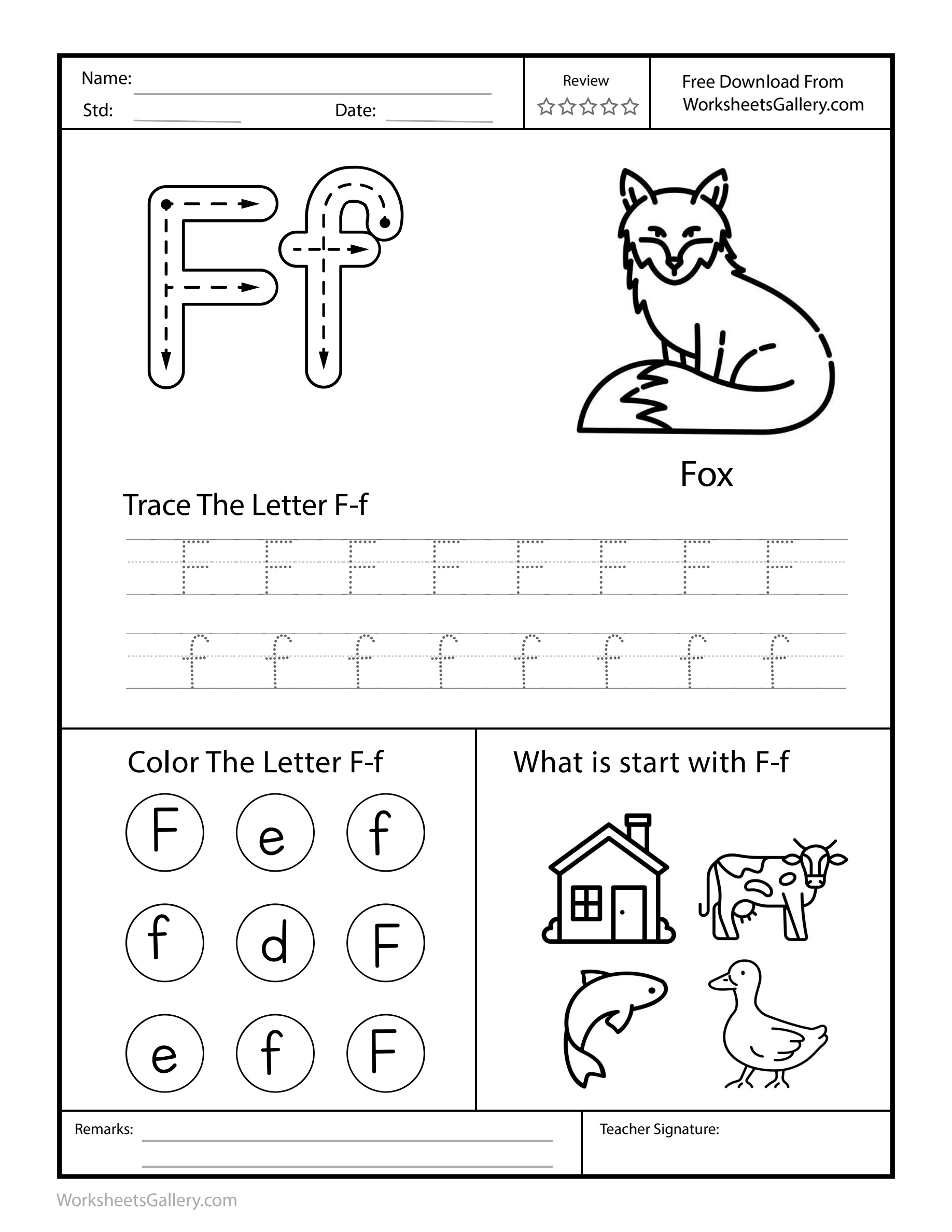
🦊 Follow.
Find.
Say fox.
Ffff... a quiet stream of air can turn fox into a word worth listening to. Before any pencil work, say it together and notice the beginning. This Letter F printable then gives that sound a visible partner: F and f, with large models, eight guided examples of each case, and six letters to find. There is also a picture-choice panel that needs careful naming because its aquatic drawing looks dolphin-like. Use the guide below to keep the sound work accurate while giving a beginner a manageable route through the page.
Let Letter F begin with a little moving air
Begin Letter F listening by saying fox at an ordinary speaking pace. Then let the initial /f/ continue briefly before returning to the whole word. The lower lip lightly approaches the upper teeth as air moves through. Keep the demonstration gentle. The child can listen and point to the fox rather than copying a mouth movement on demand.
This Letter F sound can be sustained, unlike the brief starting sound in a word such as duck. Avoid adding a strong “uh” after it. A soft “ffff” keeps attention on the sound itself. Once the child has heard it, point to both printed cases and explain that either form can represent that sound in fox.
Make the first Letter F exchange short: say the word, show the symbol, invite a response. The response might be a point, a repeated word, or a finger route. A confident spoken answer and a hesitant pencil movement can exist together, so observe them separately.
Name the pictures before choosing an answer
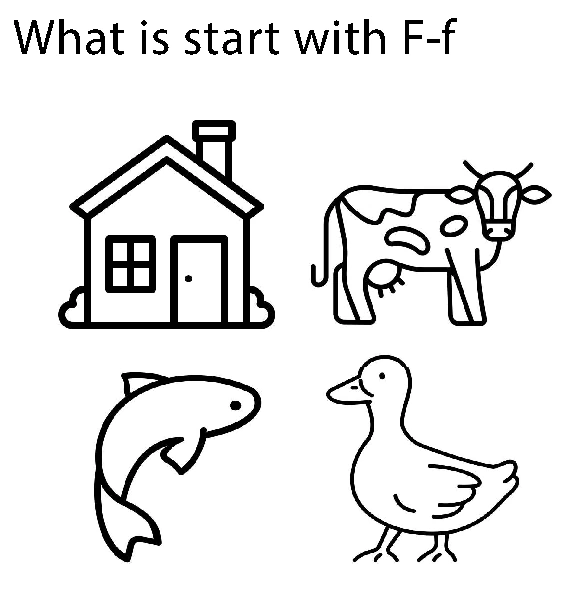
The fox introduction is above this panel on the complete worksheet. It remains a clear /f/ word to use.
The lower-left drawing on the Letter F sheet has a curved body and flipper-like features. It can readily be read as a dolphin. A dolphin is a mammal, not a fish, and dolphin begins with /d/. Do not turn Letter F practice into a demand to rename it fish simply to produce the expected letter sound.
Using the names house, cow, dolphin, and duck does not produce an /f/ match. If a learner says dolphin, acknowledge that reasonable reading of the illustration. For reliable Letter F listening, use fox from the upper page and the separate, clearly drawn fish illustration later in this guide. Leave the ambiguous choice unscored.
The printable preserves the uploaded artwork. This Letter F guide supplies the adult explanation rather than silently changing the picture. You can use the lower panel for naming and conversation, then keep sound matching with the clearer examples. There is no need to manufacture an incorrect answer to finish a box.
Six circles share the Letter F name
The Letter F recognition panel contains nine circles. Three show capital F and three show lowercase f; the other entries are two lowercase es and one d. Check across each row rather than jumping between whichever shapes look interesting. Both cases count, even though their upper parts differ.
For adult checking, choose left and right in the first row, left and right in the second row, and middle and right in the third row. That identifies all six Letter F targets. The two e entries and the central d in the middle row remain uncolored. Pointing before coloring lets an uncertain learner inspect a choice without immediately committing to a mark.
A child who notices only the capitals may need another comparison with the large lowercase model. Say the letter name while pointing to each case. Let the learner find one small Letter F with the model still in view before asking for the rest.
Eight pairs of Letter F models allow short visits
There are eight dotted capitals and eight dotted lowercase forms on the Letter F sheet. Capital F has a tall straight stroke and two right-facing arms. The lowercase model has a curved upper hook, a long stroke, and a cross-stroke. Follow the large printed arrows for movement guidance and the handwriting approach used by your teacher.
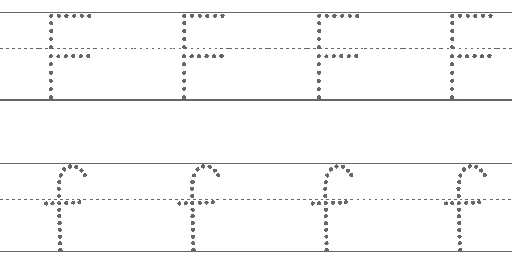
Use a fingertip on a large Letter F before moving to these smaller dotted paths. The sheet offers guided tracing, with no blank independent-writing row. Choose a few examples, watch the route, and keep the remaining spaces for later. Completing all sixteen in one sitting is not the measure of a useful session.
If a lowercase Letter F loses its cross-stroke, return to the big model and follow that part slowly. If a capital gains an extra lower arm, compare it with the two-arm reference. Keep Letter F corrections focused on one visible feature so the next attempt has a clear purpose.
Six clues from thoughtful Letter F practice
Letter F work combines visual decisions, controlled movement, and spoken language. Look for a specific action you can describe, rather than trying to infer progress from how full the page looks.
01 · A steadier visual target
The learner returns to the large Letter F when unsure. That reference gives attention an anchor and offers a practical way to check a decision without waiting for an adult to supply every answer.
02 · Recognition across cases
Both F and f receive attention in the search. Accepting the hooked lowercase form as Letter F means the child is looking beyond one familiar capital silhouette.
03 · A route the eyes can follow
The pencil follows the dotted model with a purposeful direction change. Eyes can look ahead while the spare hand keeps the page from sliding, linking visual guidance with a manageable motor task.
04 · A decision to leave something alone
An e or d stays uncolored because it does not match Letter F. Selective attention includes rejecting a familiar shape, not simply noticing something the child already knows how to name.
05 · A word connected to its beginning
Fox is named and connected to Letter F through its /f/ beginning. This gives the symbol a spoken example, while the picture-naming discussion reminds adults to use accurate vocabulary for sound activities.
06 · An explanation worth hearing
The child points out a Letter F hook, an arm, or a different animal name. Describing a reason uses language to make thinking visible, even if the finished pencil mark still needs support.
At home, a folded fan gives Letter F a purpose
Kian finds a paper fan left from an earlier craft. His adult names it and lets the beginning sound continue gently: “ffffan.” Kian tries the word, then points to the fox on the Letter F page. The objects are different, but the spoken beginnings give him something to compare.
They choose two dotted Letter F models, one from each case. Kian follows the capital comfortably and asks for another finger demonstration of f. His adult provides it, then lets him return to the fan. A short observation has identified the next helpful support without turning a playful sound comparison into a handwriting marathon.
This activity commonly suits supported learners around ages three to six. A younger child may point and name while an adult demonstrates. An older beginner can explain a feature and attempt more pencil movement. Set the amount of Letter F work from the child's comfort and response, not a fixed expectation attached to age.
In class, a careful animal name counts as good thinking
At a small literacy table, a teacher names the Letter F introduction picture with the group. Later, one learner calls the lower aquatic picture dolphin while another says fish. The teacher pauses the sound-choice instruction, acknowledges the unclear drawing, and returns to fox as the shared /f/ example.
The children then work on the letter circles and selected tracing spaces. The teacher can still observe Letter F recognition, attention to a model, and guided movement. No child loses credit for giving an animal a reasonable name. A clear separate fish picture can support another sound comparison after the printed tasks.
Keep directions concrete: “Point to one f,” “Show me the hook,” or “Say fox.” Use one prompt at a time and wait for a response. If basic routes are demanding, introduce simple paths for pencil control before asking for more small Letter F examples.
Plan the response before counting the marks
| Choose an action | A clear starting point | What to observe |
|---|---|---|
| Look and point | Find one match for each Letter F case. | Whether both cases are recognized. |
| Guide a movement | Finger-trace, then try a few dotted forms. | How the route is followed. |
| Name and listen | Use fox and a clearly identified fish. | The spoken /f/ connection. |
Prepare the Letter F sheet on a firm surface with a comfortable pencil and a single coloring tool. An adult can fill the name field. Begin with one action from the table, then move to another only when the first instruction is understood. These are choices for a lesson, not three tasks that must be completed in sequence.
A clear fish image keeps the next sound example accurate

Call the animal a fish when making the Letter F comparison; goldfish is its more specific name and begins with /g/. Say fox and fish, then notice their shared beginning. The picture gives you a clear referent for that vocabulary choice, without needing to reinterpret the ambiguous animal on the uploaded sheet.
Four invitations to revisit Letter F
- A fan-and-fox sound pair. Place a paper fan beside a toy or drawing of a fox. Name each, then let the child point when they hear the shared beginning. The objects are optional Letter F props, not pictures to find elsewhere on the worksheet.
- A hook in the air. Stand beside the learner and rehearse the large lowercase route with a finger in the air. Check the printed Letter F route afterward, noticing both its hook and cross-stroke. Follow its guidance instead of inventing an extra loop.
- A quiet picture announcement. The child introduces the clear fish illustration to an imaginary visitor. Supply the word fish if needed and invite a short sentence. Keep Letter F sound noticing inside the conversation, rather than requesting a string of isolated noises.
- A case partner on scrap paper. An adult writes F and f on separate cards. Hide one under a cloth and ask which partner is missing. Show the worksheet reference whenever useful, then swap the hidden card for another turn.
For another letter with a contrasting shape, explore the C tracing page. For a wider alphabet plan, the full tracing collection can supply separate pages as the learner is ready.
Keep a repeatable success small enough to enjoy
Notice a specific Letter F action: “You checked the big f before choosing,” or “You kept the paper still.” That feedback gives the child something to repeat. Darker tracing and more colored circles are not automatically better evidence of understanding.
Revisit a few available spaces during a familiar quiet time, perhaps after a picture book or before putting drawing tools away. A predictable invitation can be brief. Let the learner choose a finger route or a picture conversation when pencil work feels tiring. Record one observation for next time instead of demanding a completely fresh page of Letter F every day.
Download Letter F in the version that suits your session
Download Letter F as a single portrait PDF for US Letter paper. The featured JPG displays its complete source page. Choose the original sample to keep the uploaded version, including its branding. Members with a current plan can select a separate clean edition: no watermark, no website credits and no ads within the printable. Removing the branding leaves the source activities intact.
- Use the free control for the original sample. For the clean version, sign into a membership account with a current plan and select its premium option.
- Open the downloaded PDF and choose US Letter paper. Review the full portrait page in the print preview.
- Keep actual size when every border fits. If the printer clips an edge, fit the page within its printable margins before sending the job.
- Check that both lower panels and the final tracing models remain included. Set out a pencil and begin with one clear Letter F action.
Popular Worksheets
Printable resources families and teachers are downloading now.
 Free
Free
 Free
Free
 Free
Free
 Free
Free