
Below the Line: 5 Brilliant Letter G Wins for Kids
↘ Room for the part that goes below
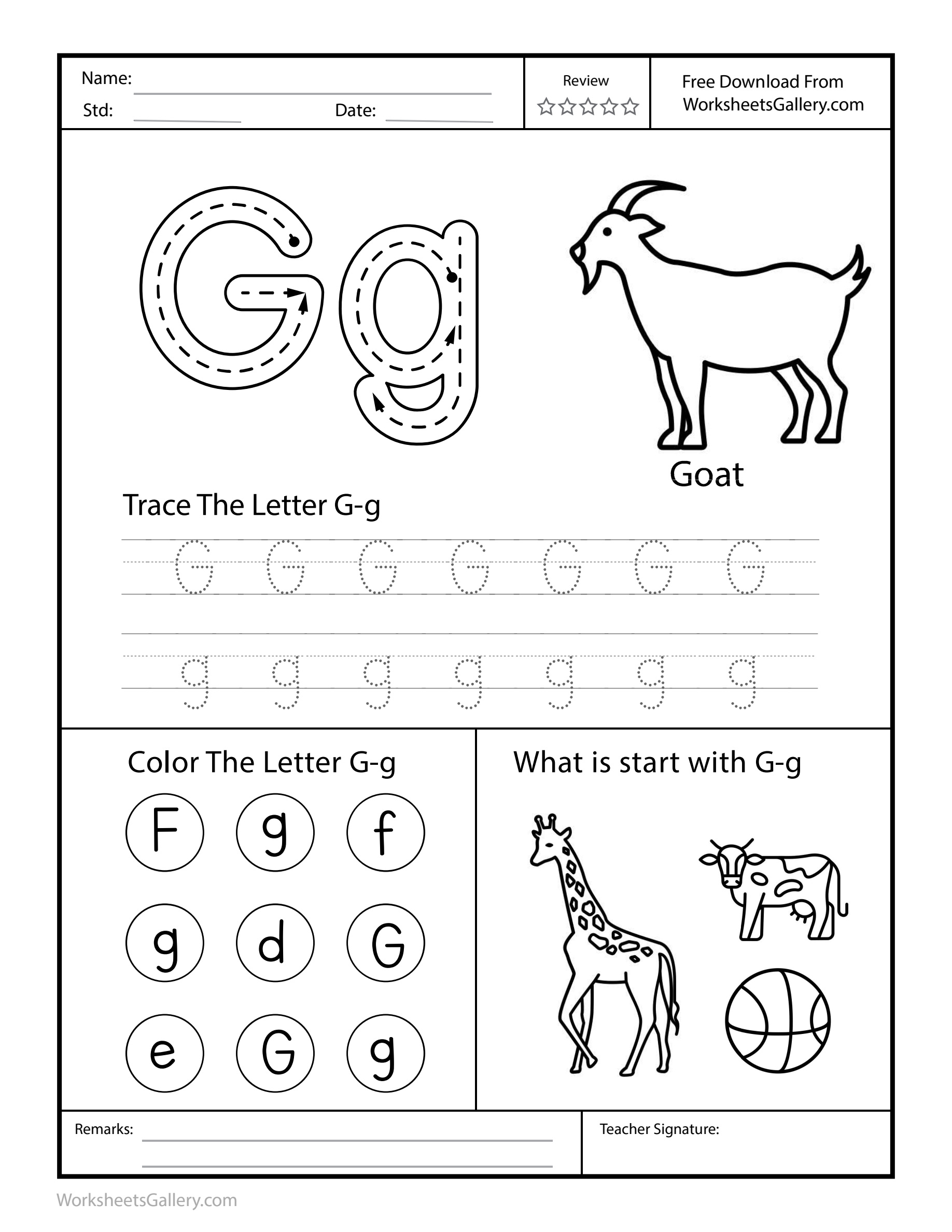
At the bottom of g, the pencil still has somewhere to go. Its tail drops below the writing line, giving a young learner something specific to notice before tracing. This Letter G worksheet pairs that lowercase shape with a capital G, a goat introduction, and five matching letters hidden among other forms. Seven models of each case provide guided practice. The giraffe picture adds a useful spelling conversation, provided an adult explains its different starting sound. Begin with the feature that catches your child's attention, then build a short session around it.
Find the body of Letter G before following its tail
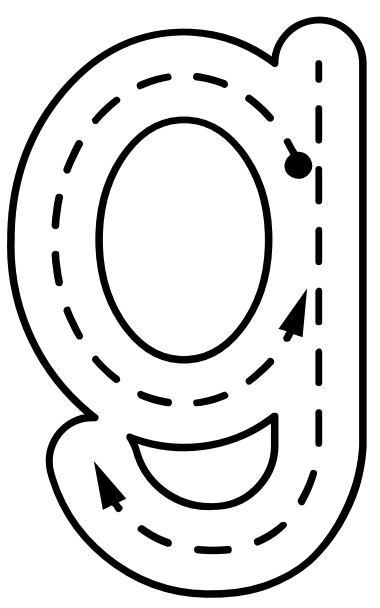
The lowercase Letter G printed here has one rounded upper body and a descending tail. This form is often called a single-storey g. Locate the rounded body first, then point to the part that reaches lower. The large model provides arrows for the route; use those and the handwriting method taught in your setting when demonstrating movement.
The horizontal line on the small practice strip gives that difference a visible reference. The lowercase Letter G body sits above the lower rule, while the tail continues beneath it. Tell the child, “There is space below for this part.” A learner may need permission to use that space after practicing letters that stay entirely above the line.
Capital Letter G works differently. Its large curve includes a short inward bar, which distinguishes it from an open C. Both cases share a name, but they are not the same drawing at different sizes. Keep the two references available and let the child compare their parts directly.
Use the line to position lowercase Letter G

There are seven dotted capitals on the upper Letter G strip and seven lowercase examples below. The page supplies guided forms rather than a blank writing row. Before choosing a few models to trace, compare the positions in this short adult reference.
| Part to notice | Where it sits | A simple prompt |
|---|---|---|
| Capital curve and bar | Within the capital's writing height. | “Find the little inward stroke.” |
| Lowercase round body | Above the lower rule. | “Show me the round part.” |
| Lowercase descending tail | Extends underneath that rule. | “Which part goes below?” |
Letter G tracing gives the eyes and hand a shared route. Keep the page steady with the spare hand and use a comfortable pencil. Watch the lower turn happen; a complete-looking outline alone does not tell you whether the child understood where that stroke belonged.
Five small wins to look for during Letter G work
- Position has a purpose. Noticing the tail below the line gives spatial language a practical use. The child can point to above and below while discussing a visible part of Letter G.
- The cases can stay connected. Choosing G and g from a mixed set encourages recognition across different forms. A learner can use the large models as references while keeping Letter G in mind.
- A curve can be guided deliberately. Following the dotted Letter G path invites changes of direction with a clear destination. The adult can observe pencil steering and page support without requiring a full row.
- A search can include careful rejection. Leaving F, f, d, and e untouched calls for comparison with the Letter G reference. Saying why a form differs can reveal more than simply coloring another circle.
- Written beginnings and spoken sounds can be discussed accurately. Goat and giraffe share an initial letter in spelling, but not the same opening sound. Naming both carefully gives language work a useful distinction.
These Letter G opportunities combine cognitive comparison, fine motor control, and language. They also give the adult separate things to observe: a child may recognize a case, understand a position word, or explain a picture name while still needing a larger movement demonstration. Treat each response as information about the next manageable step.
A pretend shopping list gives Letter G a place
Lena draws grapes on a pretend shopping list while her adult says the word. They look at the goat on the Letter G sheet and hear the same hard /g/ beginning. The adult offers to add a small g beside Lena's drawing. Lena follows its round body with a finger and notices the part hanging below the list's line.
They return to one dotted lowercase Letter G on the worksheet. The adult demonstrates, then gives Lena a turn and asks her to point to the tail afterward. Lena does not need to spell grapes or produce a whole list of letters. Her drawing has given one symbol a meaningful place and one movement an immediate reference.
For supported learners around ages three to six, that may be enough for a first visit. A younger child can name and point. A child ready for more pencil work can try selected examples of both cases. Keep Letter G practice matched to attention and comfort rather than assigning every space because it is printed.
Build a short Letter G session from these four steps
- Orient the page. Set it upright on a firm surface, with a pencil and one coloring tool ready. Point to the goat, say its name, and show the two large Letter G forms. An adult can complete the name field if that saves the learner's freshest attention.
- Demonstrate one route. Finger-trace a large model, then try a small selection from the matching dotted strip. For lowercase Letter G, discuss the body and tail separately before watching the whole movement.
- Change from tracing to finding. Ask for a point at one Letter G circle before coloring. Continue through a row with the same rule, checking both uppercase and lowercase possibilities.
- Name the pictures with an accurate goal. Use goat for hard /g/ listening. Explain the written G in giraffe if discussing the lower picture panel, then finish by inviting the child to describe one letter feature.
The Letter G page does not need to be completed in this order every time. A familiar picture conversation may be the best starting point on a day when hands are tired. Keep unfinished tracing spaces available and return to them when the child can attend to the route.
The five Letter G matches, checked row by row
There are two capital Gs and three lowercase gs in the Letter G selection panel. In the top row, the middle g is the only match. In the middle row, select the left g and right G. In the bottom row, select the middle G and right g.
The distractors are capital F, lowercase f, d, and e. If d is selected, compare its tall upper stroke with the descending tail on lowercase Letter G. If only capitals are chosen, revisit the large g and look for its partner among the circles. Supply one clear comparison, then let the learner make another decision.
Keep the answer count private until the search has been attempted. The point of Letter G recognition is identifying each form, not coloring enough circles to reach five. A single deliberate choice followed by a useful explanation can be a sensible place to pause.
Goat and giraffe: two sounds for written Letter G
The top Letter G picture is a goat. Its word begins with hard /g/, as in go. The lower panel shows giraffe, cow, and ball. Giraffe is the intended initial-letter choice in spelling, but its word begins with a soft G sound, like the beginning of jam. It is not a hard /g/ example.
Write goat and giraffe on separate paper if the written comparison will help. Point to the first letter in each while saying the full words naturally. Do not tell a child that the spoken beginnings match. For a Letter G lesson focused only on hard /g/, use goat and reserve the lower picture choice for a spelling discussion.
In a classroom, a teacher can put these two word cards beside the Letter G page. Children name the animals first, then notice the shared written initial with adult support. A learner who hears a different beginning in giraffe has made a worthwhile observation. The teacher can acknowledge it while keeping the tracing and recognition tasks available.
Let a small farm scene supply clear hard-G words
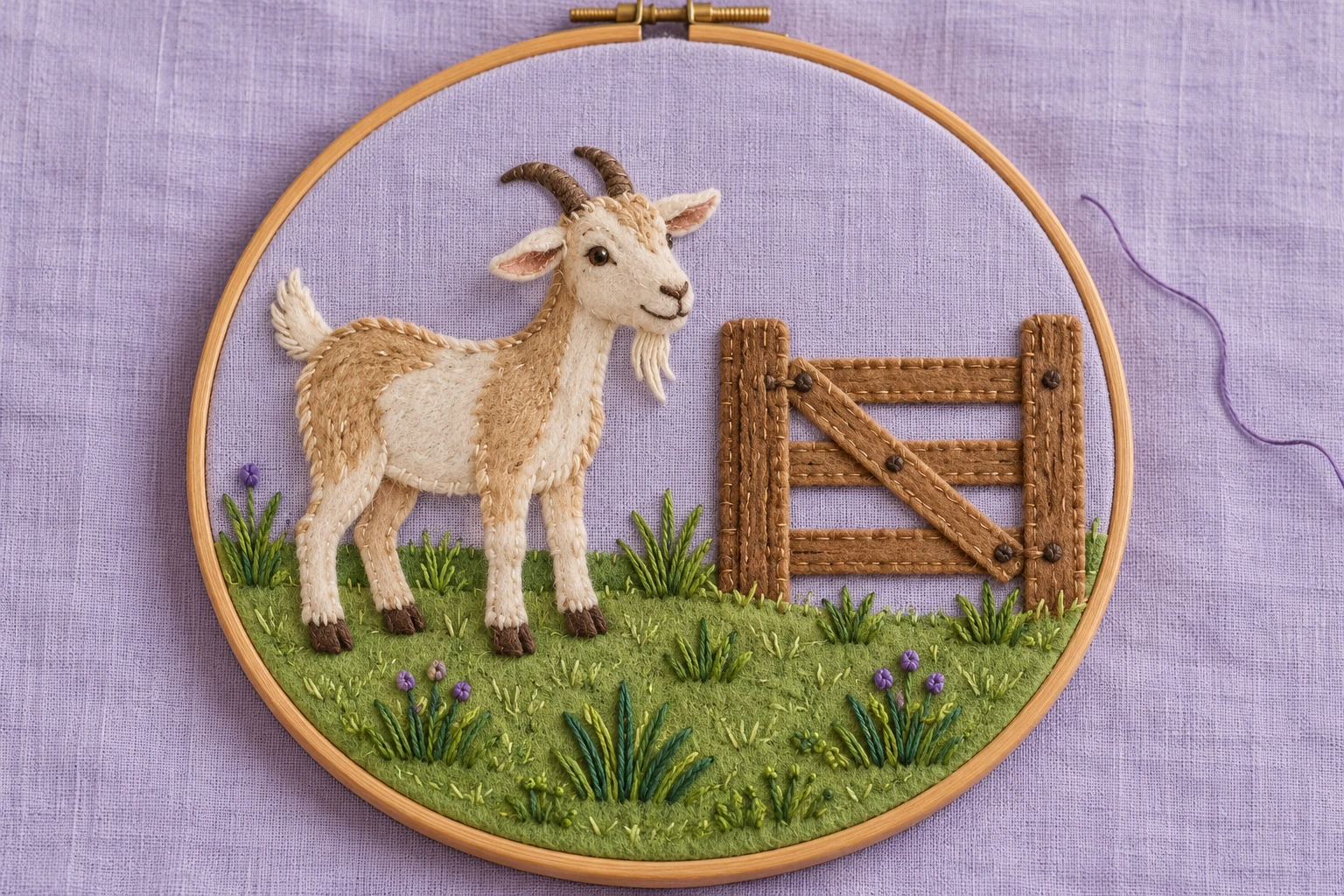
Point to the goat, gate, and grass in the supporting image. Each name begins with hard /g/. These Letter G examples let a child compare beginnings without needing to read the words. Keep the /g/ brief rather than adding a long “guh,” then return to the ordinary spoken word.
Five ways to return to Letter G with a different purpose
🐐 Give the goat a route
Invent a spoken journey from goat to gate across the grass. Let the child decide what happens next. Say the three names clearly and return to Letter G only after the little story has had room to be playful.
↘ Trace the tail in the air
While standing beside the learner, use a finger to explore the large Letter G route in the air. Pause to identify the descending portion, then check the printed model. The air movement is a preparation, with no need to judge an invisible shape.
📚 Find a different book g
Look for g in clear book print. Some fonts use a more complex, double-storey form. Explain that it is another way of printing Letter G rather than expecting it to look exactly like the handwriting model.
✎ Draw a resting line
On scrap paper, an adult draws a horizontal rule and models a large lowercase g across it. Invite the child to point above and below. Return to the worksheet when that position comparison becomes clear.
💬 Choose the useful reminder
Offer two spoken cues, such as “Find the round body” and “Leave room for the tail.” The learner chooses which reminder they want before another Letter G attempt. Their preference can show which part of the task currently needs attention.
When a simpler curve is useful, try a separate C tracing activity. For broader movement preparation, explore straight and curved line practice. The A-to-Z collection can support a gradual alphabet sequence.
Keep the next visit encouraging and specific
A lowercase Letter G tail squeezed above the line needs another position demonstration, not heavier pencil pressure. A capital without its inward bar needs comparison with the large G. Address one feature, allow a new try, and describe what changed. A useful attempt can still look unfinished.
Revisit Letter G during a familiar short drawing time. Let the learner choose one case or one picture conversation, and note an action such as checking the model independently. Repeated whole-page completion is unnecessary. If the grip tightens or the paper keeps slipping, pause and adjust the setup before inviting another small movement.
Prepare one Letter G copy for the pace you need
Download Letter G as a portrait, single-page US Letter PDF. The featured JPG displays its complete original layout, including all page edges. The free sample retains the source credits. A clean premium edition is available to members with an active plan; its printable pages have no watermark, no website branding, and no ads.
- Choose the original sample, or use a current membership account to obtain the premium download.
- Open the saved file and select portrait US Letter in your printer settings.
- Review the full border at actual size. If the printer would cut an edge, scale the sheet to its printable area and inspect it again.
- Make sure the lowercase tails and the bottom activities are visible. Print a copy and select one Letter G action to begin.
Popular Worksheets
Printable resources families and teachers are downloading now.
 Free
Free
 Free
Free
 Free
Free
 Free
Free