
Nest News: 4 Remarkable Letter N Tasks for Happy Kids
▤ A small report from the alphabet desk
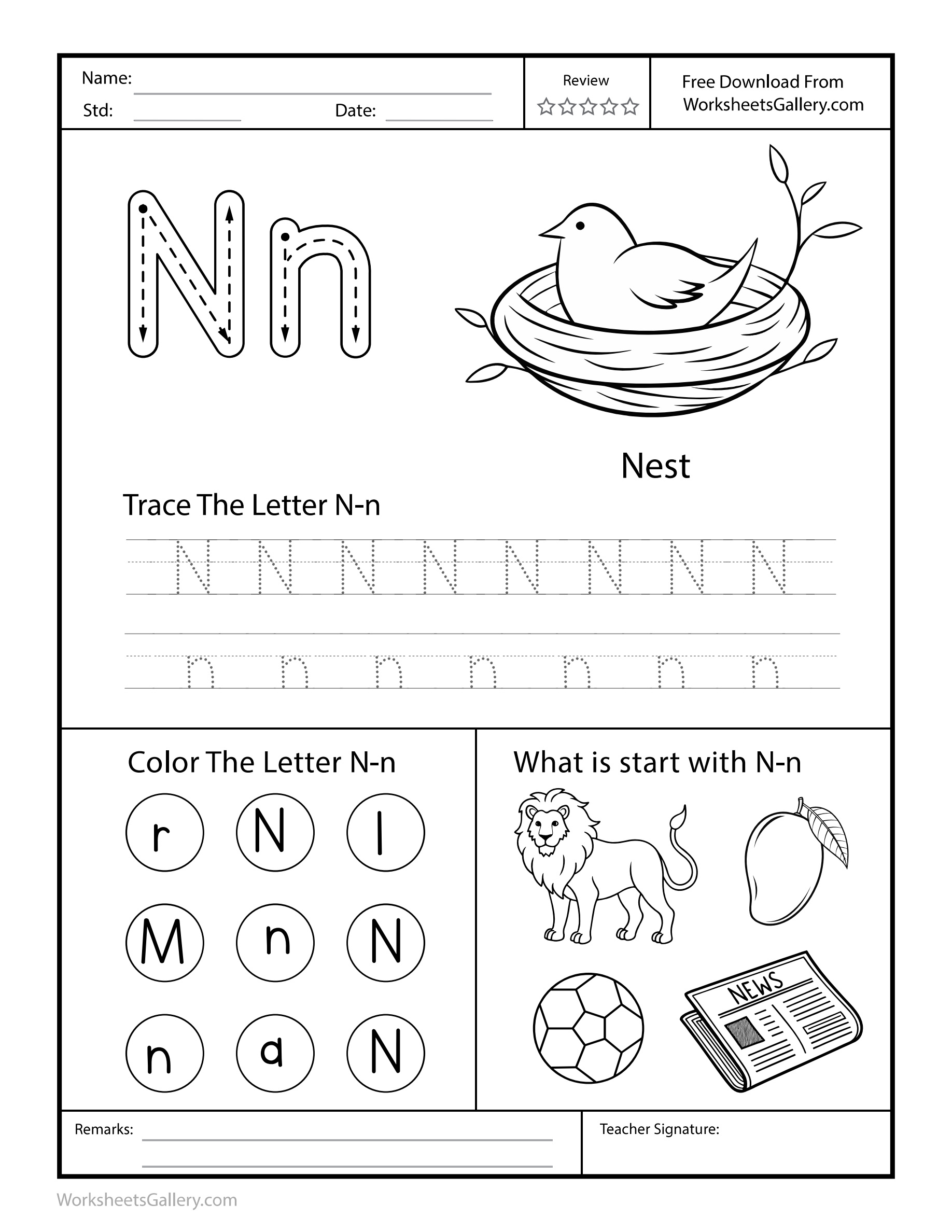
A bird sits in the nest, but nest is the word to listen to. That small distinction gives this Letter N worksheet a thoughtful beginning: name the place, hear its first sound, and then examine N and n. The capital links two tall strokes with a diagonal; the lowercase form rounds over once. Fifteen dotted examples offer guided movement, while five matching circles invite careful choices. A newspaper picture extends the sound connection. Turn those observations into a little news report, with a drawing, a spoken sentence, or a short tracing attempt as the child prefers.
Read the lower Letter N panels before choosing a task
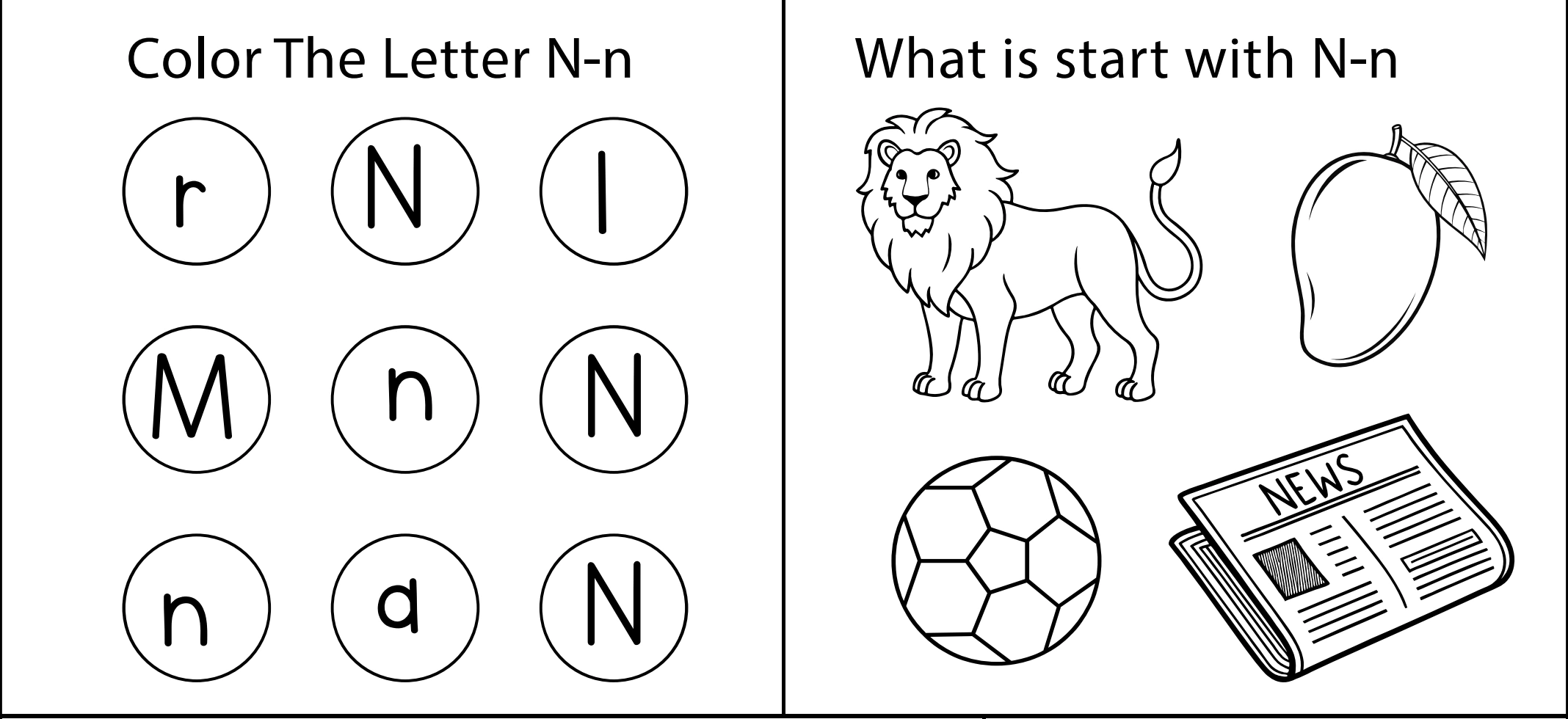
The letter rows read r, N, l; M, n, N; and n, a, N. Select the middle circle on the top row, the middle and right circles on the second row, and the left and right circles on the last row. The Letter N answer set contains three capitals and two lowercase forms.
Let the child indicate a choice before coloring it. If M is selected, compare the middle strokes with N. If r looks promising, examine whether its shoulder completes the rounded arch shown in the lowercase Letter N model. Each comparison gives a reason for the selection rule.
Counting to five can come afterward. A child may recognize the correct Letter N forms while still needing an adult to keep the tally. Treat searching, counting and filling the circles as different jobs, so a coloring difficulty does not hide a successful recognition decision.
Nest names a place; newspaper names a familiar object
Point around the bird to the woven shape beneath it and say nest. If the child initially says bird, acknowledge that accurate observation. Then explain which part the printed label names. Letter N sound practice depends on a shared word, and bird begins differently.
In the lower picture group, newspaper provides another /n/ beginning. Lion, mango and ball are the other usual names. Read newspaper aloud before asking the child to select the Letter N picture. The small NEWS heading is a printed clue, but independent reading of the entire word is not required.
Say nest and newspaper naturally, then draw attention to their common first sound. For /n/, the tongue touches behind the upper teeth and the voice continues briefly. Keep the example comfortable and avoid adding an extra “uh.” A learner can listen, point or repeat the word; those are different ways into the Letter N connection.
At home, a nest bulletin gives Letter N a purpose
Ishaan tells his aunt, “The bird is sitting down.” She records his pretend bulletin on scrap paper and writes N beside the nest drawing. He chooses the newspaper in the lower panel, then notices a little n in the search. Their Letter N visit begins with something he wants another person to know.
At home, name the nest and newspaper together, choose either tracing or pointing, and leave an obvious place to pause. An adult can write the child's report while the child attempts a single Letter N model. Dictating a sentence and steering a pencil are separate demands; they need not happen at once.
This is a guided preschool or kindergarten resource, generally suitable around ages three through six when support matches the learner. Present control matters more than a birthday. One child may be ready for a short row selection; another may begin by showing the nest and identifying a Letter N circle.
Give the capital Letter N diagonal two clear endpoints
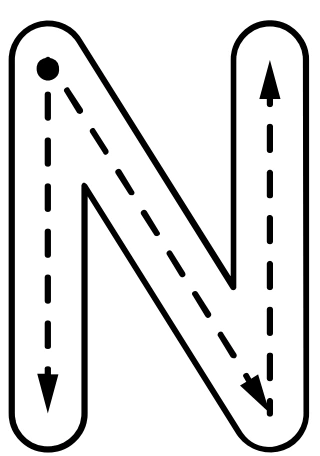
Look at the model upright. Its diagonal joins the upper left with the lower right, linking two tall strokes. A reversed slope changes the appearance. Point to both endpoints before moving between them, so the child can see where the connecting part belongs.
Follow the source arrows alongside your setting's usual handwriting instruction. The large Letter N model includes a downward left path, the diagonal and an upward right path. Demonstrate from beside the learner to keep left and right consistent for both viewers.
The ruled strip has eight dotted capital examples. They are guides, not empty spaces for unsupported copying. Use a few Letter N attempts to examine the diagonal rather than asking for a complete row before discussing what happened.
When a diagonal misses its destination, enlarge one example on another sheet and compare the endpoints again. A broad finger movement can come before the smaller pencil route. Keep the Letter N feature you are teaching visible instead of covering the model with repeated corrections.
Lowercase n needs one complete arch
The smaller Letter N partner has an upright and a single rounded arch. It sits in the lower writing space shown by the dotted row. Capital N is taller; the little n should not be stretched to the same height simply because the large introduction drawings look similar in size.
There are seven lowercase Letter N guides, so the full sheet contains fifteen tracing examples: eight capitals plus seven lowercase forms. No separate blank practice strip is provided. Save some untouched models if the learner is ready to stop after a useful comparison.
Ask the child to follow the entire arch with a finger, including its downward finish. In the search, r offers only a shoulder rather than the full n shape. If another page later introduces m, compare it separately; today's Letter N task can stay focused on the printed one-arch model.
Five observations that reveal useful progress
- Looking for a relationship
- The learner compares the two endpoints of the Letter N diagonal. That is a visual planning decision, beyond merely noticing that the letter contains straight lines.
- Finishing a recognizable curve
- A full arch distinguishes lowercase Letter N from a partial shoulder. Following it to the end links visual attention with controlled movement.
- Keeping a category stable
- Both N and n qualify during the search. The child remembers one Letter N rule while rejecting r, l, M and a.
- Choosing a precise picture name
- Naming nest instead of only bird makes the sound question meaningful. Letter N vocabulary work begins with knowing which object the adult is discussing.
- Making a message understandable
- A short nest report asks the learner to describe an observation for somebody else. Spoken language can extend Letter N work even when handwriting is brief.
The cognitive work includes selecting and comparing; motor work includes page support, pencil direction and stopping; language work includes naming and reporting. A strong response in one area does not guarantee equal ease in another. Listen to the explanation as well as looking at the traced Letter N.
In class, check the diagonal before the news round
A teacher places a large N on the board and marks its upper-left and lower-right connection points. Children point toward each destination, then watch the teacher trace between them. Before working independently, each learner shows the same relationship on the Letter N sheet.
After a short tracing selection, the teacher invites one spoken nest observation per child. “There is a bird” and “The nest is round” are both clear contributions. The group returns to newspaper as the Letter N picture choice. No child needs to write a whole report to take part.
- Show the full model and establish the case being studied.
- Demonstrate its route, then offer a manageable amount of Letter N tracing.
- Ask for one picture or search decision that the child can explain or indicate.
- Close with a short spoken report, preserving a clear starting place for the next visit.
Four reporting tasks after the Letter N page
A headline from one detail
The learner chooses something visible in the nest drawing and dictates a short headline. An adult writes it and adds a large N. Let the child explain which Letter N word connects the headline to the sheet.
Before and after a pretend flight
Imagine the pictured bird has flown away. Ask what a reporter could say before and afterward. Identify nest in both descriptions, keeping Letter N linked to the place even when the pretend bird moves.
One observation, one question
Take turns stating a visible detail and asking a question about it. “The nest has curved lines” is an observation; “Who made it?” is a question. Return to a Letter N model after the exchange.
The diagonal editor
On scrap paper, compare a clear N with an adult's version whose connecting slope runs the other way. The child acts as editor, selecting the one that follows the source Letter N model and pointing to the reason.
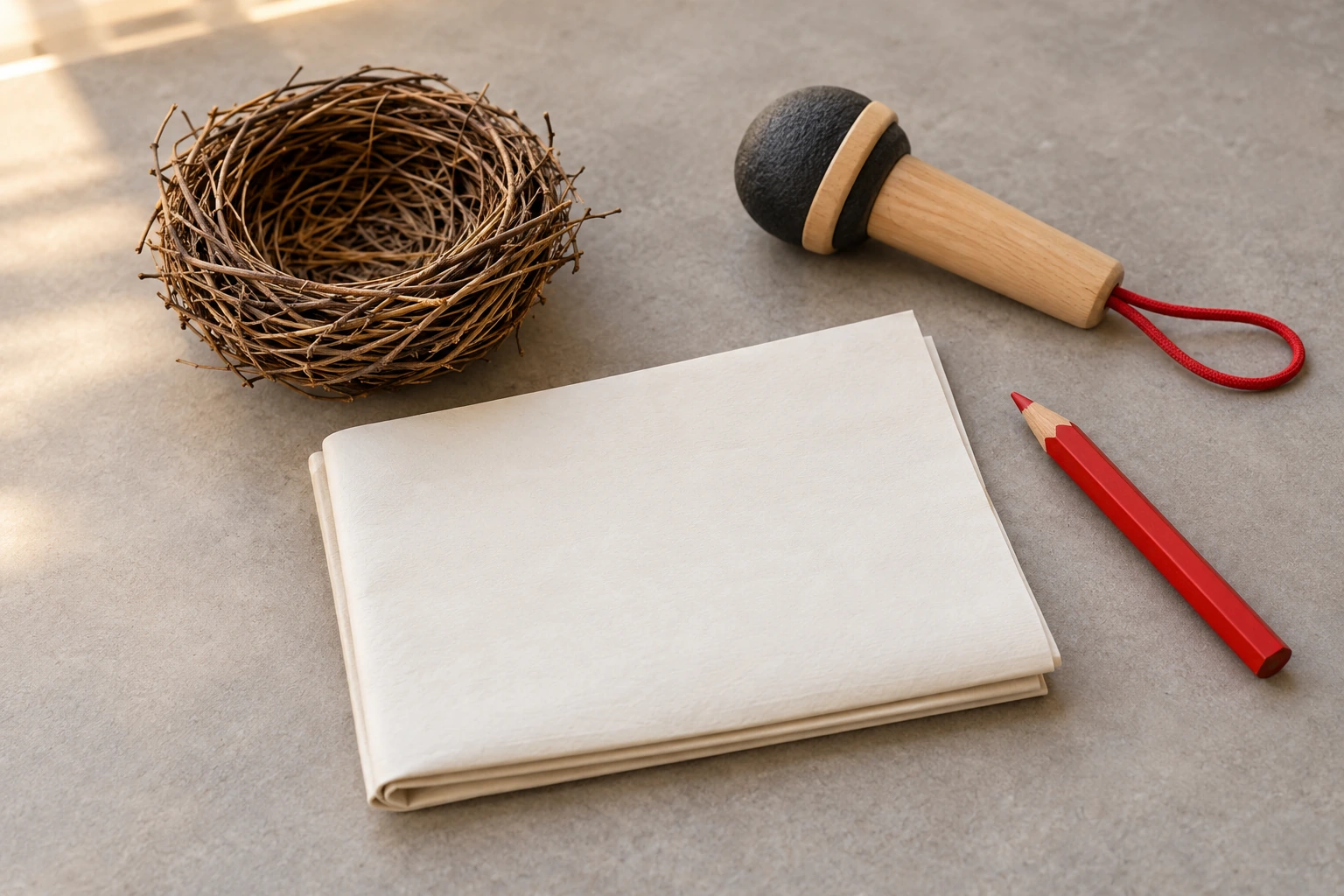
Use drawings, gestures or the optional desk image; a real nest and microphone are unnecessary. These reporting tasks invite choice and conversation. Select one for a later Letter N visit instead of extending every worksheet session into a long performance.
Keep the next Letter N invitation easy to accept
Common sticking points are a reversed diagonal, an incomplete lowercase arch and selecting only capital N circles. Identify the specific difficulty and return to the relevant model. One larger demonstration is more useful than darkening the child's entire attempt until the route becomes hard to see.
For regular Letter N practice, leave a small question unanswered for tomorrow: which circle shows little n, or where does the diagonal arrive? Offer a choice between a pencil response and a spoken report. Praise an observable action such as checking the endpoint or naming newspaper without a prompt.
For extra space before a diagonal lesson, try simple handwriting paths. A different capital-N resource can follow on another day. The A-to-Z letter guide collection supports later comparisons with a few selected forms at a time.
Select a Letter N download and check the whole print
The free sample keeps the source worksheet's website branding. A qualifying current membership unlocks the clean premium Letter N PDF, with that branding removed. The member copy contains no website watermark, and no advertisements have been added to its pages. The exercises, NEWS picture detail and writing guides stay intact.
| At the download stage | Before printing more copies |
|---|---|
| Choose the sample, or sign in to an eligible active plan and select the premium control. | Open the PDF in a reader and view the entire single page. |
| Use portrait orientation for the US Letter sheet: 8.5 inches wide by 11 inches tall. | Check the border at actual size; use fit-to-printable-area if an edge would be clipped. |
| Print one trial and prepare a comfortable pencil and coloring tool. | Inspect all fifteen dotted guides, nine circles and four picture choices, then choose a small Letter N task. |
Popular Worksheets
Printable resources families and teachers are downloading now.
 Free
 Free
 Free
 Free