
Penguin Post: 6 Brilliant Letter P Tasks for Joyful Kids
✉ Penguin Post: leave room for the lower stem
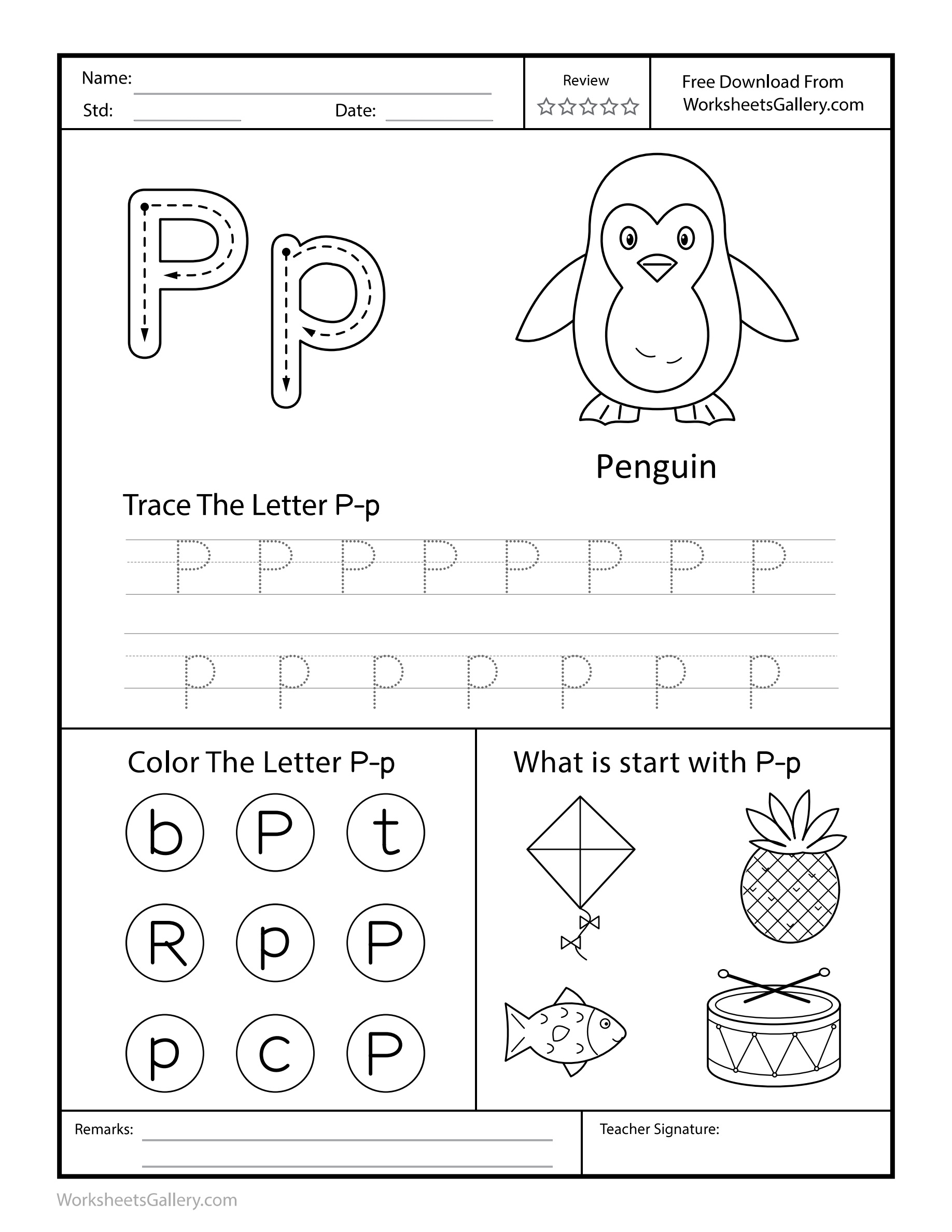
To make sense of p, look beneath its round part. The bowl sits in the smaller writing space, while the stem continues below the line. That position is the central idea on this Letter P worksheet, alongside a tall capital P and a friendly penguin. Eight capital models and seven lowercase models offer guided practice, and five matching circles test a different kind of attention. Pineapple provides a clear /p/ word in the picture choices. Give the lower stem enough room, then use a pretend postcard to connect that small handwriting observation with something the child wants to say.
Let lowercase Letter P continue below the writing line

The bowl of lowercase p rests in the smaller ruled space. Its straight stem extends below that area's bottom line, a part often called a descender. Point to the line and then to the lowest dot. The child can see that the Letter P route has more to do after it reaches the rule.
Capital P uses a tall upright with a bowl attached near the top. In the worksheet's ruled row, its stem ends at the lower writing rule. Both cases belong to Letter P, but their placement differs. Use the small examples for position comparisons; the oversized introduction drawings mainly explain the movement.
Follow the printed start dots and arrows with your setting's handwriting method. Keep the bowl joined to the stem instead of drawing a floating circle beside it. One recognizable Letter P connection is more useful than a fast row of disconnected parts.
Six things a Letter P session can make visible
- Attention to a reference line. The learner notices that lowercase Letter P continues below a rule. The line becomes a position guide rather than an automatic stopping signal.
- A connection between parts. A stem and a rounded bowl must meet. Watching that join encourages the child to plan how the Letter P features belong together.
- A meaningful case comparison. Capital P and little p keep related features while occupying different writing spaces. The learner can point out a difference without memorizing a long explanation.
- A deliberate selection rule. Both cases count as Letter P in the search. The child compares the model with distractors instead of choosing every symbol with a curve.
- A sound with familiar referents. Penguin and pineapple connect /p/ with named pictures. Understanding those names makes the Letter P listening task clearer.
- A message worth expressing. A pretend postcard gives spoken language a recipient. The adult can write the sentence while the learner contributes a Letter P observation or a chosen tracing attempt.
These observations involve visual thinking, coordinated movement and language. Stabilizing the sheet supports the writing hand; locating the bowl uses spatial attention; explaining a postcard uses vocabulary. A child may understand the Letter P position before reproducing it neatly, so listen to the explanation as well as inspecting the marks.
Five Letter P matches, with b and R to compare
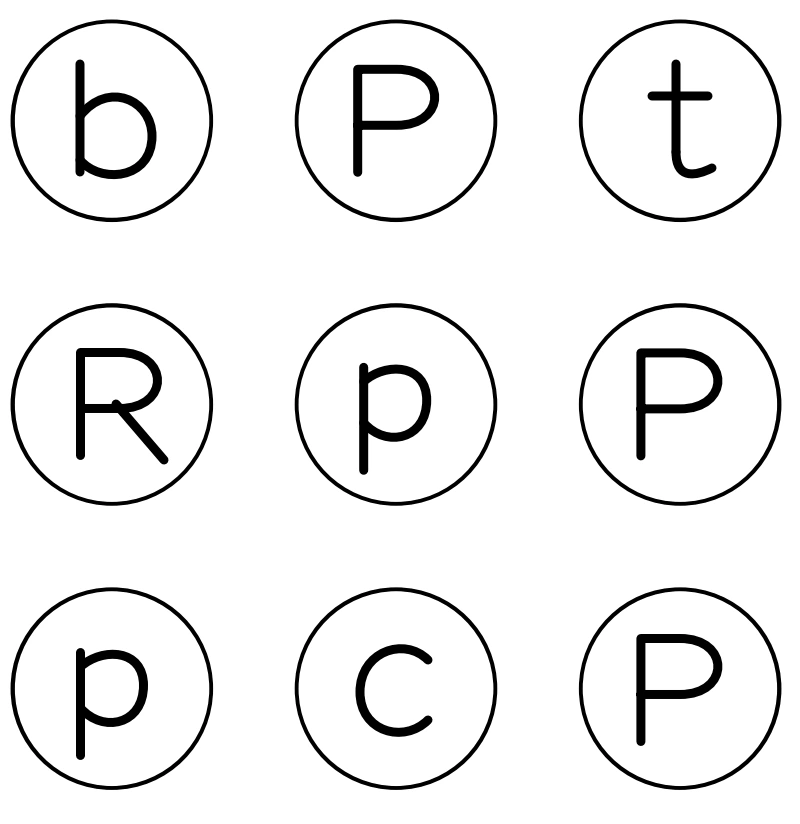
The first row has one answer. The second and third rows have two each, making five matches across both cases.
The rows read b, P, t; R, p, P; and p, C, P. There are three capital and two lowercase Letter P choices. Ask the learner to point first so you can see the recognition decision before coloring control becomes another task.
Lowercase b and p both have a stem on the left of a rounded part. Their vertical relationship differs: b rises above its bowl, while p reaches beneath it. Compare the complete forms rather than telling a child that one merely faces the other way. That explanation would miss the useful Letter P feature.
Capital R adds a diagonal leg that P does not have. Point to that extra stroke if R is selected. The open C has no upright stem and is another nonmatch. A clear reason for rejecting a distractor supports the next Letter P choice more than a correction with no explanation.
A penguin and a pineapple begin with the same brief sound
Name the introduction animal as penguin. In the lower picture area, pineapple is at the upper right. Say the names naturally and compare their beginnings. The /p/ is a short release of air after the lips close, rather than a sound to stretch into a long hum.
The other options are kite, fish and drum. None of those usual names begins with /p/. Let the child name or point to the pineapple before making a Letter P sound choice. If the fruit name is unfamiliar, supply it; the picture task should not depend on guessing a word the learner has never heard.
Keep the Letter P consonant model brief rather than turning it into a separate “puh” syllable. You can say penguin, pause, then pineapple. A learner may hear the Letter P connection while still needing an adult to identify the written form. Support naming and shape recognition separately when necessary.
At home, a postcard gives the little p somewhere to go
Leena dictates a pretend message from a penguin: “I have a parcel for you.” Her older brother writes the sentence on a card. When she adds a little p beside the picture, she stops the stem at the line. Together they compare the ruled Letter P guide and notice the extra space underneath.
For home practice, introduce a case, demonstrate one guide and let the child choose a modest tracing selection. Pause to check either the joined bowl or the lower stem. End with a picture or search choice, or let the learner dictate a second postcard sentence. The Letter P visit can be useful without a fully completed page.
Offer this resource to supported preschool and kindergarten learners, often roughly three to six years old, adapting to current control and attention. A child who prefers pointing can identify the pineapple or a matching p. Another learner may be ready to compare several Letter P examples with a pencil.
In class, locate the rule before tracing across it
A teacher lays a narrow paper strip beside the lower rule of a large p demonstration. Children point to the bowl above the reference and the stem below it. The strip is moved aside before tracing, leaving the complete Letter P model visible. The temporary reference makes position easier to discuss.
After the Letter P finger demonstration, children attempt a few dotted examples and explain one placement decision. The sheet provides eight capital P models and seven lowercase p models, fifteen altogether. They are guided routes, with no separate blank writing strip. Spare examples can remain for another Letter P session.
Demonstrate from the same viewing direction as the learners and keep the page steady. When the group moves to the search, ask each child for one independent selection. That helps the teacher distinguish following a classmate's coloring from recognizing Letter P personally.
Six postal tasks to extend Letter P play

Choose the parcel's destination
Let the child tell an adult where the imaginary parcel should go. Draw a simple recipient and write P on the parcel tag. The learner connects the parcel name with Letter P before describing the delivery.
Leave space on a postcard
Draw a writing rule close to the bottom edge of scrap paper, then another with more room underneath. Ask which gives little p a clearer place to descend. Compare both with the Letter P row.
Invent a pineapple clue
The learner describes the pictured fruit without naming it: perhaps its spiky top or patterned skin. An adult guesses pineapple and repeats the initial /p/. The child can then locate a Letter P match.
Sort the letter post
Prepare large P, p, b and R cards. The child puts only P/p into a pretend postbox and explains one rejected card. Use the actual Letter P models as references whenever a choice feels uncertain.
Dictate a tiny greeting
Invite one sentence the penguin might send with its parcel. An adult writes the message while the child chooses a P or p to add nearby. Spoken composition can stay richer than the current handwriting demand.
Hear a reply from the recipient
Switch roles and invent a response to the penguin's greeting. Ask which part of the message needs a picture. Return to penguin and pineapple as Letter P words after the conversation.
The scene is a pretend story prompt, so the child can choose the destination and events. Select one postal task at a time. The purpose is a meaningful return to Letter P, not a requirement to complete six games after tracing.
Choose the next Letter P demand deliberately
| If today is about | Offer | Watch for |
|---|---|---|
| Position | One lowercase guide and a reference rule. | The stem continuing below the bowl. |
| Recognition | A pointing search before coloring. | Both P and p accepted under one rule. |
| Language | A picture name or dictated postcard. | A clear word or understandable message. |
Common difficulties include an undersized lower stem, a bowl detached from the upright, or selecting b because of its rounded part. Show the relevant feature again at a larger scale. Address one Letter P issue instead of changing every aspect of the child's attempt simultaneously.
For regular Letter P practice, return at a calm familiar moment and offer a small choice. Save a guide or postcard idea for tomorrow. Children may enjoy the penguin, the delivery story or the discovery that writing can carry a message. Praise a visible decision, such as leaving space beneath p or checking R's extra leg.
If movement needs a broader start, choose prewriting paths with room to move. A later visit can use another capital-P tracing format. For gradual comparisons, select a few forms from the complete A-to-Z tracing group.
Download Letter P and preserve the lower writing space
The free sample uses the original worksheet with website branding. Use a current qualifying membership to access the clean premium Letter P edition. In this PDF, the website branding is removed, no website watermark remains, and the printable pages contain no added advertisements. The original exercises are preserved.
- Choose the original sample, or sign in to a qualifying membership and use the premium download option.
- Open the file in a PDF reader. Check that it contains one portrait sheet in US Letter size, 8.5 inches across by 11 inches down.
- Inspect the border and the space beneath the lowercase stems. Print at actual size when everything fits; use fit-to-page when your printer would otherwise clip an edge.
- Check one test copy for all fifteen guides, nine circles and four picture choices before making a group set. Begin with one manageable Letter P task.
Popular Worksheets
Printable resources families and teachers are downloading now.
 Free
 Free
 Free
 Free