
Umbrella and Unicorn: 4 Powerful Letter U Wins
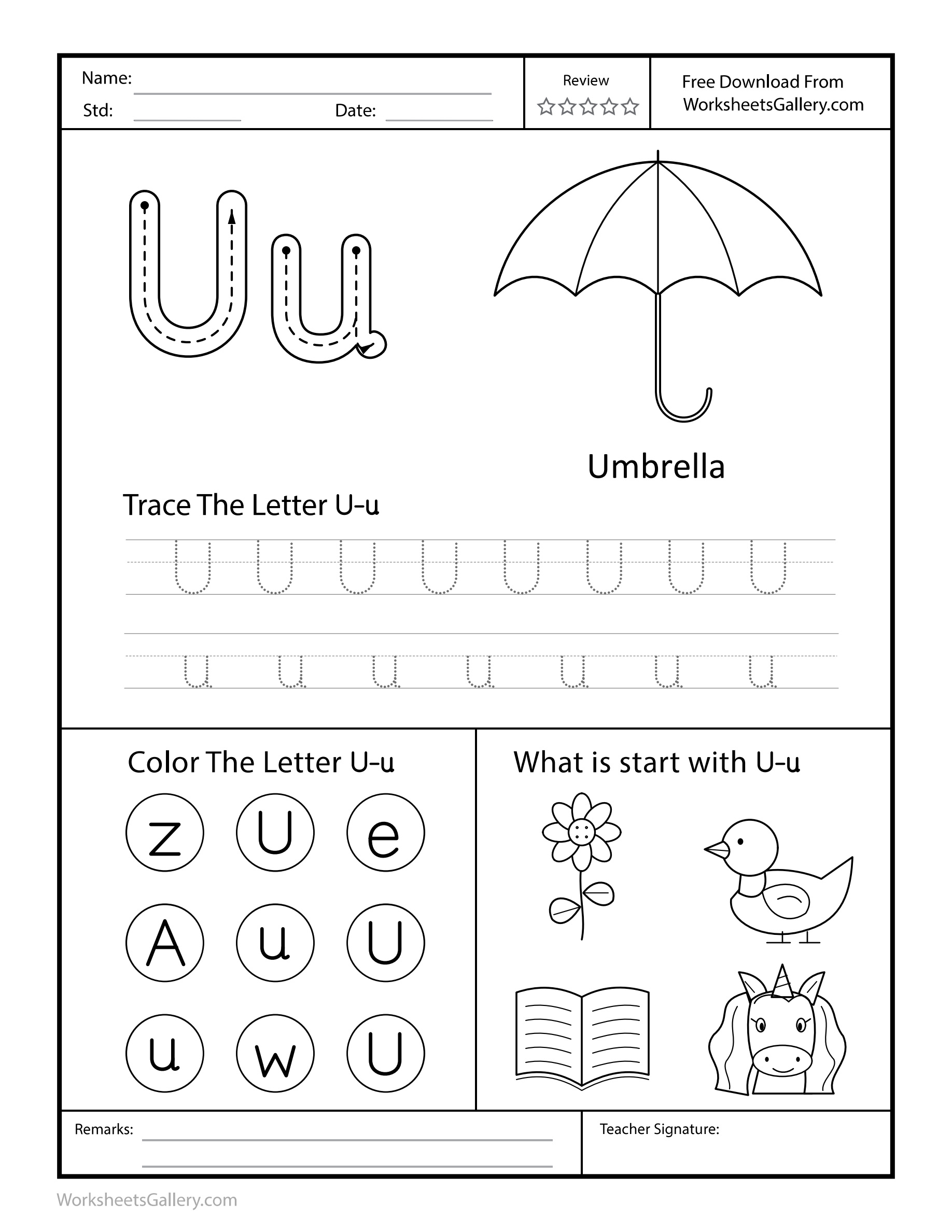
Say umbrella, then unicorn, and listen before making a choice. Both names begin with written U, although their spoken beginnings differ. That distinction makes this Letter U worksheet an interesting conversation as well as a tracing activity. An umbrella introduces the page; a unicorn appears among the picture choices. Eight capital guides and seven lowercase guides provide movement practice, while five matching circles test recognition. Explore the rounded base, notice the small form's extra return, and let Letter U connect careful looking with a child's own explanation of what they hear.
☂ First decide: are we choosing a written initial or listening for a particular beginning?
Two Letter U words need two listening descriptions
Umbrella opens with the short u sound heard in up. Unicorn begins with “yoo,” like the spoken name of U. The shared written initial does not make the two openings sound the same. Establish that difference before asking the child to choose a Letter U picture.
| Word | Written beginning | What to notice aloud |
|---|---|---|
| Umbrella | U/u | Short u, as in up. |
| Unicorn | U/u | A “yoo” beginning. |
The adult can write both names on scrap paper and point to their first letters. Reading the complete words independently is unnecessary. A learner can hear their different openings while an adult supplies the print connection.
For this page, choose unicorn as the intended U-initial object. If today's separate goal is short-u listening, use umbrella with a word such as up. Keep that Letter U listening task distinct from the worksheet's written-initial choice.
The lower boxes separate two Letter U decisions
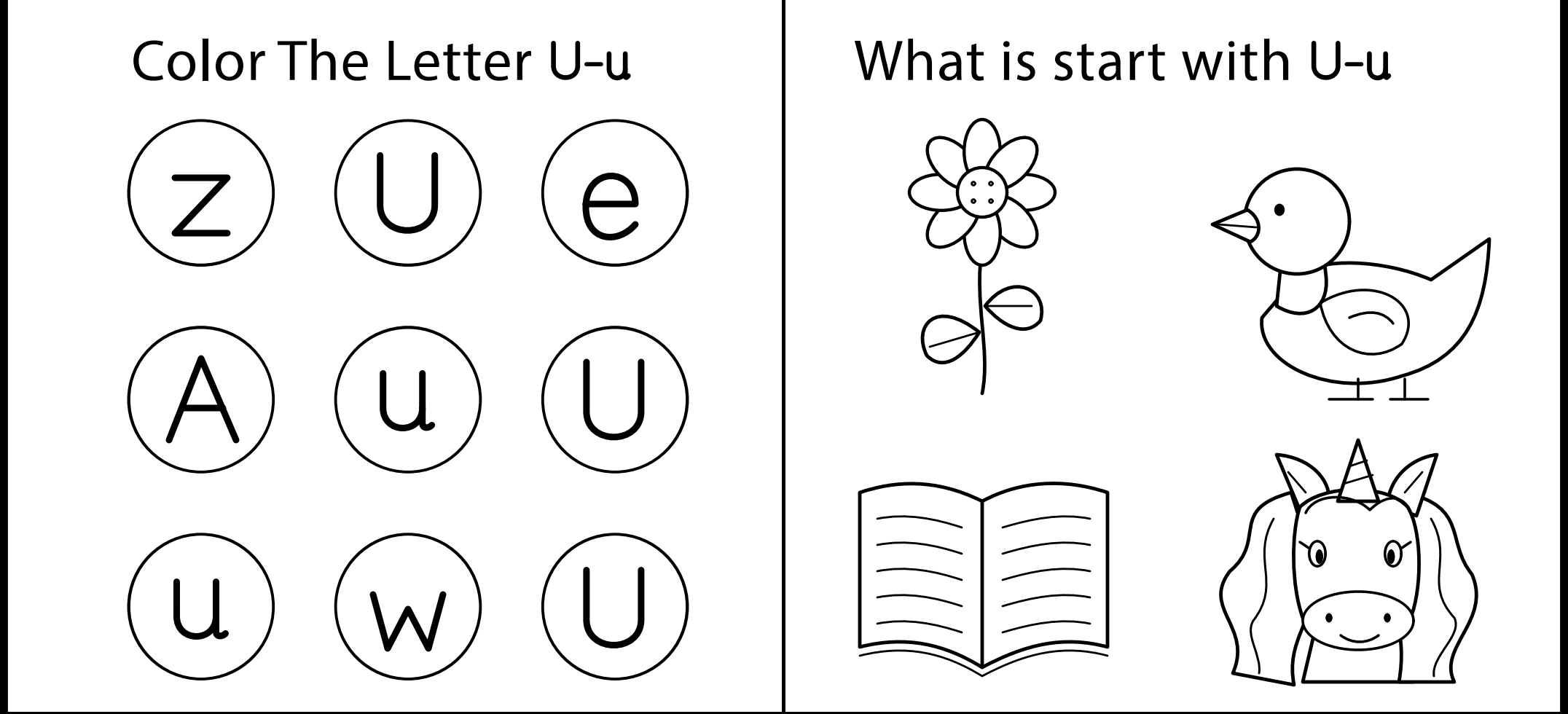
Flower is at upper left, duck at upper right, book at lower left and unicorn at lower right. Supply these names first. A child who calls the horned character “a horse” needs the intended word unicorn before a Letter U choice can be meaningful.
Point out the horn and introduce the word without turning the activity into a test of imaginary-animal knowledge. Unicorn supplies written U in this set. The umbrella above the practice rows provides a different Letter U example, with a different spoken beginning.
Let the child point or say the name before coloring. In the neighboring box, the rule changes: now the task is to recognize U and u among other letters. One successful picture answer does not automatically show letter-form recognition.
Five Letter U gains worth noticing separately
For many learners aged three to six, one part of this page will be easier than another. These five opportunities help an adult notice the thinking, movement and language involved in Letter U practice.
- A Letter U distinction between print and speech
- The child can learn that two words share a written beginning even when the first sound heard is different. That observation supports more precise questions.
- A rounded Letter U change of direction
- Guiding the pencil around the bottom of U involves changing from downward to upward movement through a curve, rather than a pointed corner.
- Attention to the lowercase finish
- Following the right-side return gives the hand a specific finishing task beyond making a smaller capital shape.
- An explained visual selection
- The learner compares U/u with z, e, A and w, using features of the whole letter instead of choosing every open shape.
- Useful vocabulary for disagreement
- A child can explain “They do not sound alike” and hear an adult clarify the question. A thoughtful objection becomes part of the lesson.
The helping hand keeps the sheet still while the writing hand follows its route. Meanwhile, the child is comparing forms, remembering a selection rule and using words to explain a decision. Letter U understanding may be visible through conversation before tracing becomes steady.
Round the Letter U base, then notice the lowercase return
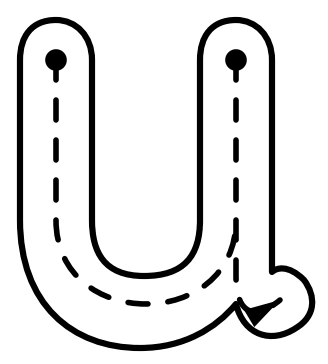
The capital Letter U travels down one side, rounds the base and rises on the other. Its top stays open. Keep the bottom rounded rather than pointed; a sharp point changes the resemblance toward V. The oversized Letter U model gives an adult room to demonstrate that turn.
The lowercase Letter U form printed here adds another action. After rounding the base and rising on the right, the route returns down that side and finishes with a small exit. Lowercase u is more than a reduced capital U in this model.
Follow the dots and arrows with the handwriting method used in your setting. Compare the tall capital row with the smaller ruled row below. Give the Letter U movement enough room before asking a child to reproduce it at the smaller size.
At home, a Letter U objection can reveal good listening
Zain looks at the umbrella, hears its name and then hesitates over unicorn. “That one starts differently,” he tells his grandmother. She agrees with his listening. Then she writes the two names and points to their shared first letter.
She changes the question to “Which picture's name begins with written U?” Zain chooses unicorn and explains that the question is about a letter this time. His Letter U decision now has a reason beyond following an adult's answer.
Later, they choose a capital guide to trace and discuss its rounded bottom. The naming conversation and the pencil task can happen in separate short moments. A child does not have to settle every Letter U idea in one sitting.
Keep the original worksheet visible, but use separate paper for added word labels. Offer enough time for the child to question a choice. A calm clarification can preserve curiosity when a familiar letter behaves differently in two words.
Two story windows give Letter U vocabulary somewhere to go
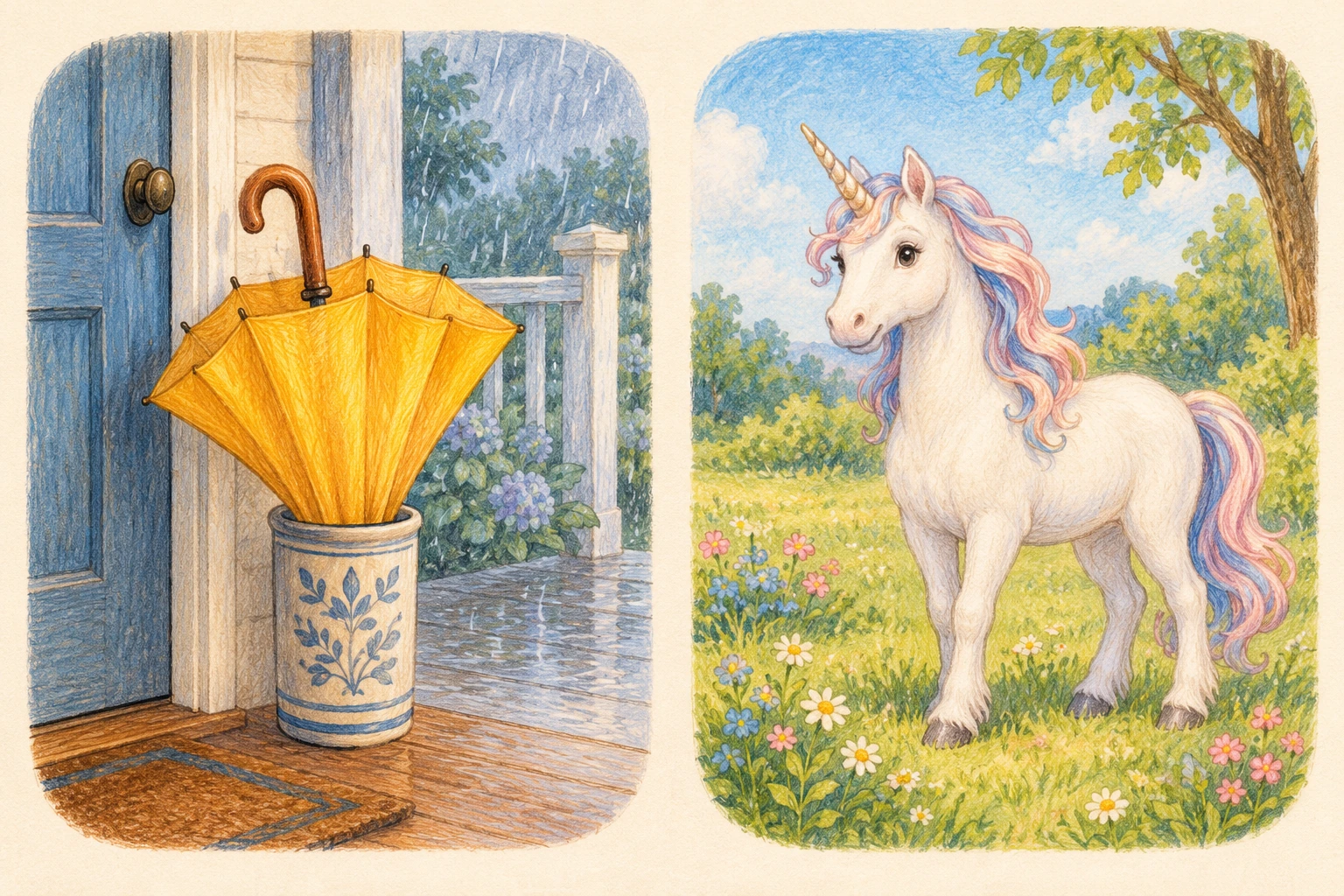
One picture suggests a rainy day; the other opens an imaginary meadow story. Ask which setting the child would like to describe. The choices share Letter U in print while offering different things to say, notice and imagine.
The unicorn is a story character. The umbrella is an everyday object. Let those meanings stay distinct while comparing their names. A learner may enjoy explaining a practical use for one and inventing an adventure for the other.
In class, say which Letter U question you mean
A teacher names all four pictures with the group before asking for a response. She makes the written-initial question explicit, then explains why unicorn belongs. On separate word cards, she contrasts umbrella with unicorn aloud so the children hear why a short-u question would be different.
- Establish the intended Letter U picture names.
- State whether the choice concerns written U or a spoken beginning.
- Invite a point and a short explanation from each learner.
- Demonstrate the selected capital or lowercase Letter U route.
- Allow a chosen tracing attempt, then inspect the rounded base or return.
A clear question prevents a vocabulary or sound disagreement from being confused with weak recognition. Keep the Letter U models upright and the sheet steady. The Letter U examples can then support a short movement lesson after the naming decision.
Four picture-led invitations for Letter U exploration
1. Choose for a rainy journey
Describe a pretend walk in the rain. The child chooses an umbrella and explains its purpose. Say umbrella and up together to notice their short-u opening, then find U/u on the page. This Letter U invitation combines a practical decision with one clearly specified listening comparison.
2. Give the unicorn a new event
Start a meadow story and ask what the unicorn discovers. Write unicorn if the learner wants to see its name, then point to its initial. The story can continue with any sensible word the child chooses; it need not collect a string of U words.
3. Match names before comparing openings
An adult places written umbrella and unicorn labels beside their pictures. The learner points out the first letter that looks alike. Then say the words and discuss what sounds different. Separating those two steps makes the Letter U discovery easier to explain.
4. Inspect a curve and a corner
An adult draws a clear U beside a clear V. Compare the rounded base with the pointed base, then locate the matching model on the worksheet. Move the comparison cards to new positions and explain again. The Letter U decision should follow the form, not a memorized place.
Audit the five Letter U matches by their features
The circle rows read z, U, e / A, u, U / u, w, U. There are three capitals and two lowercase forms. Select the middle of the first row, the two right-hand circles in the second row and the two outside circles in the final row.
The distractors are z, e, A and w. The w has multiple pointed changes, while U has a rounded base. Look at the complete printed forms when explaining a choice. A Letter U answer needs more than an opening at the top.
Pointing first leaves room to discuss a change of mind before coloring. If a child accepts only the capitals, compare the lowercase route with the smaller practice guides. Both cases count in this Letter U search.
Keep the next Letter U visit short and specific
Common difficulties include a pointed bottom, a closed top, or a lowercase return that is omitted. Compare one feature with the source model and demonstrate on larger paper if helpful. If the task concerns words, check the question before correcting the child's answer.
Eight capital and seven lowercase guides make fifteen available examples. They can serve several visits. A familiar brief routine might start with a picture name, move to a chosen Letter U model and finish with one observation about the curve.
Children may enjoy the rainy-day decision, the imaginary character or the chance to notice something an adult needs to explain. Acknowledge a particular idea: “You heard that those words begin differently.” Curiosity can be a useful reason to return.
For a broader movement start, try longer curved tracing paths. Compare formats with the other U tracing resource, or choose future practice from the complete alphabet tracing group.
Print Letter U with its rounded paths clearly visible
The free option supplies the original branded sample. A qualifying active membership provides a separate clean premium Letter U PDF. Website branding and domain text are removed from that edition, leaving no website watermark; no advertisements are added to the printable. Its learning content remains complete.
- Choose the sample, or sign in and use the clean member edition supported by your current plan.
- Open the PDF and inspect the umbrella introduction, both tracing rows and the complete lower tasks.
- Set US Letter portrait paper and a print scale that keeps the worksheet frame inside the usable page area.
- Check a test copy for visible dotted curves and the small lowercase returns before printing more.
Offer the Letter U page on a firm writing surface. Begin with an accurate name and a clear question, then let the learner choose a word, a circle or a tracing route to discuss.
Popular Worksheets
Printable resources families and teachers are downloading now.
 Free
 Free
 Free
 Free