
Tripod Number 3 Tracing for a Brilliant Look at Three Corners
Keep the three lesson handy alongside the other 99 original tracing sheets in one $8 printable collection.
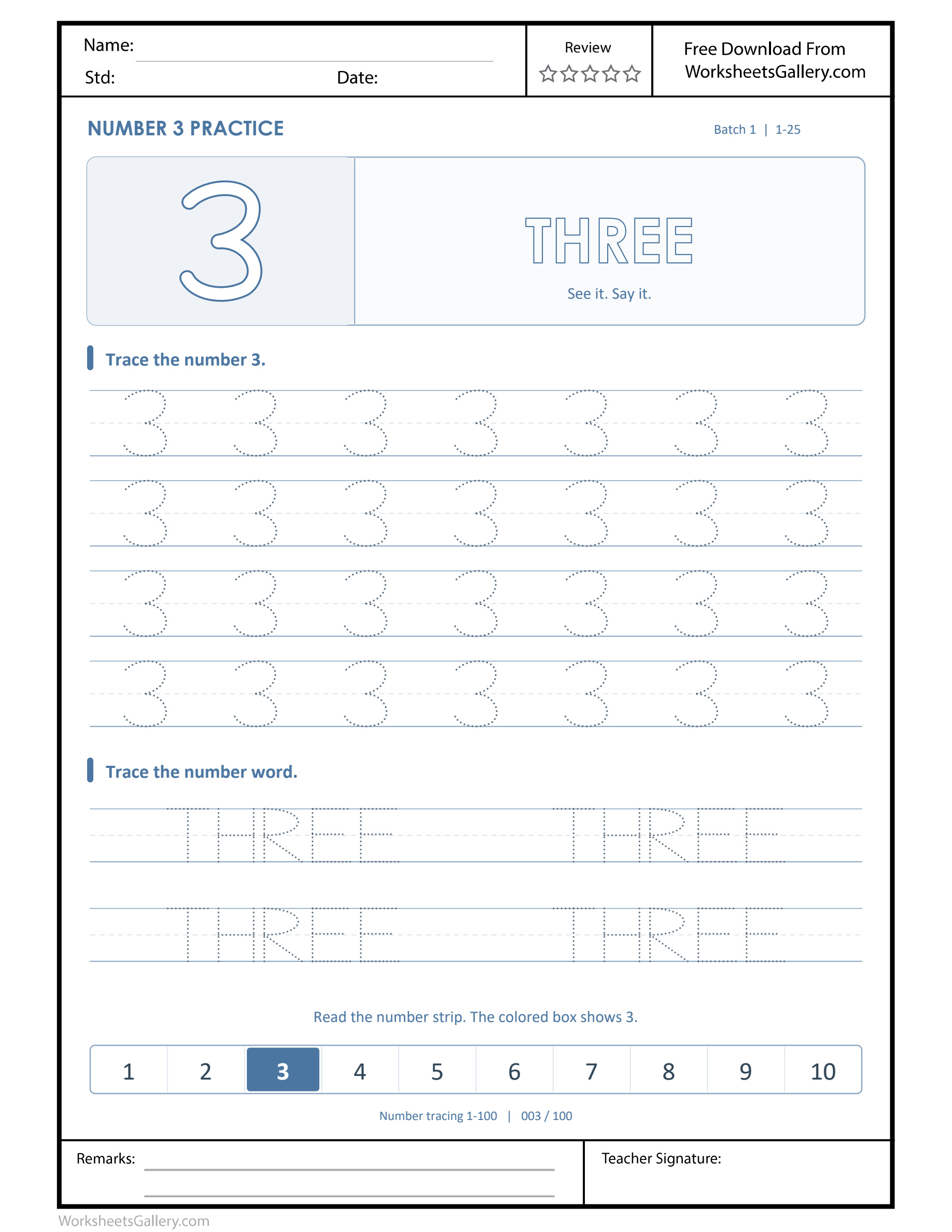
The original THREE worksheet retains every numeral, word and sequence activity.
The full sheet pairs the large 3 model with four numeral lines, two THREE writing rows and its ten-number strip.
Ada sets three toy feet beneath a pretend camera. She pushes one foot farther away and looks again. The triangle seems larger, yet the number of supports remains the same when she touches each foot once. Which label fits the tripod feet? Number 3 Tracing invites a comparison between the answer and its printed forms. Say three while pointing at the outlined 3. Move to a dotted copy when the child is ready and use the 1–10 strip to check its place.
Number 3 Tracing with a single movement cue
A low-pressure way into the THREE page is to watch the adult make one mark, then take a turn. The cue for 3 is to guide the upper curve into the middle and the lower curve back toward the left. Stay close to the model and compare one part of the result that the child can name.
Look for a middle turn in the printed 3. A learner who draws two separate arcs may recognize the component shapes but miss their connection. Give the middle point a quiet verbal cue and leave a little space for a slow attempt. Try recognizing 3 from two different sized cards before expecting a neatly written figure.
What appears on the tripod lesson sheet
- Find 3 and THREE. The top panel separates 3 from its name. Say three, then point to the outlined 3.
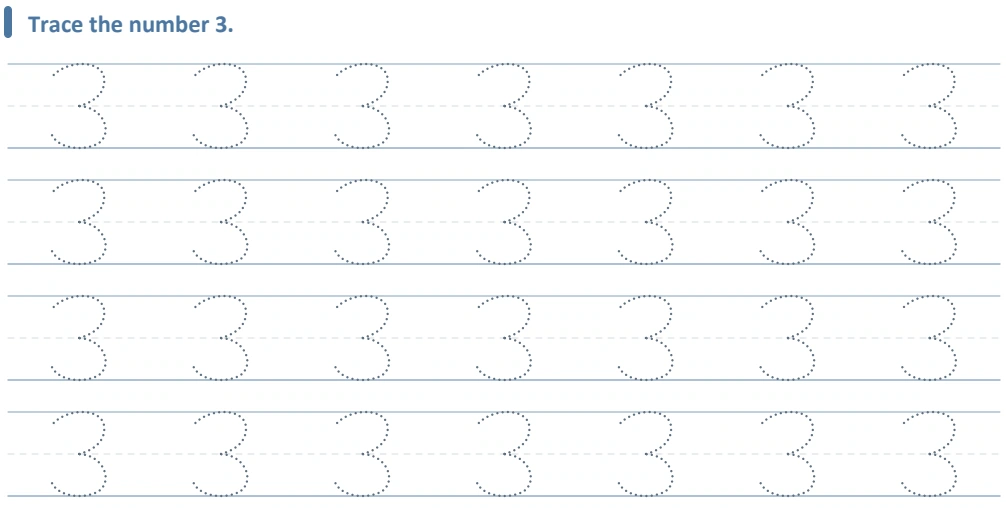
- Choose a line for 3. Each line has 7 dotted models of 3. Use just part of a row to guide the upper curve into the middle and the lower curve back toward the left.
- Trace THREE. Its two ruled lines show THREE in dotted capitals. Save the lower THREE line for another day.
- Locate 3. Position 3 on the strip shows 3. Point at 1 and 10 and decide whether 3 sits near an end.

A small way to check the middle of 3
Ask Ada to draw the front of the camera beside its three supports. Make three different pictures of the feet, starting each time with the support in a different position. Have the child check the supports while ignoring the camera shape itself. Use a paper label with a large 3 so the camera and stand can be put away together. Find the place on the printed 3 where the upper turn hands over to the lower one. Let the child show that change to an adult by drawing slowly in the air.
Troubleshoot 3 with a small second attempt
| What happened with 3 | Cue | Check for THREE |
|---|---|---|
| Counting the spaces between the supports as objects. | Return to a triangular arrangement that can become a row without changing its total. | Show the tripod feet and check the first label. |
| The pencil leaves a dotted 3. | Show where the printed 3 changes direction. | Follow one dotted 3 slowly and compare that turn. |
| The THREE label gets a quick guess. | Point across THREE. | Revisit a missed letter from THREE. |
| The reader misnames the 3 cell. | Look for 4 to the right of 3. | Hide 3 and read a neighbor. |
Choose one cue for the tripod moment. If the child rushes 3, check the count with the tripod feet first. Return to a short 3 attempt once the amount is clear.
How to check the THREE total
The lesson separates how far objects spread from how many objects there are. Three tripod feet may make a tiny or a wide triangle, and three feet may stand in a line on a drawing. Have the child place a finger on each support instead of sweeping the space between them. After moving one foot, ask whether anybody brought in a new one or took an old one away.
What did Ada move, and did she change the number of feet? Listen for a triangular arrangement that can become a row without changing its total. With the tripod feet in view, decide together whether 3 still fits.
Home practice with tripod feet and 3
Put three wide jar lids into a triangle on the table. Slide the bottom lid sideways, then turn the triangle into a line. Let the child choose where to start a count each time.
- Start with the tripod supplies. Say 3 together before pointing at its outline.
- Ask how the tripod feet show a triangular arrangement that can become a row without changing its total. Let the child move those tripod feet while explaining.
- After the tripod activity, pick a dotted 3 model and have an adult read THREE.
- Note which part of 3 needed a cue. Plan the next tripod visit around that movement.
Locate 3 without relying on the color
Look for 4 to the right of 3. Hide the shaded 3, read its exposed neighbors and ask which value is covered. Reveal 3 and read three. One correct location is enough during the tripod exercise.
Use a ruler or folded paper to expose only a few cells near 3. Let the reader uncover the rest one at a time and predict what is next. Finish by checking 3 against the figure model at the top of the page.

Six skills visible in the THREE practice
Let two classmates check the 3 work
In a small group, put three floor spots in a triangle, then invite a child to turn them into a line. Read 3 together first. Then divide the tripod jobs.
Assign one partner to move the tripod feet and another to read 3. A third child can ask, “What did Ada move, and did she change the number of feet?” Rotate after one tripod explanation. Leave 3 in view for the partner who checks it.
Make a second tripod display by rearranging the tripod feet. While one learner writes 3, another can explain a triangular arrangement that can become a row without changing its total. Ask the group to find 3 on the 1–10 strip.
Give THREE a reading turn
Say THREE while showing 3. In this reading turn, notice the double E at the end of THREE. Track THREE from its first letter onward. After one THREE trace, read 3 aloud again.
During the tripod session, give THREE a job such as labeling an envelope. The child can match the printed word to the label even when writing all of it is a stretch. Ask whether the label and the numeral 3 name the same thing.

Three legs can face any way
Make a tiny stand on paper with one long leg and two short ones. Replace the long leg with a shorter piece. A child might say the new design has less because it looks smaller. Say “fewer legs” only if a leg is taken away without a replacement. This gives a reason to compare 2, 3 and 4 on the strip. Trace one 3 after designing a stand that still has three feet. Keep the sketch as a record of the quantity, and invite the learner to explain the two curved parts of the written mark separately.
Build a second lesson around tripod feet
- Make a tripod sign. Ask the learner to label an open triangle with the number of corners its three dots mark. Let a partner explain why 3 fits before tracing it.
- Rearrange the tripod feet. Count 3, move the tripod feet and predict the recount. Add one to 3 for a different result.
- Point to 3 in silence. Indicate 3 and a neighbor on the 1–10 strip. A partner reads 3 and chooses the THREE card.
- Record the tripod report. A child can explain a triangular arrangement that can become a row without changing its total in a pretend message. Give the report a 3 label.
- Write 3 on another surface. Set THREE next to a board or dark paper. Compare your two 3 attempts with the outline.
Return to 3 when the child is ready
The THREE page suits preschool and kindergarten children around 3–6 with some pencil control. During tripod play, a younger child can point at 3 or move the tripod feet. Let the child choose when to try writing 3.
Give each visit to 3 a purpose. Try the shape of 3 today and explain the tripod count another day. Ask which THREE task to revisit.
Ask what changed in the latest 3. Did it help to guide the upper curve into the middle and the lower curve back toward the left? Save one THREE line for later. End with the child's description of 3.
Practice to pair with the tripod lesson
Compare a page of pencil-control paths with your 3 lesson. Try the earlier 1–10 tracing set after tripod play, or pair 3 with a mixed 1–10 numeral sheet.
Family play with tripod feet can grow from NAEYC family play ideas. For a tripod variation, browse PBS KIDS for Parents and adapt an activity around 3.
Put the 3 practice on US Letter paper
Use the free download on this page for the original THREE worksheet. If you have an eligible active membership, sign in and choose the member download for the clean 3 PDF.
Select US Letter portrait for the 3 PDF. Check the border around THREE in print preview. Give the 3 dots a standard-quality test.
Print the clean THREE file without watermarks or ads. The $8 collection includes 3 and the other 99 sheets.
Related Topics
Popular Worksheets
Printable resources families and teachers are downloading now.
 Free
 Free
 Free
 Free