
Clockwork Number 15 Tracing for a Bright Read for Fifteen
Keep the fifteen lesson handy alongside the other 99 original tracing sheets in one $8 printable collection.
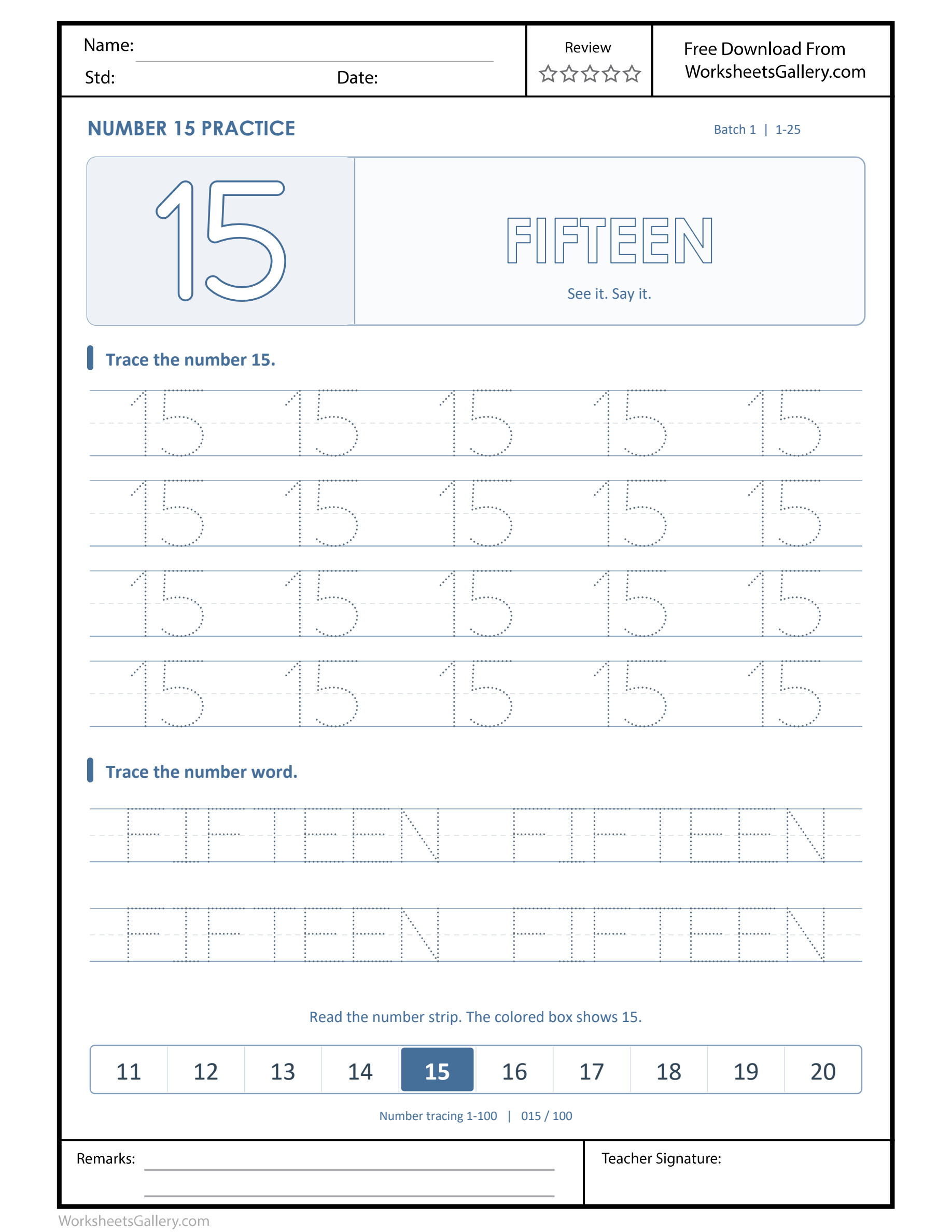
The original FIFTEEN worksheet retains every numeral, word and sequence activity.
The full sheet pairs the large 15 model with four numeral lines, two FIFTEEN writing rows and its ten-number strip.
A pretend library clock gives Nia fifteen minutes for story time. She uses fifteen paper minute tiles to model the wait, then puts ten in a row and five below. Her partner matches the amount to the clock sign. Use Number 15 Tracing to give the minute tiles a written label. Read fifteen aloud and look at its large printed model before tracing. In the 11–20 strip, find 15 and compare it with the numbers around it. A conversation about ten tiles plus five, or three groups of five can lead into a short writing turn.
Where the FIFTEEN sheet puts each clue
- Find 15 and FIFTEEN. The top panel separates 15 from its name. Say fifteen, then point to the outlined 15.
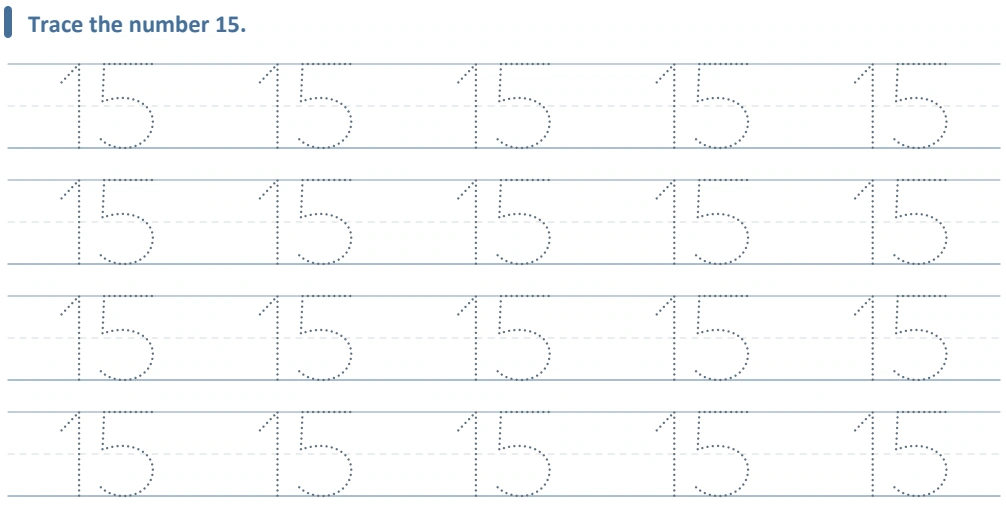
- Choose a line for 15. Each line has 5 dotted models of 15. Use just part of a row to make room to turn the bottom curve of 5 beside the straight 1.
- Trace FIFTEEN. Its two ruled lines show FIFTEEN in dotted capitals. Save the lower FIFTEEN line for another day.
- Locate 15. Position 5 on the strip shows 15. Point at 11 and 20 and decide whether 15 sits near an end.

A wait can be shown in three turns
Put out three five-minute paper strips. Mark a stop after each group, then rearrange all the tiles into ten and five. A child can check both totals by counting the same minutes once. Lay the worksheet beside the model and ask which printed digit tells about the extra five in the second arrangement. You can hold a small flag at the middle of the 5 curve if the pencil drifts there, removing it after one deliberate trace. Finish by asking what would happen to the lesson label if one minute were added.
A five-minute marker after the first ten
Prepare three identical paper bars, each labeled 5. Put two together under a 10 label, and then attach the third at the right. Give a child the job of finding the amount in the worksheet strip and matching the label to the whole row. Before tracing 15, compare that row with a half of the display and explain which groups belong in the total. Follow the 5 inside 15 at a calm pace, stopping briefly at its curved base if the learner needs to examine that part of the shape.
Home practice with minute tiles and 15
Put three groups of five paper squares on a table. Ask your child to build ten from two groups and place the final group to the side before matching the label.
- Start with the clockwork supplies. Say 15 together before pointing at its outline.
- Ask how the minute tiles show ten tiles plus five, or three groups of five. Let the child move those minute tiles while explaining.
- After the clockwork activity, pick a dotted 15 model and have an adult read FIFTEEN.
- Note which part of 15 needed a cue. Plan the next clockwork visit around that movement.
Give FIFTEEN a reading turn
Say FIFTEEN while showing 15. In this reading turn, listen for the end of FIFTEEN while tracking its printed TEEN letters. Track FIFTEEN from its first letter onward. After one FIFTEEN trace, read 15 aloud again.
During the clockwork session, give FIFTEEN a job such as labeling an envelope. The child can match the printed word to the label even when writing all of it is a stretch. Ask whether the label and the numeral 15 name the same thing.

How to check the FIFTEEN total
Fifteen works as an amount of time and as a count of fifteen minute tiles in a model. A learner does not need to read a clock independently to use the comparison. One longer row of ten and a shorter row of five provide a quick amount check. For a second representation, make three groups of five and recombine them.
Would a library story still last fifteen minutes if the same tiles were shown in three groups? Listen for ten tiles plus five, or three groups of five. With the minute tiles in view, decide together whether 15 still fits.
Let two classmates check the 15 work
In a small group, set three teams to count five tiles each and combine their reports. Read 15 together first. Then divide the clockwork jobs.
Assign one partner to move the minute tiles and another to read 15. A third child can ask, “Would a library story still last fifteen minutes if the same tiles were shown in three groups?” Rotate after one clockwork explanation. Leave 15 in view for the partner who checks it.
Make a second clockwork display by rearranging the minute tiles. While one learner writes 15, another can explain ten tiles plus five, or three groups of five. Ask the group to find 15 on the 11–20 strip.
Number 15 Tracing with a single movement cue
Before handing over a pencil, ask your reader to show 15 with a finger on the large model. The movement focus is to make room to turn the bottom curve of 5 beside the straight 1. Put a clean slip beneath the first line of dots for 15 if the rows below distract.
FIFTEEN and FIFTY share an opening sound and a string of letters. Hear the entire number before selecting a card, especially the ending. On the worksheet, the printed word and 15 are paired clearly. Move from the word to the pair, then return to the dotted model only after saying the amount.
Locate 15 without relying on the color
Look for 16 to the right of 15. Hide the shaded 15, read its exposed neighbors and ask which value is covered. Reveal 15 and read fifteen. One correct location is enough during the clockwork exercise.
Use a ruler or folded paper to expose only a few cells near 15. Let the reader uncover the rest one at a time and predict what is next. Finish by checking 15 against the figure model at the top of the page.

Troubleshoot 15 with a small second attempt
| What happened with 15 | Cue | Check for FIFTEEN |
|---|---|---|
| Confusing a fifteen-minute label with 50 because fifteen and fifty begin similarly. | Return to ten tiles plus five, or three groups of five. | Show the minute tiles and check the first label. |
| The pencil leaves a dotted 15. | Show where the printed 15 changes direction. | Follow one dotted 15 slowly and compare that turn. |
| The FIFTEEN label gets a quick guess. | Point across FIFTEEN. | Revisit a missed letter from FIFTEEN. |
| The reader misnames the 15 cell. | Look for 16 to the right of 15. | Hide 15 and read a neighbor. |
Choose one cue for the clockwork moment. If the child rushes 15, check the count with the minute tiles first. Return to a short 15 attempt once the amount is clear.
Build a second lesson around minute tiles
- Make a clockwork sign. Ask the learner to make fifteen with a ten strip and a paper hand that supplies the extra five. Let a partner explain why 15 fits before tracing it.
- Rearrange the minute tiles. Count 15, move the minute tiles and predict the recount. Add one to 15 for a different result.
- Point to 15 in silence. Indicate 15 and a neighbor on the 11–20 strip. A partner reads 15 and chooses the FIFTEEN card.
- Record the clockwork report. A child can explain ten tiles plus five, or three groups of five in a pretend message. Give the report a 15 label.
- Write 15 on another surface. Set FIFTEEN next to a board or dark paper. Compare your two 15 attempts with the outline.
Six skills visible in the FIFTEEN practice
Return to 15 when the child is ready
The FIFTEEN page suits kindergarten and early primary learners around 4–7 with some pencil control. During clockwork play, a younger child can point at 15 or move the minute tiles. Let the child choose when to try writing 15.
Give each visit to 15 a purpose. Try the shape of 15 today and explain the clockwork count another day. Ask which FIFTEEN task to revisit.
Ask what changed in the latest 15. Did it help to make room to turn the bottom curve of 5 beside the straight 1? Save one FIFTEEN line for later. End with the child's description of 15.
Practice to pair with the clockwork lesson
Compare the earlier 1–10 tracing set with your 15 lesson. Try a mixed 1–10 numeral sheet after clockwork play, or pair 15 with the even-number dice game.
Family play with minute tiles can grow from NAEYC family play ideas. For a clockwork variation, browse PBS KIDS for Parents and adapt an activity around 15.
Put the 15 practice on US Letter paper
Use the free download on this page for the original FIFTEEN worksheet. If you have an eligible active membership, sign in and choose the member download for the clean 15 PDF.
Select US Letter portrait for the 15 PDF. Check the border around FIFTEEN in print preview. Give the 15 dots a standard-quality test.
Print the clean FIFTEEN file without watermarks or ads. The $8 collection includes 15 and the other 99 sheets.
Related Topics
Popular Worksheets
Printable resources families and teachers are downloading now.
 Free
 Free
 Free
 Free