
Double-Decker Number 22 Tracing for a Brilliant Twenty-Two Lesson
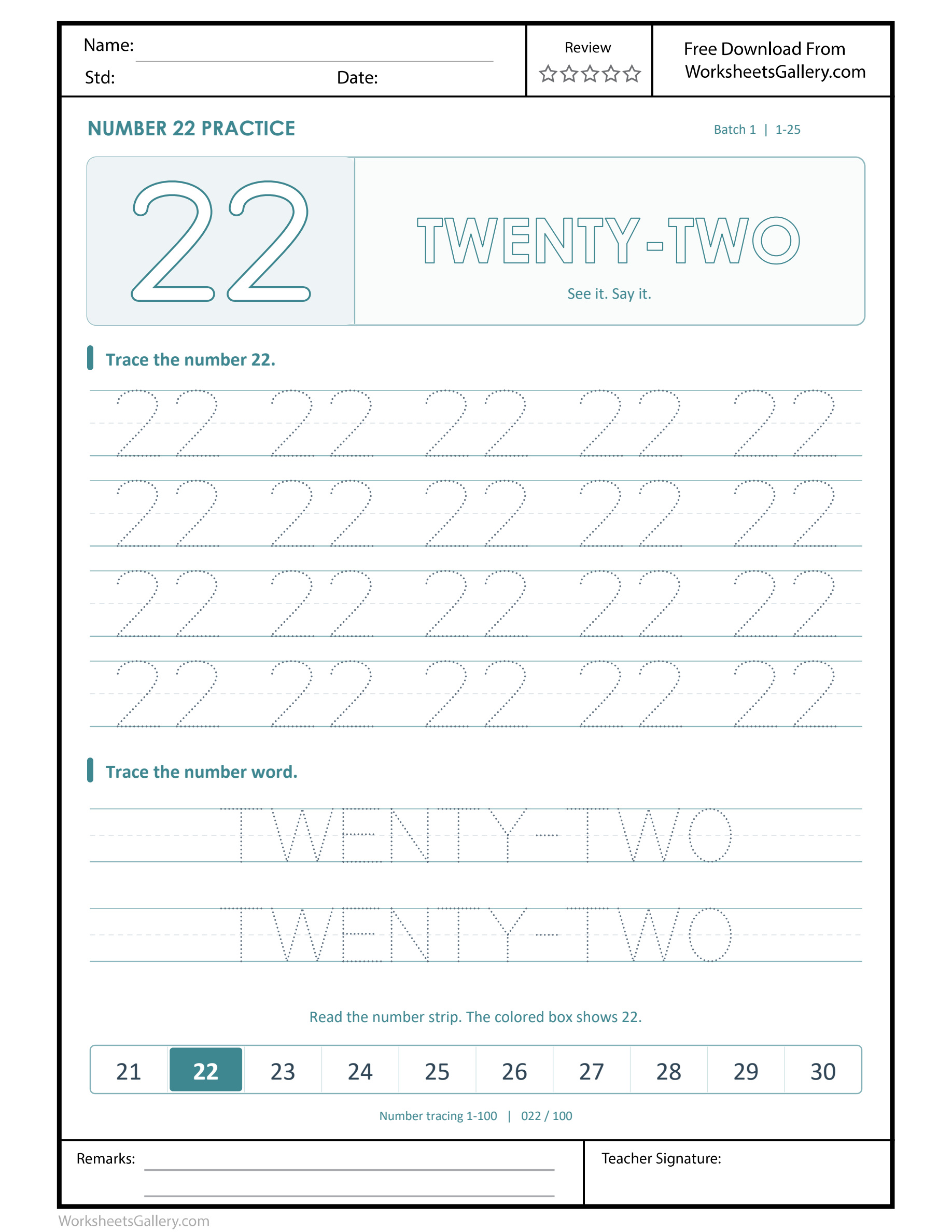
Keep the twenty-two lesson handy alongside the other 99 original tracing sheets in one $8 printable collection.
The original TWENTY-TWO worksheet retains every numeral, word and sequence activity.
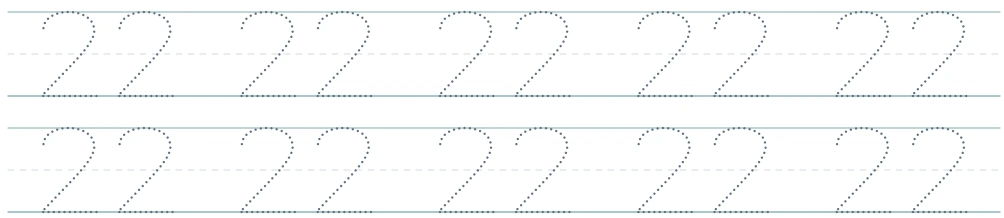
The full sheet pairs the large 22 model with four numeral lines, two TWENTY-TWO writing rows and its ten-number strip.
Two pretend buses bring eleven riders apiece to a show. Kiara groups all the rider tokens into tens and finds two loose after the second bundle. Now she has to explain why both written digits look alike in the total. Bring the rider tokens to Number 22 Tracing and look for the printed answer. The word TWENTY-TWO has its own place, while 22 appears first as a big outline and later on dotted lines. Finish the double-decker example by finding 22 on the short sequence strip.
A count for two separate bus doors
Open a pretend bus door for one group of eleven. Ask a child to point at a card that would fit the riders on that bus. Then open a second door and tally the combined group of twenty-two. Have a partner group the riders into tens while another holds up 22. They can tell whether the total stayed the same during regrouping. The double-digit model gives two opportunities to form the same curved route. Ask the learner to lift gently before the second 2 and look for the narrow blank between both complete shapes.
Four places to look on the 22 printable
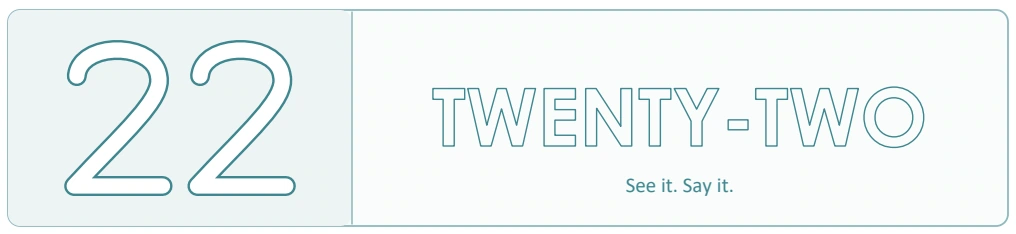
- Find 22 and TWENTY-TWO. The top panel separates 22 from its name. Say twenty-two, then point to the outlined 22.
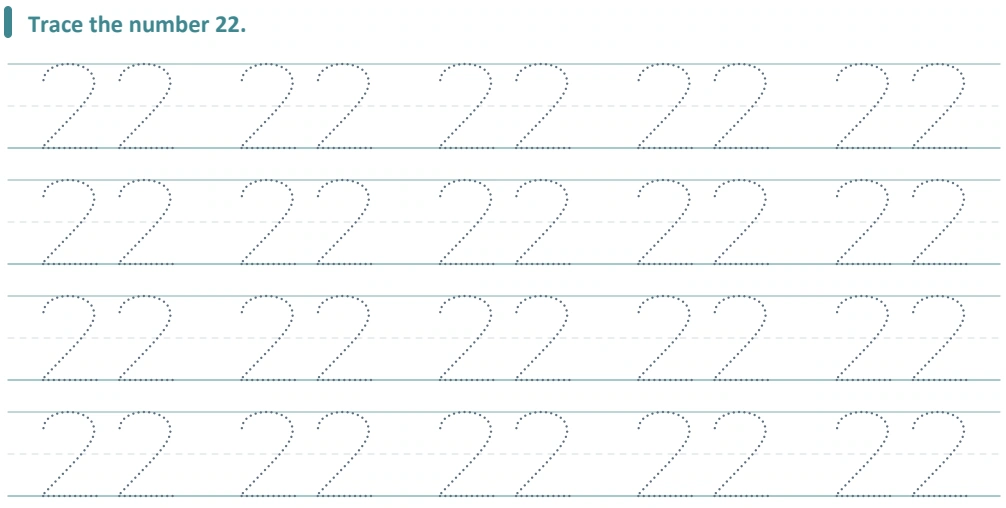
- Choose a line for 22. Each line has 5 dotted models of 22. Use just part of a row to repeat the same 2 movement with a fresh start and a visible separation.
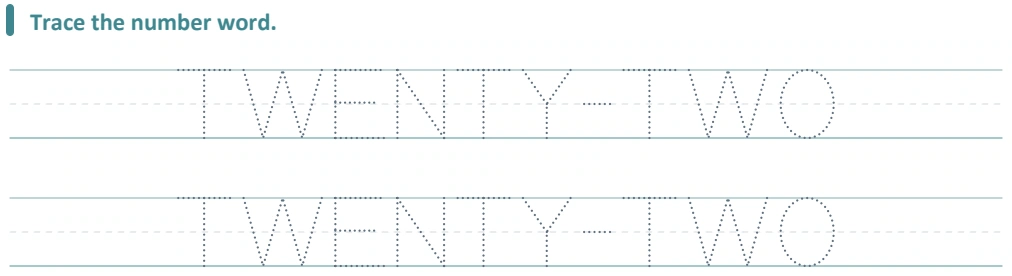
- Trace TWENTY-TWO. Its two ruled lines show TWENTY-TWO in dotted capitals. Save the lower TWENTY-TWO line for another day.
- Locate 22. Position 2 on the strip shows 22. Point at 21 and 30 and decide whether 22 sits near an end.
Invite a family partner to investigate twenty-two
Make two short lists of eleven tally slips and gather them together. Exchange twenty slips for two marked ten cards. Lay the two leftovers beside those cards and ask the child to label both parts together.
- Start with the double-decker supplies. Say 22 together before pointing at its outline.
- Ask how the rider tokens show eleven and eleven regrouped as two tens and two ones. Let the child move those rider tokens while explaining.
- After the double-decker activity, pick a dotted 22 model and have an adult read TWENTY-TWO.
- Note which part of 22 needed a cue. Plan the next double-decker visit around that movement.
Keep track of two quite different twos
Set two ten cards on the left side of a mat and two loose pieces on the right. Write 22 above them. Ask a child to explain the digit on one side while a partner describes the other. Exchange the partners' jobs and repeat with the printed TWENTY-TWO. Both sides can be spoken naturally as part of one number even though the pair of printed shapes repeats. Ask the learner to leave a tiny space between the digits while tracing. When a bus passenger is removed from the model, compare the result to the box immediately before 22.
From a spoken twenty-two to the capitals
Say TWENTY-TWO while showing 22. In this reading turn, trace TWENTY and TWO as separate word parts linked by the printed hyphen. Track TWENTY-TWO from its first letter onward. After one TWENTY-TWO trace, read 22 aloud again.
Write a neat copy of TWENTY-TWO on a broad piece of scrap paper. Ask the child to point to a letter that also appears in a familiar label. Then compare the broad word card with the worksheet's much shorter numeral 22.
Investigate the quantity written as 22
Twenty-two makes a useful comparison between identical shapes and unequal place values. Kiara's bus groups contain eleven each, yet she can exchange groups of ten and keep two rider pieces loose. The 2 on the left describes two groups of ten. The one on the right describes two units. Cover one place on a hand-made card to talk about the visible position.
Why does Kiara use one kind of digit twice to describe two different amounts? Listen for eleven and eleven regrouped as two tens and two ones. With the rider tokens in view, decide together whether 22 still fits.
A TWENTY-TWO station with a speaking turn
In a small group, put a ten tray beside two loose tokens and ask the class to distinguish 12 from 22. Read 22 together first. Then divide the double-decker jobs.
Assign one partner to move the rider tokens and another to read 22. A third child can ask, “Why does Kiara use one kind of digit twice to describe two different amounts?” Rotate after one double-decker explanation. Leave 22 in view for the partner who checks it.
Make a second double-decker display by rearranging the rider tokens. While one learner writes 22, another can explain eleven and eleven regrouped as two tens and two ones. Ask the group to find 22 on the 21–30 strip.
Number 22 Tracing with a single movement cue
Make 22 on an imaginary board with a big arm motion. Reduce it to a finger motion when the learner can explain where to start. During that smaller rehearsal, repeat the same 2 movement with a fresh start and a visible separation. Keep the printed 22 in sight as a reference.
Repeated 2 shapes benefit from an audible pause when the first curve and base finish. Trace the next 2 from a fresh start. Looking at the word, the TW at the beginning of both parts may catch a learner's eye. Read all of TWENTY-TWO to check that one of the word parts was not skipped.
The boxes beside 22
Look for 23 to the right of 22. Hide the shaded 22, read its exposed neighbors and ask which value is covered. Reveal 22 and read twenty-two. One correct location is enough during the double-decker exercise.
The printed span 21–30 is a local view around 22. Talk about what happens when a number just outside the span is needed. Draw another small box on a spare piece of paper and let the child position it beside the strip.

Watch for these double-decker mix-ups
| What happened with 22 | Cue | Check for TWENTY-TWO |
|---|---|---|
| Treating the two written 2s as equal amounts. | Return to eleven and eleven regrouped as two tens and two ones. | Show the rider tokens and check the first label. |
| The pencil leaves a dotted 22. | Show where the printed 22 changes direction. | Follow one dotted 22 slowly and compare that turn. |
| The TWENTY-TWO label gets a quick guess. | Point across TWENTY-TWO. | Revisit a missed letter from TWENTY-TWO. |
| The reader misnames the 22 cell. | Look for 23 to the right of 22. | Hide 22 and read a neighbor. |
Choose one cue for the double-decker moment. If the child rushes 22, check the count with the rider tokens first. Return to a short 22 attempt once the amount is clear.
Take the double-decker idea beyond the tracing rows
- Make a double-decker sign. Ask the learner to make two rows of eleven and trade them for two tens and two loose pieces. Let a partner explain why 22 fits before tracing it.
- Rearrange the rider tokens. Count 22, move the rider tokens and predict the recount. Add one to 22 for a different result.
- Point to 22 in silence. Indicate 22 and a neighbor on the 21–30 strip. A partner reads 22 and chooses the TWENTY-TWO card.
- Record the double-decker report. A child can explain eleven and eleven regrouped as two tens and two ones in a pretend message. Give the report a 22 label.
- Write 22 on another surface. Set TWENTY-TWO next to a board or dark paper. Compare your two 22 attempts with the outline.
Small signs of progress with 22
Keep the TWENTY-TWO practice brief
The TWENTY-TWO page suits kindergarten and early primary learners around 4–7 with some pencil control. During double-decker play, a younger child can point at 22 or move the rider tokens. Let the child choose when to try writing 22.
Give each visit to 22 a purpose. Try the shape of 22 today and explain the double-decker count another day. Ask which TWENTY-TWO task to revisit.
Ask what changed in the latest 22. Did it help to repeat the same 2 movement with a fresh start and a visible separation? Save one TWENTY-TWO line for later. End with the child's description of 22.
Practice to pair with the double-decker lesson
Compare a mixed 1–10 numeral sheet with your 22 lesson. Try the even-number dice game after double-decker play, or pair 22 with the printable 1–6 dice activity.
Family play with rider tokens can grow from NAEYC family play ideas. For a double-decker variation, browse PBS KIDS for Parents and adapt an activity around 22.
Get a copy for the double-decker session
Begin at the download area for 22. The free file gives you the source worksheet, and the clean TWENTY-TWO member file appears through the eligible membership option after sign-in.
Select US Letter portrait for the 22 PDF. Check the border around TWENTY-TWO in print preview. Give the 22 dots a standard-quality test.
Print the clean TWENTY-TWO file without watermarks or ads. The $8 collection includes 22 and the other 99 sheets.
Related Topics
Popular Worksheets
Printable resources families and teachers are downloading now.
 Free
 Free
 Free
 Free