
Ff Worksheet: 4 Wonderful Frog Route Missions
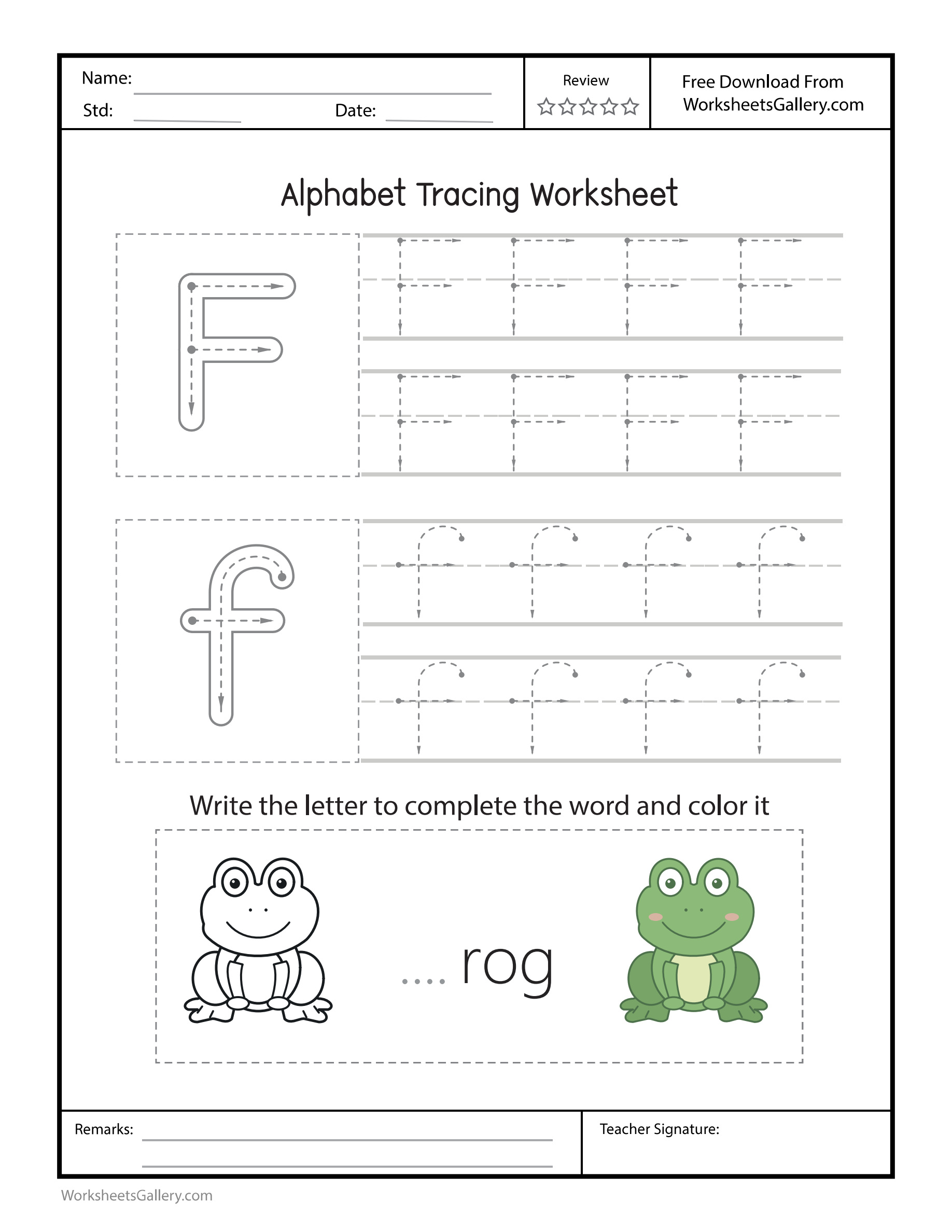
The Ff frog activity belongs to the complete A–Z letter-pair collection. One $4 purchase supplies all 26 clean tracing pages in a single alphabetically ordered PDF, including this pond route label lesson.
Where should this letter stop? The Ff Worksheet gives that question a useful answer through capital F, whose upright and two bars do not need a third bar at the bottom. Its lowercase partner follows a different hooked route, and both lead toward a frog picture word awaiting its first letter. Children aged three to six can explore the page as a pretend pond-route task, with an adult reading the longer word and the learner supplying f. Short tracing choices, conversation and coloring keep the focus on purposeful marks rather than filling every line.
Begin the Ff Worksheet with a route-marker inspection
| Marker feature | What to check |
|---|---|
| Capital F | A tall upright joins the upper and middle bars. |
| Small f | The source guide shows a curved top and crossing stroke. |
| Frog word | Only the first f is missing before rog. |
The Ff Worksheet is not asking children to decorate an unfinished capital with every stroke they know. Look at the actual F model before adding a bottom bar. Its absence is part of the letter's identity. An adult can point to the lower end of the upright and ask whether a horizontal stroke is printed there, giving the learner a visible reason to leave that area alone.
Use the Ff Worksheet table as an adult's discussion guide, not an extra reading assignment for the child. A beginner can show the relevant part with a finger. If the two forms are unfamiliar, introduce one first and return to the partner later. There is no benefit in making the pretend route marker into a rapid test of several new shapes at once.
A frog is waiting for the Ff Worksheet initial
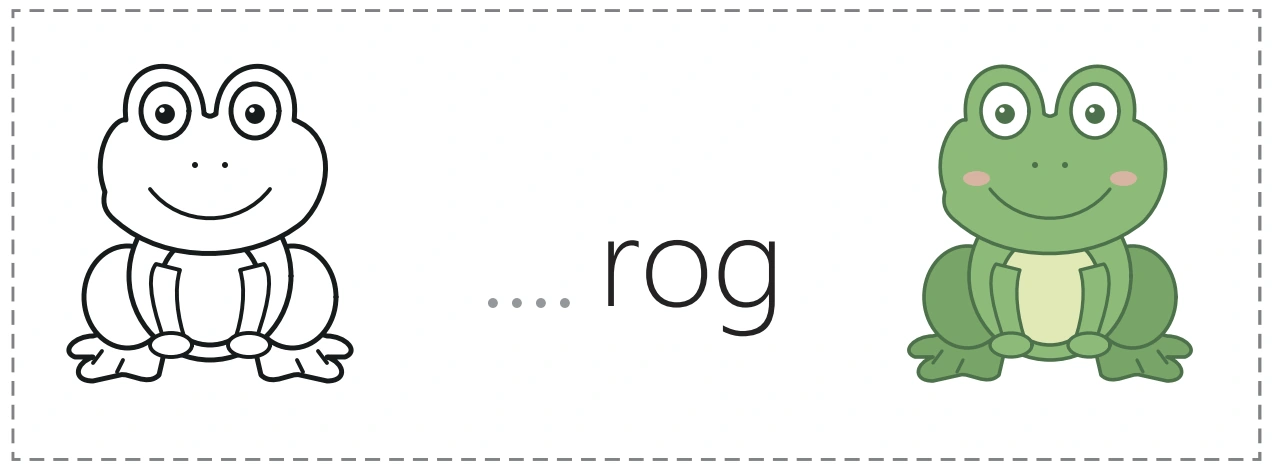
The Ff Worksheet pictures show the same frog as an outline and a colored example. Between them, rog is already printed. Supply lowercase f at the beginning and let an adult read frog with a sweep beneath the whole word. This gives a new written mark a meaning without requiring the learner to decode or spell the remaining letters independently.
Say the first /f/ in frog clearly during Ff Worksheet talk, then distinguish it from the letter name F. The word also contains r immediately afterward, so an adult can model the beginning gently rather than forcing a child to isolate every sound in the cluster. The immediate writing job remains one initial. Naming eyes, legs or a lily pad can extend the story without expanding that requirement.
The Ff Worksheet colored frog is a recognition aid, not a demand for a matching artwork. Offer a choice of crayon colors for the outlined animal and keep the word gap visible. A learner may prefer to supply f first or discuss the frog before writing. Either route can work when the adult brings attention back to the one letter the printed word still needs.
Capital Ff Worksheet routes have a stopping rule
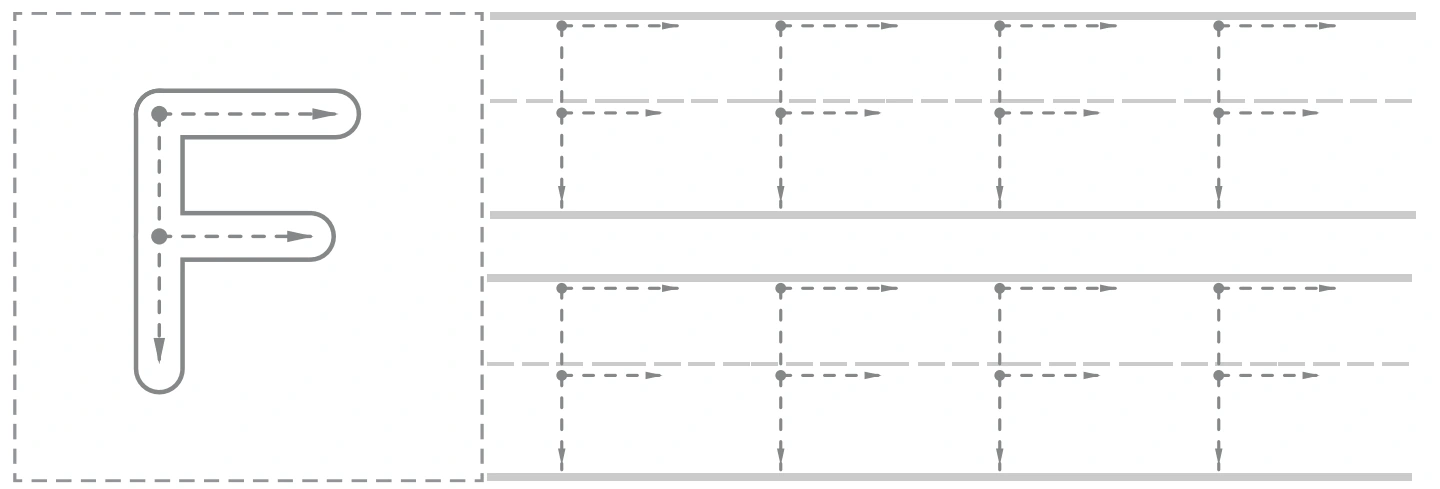
Find the Ff Worksheet capital's starting marks and follow its arrows before moving to a small example. Its long upright and two horizontal portions should stay connected. Compare where the middle bar meets the upright, then look at the open lower area. A child can learn that a deliberate stop is part of forming a letter, not a sign that the drawing must be completed with another familiar line.
Two capital rows on the Ff Worksheet contain four small F examples each. Try one with a finger and another with a pencil if interest remains. If every attempt gains a bottom bar, pause the sequence and inspect a large adult-made example. Remove or cover the extra bar and ask which version matches the source. That comparison addresses the feature directly instead of multiplying the same mistake.
A different small-letter plan on the Ff Worksheet
Lowercase f on the Ff Worksheet has a curved upper portion, a longer stroke and a cross stroke. Use the large small-letter guide from the complete sheet for that movement, even though the close-up image here emphasizes the capital. The small form is not a reduced F. Naming the two partners together can happen before the hand is comfortable following both routes.
The Ff Worksheet supplies another eight models in its two lowercase rows. Let the learner compare the crossing place with the large reference rather than guessing from a remembered font. If the hook is difficult at the printed size, make one broad finger route on blank paper. Changing the size can reveal whether the child understands the movement while still developing fine control.
Sam places a sign beside the paper pond
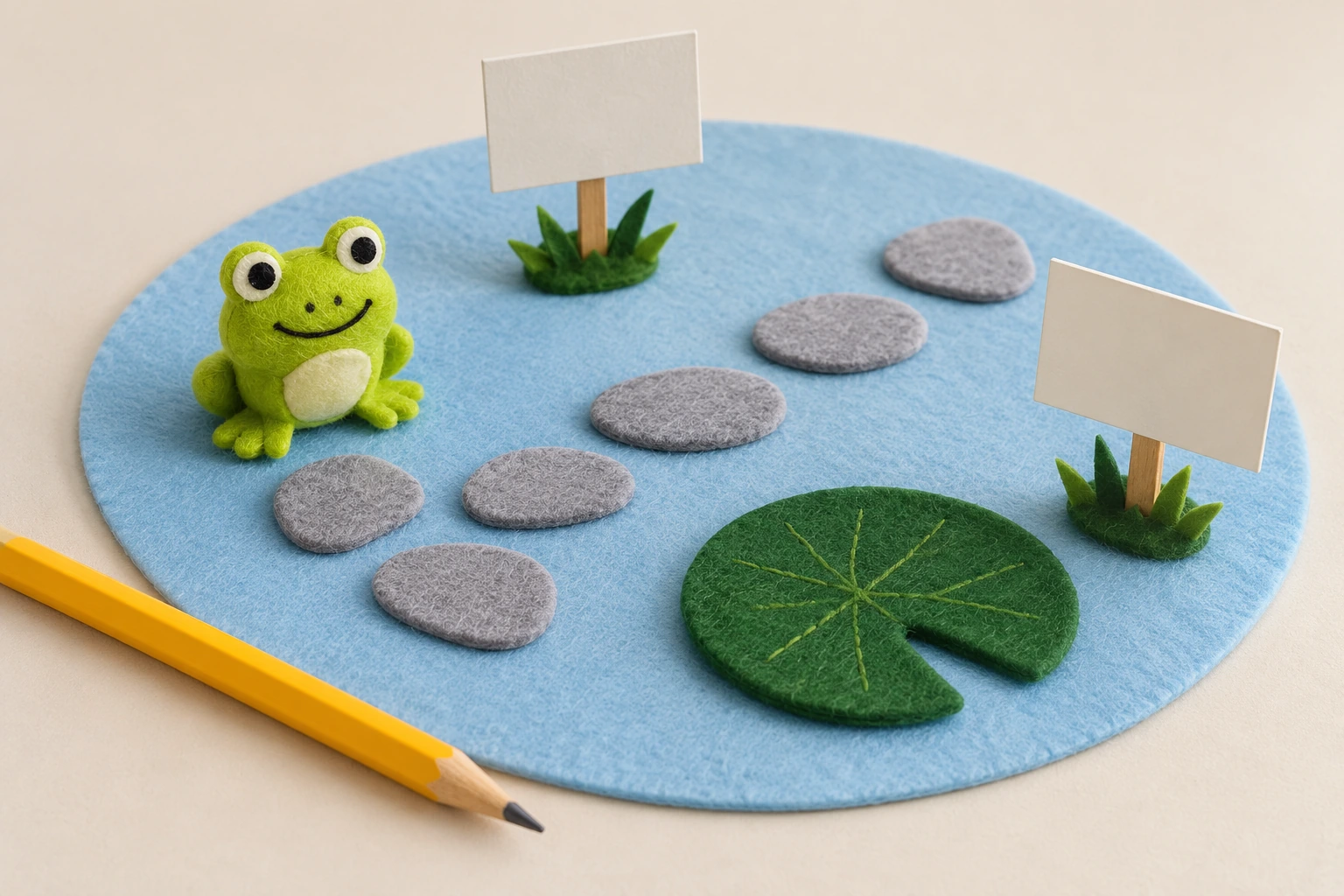
Sam and his grandmother arrange a felt frog beside an unprinted trail marker for Ff Worksheet play. The marker will identify their pretend frog corner. His grandmother reads the unfinished picture word, and Sam chooses the f model to help complete it. She waits while he makes one larger attempt on a spare card, keeping the writing purpose visible beside the toy scene.
When Sam adds a lower bar to a capital sign, the Ff Worksheet becomes their checking tool. His grandmother asks him to compare the sign with the printed F and notice what was added. They repair an adult-made version using a movable paper strip. Sam then decides whether to write another capital or return to coloring, so correction does not remove his choice of how to continue.
For a family Ff Worksheet visit, start with the paper pond, name the frog and rehearse one selected route. A blank card can carry the larger version while the printed gap receives a small f only when the child is ready. The adult may write an entire dictated pond notice separately. That lets the beginner contribute meaningfully without turning a short initial task into an unexpected sentence-copying exercise.
Five Ff Worksheet learning clues to listen for
Choosing when an Ff Worksheet stroke is enough
The Ff Worksheet capital makes restraint observable: its two bars are sufficient. A learner who stops before adding an unnecessary lower line is applying a feature of the model. Describe that choice specifically rather than praising speed. The child can see why the result resembles F, giving the next attempt a clearer purpose.
Recognizing a differently drawn Ff Worksheet partner
Ff Worksheet matching connects a straight capital with a hooked lowercase form. The adult can offer two loose small-letter cards and ask for F's companion. A correct point is evidence of recognition, even when the child is not yet ready to produce the small f route with a fine pencil.
Switching between Ff Worksheet line types
Straight and curved portions meet in Ff Worksheet practice. Finger tracing can make a transition visible without requiring a neat result. When a learner understands the hook in a broad movement, return to a single small guide rather than insisting on a whole row. The route and its printed size are related but separate demands.
Giving an Ff Worksheet initial a job
The Ff Worksheet f completes a named animal label. An adult's reading connects the child's mark with frog, making the contribution part of a message. The same picture can then prompt a dictated pond story, while the learner's independent writing responsibility stays limited to the initial they were invited to supply.
Explaining an Ff Worksheet comparison
Ask an Ff Worksheet learner which stroke is different between a matching model and an adult's altered version. Pointing, saying bottom or moving a strip can all communicate a reason. A short explanation gives more useful information than a silent copied row, because it shows which feature guided the decision.
Four pond-route games following the Ff Worksheet
1. The marker with an extra bar
Build a large capital with paper strips and add an unnecessary bottom bar. The Ff Worksheet supplies a neutral reference while the child decides what to remove. Move the strip aside and compare again. Repeat with a correctly built sign so the learner must inspect the actual arrangement, rather than assuming that every adult example contains the same error.
2. Deliver f to the frog corner
Write rog on a loose marker and offer a lowercase f card nearby. A child carries the missing initial to its beginning, checking the Ff Worksheet if needed. Read the repaired frog label and place it beside the toy. Another partner can take the delivery role while the first learner becomes the model-finder, keeping the task cooperative.
3. Describe the hook to a partner
An adult follows a large invisible route while a learner uses the Ff Worksheet to explain the small letter's curved top and crossing stroke. Gestures are welcome when direction words are difficult. Swap the directing role after one attempt. The game can reveal an understanding of the route that small handwriting has not yet made easy to see.
4. Compose a pond visitor notice
Invite one sentence for a pretend visitor to the paper pond. The adult writes what the child dictates, and the learner adds an optional f on a separate sign with Ff Worksheet support. Read the notice back and let the child place it in the scene. The message may be imaginative; its value does not depend on independent sentence spelling.
Keep Ff Worksheet returns light and purposeful
In class, the Ff Worksheet can become a two-role station: one child locates a feature while another makes a short writing attempt. Exchange jobs, and let an adult note whether the model, a spoken cue or a movable strip was most helpful. Do not use completed-row totals to compare children who were working on different levels of control or recognition.
A helpful Ff Worksheet correction concerns one thing: a missing cross stroke, an extra lower bar or a hook whose route needs another look. Make the comparison before requesting more marks. Ages three to six cover varied experience with writing tools, so a large gesture or clear letter match may be the right stopping point for a particular visit.
The next Ff Worksheet turn might begin with the marker game instead of tracing. A fresh purpose can make familiar materials inviting. Notice a change such as remembering to stop the capital without a cue, then offer coloring or a pause. The paper frog does not need every sign finished today. Short practice is useful when it keeps attention on the actual letter feature.
Download and print an Ff Worksheet copy
Choose the Ff Worksheet original sample for free or access the clean premium PDF through an eligible active membership. In the clean printable, the website's branding, domain and watermark text have been removed; no advertisements are embedded. The related alphabet collection is available for $4 and combines all twenty-six clean pages into one purchased PDF, alongside the separate individual download choice.
Print the Ff Worksheet in portrait orientation on US Letter paper. Inspect the light paths and outer frame on a single test sheet before preparing more. Keep loose paper nearby for broad f hooks or movable capital bars. Ordinary writing pressure should be enough to see a route; a tense grip is a reason to pause, not to demand that every remaining guide be filled.
For another brief task, use five basic movement routes, additional paths with changes of direction or a picture-supported number visit. Adult readers can find further ideas through PBS KIDS for Parents' reading activities and NAEYC's writing-at-home guidance.
Popular Worksheets
Printable resources families and teachers are downloading now.
 Free
 Free
 Free
 Free